


Crisis Windfall: Bahri Earns More in Three Months Than in All of 2025
Record tanker earnings strengthen Saudi Arabia’s national shipping company, but Houthi threats are now pushing operational risks toward Yanbu, Petroline and Bahri’s own fleet


The Strait of Hormuz crisis is reshaping global crude oil transportation, and Saudi Arabia’s national shipping company, Bahri, has emerged as one of the most direct financial beneficiaries.
On July 29, Bahri reported a net profit of SAR 2.75 billion, equivalent to approximately $733 million, for the second quarter of 2026. The result represented a year-on-year increase of 574%, taking quarterly profit to 6.7 times the level recorded during the same period of 2025.
Quarterly revenue rose by 156% to SAR 6.31 billion, or approximately $1.68 billion.
The comparison with Bahri’s full-year 2025 performance is even more striking.
Bahri generated net profit attributable to shareholders of approximately SAR 2.43 billion during the whole of 2025. Its second-quarter 2026 profit of SAR 2.75 billion was therefore around 13% higher than the company earned in the previous 12 months combined.
For the first half of 2026, Bahri recorded revenue of SAR 11.27 billion, up 144% year on year, while net profit reached SAR 4.90 billion, an increase of 421%. In only six months, the company earned roughly twice its full-year 2025 profit.
Crude oil shipping drives the surge
The main engine behind Bahri’s record performance was its crude oil transportation business.
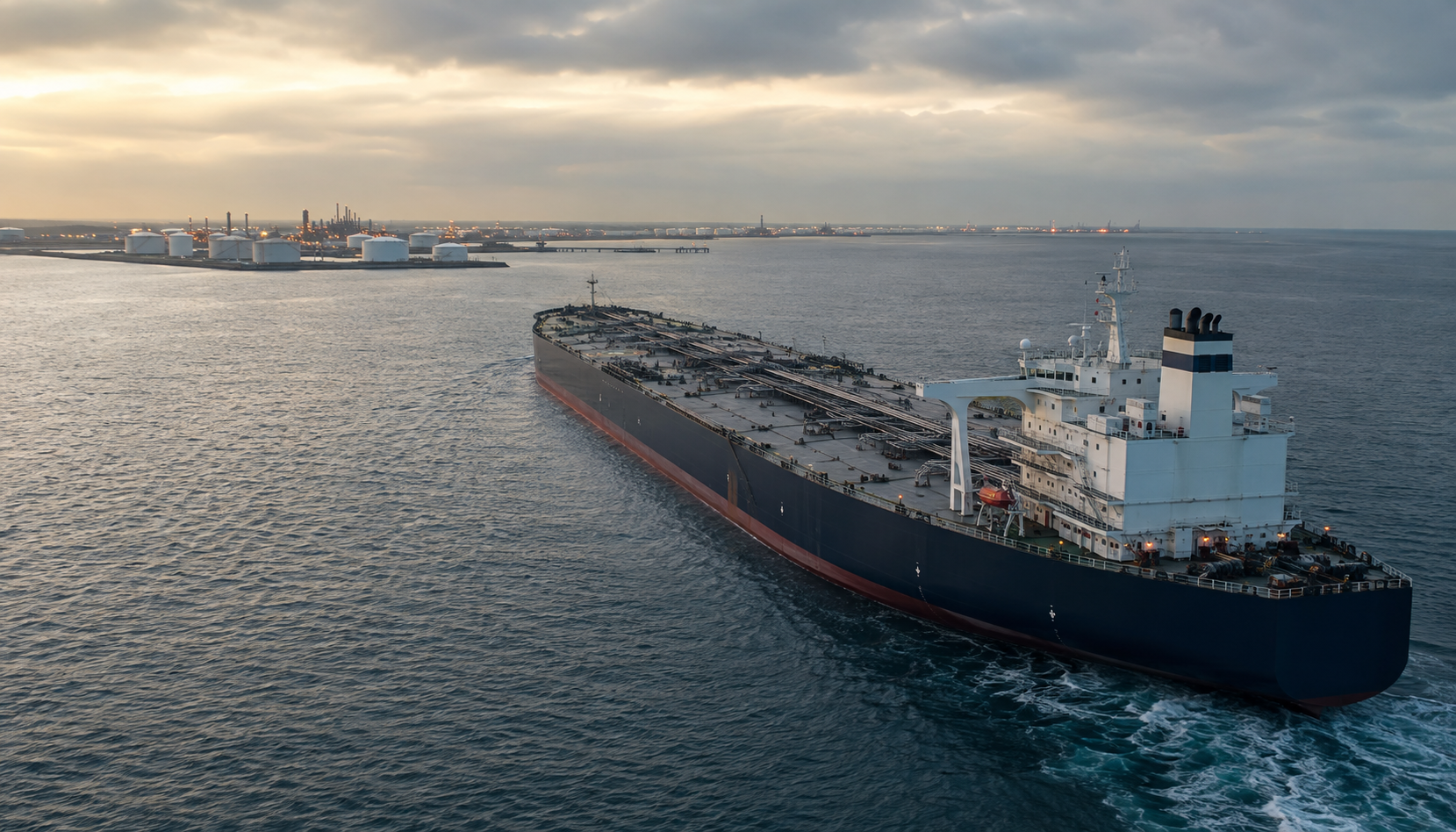
Disruption around the Strait of Hormuz sharply reduced the number of tankers readily available in the Arabian Gulf, while longer voyages and more complex fleet positioning absorbed effective capacity. VLCC freight rates rose significantly as charterers competed for available vessels.
Bahri also increased its use of chartered-in tankers to meet growing customer demand and maintain the flow of Saudi crude exports.
Revenue from Bahri Oil increased by 266% year on year during the second quarter.
The company said the strong performance was primarily driven by higher freight rates and increased vessel-chartering activity. All owned and chartered vessels remained commercially deployed during the quarter, allowing Bahri to benefit from both high fleet utilisation and elevated tanker earnings.
Chief Executive Officer Ahmed Ali Alsubaey said the company had operated through an unprecedentedly volatile environment in the Arabian Gulf by relying on flexible fleet deployment, established customer relationships and the scale of its global network.
However, the second-quarter results cover the period ending June 30.
The Houthi movement’s late-July threat to impose a maritime blockade on Saudi-linked shipping had therefore not yet affected the financial figures. That development will become an important factor in Bahri’s third-quarter performance.
A fleet built to capture the tanker upcycle
Bahri entered the 2026 tanker market with a significant scale advantage.
The company is one of the world’s largest owners of very large crude carriers and serves as a key transportation platform within Saudi Arabia’s oil-export system. It carries crude sold by Saudi Aramco on delivered terms and provides the shipping capacity required to move those cargoes to customers worldwide.
By the first quarter of 2026, Bahri reportedly controlled around 50 VLCCs, six more than a year earlier and equivalent to approximately 5% of the global VLCC fleet.
Part of that growth came from Bahri’s acquisition of nine VLCCs from Capital Maritime in a transaction valued at about $1 billion. The vessels were delivered during 2025, shortly before the VLCC market accelerated sharply.
The timing proved highly favourable.
The additional tonnage gave Bahri more exposure to rising freight rates, increased the volume of crude it could transport and strengthened its ability to respond to shifts in Saudi export routes.
The company continued expanding during the second quarter of 2026.
Bahri acquired five IMO II MR chemical tankers, four of which entered full commercial operation during the period. It also sold an older VLCC, bringing its owned fleet to a record 107 vessels at the end of June.
Including two vessels under long-term leases, Bahri operated 109 ships, together with three floating seawater desalination barges.
After the end of the quarter, the company signed contracts for two additional container and roll-on/roll-off vessels. The orders increased Bahri’s newbuilding programme to 12 vessels, scheduled for delivery between 2026 and 2030.
Record profits strengthen the balance sheet
The earnings surge is also improving Bahri’s financial position.
Operating cash flow reached SAR 3.87 billion during the first half of 2026, an increase of 235% year on year.
Net debt fell by 34% to SAR 6.62 billion, while the company’s net debt-to-EBITDA ratio declined from 2.19 times a year earlier to only 0.72 times at the end of June.
The combination of stronger cash flow, lower leverage and record earnings gives Bahri greater flexibility to acquire vessels, order new tonnage and expand its operations.
It also gives the company more capacity to absorb the higher fuel, insurance and operating costs now emerging from security threats around both the Strait of Hormuz and the Bab el-Mandeb.
Saudi crude crosses the Kingdom to reach Yanbu
As passage through the Strait of Hormuz became more difficult, Saudi Arabia increasingly relied on its East-West crude oil pipeline, widely known as Petroline.
The pipeline begins in oil-processing and gathering areas around Abqaiq in eastern Saudi Arabia. It crosses approximately 1,200 kilometres of the Arabian Peninsula before reaching the Red Sea port of Yanbu.
Crude transported through Petroline can be stored, blended and loaded onto tankers at Yanbu without passing through the Strait of Hormuz.
The system has a total capacity of approximately 7 million barrels per day. Around 2 million barrels per day are used by refineries on Saudi Arabia’s western coast, leaving a theoretical export capacity of about 5 million barrels per day.
By late March 2026, Petroline was reportedly operating close to full capacity. Crude exports from Yanbu rose to around 5 million barrels per day, while an additional 700,000 to 900,000 barrels per day of refined products were being exported from Red Sea ports.
An attack in April temporarily reduced pipeline capacity by approximately 700,000 barrels per day, although throughput was later restored to around 7 million barrels per day.
Saudi Arabia is also studying options to add another 1 million to 2 million barrels per day of capacity and has reportedly held preliminary discussions with neighbouring producers, including Kuwait.
Such an expansion would require new pumping stations, storage tanks and connecting infrastructure. It would involve billions of dollars of investment and could take several years to complete.
Houthi threats move closer to Bahri
Petroline and Yanbu provide Saudi Arabia with an alternative to Hormuz, but they remain dependent on safe navigation through the Red Sea.
On July 20, the Houthi movement announced what it described as a maritime blockade against Saudi Arabia. It warned that ships calling at Saudi ports or transporting Saudi cargoes could become targets.
Several tankers carrying Saudi crude and originally expected to sail through the Bab el-Mandeb toward China and India subsequently reversed course and headed north toward the Suez Canal.
On July 22, the Houthis claimed attacks against the tankers ENCELIA and LAYLA, both of which were reportedly carrying Saudi crude. Saudi authorities confirmed that a fire occurred in the bow area of ENCELIA, while the crew remained safe.
In the following days, the group also directed threats toward Saudi Aramco facilities around Jizan and Yanbu.
On July 27, the Houthis claimed to have attacked infrastructure associated with the transportation of crude from eastern Saudi oilfields to Yanbu.
The risk then moved directly toward Bahri’s managed fleet.
On July 28, the Houthis claimed to have launched a ballistic missile at the Saudi-flagged chemical and product tanker NCC GHAZAL, alleging that the vessel had violated the blockade.
NCC GHAZAL is owned by National Chemical Carriers and managed by Bahri.
The UK Maritime Trade Operations office received a report of an explosion in the vicinity. However, the vessel and crew were reported safe, and no pollution was recorded. The claimed connection between the explosion and NCC GHAZAL has not been independently confirmed.
Bahri had also faced an earlier security incident in the Hormuz area.
On July 7, its VLCC WEDYAN was involved in an incident. Bahri subsequently said all crew members were safe, the cargo remained stable and the vessel retained its seaworthiness.
High earnings, higher exposure
The Bab el-Mandeb had not completely closed by the end of July.
On July 28, 39 bulk commodity vessels reportedly passed through the strait, the highest daily number since July 19. On the same day, only eight vessels of the same broad category transited the Strait of Hormuz.
The figures show that the two chokepoints were experiencing different levels of disruption. Hormuz remained severely constrained, while the Bab el-Mandeb continued to operate selectively.
For Bahri, the Hormuz crisis produced high freight rates, strong fleet utilisation and increased chartering activity, creating the foundation for its record first-half profit.
The next phase may prove more complicated.
Houthi threats are now extending toward Yanbu, Petroline infrastructure, Saudi-flagged vessels and ships connected to Saudi ports. Those risks could continue supporting tanker rates by absorbing vessel capacity and extending voyage distances.
At the same time, Bahri may face higher war-risk insurance premiums, longer diversions, greater bunker consumption, more complicated crew-management decisions and increased exposure to vessel damage.
The company has therefore entered a rare market environment in which the same geopolitical crisis is simultaneously driving extraordinary earnings and creating extraordinary operational risks.
Bahri earned more in three months than it did during all of 2025. Whether that momentum can continue will depend on how successfully the company balances record tanker-market opportunities against the growing security pressures surrounding Saudi Arabia’s two critical maritime gateways.


READ MORE
 Tankers
VLCCs top $1m a day — but what price is TD3C actually discovering?
 Tankers
Nearly $1 Billion: Dynacom Orders 8More Ships as Hengli Tops Global 2026 VLAC Orders
 Tankers
$862,150 a Day: VLCC Rates Set Another Record as Global Composite Nears $500,000
 Tankers
Seven Months, $78 Million: George Procopiou Reaps Windfall on Hengli-Built VLCC
 Tankers
Ernst Russ Expands Chinese-Built Tanker Fleet to Six with Cargill Charters
 Tankers
VLCC,$759,969/Day !!!
 Tankers
VLCC Resale Talk Hits $200m as Prompt Tonnage Commands a Record Premium
 Tankers
Putin Launches Vostok Oil as Arctic Crude Exports Enter Shipping Phase
 Tankers
Behind CMES’ CNY6.96bn Profit: What Its 50-VLCC Fleet Got Right
 Tankers