


Five Dead as Fire Engulfs Indonesian Ferry: Vehicle Deck, Delayed Alert and Safety Failures Under Investigation
The fire is suspected to have started on the vehicle deck. Investigators are focusing on the delay in reporting the emergency, cargo declarations, the effectiveness of firefighting systems and discrepancies in passenger records.
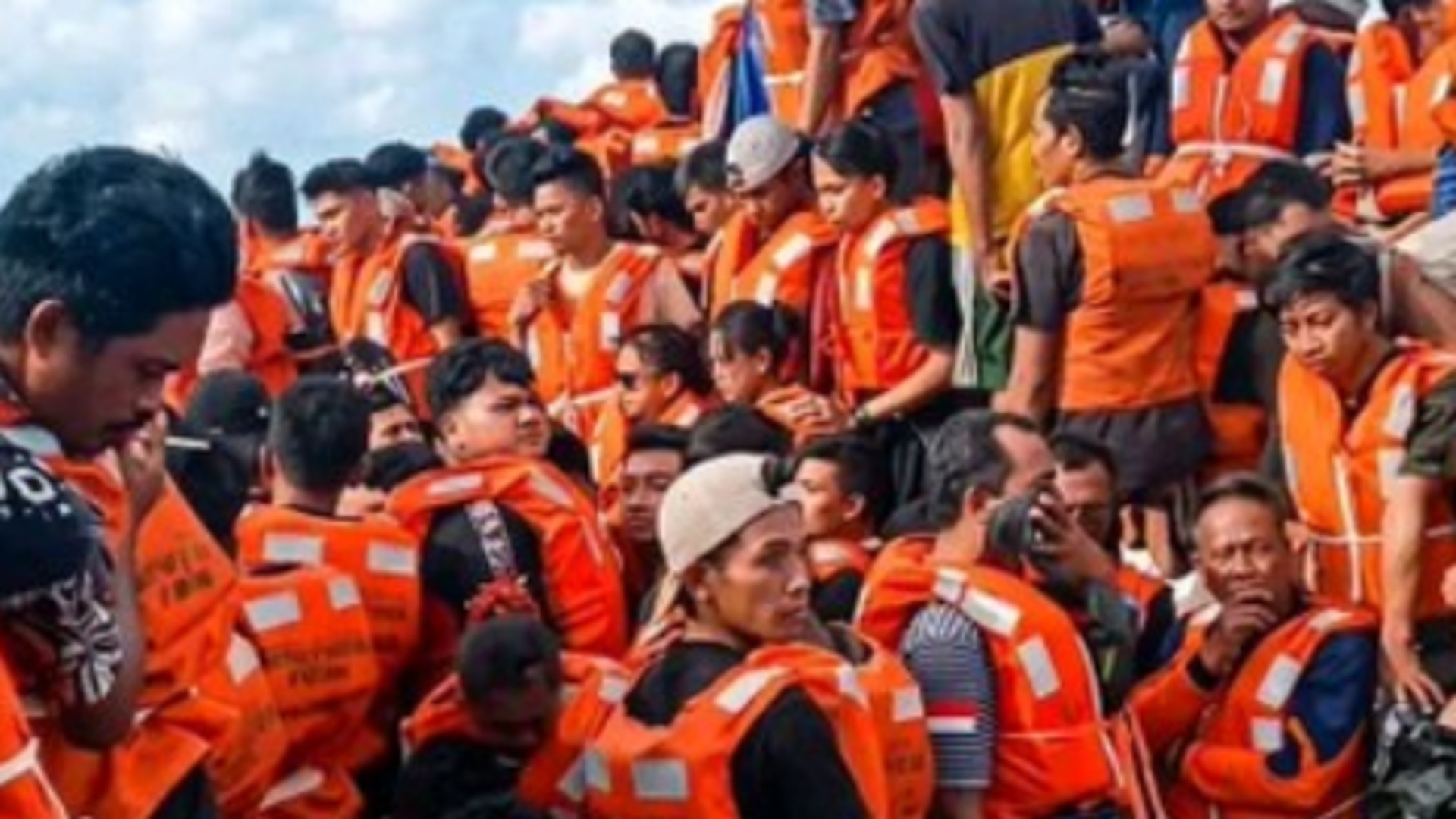

A passenger and vehicle ferry carrying hundreds of people and a large number of trucks caught fire during an early-morning voyage in Indonesian waters, forcing passengers to gather at the bow and, in some cases, jump into the sea to escape the flames.
The ferry Mutiara Sentosa 2 caught fire on August 2, 2026, while sailing from Surabaya, East Java, to Makassar, South Sulawesi. The accident occurred near Madura Island.
According to figures released by Indonesia’s National Search and Rescue Agency, Basarnas, late on August 2, the ferry was carrying 271 people, including 232 passengers and 39 crew members.
Rescuers had accounted for 236 people, including 231 survivors and five confirmed fatalities. Based on the official manifest, 35 people had yet to be fully accounted for.
Earlier media reports cited 41 people as missing. That figure reflected an earlier stage of the search and rescue operation, before survivors transferred to several responding vessels had been fully counted.
The casualty figures may continue to change as authorities reconcile the passenger and crew lists with records from the rescue ships.
When was the fire reported?
Available information indicates that the fire broke out at about 06:00 or 07:00 local time on August 2.
Basarnas said the harbourmaster’s office at Tanjung Perak, Surabaya, reported the accident at 08:24. The ship’s operator, PT Atosim Lampung Pelayaran, reportedly notified authorities at around 08:25.
Search and rescue personnel then attempted to contact the vessel’s master, but communications were temporarily lost. The ferry’s position was further confirmed at about 09:45, when it was located approximately 19 nautical miles north of the Buruan area on Sapudi Island, east of Madura.
Nearby merchant vessels began arriving at the scene shortly before or after 10:00.
Based on the publicly available timeline, there may have been a gap of between about one hour and 24 minutes and two hours and 24 minutes between the outbreak of the fire and the formal notification received by rescue authorities.
That gap cannot yet be treated as proof of negligence or delayed reporting by the crew. Investigators will first need to establish when smoke or flames were initially detected, when the master was informed, whether the vessel experienced communication problems, and whether any distress message was transmitted through another maritime communications channel.
Nevertheless, the reporting timeline will be a critical part of the investigation. On a ro-pax ferry carrying hundreds of people and a large number of vehicles, the first few minutes can determine how quickly nearby ships divert, how soon rescue assets are mobilised, and how long passengers remain exposed to fire and smoke.
Vehicle deck emerges as key area of investigation
A survivor told local media that he first saw flames near a truck on the lower vehicle deck. When crew members went to investigate, two vehicles were reportedly already burning.
Strong winds and airflow generated by the vessel’s movement may then have accelerated the spread of the fire. Within about half an hour, many passengers had reportedly been forced to move towards the bow.
This account remains a survivor’s testimony. Indonesia’s National Transportation Safety Committee, KNKT, has not confirmed which vehicle first caught fire.
Investigators have also not determined whether the ignition source came from a vehicle’s electrical system, engine components, batteries, fuel system or undeclared cargo.
The ferry was carrying 181 vehicles, including 15 motorcycles, 25 passenger cars, six medium-sized trucks, 103 large trucks, 31 tractor-trailers and one item of heavy machinery.
Of the 232 passengers, 219 were reportedly drivers or people accompanying the vehicles. Only 13 were travelling as ordinary passengers.
This passenger profile shows that the vessel was primarily serving as an inter-island freight and accompanied-vehicle ferry.
The presence of a large number of heavy trucks will complicate the investigation. Authorities will need to inspect vehicle declarations, bills of lading, hazardous cargo documents and stowage positions.
Some trucks may have been covered with tarpaulins or fitted with enclosed cargo compartments, making it difficult for the crew to identify the contents through a visual inspection.
Limited spacing between vehicles may also have prevented firefighters from reaching the initial seat of the fire.
Investigators will therefore need to answer two separate questions: what caused the initial ignition, and why the fire was able to spread beyond the immediate area and eventually devastate much of the vessel’s upper structure.
Did the fixed firefighting systems operate effectively?
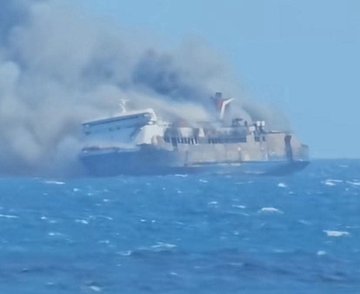
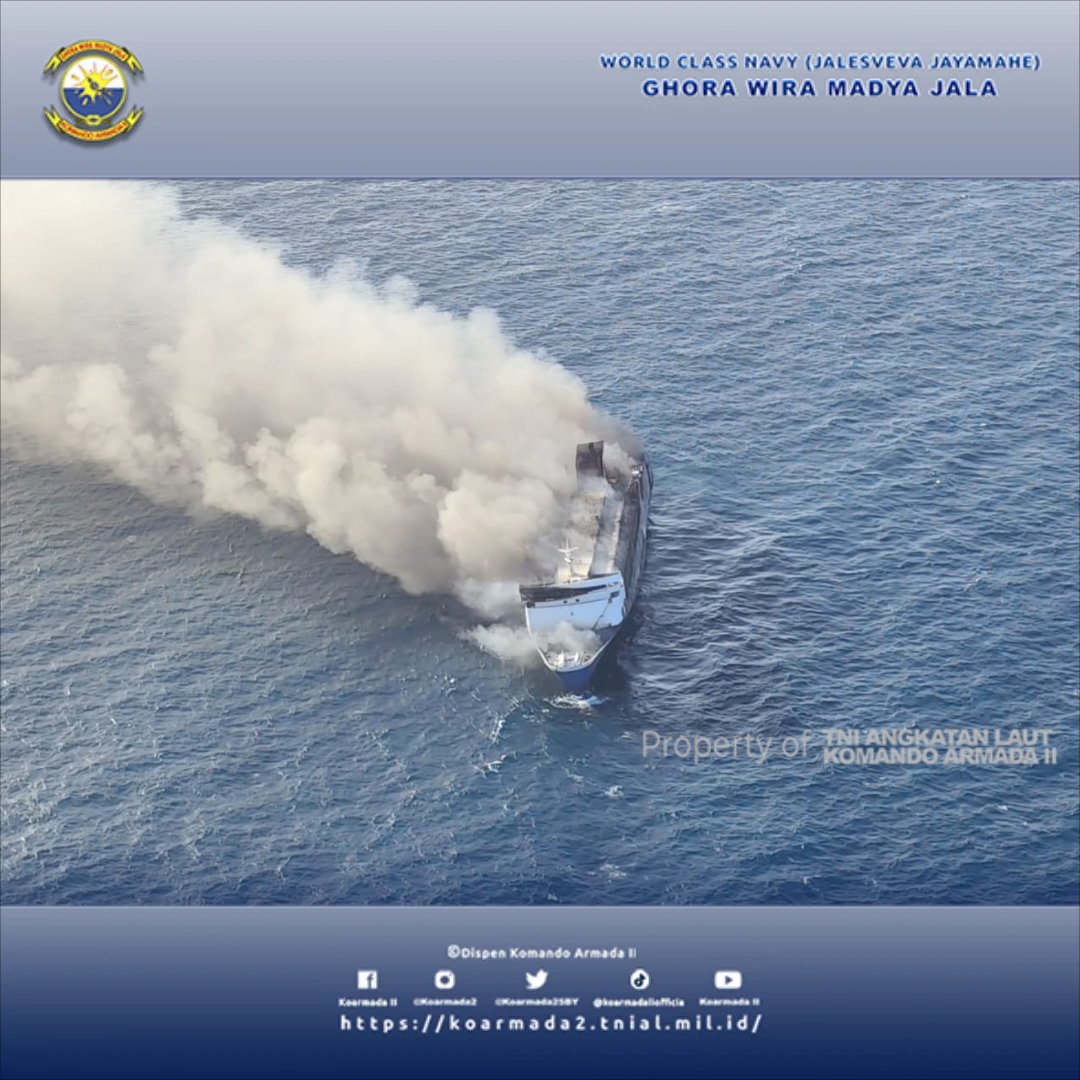
Early footage showed heavy smoke rising from the aft third of the ferry. Later images indicated that the fire had spread across a much larger section of the vessel.
The superstructure and hull paint appeared to have suffered extensive heat and fire damage.
Vehicle deck fires on ro-pax vessels are particularly dangerous. Vehicles, tyres, plastics, fuel and transported cargo can create a high fire load.
Ventilation systems and open vehicle deck arrangements may supply additional oxygen. Dense smoke can quickly reduce visibility and prevent crew members from approaching the fire.
KNKT will need to examine the vessel’s fire detection and alarm systems, fixed water-spray system, fire pumps, hydrants, fire divisions and ventilation shutdown arrangements.
Investigators will also need to determine whether the systems were activated at an early stage, whether water spray reached the burning vehicles and whether the height or arrangement of the vehicles obstructed firefighting coverage.
Mutiara Sentosa 2 was built in 1992. The vessel is approximately 160 metres long and 25 metres wide and carries IMO number 9021382.
It was formerly known as Ferry Osaka and previously operated in Japan before entering Indonesian service around 2015.
The vessel’s age does not in itself prove that it was unseaworthy. However, at about 34 years old, its maintenance history, structural modifications, fire-protection materials and firefighting equipment will all be closely examined.
Why were passengers forced to jump overboard?
After the fire broke out, large numbers of passengers gathered on the forward deck.
Video from the scene showed smoke and flames advancing towards the bow. Some passengers eventually jumped into the sea.
Wind and moderately rough surface conditions increased the risks of drowning, hypothermia, separation from the vessel and injuries caused by debris or the ship itself.
Several nearby merchant ships and workboats joined the rescue operation.
The vessels reportedly included Meratus Pematang Siantar, Hasnur 26, Transco Arafura, Meratus Project 3, Prakarsa Mas, SC Aila XVII, Selaras Mas and British Mentor.
Meratus Pematang Siantar rescued more than 100 people and became one of the principal responding vessels.
An Indonesian road transport association later raised questions about the evacuation process. Based on video footage, the organisation said many passengers appeared to have relied on jumping into the sea, while there was no clear evidence that lifeboats or inflatable liferafts had been deployed on a large scale.
That allegation has not been confirmed by regulators.
Investigators will need to verify the number and condition of lifesaving appliances, whether they were deployed, how crew members were assigned and what evacuation instructions were given.
They will also need to establish whether the crew initially intended to keep passengers at the bow while waiting for outside assistance, or whether fire, vessel condition or equipment failure made an orderly abandonment impossible.
Abandoning a large ferry too early can expose passengers to greater danger. However, keeping them on board without an effective evacuation plan becomes equally hazardous when fire and smoke continue to approach the only remaining safe area.
Same operator suffered similar fatal fire in 2017
Mutiara Sentosa 2 is operated by PT Atosim Lampung Pelayaran.
On May 19, 2017, another ferry operated by the company, Mutiara Sentosa I, suffered a serious fire near the Masalembu Islands. Five people were killed.
KNKT’s investigation into the 2017 accident found that Mutiara Sentosa I was carrying 134 registered passengers, 37 crew members, 26 unregistered people and 80 vehicles.
Crew members first noticed smoke coming from a tarpaulin-covered truck on the vehicle deck.
They attempted to fight the fire using portable extinguishers, fire hoses and the fixed water-spray system. However, dense smoke quickly prevented them from approaching the area. The master eventually ordered the abandonment of the vessel.
The 2017 accident and the latest fire have several apparent similarities.
Both involved passenger and vehicle ferries. In both cases, initial evidence pointed to a vehicle or truck cargo area. In both cases, heavy smoke spread across the vehicle deck and forced passengers and crew to abandon the vessel or enter the water.
These similarities do not prove that the accidents had the same technical cause.
However, the earlier investigation means that authorities are likely to examine whether the operator fully implemented previous safety recommendations relating to vehicle inspections, hazardous cargo identification, firefighting drills, maintenance of fixed firefighting systems and accurate passenger accounting.
Public regulatory records also show that another vessel operated by the same company, Mutiara Berkah I, caught fire while berthed at Merak port in Banten Province in 2023.
The publicly available documentation does not clearly establish the final technical cause of that accident. The three fires therefore cannot yet be attributed to the same management failure.
Indonesia’s Transport Minister, Dudy Purwagandhi, has said the government will evaluate the operator based on the final findings of KNKT.
The investigation could therefore lead to further scrutiny of the company’s operating licence, safety management system, vessel inspection procedures and administrative compliance.
Passenger records remain a persistent weakness
The initial manifest for Mutiara Sentosa 2 listed 271 people.
Search and rescue authorities must now compare the passenger manifest, crew list and vehicle-accompanying personnel records with the people received by each rescue vessel.
Indonesia’s domestic ferry sector has repeatedly experienced discrepancies between official manifests and the actual number of people on board.
In a separate ferry fire involving KM Barcelona V-A in 2025, the initial manifest listed about 280 people, but rescuers ultimately reported saving 575.
Such discrepancies can seriously disrupt search and rescue operations. Authorities may not know how many people remain in the water or whether the search area should be expanded.
No discrepancy of that scale has yet been confirmed in the Mutiara Sentosa 2 accident.
Even so, investigators must establish whether all 219 drivers and accompanying personnel were registered, whether each truck carried only declared occupants and whether any passengers boarded without being entered on the manifest.
What is known about the cause?
Authorities have so far confirmed that the fire broke out while the ferry was under way.
Smoke initially appeared from the aft section and the vehicle deck area. The ship was carrying a large number of heavy trucks and tractor-trailers. The fire spread rapidly, some passengers jumped overboard and at least five people died.
A burning truck is currently the most important investigative lead. It is not yet the official cause.
Online claims suggesting that the fire resulted from an electrical short circuit, vehicle batteries or plastic cargo have not been confirmed by KNKT or Indonesia’s transport authorities.
KNKT has said that its investigation will examine the technical condition of the vessel, crew actions, passenger and vehicle data, weather conditions and the full sequence of events.
Investigators will also need to secure the voyage data recorder, bridge and engine-room logs, alarm records, firefighting system activation records, CCTV footage and ship-to-shore communications.
The investigation must answer more than the question of which truck first caught fire.
It must explain why the fire was not contained, why outside authorities may not have been alerted earlier, why passengers were forced to jump into the sea, and whether the weaknesses identified after a similar fatal fire nine years earlier were ever fully corrected.
Those findings will determine whether the loss of Mutiara Sentosa 2 was an isolated vehicle fire or another sign of systemic weaknesses in Indonesia’s domestic ferry sector, including cargo control, firefighting readiness, emergency communications and passenger management.

READ MORE
 Safety
Almost the Entire Black Sea Is Now a War-Risk Listed Area
 Safety
Saudi pipeline attack exposes limits of Hormuz bypass strategy
 Safety
Engine Room Fire Epidemic Prompts Global Safety Alert After Qingdao Shipyard Tragedy
 Safety
Xinde Marine Forum London 2026: Shipping Moves from Lean Logistics to Resilience by Design
 Safety
Major Collision Off India: 21 Crew Evacuated After KMAX EMPEROR Suffers Heavy Damage
 Safety
Houthis Seize Mocha as Bab el-Mandeb Risks Rise — but Signal “Safe Passage” for Non-Saudi Shipping
 Safety
Shipping’s New Risk Equation: Flexibility Becomes the Premium Asset
 Safety
25 Killed in Fire Aboard Ocean Melody at Qingdao Beihai Shipyard
 Safety
Hormuz Crisis Exposes Shipping’s Three Fault Lines. Shipping Leaders Confront the Lessons of the Hormuz Crisis
 Safety