


Sallaum Lines Adds 1+1 Large PCTCs at China Merchants Jinling, Taking Firm Newbuild Programme to Nine Ships
Only weeks after ordering two firm plus two optional 8,600-CEU car carriers at Xiamen Shipbuilding, Sallaum Lines has returned to China for another 1+1-vessel deal. Its confirmed newbuilding programme now represents more than USD 850 million of investment, with three large PCTCs scheduled for delivery in 2029.
Sallaum Lines is accelerating its fleet expansion in China with a new contract for one firm plus one optional 8,600-CEU LNG dual-fuel, ammonia-ready pure car and truck carrier.
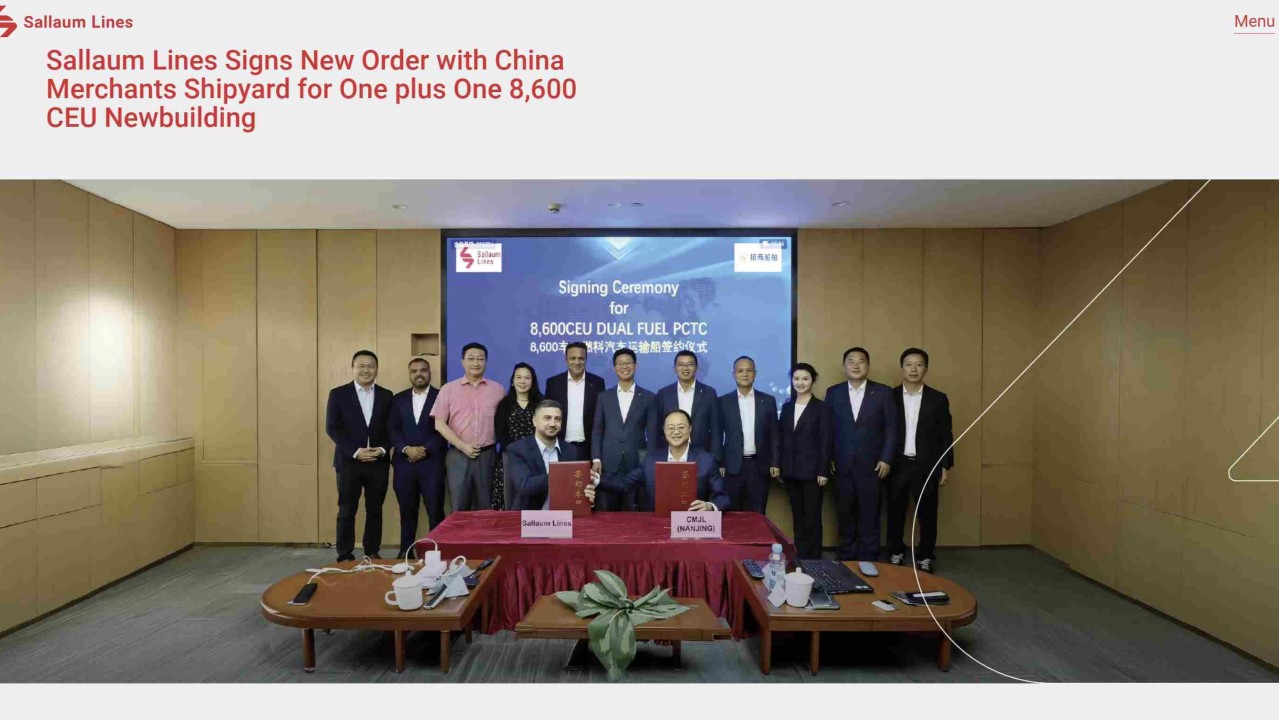
The company announced the agreement on July 27, while its official statement dated the signing to June 2026. Although the announcement identified the builder more broadly as “China Merchants Shipyard,” the photograph released with the statement confirms that the contract was signed with China Merchants Jinling Shipyard (Nanjing) Co., Ltd., or CMJL (Nanjing).
The firm vessel is scheduled for delivery in 2029. It will be equipped with LNG dual-fuel propulsion and designed with ammonia-ready capability, allowing Sallaum Lines to operate with a commercially available lower-emission fuel while preserving the possibility of adapting the ship to a future fuel pathway.
The order comes only weeks after Sallaum Lines concluded a separate contract with Xiamen Shipbuilding Industry Co., Ltd. for two firm plus two optional 8,600-CEU PCTCs. Combining the two projects, the carrier has now secured three firm and three optional vessels of 8,600 CEU, with all three confirmed ships due for delivery in 2029.
Should all three options be exercised, Sallaum Lines’ latest round of large-PCTC ordering would expand to six vessels.
Nine Firm Newbuildings Worth More Than USD 850 Million
The latest firm order raises Sallaum Lines’ overall newbuilding programme to nine vessels, with a disclosed total investment exceeding USD 850 million.
According to the company, four of the nine ships have already been delivered. A fifth is scheduled to enter the fleet in August 2026, followed by a sixth in December. The remaining three confirmed vessels—all 8,600-CEU PCTCs—are scheduled for delivery in 2029.
This delivery profile reflects two phases in the company’s fleet strategy.
The first consists of six LNG dual-fuel car carriers that established the foundation of Sallaum Lines’ modern fleet-renewal programme. Four of these vessels are already in service, while the remaining two are approaching delivery.
The second phase introduces the larger 8,600-CEU design. Two firm ships have been ordered from Xiamen Shipbuilding, while the latest firm vessel will be built by CMJL (Nanjing). The increase in capacity marks a clear step up from the approximately 7,400- to 7,500-CEU ships delivered under the earlier programme.
Based on the confirmed orders, Sallaum Lines’ nine-vessel programme represents approximately 70,400 CEU of total carrying capacity. If the three options attached to the two latest contracts are exercised, the programme could expand to 12 vessels and around 96,200 CEU.
A Return to China Merchants Jinling
The latest agreement also deepens Sallaum Lines’ relationship with China Merchants Jinling Shipyard.
CMJL has already played an important role in the company’s existing fleet-renewal programme, building several of its LNG dual-fuel Ocean Class car carriers. By returning to the group for an 8,600-CEU vessel, Sallaum Lines is extending the partnership into a larger and more technically advanced generation of tonnage.
The decision comes as Chinese shipyards consolidate their position in the global PCTC newbuilding market. China has become the principal construction centre for the latest generation of large car carriers, supported by expanded shipbuilding capacity, experience with LNG dual-fuel systems and the ability to offer designs tailored to electric vehicles, high-and-heavy cargoes and future alternative fuels.
For owners, the selection of a shipyard now involves more than securing construction capacity. Delivery timing, propulsion systems, cargo flexibility, equipment makers and the scope for future fuel conversion have become central parts of long-term fleet planning.
Sallaum Lines’ latest order brings these considerations together. The vessel will be prepared to carry passenger cars, light commercial vehicles, trucks, heavy rolling equipment and project cargo, allowing the company to respond to a wider range of trade flows and customer requirements.
Bigger Ships for a Changing Automotive Trade
The move into 8,600-CEU vessels reflects the changing structure of global automotive logistics.
Traditional vehicle exports remain a core source of demand, but the cargo mix carried by PCTCs has become increasingly diverse. Chinese-made passenger vehicles, electric vehicles, hybrid vehicles, commercial vehicles, construction machinery and agricultural equipment are creating new flows across Asia, Europe, Africa, the Middle East and the Americas.
For operators such as Sallaum Lines, scale must therefore be combined with flexibility.
A larger vessel can reduce unit costs by carrying more cargo on each voyage, but its commercial value also depends on deck arrangements, ramp capacity, deck strength and the ability to handle high-and-heavy cargoes alongside passenger vehicles. These characteristics are increasingly important as shipping companies seek to balance automotive volumes with machinery, trucks and other rolling cargo.
Sallaum Lines said its new vessel would support a broad cargo mix across the company’s global network. The 8,600-CEU design provides additional scale while preserving the operational flexibility required to serve different ports, customers and trade lanes.
LNG Today, Ammonia Readiness for the Future
Propulsion is another central feature of the project.
The vessel will be capable of operating on LNG as well as conventional marine fuel. LNG remains one of the most commercially mature alternative-fuel options for deep-sea shipping, with an established engine technology base and expanding bunkering infrastructure.
The ammonia-ready notation gives Sallaum Lines an additional degree of flexibility. It does not mean the vessel will operate on ammonia upon delivery. It indicates that relevant design considerations are being incorporated during construction to support a possible future conversion when fuel availability, safety standards, regulation and commercial conditions become more mature.
This approach allows the company to address near-term emissions requirements while avoiding dependence on a single long-term fuel scenario.
Hasan Sallaum, managing director of Sallaum Lines, described the order as another important step in the development of the company’s future fleet. He said customers increasingly require capacity, reliability, cargo flexibility and a clear environmental direction from their shipping partners.
Securing 2029 Capacity
The timing of the order is as significant as the vessel specification.
PCTCs are highly specialised assets with long construction lead times, while access to suitable shipyard slots remains an important consideration for owners planning fleet requirements several years ahead. By securing three firm 8,600-CEU vessels for 2029 delivery, Sallaum Lines is positioning itself for the next phase of the market before the ships are required in service.
The PCTC sector is also entering a more complex period. A large volume of new tonnage ordered during the recent market upcycle is being delivered, increasing fleet supply and gradually easing the acute vessel shortage seen in previous years.
At the same time, long-term automotive trade patterns continue to evolve. Chinese vehicle exports, emerging-market demand and the movement of heavy rolling equipment are supporting new cargo flows, while manufacturers and logistics providers are demanding more reliable and lower-emission transport capacity.
Against this background, Sallaum Lines is building a fleet designed around scale, fuel flexibility and diversified cargo capability.
With nine firm vessels representing more than USD 850 million of investment—and a potential expansion to 12 ships if all options are exercised—the company’s newbuilding programme has become a substantial long-term commitment to Chinese shipbuilding and to the future of global automotive logistics.

READ MORE
 Shipbuilding
11-Ship Programme: Hengli Wins Six More Boxships from Jiangsu Port Group
 Shipbuilding
Kawasaki Heavy Industries Teams Up with NVIDIA on Next-Generation Digital Shipyard
 Shipbuilding
J.P. Morgan’s $3bn Shipping Bet: Why Wall Street Is Rushing to Secure Maritime Assets
 Shipbuilding
NVIDIA Enters Shipbuilding: Kawasaki Brings Physical AI to the Shipyard
 Shipbuilding
26-Year-Old Car Carrier Reportedly Sold for $42 Million as MSC-Owned GCC Also Showed Interest
 Shipbuilding
Bahri Line Orders LNG Dual-Fuel RoCon Vessels from China Merchants Jinling Shipyard
 Shipbuilding
China Captures 82.3% of Global Ship Orders as Shipbuilding Indicators Reach New Highs
 Shipbuilding
Dajin Heavy Industry Lands Newbuilding Contracts for 7 Commercial Vessels
 Shipbuilding
China’s Shipyards Capture the Lion’s Share of a $132.6 Billion Newbuilding Boom
 Shipbuilding