


H-Line Ends Five-Year Bulker Ordering Hiatus With POSCO-Linked LNG Pair at New Times
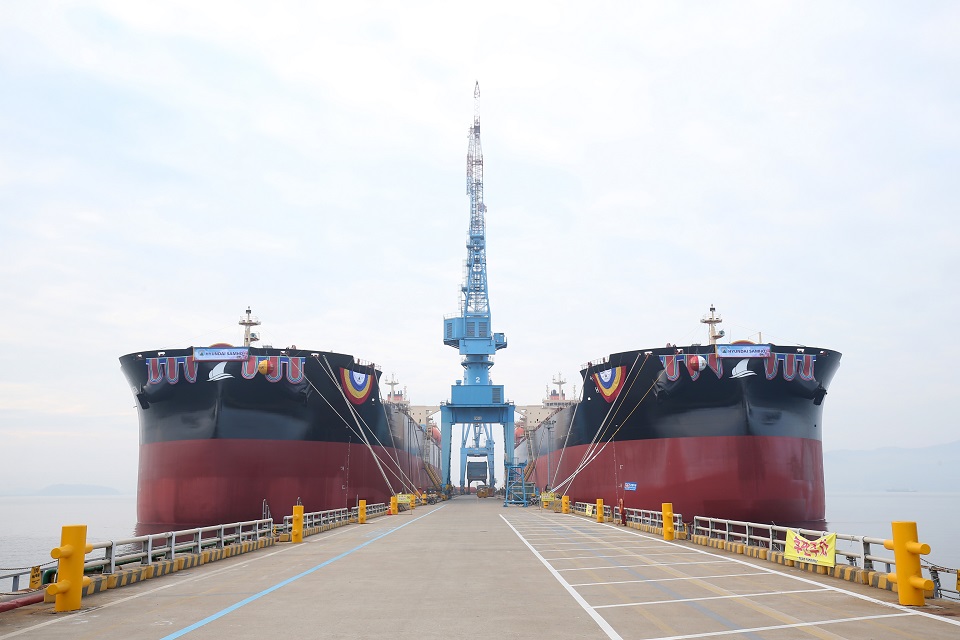

South Korea’s H-Line Shipping is reported to have returned to the dry bulk newbuilding market with two LNG dual-fuel Newcastlemaxes in China, with the ships linked to POSCO cargoes. The deal puts the spotlight on an ageing pool of dedicated steel-mill carriers — and on Chinese yards’ growing depth in high-specification large bulkers.
South Korean long-term contract carrier H-Line Shipping is reported to have ordered two LNG dual-fuel Newcastlemax bulk carriers at China’s New Times Shipbuilding, ending an approximately five-year absence from the dry bulk newbuilding market.
TradeWinds reported the order on September 7, saying the two vessels are linked to transportation business with South Korean steelmaker POSCO.
Neither H-Line, POSCO nor New Times has publicly disclosed the full commercial terms of the deal. H-Line’s current website still lists 42 bulk carriers in service and none under construction, meaning the reported order has yet to appear in the owner’s public fleet data. Contract price, exact deadweight, delivery dates, engine specification, LNG tank configuration and the duration of the associated POSCO transportation contract have not been publicly confirmed.

Source:https://www.h-lineshipping.com/en/business/bulk/
That uncertainty matters. But the significance of the deal extends beyond another pair of Chinese-built bulkers.
H-Line’s fleet investment model is built around long-term cargo commitments from major industrial and commodity customers. If the two new Newcastlemaxes are ultimately confirmed against POSCO employment, the ships would fit a familiar pattern: secure the cargo first, then build the tonnage around it.
Cargo first, ships second
H-Line is one of South Korea’s largest operators of dedicated bulk carriers, with a business model that differs markedly from owners whose earnings depend primarily on the spot market.
The company traces its dedicated dry bulk relationship with POSCO back to 1972, when a predecessor business signed a carrier contract with Pohang Iron & Steel, now POSCO. H-Line today names POSCO, Korea Electric Power Corp, Hyundai Steel and Vale among its major long-term customers and says more than 90% of its operating fleet is owned rather than chartered in.
For a shipowner working under long-term contracts, a newbuilding decision is therefore not simply a bet on where Capesize spot rates will be when the vessel is delivered.
A long-duration cargo commitment can provide the revenue visibility needed to support a high-capex vessel, while the ship itself can be designed around a particular trade, cargo profile and customer requirement.
That logic has already shaped H-Line’s relationship with POSCO.
In 2018, POSCO and H-Line agreed to replace two conventional raw-material carriers with 180,000-dwt LNG-fuelled bulkers. The resulting HL Green and HL Eco, built by Hyundai Samho Heavy Industries, entered service carrying iron ore and coal between Australia and South Korea.
POSCO said at the time that it supported H-Line’s adoption of LNG propulsion by providing stable cargo volumes through a long-term contract — particularly important when LNG bunkering infrastructure was still limited.
The newly reported order would therefore not represent a completely new strategy. It would extend an established combination of long-term steel cargoes, dedicated tonnage and alternative-fuel investment.
POSCO fleet renewal moves into focus
The more important question is whether the two vessels represent fleet growth or the beginning of a replacement programme.
H-Line’s fleet data at the end of 2024 showed several large bulk carriers assigned to POSCO that were built around the start of the last major dry bulk newbuilding cycle.
They include the 208,000-dwt HL Frontier, built in May 2010; the 180,000-dwt HL Port Hedland, built in July 2010; HL Sines, built in June 2009; and HL Saldanha Bay, built in December 2010.
By the end of this decade, vessels from that generation will be approaching or exceeding 20 years of age.
There is no public evidence that the newly reported Newcastlemaxes are direct replacements for any specific H-Line ship, and it would be premature to describe the order as a confirmed replacement programme.
But the age profile is difficult to ignore.
If the ships are tied to a renewed or extended POSCO contract, the deal could provide an early indication of how the steelmaker and its shipping partners intend to renew the older end of their dedicated raw-material fleet.
For shipyards, that matters because the potential opportunity is larger than two ships. Long-term industrial shipping fleets tend to renew in groups as older vessels reach major survey, efficiency and operating-cost thresholds.
H-Line returns to a familiar Chinese yard
New Times is also not a new shipbuilding partner for H-Line.
The privately controlled yard in Jingjiang, Jiangsu province, built a series of large Newcastlemaxes for the Korean owner in the previous investment cycle. TradeWinds reported in 2019 that H-Line had ordered additional Newcastlemaxes at New Times against employment with Brazilian mining group Vale.
One of those ships, the approximately 208,000-dwt HL Sapphire, was delivered from New Times in January 2021.
H-Line subsequently selected another Chinese yard for its LNG-fuelled Newcastlemax programme linked to Rio Tinto.
H-Line’s own corporate history records an April 2021 long-term transportation agreement with Rio Tinto covering up to six LNG-fuelled 208,000-dwt Newcastlemaxes.
The H-Line portion of that programme was built by CSSC Qingdao Beihai Shipbuilding. China Shipbuilding Trading and Qingdao Beihai officially delivered the first vessel, the 210,000-dwt HL Future, in October 2023. H-Line’s later fleet list also records HL Hope and HL Trust as 210,000-dwt LNG dual-fuel bulkers serving Rio Tinto.
The reported return to New Times should therefore not be read simply as H-Line “switching” yards. Rather, it highlights how several Chinese builders have accumulated credible references in the 200,000-plus-dwt Newcastlemax segment.
New Times has built up dual-fuel credentials
New Times itself has added substantial LNG dual-fuel Newcastlemax experience since H-Line’s earlier conventional-fuel series.
The clearest reference is Himalaya Shipping, which developed an entire fleet of 12 210,000-dwt LNG dual-fuel Newcastlemaxes at the Chinese yard.
Himalaya took delivery of its first vessel, Mount Norefjell, in March 2023, and all 12 ships are now in operation. The company describes the fleet as 210,000-dwt Newcastlemaxes equipped with latest-generation LNG dual-fuel technology.
That track record is commercially important.
Dual-fuel capability adds complexity well beyond the basic hull design. The yard must integrate engines, gas supply systems, cryogenic storage tanks, safety systems and control architecture, while managing commissioning and gas trials.
A shipyard that has already delivered a large series of near-identical vessels can therefore offer owners something increasingly valuable: operational reference rather than design promise.
For New Times, a new H-Line order would strengthen its position in a segment where Chinese builders have progressively moved from competitively priced conventional bulk carriers into higher-specification tonnage tied to blue-chip charterers and commodity groups.
Timing supported by a stronger Capesize market
The timing of H-Line’s reported return also comes against a firmer large-bulker market.
On September 7, TradeWinds reported that Capesize earnings had reached their highest level since 2021, with sentiment strengthening across dry bulk segments.
The supply picture remains relatively restrained compared with several other major shipping sectors.
Himalaya Shipping, citing Clarksons Shipping Intelligence Network data during its second-quarter 2026 presentation, said the Capesize orderbook had risen to around 16% of the existing fleet. The company also noted that roughly 46% of the Capesize and Newcastlemax fleet was built between 2009 and 2015, leaving a substantial block of tonnage moving toward replacement age over the coming years.
Newbuilding prices, however, remain elevated.
A useful recent benchmark came in June, when Taiwan’s U-Ming Marine Transport was reported to have ordered two firm 211,000-dwt Newcastlemaxes, plus two options, at Jiangsu Hantong Ship Heavy Industry for around $77 million to $80 million per vessel. Those ships are scheduled for delivery in 2029 and 2030. The figure is a market reference and should not be treated as the price of H-Line’s reported New Times order.
For owners exposed solely to spot freight, committing capital at those asset values requires a strong view of future earnings.
For H-Line, the equation can be different. A sufficiently long POSCO-backed transportation contract could reduce market exposure and make a high-specification newbuilding economically viable even while ship prices remain historically firm.
What comes next matters more than the price
The most useful details are therefore still missing.
Confirmation of the delivery schedule would indicate how quickly H-Line intends to renew capacity. The duration and structure of the POSCO employment would show how much revenue certainty sits behind the investment. And confirmation of whether the vessels replace specific older ships would reveal whether this is an isolated order or the beginning of a broader fleet renewal cycle.
The fuel specification will also be worth watching.
LNG remains a transitional rather than zero-carbon fuel, and long-lived vessels delivered late this decade will operate well into a period of tightening greenhouse-gas regulation and changing fuel economics. Owners ordering dual-fuel ships today are therefore balancing near-term fuel availability and emissions performance against much less certain long-term residual values.
For H-Line, however, the immediate commercial logic is familiar: long-term cargo, large dedicated ships and a newbuilding specification designed around the customer’s transport requirement.
If the two reported Newcastlemaxes are formally confirmed, the next question will be whether they stand alone — or whether POSCO’s ageing large-bulker fleet is beginning a much broader replacement cycle.

READ MORE
 Shipbuilding
COSCO SHIPPING Bulk Leads Order for 16 New 87,000-DWT Multipurpose Grain Carriers
 Shipbuilding
MISC Signs for Five More LNG Carriers at Hudong-Zhonghua
 Shipbuilding
Another Chinese Bridge Builder Moves Into Shipbuilding
 Shipbuilding
Global Newbuilding Orderbook Matches 2008 Peak as Clarksons Flags Faster Fleet Growth
 Shipbuilding
Amid China’s Shipbuilding Boom, a State-Owned Yard Quietly Enters Liquidation
 Shipbuilding
Yichang Changyun plans RMB120m inland bulker programme
 Shipbuilding
Steel Giant Shagang Eyes Shipbuilding as a Booming Market Draws Industrial Capital
 Shipbuilding
Hengli Secures 12 Tanker Orders, Retaining World’s Largest VLCC Orderbook
 Shipbuilding
Hengli Signs 11 VLAC Contracts in One Week
 Shipbuilding