


SAL Moves to Double Orca Heavy-Lift Series at Wuhu With Five-Vessel MoU

The non-binding agreement could expand SAL Heavy Lift’s 14,600-dwt Orca programme at China’s Wuhu Shipyard from five vessels to ten, as project-cargo carriers renew ageing MPP fleets and invest in higher lifting capacity for larger energy and infrastructure cargoes.
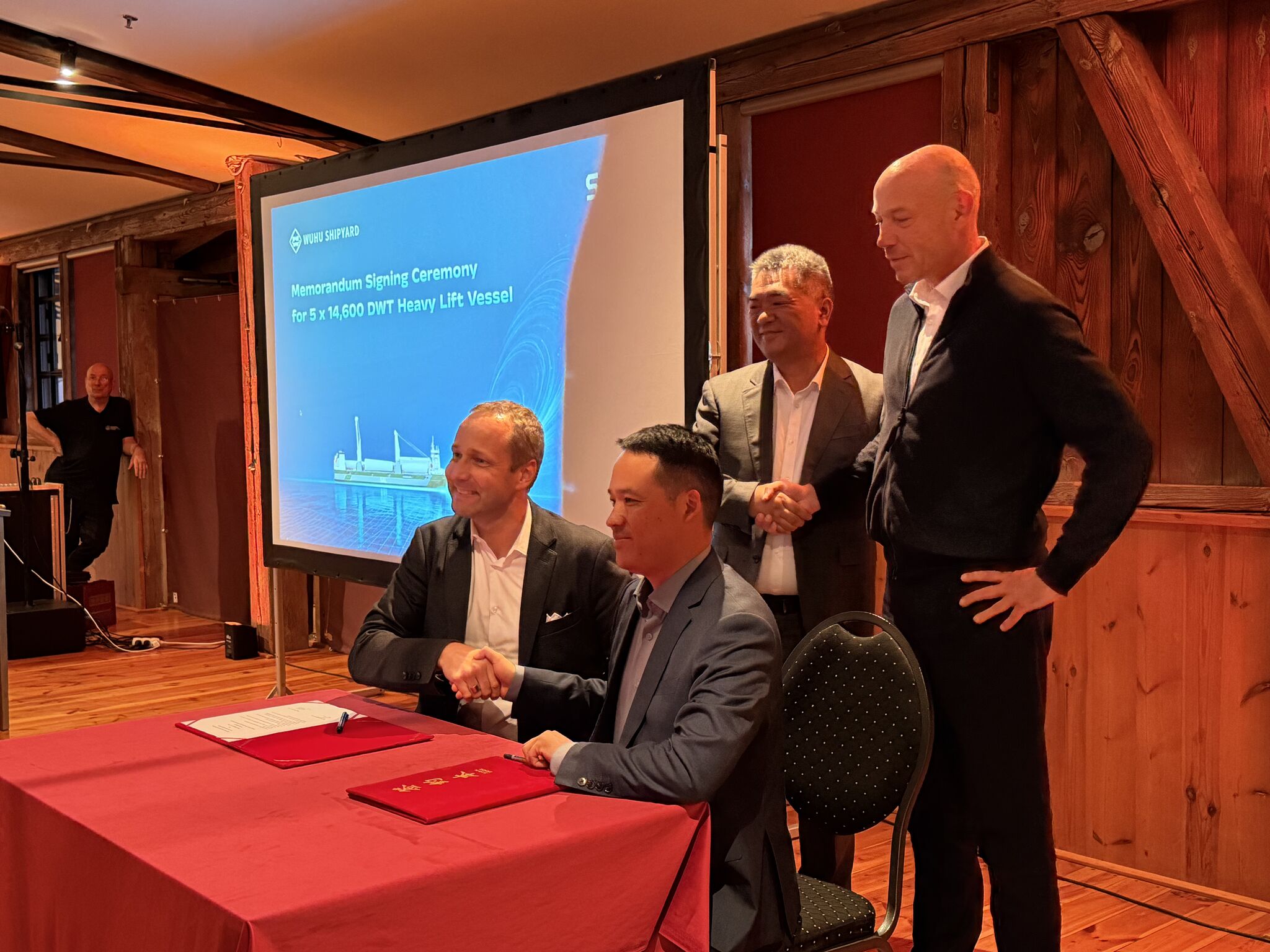
German project-cargo specialist SAL Heavy Lift has signed a memorandum of understanding with Wuhu Shipyard covering five additional 14,600-dwt Orca-class multipurpose heavy-lift vessels, potentially doubling the series being built in China from five ships to ten.
The agreement was signed on September 3 during SMM 2026 in Hamburg. Crucially, the five additional vessels are not firm newbuilding orders at this stage: TradeWinds describes the agreement as non-binding, with the fleet only rising to ten if the MoU is subsequently converted into construction contracts. No contract value or delivery schedule for the proposed second batch has been publicly disclosed.
The move nevertheless represents a significant next step in a relationship that has already moved well beyond the initial design and construction phase. Three Orca-class vessels have entered the SAL fleet, while the remaining two ships in the existing firm series are due for delivery later this year.

From a 4+2 deal to a potential ten-ship series
SAL’s original Wuhu programme dates back to 2022 and was structured as four firm vessels plus two options. One of those options was exercised at Marintec China in late 2023, bringing the firm series to five vessels.
The first three ships — Elise, Frida and Patricia — have now been delivered. TradeWinds reported that the remaining two units from the existing batch are scheduled for handover in October and December.
Patricia, the third vessel, was delivered in June and began her maiden commercial deployment carrying Vestas wind-energy equipment from Asia to Europe. SAL describes the ship as the third unit in its Orca newbuilding programme.
That sequence matters. The latest MoU is not an initial commitment to an untested platform: SAL is discussing a second five-ship batch after the first vessels have already moved into commercial service.
If all five proposed ships ultimately become firm orders, Wuhu would effectively build a second full series of the same heavy-lift platform for SAL.
A 1,600-tonne lifting platform built around project cargo
At 14,600 dwt, the Orca class is relatively compact by deadweight, but its commercial proposition lies primarily in cargo geometry and lifting capability rather than sheer carrying capacity.
SAL lists the ships at about 149.9 metres in length, with 23,600 cu metres of cargo capacity and a single large box-shaped hold measuring 107 metres by 18.5 metres by 13.3 metres. Each vessel carries two fully electric 800-tonne cranes, providing up to 1,600 tonnes of combined tandem-lift capacity.
The design also includes a hybrid drive concept, shore-power capability and methanol readiness. SAL’s technical documentation is specific on the latter point: the ships can be prepared for methanol operation following installation of a pre-approved methanol module. They should therefore be described as methanol-ready, rather than as methanol-fuelled vessels in current operation.
SAL explicitly positions the Orca class for offshore wind logistics, oversized industrial equipment and complex project cargo. The combination of a large unobstructed cargo arrangement and high-capacity shipboard cranes allows the vessels to handle cargoes at ports where suitable shore-side lifting infrastructure may be limited.
The significance of another five ships, therefore, would be more than an additional 73,000 dwt of nominal capacity. It would add another block of highly specialised lifting and project-cargo capability.
Fleet renewal, not necessarily simple fleet expansion
The proposed investment also needs to be viewed against changes in SAL’s existing fleet.
TradeWinds, citing VesselsValue, reported that SAL operates 33 MPP heavy-lift vessels and sold seven ships between 2024 and June 2026. Three of those sales occurred in June.
That makes it too early to characterise the prospective five-ship batch simply as net fleet growth.
A more important question is whether SAL is progressively replacing older or less competitive tonnage with vessels offering higher lifting capacity, greater cargo intake and lower emissions intensity. If disposals continue alongside Orca deliveries, the programme could represent as much a change in fleet quality and cargo capability as an increase in vessel numbers.
SAL’s wider commercial platform has also expanded. Since the integration of Intermarine under the SAL brand, the group says its broader ocean-services operation has access to around 80 vessels across heavy lift, multipurpose, bulk and related services.
MPP owners are investing again
SAL is not alone.
Several established project-cargo and heavy-lift operators have been committing capital to new tonnage, with many of the programmes focused on larger deck areas, stronger cranes and more flexible cargo configurations.

AAL Shipping announced this year that AAL Tianjin and AAL Miami will join its Super B-Class fleet in early 2028, taking the series to ten ships. The newer 32,000-dwt units feature upgraded 400-tonne cranes providing 800 tonnes of combined lifting capacity, with AAL specifically linking the changes to evolving cargo requirements in offshore renewable energy.
Jumbo Shipping, SAL’s partner in the JSI Alliance, signed a firm contract with Dajin Heavy Industry in May for two 25,000-dwt L-Class heavy-lift vessels. Each will carry two 1,200-tonne Huisman cranes for a combined lifting capacity of 2,400 tonnes. The first is scheduled for delivery in 2028 and the second in 2029, with offshore wind, oil and gas and mining among their target markets.
Briese Group’s LakerMax programme for BBC Chartering provides another example. The original programme covered 15 13,000-dwt ships from Taizhou Sanfu Heavy Industry, fitted with two 250-tonne Liebherr cranes and designed around large deck and under-deck cargo volumes.
BRS Shipbrokers’ Annual Review 2026 subsequently reported that the Briese/BBC LakerMax programme had expanded to 21 units. The same review identified fleet renewal as one of the key drivers behind recent MPP ordering, noting that a substantial share of existing tonnage is moving beyond 15 years of age and towards the 20-year mark.
United Heavy Lift, meanwhile, has already completed its 19-vessel F900 Eco-Lifter series, giving the market another large pool of relatively modern high-specification MPP tonnage.
Taken together, these projects do not prove that the entire MPP market has entered a broad newbuilding supercycle. Vessel sizes, lifting capabilities and business models differ substantially.
They do, however, show a clear pattern among major project-cargo operators: renew old tonnage, increase cargo flexibility and build more capability around heavy and oversized loads.
The cargo is getting bigger
That investment trend is partly being shaped by what the ships are being asked to carry.
BRS said the recent strength of the MPP market had supported newbuilding investment, but argued that ageing fleets were only one part of the story. Cargo requirements have also changed: operators increasingly need larger usable deck areas, more effective cargo handling arrangements and vessel layouts optimised for oversized energy-sector components. BRS identified wind and energy cargoes as an important driver of that shift.
Offshore wind provides a useful illustration.
The Global Wind Energy Council said 9.3 GW of offshore wind capacity was connected worldwide in 2025, taking the installed global fleet to 92.5 GW. The average offshore turbine installed during the year reached 10.3 MW, crossing the 10-MW threshold for the first time. GWEC forecasts that more than 327 GW of additional offshore capacity could be installed over the coming decade.
Larger turbines translate into larger blades, towers and other components moving through the logistics chain. WindEurope has similarly warned that increasingly large turbine components require stronger quays, deeper berths, more storage space and suitable vessel capacity.
That does not mean every new heavy-lift order can be attributed directly to offshore wind. Project cargo demand also comes from conventional energy, mining, industrial construction and infrastructure, while wind developments themselves remain exposed to permitting, financing, grid-connection and final-investment-decision delays.
But the direction of vessel design is increasingly visible: more deck space, more lifting power and greater ability to handle cargoes that conventional MPP ships cannot efficiently accommodate.
Chinese yards capture a large share of the MPP pipeline
For Chinese shipbuilding, the SAL-Wuhu relationship is part of a much wider shift.
Chinese yards are no longer competing only on relatively standard multipurpose tonnage. They are building increasingly specialised vessels for established European and international project-cargo operators, including SAL, AAL, BBC Chartering and Jumbo.
New-Ships’ public MPP orderbook, dated September 7, 2026, lists 137 multipurpose vessels either on order, under option or covered by letters of intent. Seven Chinese yards or shipbuilding groups appearing in its top-ten yard ranking account for at least 77 of those entries — roughly 56% of the total database pipeline. They include Taizhou Sanfu, CSSC, Wuhu Shipyard, Bestway, Huanghai Shipbuilding, China Merchants Industry and Jiangxi New Jiangzhou.
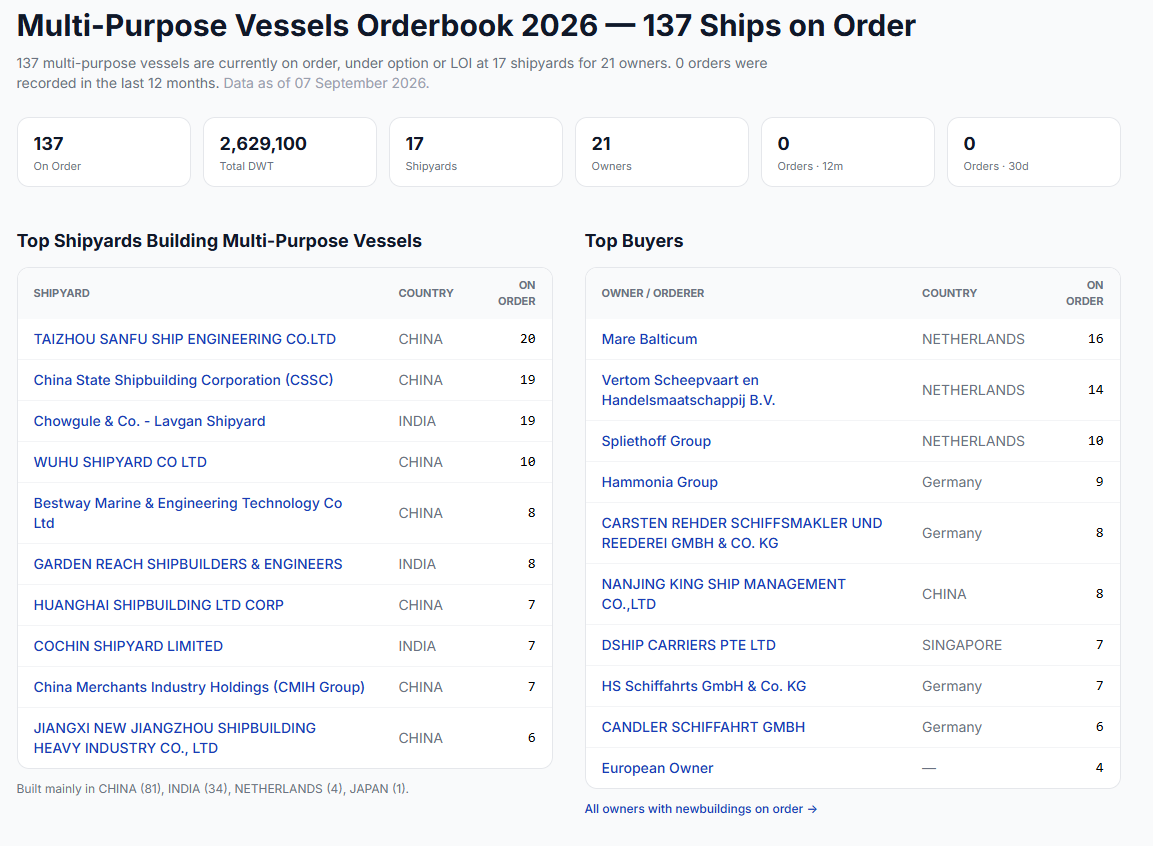
That percentage should not be interpreted as China holding 56% of the world’s firm MPP orderbook: the New-Ships dataset explicitly includes options and LOIs, and the latest five-vessel SAL proposal itself remains an MoU.
It does, however, illustrate how heavily the present MPP newbuilding pipeline is concentrated at Chinese yards.
For Wuhu Shipyard in particular, a firm follow-on SAL order would be important because it would demonstrate repeat series-building for one of the sector’s established heavy-lift operators rather than a one-off specialised project.
What happens next
The first question is straightforward: whether SAL and Wuhu convert the five-vessel MoU into a binding construction contract.
Contract price, delivery dates and final technical specifications have yet to be disclosed, while it remains to be seen whether any second batch would replicate the current Orca configuration without significant changes.
SAL’s fleet disposals will also be worth watching. Continued sales of older ships alongside newbuilding deliveries would reinforce the case that the company is undertaking a broader fleet renewal rather than pursuing capacity growth alone.
Beyond SAL, the bigger test will come later in the decade. A new generation of higher-capacity MPP and heavy-lift vessels is entering the market just as wind, energy and infrastructure cargoes become larger and more technically demanding.
Whether those projects proceed quickly enough to absorb the additional high-specification tonnage arriving around 2028-2030 will ultimately determine whether today’s fleet-renewal wave develops into a broader investment cycle.

READ MORE
 Shipbuilding
COSCO SHIPPING Bulk Leads Order for 16 New 87,000-DWT Multipurpose Grain Carriers
 Shipbuilding
MISC Signs for Five More LNG Carriers at Hudong-Zhonghua
 Shipbuilding
Another Chinese Bridge Builder Moves Into Shipbuilding
 Shipbuilding
Global Newbuilding Orderbook Matches 2008 Peak as Clarksons Flags Faster Fleet Growth
 Shipbuilding
Amid China’s Shipbuilding Boom, a State-Owned Yard Quietly Enters Liquidation
 Shipbuilding
Yichang Changyun plans RMB120m inland bulker programme
 Shipbuilding
Steel Giant Shagang Eyes Shipbuilding as a Booming Market Draws Industrial Capital
 Shipbuilding
Hengli Secures 12 Tanker Orders, Retaining World’s Largest VLCC Orderbook
 Shipbuilding
Hengli Signs 11 VLAC Contracts in One Week
 Shipbuilding