


11-Ship Programme: Hengli Wins Six More Boxships from Jiangsu Port Group
Jiangsu Port Group Commits Over US$440 Million to Six More Boxships at Hengli
Zhenghe Mainline’s containership programme at Hengli Shipbuilding is set to expand to 11 vessels and approximately 47,700 TEU, as Jiangsu Port Group builds controlled ocean-going capacity connecting Taicang Port with the Baltic region.
A major Chinese provincial port group is moving decisively beyond terminals and cargo handling into direct control of ocean-going ships and international liner capacity.
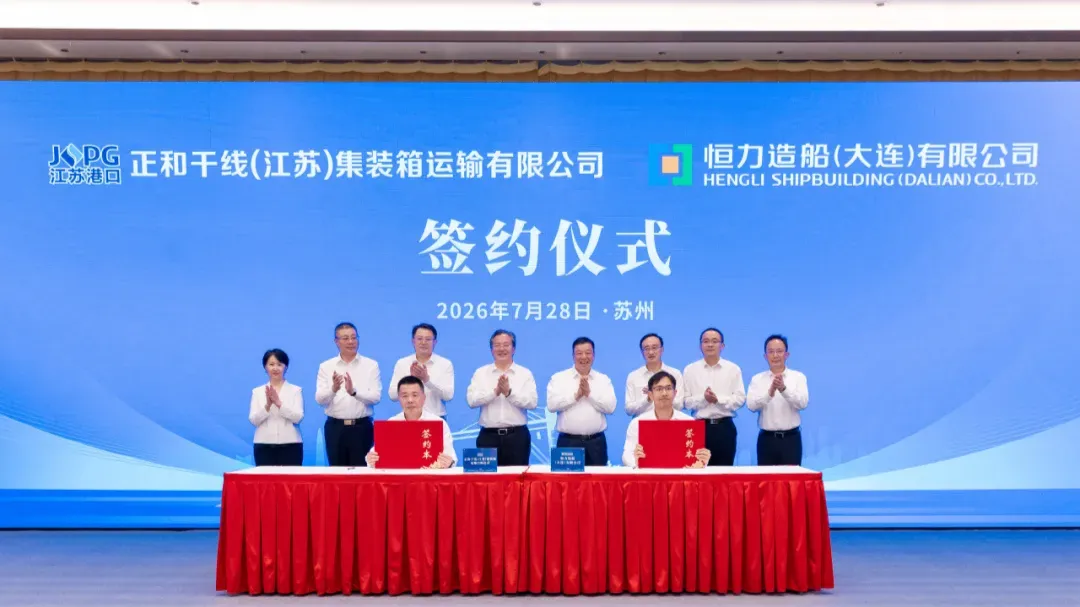
On 28 July 2026, Zhenghe Mainline (Jiangsu) Container Transportation Co., Ltd. signed a newbuilding agreement with Hengli Shipbuilding (Dalian) Co., Ltd. for six 4,600-TEU containerships.
According to an official announcement released by Suzhou Port, Zhenghe Mainline plans to invest more than RMB 3 billion in the six-vessel project. Based on exchange rates prevailing on 28 July, the investment is equivalent to more than US$440 million, suggesting an average commitment of over RMB 500 million, or approximately US$74 million, per ship.
All six vessels will be deployed on a service originating from Taicang Port and connecting with the Baltic Sea region once delivered.
Combined with the five containerships covered by an earlier agreement between Zhenghe Mainline and Hengli Shipbuilding, the latest deal will increase the company’s publicly identified orderbook at the Dalian yard to 11 ships with aggregate nominal capacity of approximately 47,700 TEU.
The investment provides one of the clearest signs yet that Jiangsu Port Group intends to establish direct control over ships, liner capacity and international shipping routes as part of a wider integration of ports, shipping, logistics and manufacturing cargoes.
Six vessels dedicated to the Taicang–Baltic trade
The signing ceremony brought together senior officials and executives from Suzhou, Taicang, Jiangsu Port Group and Hengli Group.
Fan Bo, a member of the Standing Committee of the Jiangsu Provincial Party Committee and Party Secretary of Suzhou, attended the event. The ceremony was chaired by Shen Zhidong, a member of the Standing Committee of the Suzhou Municipal Party Committee.
Chen Gao, Party Secretary of Taicang; Chen Ming, chairman of Jiangsu Port Group; and Chen Jianhua, chairman and president of Hengli Group, delivered speeches.
The agreement was signed by Hu Meiquan, chairman of Jiangsu Port Container Group, and Chen Hanlun, general manager of Hengli Shipbuilding.
Zhenghe Mainline is described in the official announcement as a wholly state-owned company under Jiangsu Port Group. Its six new vessels will support a service linking Taicang with the Baltic region, providing additional transport capacity for cargoes originating from Suzhou, Jiangsu and the wider Yangtze River Delta.
The decision to allocate the entire six-ship series to one trade corridor gives the order broader strategic importance. It indicates that the investment is closely connected with a defined international route, an established cargo base and Jiangsu Port Group’s long-term plans for Taicang Port.
For the provincial port group, controlled shipping capacity can provide greater influence over sailing frequency, slot availability and schedule reliability. These capabilities have become increasingly valuable as geopolitical disruption, route diversions and continuous adjustments by the major liner alliances reshape international container shipping networks.
The 4,600-TEU design also offers a practical balance between scale and flexibility. Ships in this segment are large enough to support long-distance services while remaining suitable for ports and trade corridors where cargo volumes may not justify the year-round deployment of much larger mainline vessels.
However, the official announcement has not yet disclosed the intended port rotation or geographical routing of the service.
The reference to the Baltic Sea does not, on its own, confirm that the vessels will use the Northern Sea Route through the Arctic. A conventional service could sail through Southeast Asia, the Indian Ocean, the Suez Canal, the Mediterranean, the Strait of Gibraltar and the North Sea before entering the Baltic.
Any potential seasonal deployment through the Arctic would need to be supported by further technical evidence, including the ships’ ice class, polar certification, winterisation measures and low-temperature operating capability.
Cooperation expands from five ships to 11
The latest contract follows an earlier round of cooperation between Zhenghe Mainline and Hengli Shipbuilding.
On 24 November 2025, Jiangsu Port Group and Hengli Group signed a strategic cooperation agreement in Dalian. During the same event, Hengli Shipbuilding and Zhenghe Mainline signed a shipbuilding agreement aimed at strengthening core shipping capacity and accelerating the green and intelligent development of maritime services.
The original announcement did not disclose the number or size of the ships involved. Subsequent tenders for newbuilding supervision provided a clearer picture of the programme.
Those documents showed that the initial project comprised three 4,900-TEU containerships and two 2,700-TEU vessels, all scheduled to be built at Hengli Shipbuilding’s production base on Changxing Island in Dalian.
The supervision tender for the two 2,700-TEU ships stated that construction was expected to begin around October 2026, with an anticipated construction and supervision period of approximately 18 months.
Clarksons orderbook data reviewed by Xinde Marine News also records five Hengli-built vessels for Zhenghe Mainline, with Jiangsu Port Group identified as the parent group.
The database lists three ships of 4,900 TEU and approximately 60,000 dwt, together with two ships of 2,700 TEU and approximately 35,000 dwt. Their delivery dates are currently shown as being concentrated in 2028.
Some early market reports described the original contract as covering five 2,700-TEU containerships. The subsequent supervision tenders and Clarksons data support a more reliable configuration of three 4,900-TEU ships and two 2,700-TEU vessels.
The five vessels in the first programme have combined nominal capacity of approximately 20,100 TEU. The six newly announced 4,600-TEU ships will add another 27,600 TEU.
Zhenghe Mainline’s total programme at Hengli will therefore increase to 11 vessels and approximately 47,700 TEU.
Measured by nominal container capacity, the new six-ship series represents an increase of roughly 137% over the original five-vessel programme.
The structure of the programme is also evolving. The first order combined two different vessel sizes, potentially allowing the operator to serve routes with different cargo volumes and port requirements. The latest order establishes a uniform series of six ships with a clearly stated deployment on the Taicang–Baltic trade.
Jiangsu Port Group builds controlled ocean capacity
The expansion of the Zhenghe Mainline orderbook reflects a wider shift in the role of China’s regional port groups.
Port companies have traditionally focused on terminal operation, cargo handling, storage, inland transport and associated logistics services. Competition between ports is now extending further into route development, cargo aggregation, supply-chain integration and access to international shipping capacity.
Through Zhenghe Mainline, Jiangsu Port Group has established a platform capable of participating directly in container shipping.
By investing in vessels and developing international routes, the group can connect Taicang Port’s terminal infrastructure with Jiangsu’s manufacturing base and controlled ocean transport capacity. This creates the foundations for an integrated network covering ports, shipping, logistics, trade and industrial cargo flows.
Such a model may offer practical benefits for export-oriented manufacturers.
During periods when international carriers reduce sailings, restructure services or redirect ships in response to geopolitical and commercial pressures, locally controlled capacity can provide greater certainty over available slots, departure schedules and transport lead times.
The decision to assign all six new ships to the Baltic trade also suggests that Jiangsu Port Group sees sufficient long-term cargo potential to support a dedicated service rather than relying solely on capacity purchased from established global carriers.
Taicang Port provides a substantial cargo base for the strategy.
In 2025, the port handled 8.736 million TEU, representing year-on-year growth of 5%. Total cargo throughput reached approximately 299 million tonnes, while automobile exports rose by more than 80% to around 900,000 vehicles.
The port also recorded nearly 8,000 international vessel entries and departures during the year. Suzhou’s major export industries—including semiconductors, photovoltaic equipment, automobiles and automotive components—generate significant demand for reliable international transport services.
Against this background, the investment of more than RMB 3 billion in six containerships carries significance beyond the fleet expansion of an individual shipping company.
The project is closely connected with efforts to increase Taicang’s international route density, support the overseas movement of products manufactured in Suzhou and reinforce the port’s position as a national logistics hub.
It also reflects Jiangsu Port Group’s ambition to control a larger share of the transport chain between local factories and overseas markets.
A state-owned shipping platform backed by port resources
Zhenghe Mainline is a relatively new corporate entity within the Jiangsu Port Group structure, although its development is backed by the established port, shipping and logistics resources of the wider group.
Jiangsu Port Group’s public disclosures identify Zhenghe Mainline as a wholly owned subsidiary based in Taicang, with registered capital of RMB 99.99 million and waterborne transportation as its principal business category.
The group also controls Zhenghe Mainline (Hong Kong) Container Transportation Co., Ltd., which is registered in Hong Kong and engaged in liner transportation.
This corporate structure provides an onshore operating platform and an offshore entity capable of supporting international shipping activities.
The significance of Zhenghe Mainline therefore lies less in the age of the individual legal entity than in the resources available through its parent group.
Jiangsu Port Group can bring together terminal infrastructure, cargo sources, regional logistics networks, customer relationships and public-sector coordination. Zhenghe Mainline provides the shipping platform through which those resources can be extended into vessel ownership and route operation.
The result is a model in which a provincial port group can organise cargo at origin, handle it through its own terminals, transport it aboard controlled ships and provide related logistics services along the supply chain.
The 11-vessel programme at Hengli offers the clearest indication to date of the scale at which this model may be developed.
Hengli broadens its containership portfolio
The contract also represents another important step in the expansion of Hengli Shipbuilding’s containership business.
Since restarting shipbuilding operations, Hengli has rapidly established an orderbook spanning tankers, bulk carriers and containerships. Its earliest containership projects were concentrated at the largest end of the market.
Clarksons data reviewed by Xinde Marine News shows that Hengli secured a major series of 24,000-TEU LNG dual-fuel containerships associated with Mediterranean Shipping Company in 2024.
The yard subsequently expanded into the 6,000-TEU segment, securing projects associated with major international owners and liner operators including Eastern Pacific Shipping, Zodiac Maritime and CMA CGM.
The Zhenghe Mainline programme extends Hengli’s product coverage further into the regional and midsize containership sectors.
With the 2,700-TEU and 4,900-TEU ships already on order, together with the newly announced 4,600-TEU series, Hengli is developing a container vessel portfolio covering a much broader range of operational requirements.
Its product line now extends from regional and midsize containerships through 6,000-TEU vessels to 24,000-TEU megamax ships.
This breadth is significant for a yard seeking to establish a sustainable position in the container shipbuilding market.
Megamax vessels are primarily ordered by the world’s largest liner companies and major tonnage providers. Midsize ships serve a wider range of customers and can be deployed in regional trades, feeder networks, independent long-haul services and chartering arrangements.
Repeat business from Zhenghe Mainline also indicates that cooperation between Jiangsu Port Group and Hengli Group is developing beyond a single shipbuilding transaction.
The relationship now connects ship construction, port operations, shipping services, logistics, industrial production and trade flows.
For Hengli, which has major industrial roots in Suzhou, the order also reinforces its economic links with its home region while adding another substantial series to its expanding shipbuilding backlog.
Will the vessels use an Arctic route?
The stated Baltic deployment inevitably raises questions over whether the six new ships could eventually use the Northern Sea Route.
China–Europe container voyages through the Arctic have attracted growing attention because of the potential distance and time savings during the navigable season. However, a Baltic destination alone provides insufficient evidence to determine the intended route.
Ships travelling from Taicang to the Baltic can operate through the conventional Suez route throughout the year, subject to security and navigation conditions.
Arctic operation would require a more specialised technical and regulatory framework. Relevant factors would include an appropriate ice class, compliance with the IMO Polar Code, polar ship certification, low-temperature protection, suitable lifesaving and navigation equipment, trained crews and permission to operate through waters administered under Russia’s Northern Sea Route regime.
Ice strengthening for winter operations in the Baltic would also need to be distinguished from a polar-class specification designed for Arctic navigation.
The official announcement has not disclosed the ships’ classification society, ice class, propulsion configuration, design temperature or polar capability. It has also not stated that the service will use the Northern Sea Route.
The appropriate conclusion at this stage is therefore that the vessels are intended for a Taicang–Baltic service, while the precise geographical routing remains undisclosed.
The ships’ eventual class notation and technical specification will provide the strongest evidence of whether Jiangsu Port Group is considering conventional year-round deployment, seasonal Arctic voyages or a combination of routing options.
The strategic questions behind the 11-ship programme
Zhenghe Mainline’s publicly identified programme at Hengli has expanded from five vessels to 11 and from approximately 20,100 TEU to 47,700 TEU.
Several operational and technical details remain unanswered.
The market will be watching which Baltic ports are included in the planned service, how frequently the ships will sail and whether Zhenghe Mainline intends to operate independently or cooperate with an established carrier through slot exchanges, vessel-sharing arrangements or other commercial partnerships.
The delivery schedule for the latest six ships has not been disclosed. Details of their principal dimensions, propulsion systems, alternative-fuel capabilities, classification society and individual contract prices also remain unavailable.
Hengli Group has stated that it will pursue high-end, intelligent and green development in fulfilling the project. The specific solutions adopted for energy efficiency, emissions compliance, digitalisation and possible ice strengthening will therefore be closely watched.
Another important question concerns the relationship between the first five vessels and the latest six-ship series.
The earlier 2,700-TEU and 4,900-TEU ships may provide flexibility across different services, while the six identical 4,600-TEU vessels appear designed to support a more standardised and regular liner operation.
Together, they could enable Jiangsu Port Group to establish a network combining mainline and regional capacity, although the detailed route structure has yet to be announced.
Port competition enters a new phase
The significance of the RMB 3 billion-plus order extends well beyond the six ships covered by the latest contract.
It connects Jiangsu Port Group’s move into controlled ocean-going capacity, Taicang Port’s expansion of international liner links, Suzhou’s demand for reliable export logistics and Hengli Shipbuilding’s growing presence in the midsize containership sector.
The programme also demonstrates how competition between major ports is evolving.
Terminal capacity and cargo-handling efficiency remain essential, but they increasingly form only part of a port’s competitive position. Route density, cargo aggregation, vessel capacity, schedule reliability and end-to-end supply-chain control are becoming equally important.
A port group capable of combining terminals, logistics networks, cargo sources and an ocean-going fleet can exert greater influence over how regional trade connects with global markets.
Jiangsu Port Group’s commitment of more than US$440 million to six additional ships shows that this strategy is moving from concept to large-scale asset investment.
With 11 containerships and approximately 47,700 TEU now publicly associated with Zhenghe Mainline’s programme at Hengli, a new state-backed liner fleet centred on Taicang Port is beginning to take shape.
Its ultimate scale, route network and commercial operating model remain to be seen. The direction of travel, however, is becoming increasingly clear: Jiangsu Port Group is seeking a larger and more direct role in carrying Jiangsu’s export cargoes from the factory gate to overseas markets.

READ MORE
 Shipbuilding
A New State-Owned Shipbuilding Group Is Born in China
 Shipbuilding
Breaking! Hengli Announces Deals for 52 Ultra-Large LNG Dual-Fuel Containerships
 Shipbuilding
Global Newbuilding Orderbook Matches 2008 Peak as Clarksons Flags Faster Fleet Growth
 Shipbuilding
Pavimar Returns to Newbuilding Market After a Decade With Four Hengli Kamsarmaxes
 Shipbuilding
COSCO SHIPPING Bulk Leads Order for 16 New 87,000-DWT Multipurpose Grain Carriers
 Shipbuilding
MISC Signs for Five More LNG Carriers at Hudong-Zhonghua
 Shipbuilding
Another Chinese Bridge Builder Moves Into Shipbuilding
 Shipbuilding
Amid China’s Shipbuilding Boom, a State-Owned Yard Quietly Enters Liquidation
 Shipbuilding
Yichang Changyun plans RMB120m inland bulker programme
 Shipbuilding