


Three Fatal Accidents in Half a Month: Why HD Hyundai Heavy Industries Had to Stop
.
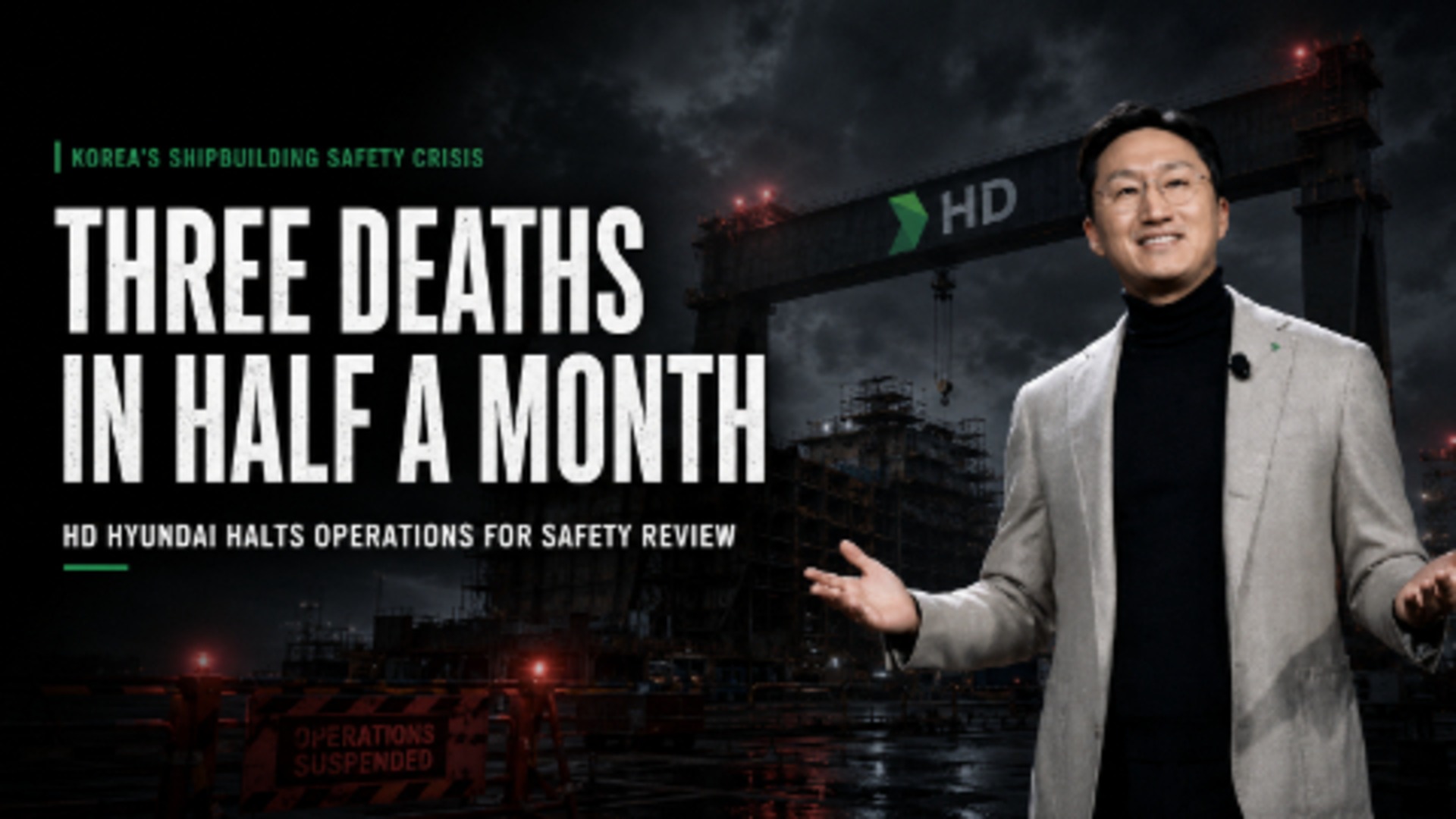

A fatal crushing accident at HD Hyundai Heavy Industries’ Gunsan shipyard has become the third workplace death linked to the company’s production network in just over two weeks. The shipbuilder has now ordered a company-wide safety shutdown, creating an almost two-week production pause when combined with its scheduled summer holiday. Yet the real test will not be how long the yards remain idle, but whether HD Hyundai can correct the deeper weaknesses exposed by repeated fatalities involving subcontracted workers, modified equipment and high-risk operations.
At approximately 4:44 p.m. on July 24, a subcontracted worker in his 30s was killed in a crushing accident at HD Hyundai Heavy Industries’ Gunsan shipyard in North Jeolla Province.
The worker, identified by South Korean authorities only as “A”, was reportedly reversing a fixed winch when his head became trapped between a lifting lug protruding from the underside of a ship block and the protective guard around the winch head.
The Ministry of Employment and Labor immediately issued a stop-work order covering the relevant operations and launched an investigation into the cause of the accident. Authorities are also examining whether the shipyard violated South Korea’s Occupational Safety and Health Act and the Serious Accidents Punishment Act.
The death marked the third fatal accident within HD Hyundai Heavy Industries and its integrated production facilities in just over two weeks.
On July 18, a subcontracted worker from Uzbekistan, aged in his 20s, died at the company’s Ulsan shipyard while grinding inside the cargo containment area of an LNG carrier under construction. The worker was trapped between a work gondola and an overhead structure.
On July 9, another worker fell to his death while carrying out maintenance on a shipbuilding gantry crane at an HD Hyundai M&S facility in Ulsan, linked to the former HD Hyundai Mipo operations acquired at the end of 2025.
The recent accidents involved two crushing incidents and one fatal fall.
An earlier fatality had already occurred in April. A fire broke out aboard a submarine undergoing repair at HD Hyundai Heavy Industries’ Ulsan shipyard, killing a subcontracted worker who had been cleaning inside the vessel ahead of sea trials.
Although the incidents occurred at different facilities and involved different operations, four workplace deaths in less than four months can no longer be treated as unrelated site-level failures.
They point to a broader question: whether HD Hyundai’s safety management system is keeping pace with the complexity, production intensity and subcontracting structure of one of the world’s largest shipbuilding organisations.
Repeated “line-of-fire” accidents expose weaknesses in engineering controls
The two most recent deaths share an important characteristic. Both workers entered areas where moving machinery and fixed structures created a foreseeable crushing hazard.
In the Gunsan accident, the fatal space was formed between the ship block, its protruding lifting lug and the winch assembly. At the Ulsan LNG carrier, the worker was trapped between a moving work platform and the structure above it.
These are classic “line-of-fire” or pinch-point hazards.
Such risks are well understood in shipbuilding. Large steel blocks, winches, gondolas, scaffolding and lifting equipment frequently move through confined spaces where even a small unintended movement can be fatal.
For that reason, effective controls cannot depend primarily on workers being careful.
The hierarchy of controls requires companies to eliminate the hazardous interface where possible, redesign the equipment, install physical guards and interlocks, introduce travel limits and proximity sensors, establish exclusion zones, and ensure that an independent signalman or spotter is present when visibility is restricted.
Training and warning signs are necessary, but they are weaker controls. They assume that a worker can recognise and respond to the danger before the machinery moves.
The Korean Metal Workers’ Union has alleged that the equipment involved in the Gunsan accident had been modified from a 1.5-tonne forklift-type unit and that its original overhead protective structure had been lowered or removed because it interfered with the work. The union also claimed that concerns over the equipment had previously been raised.
HD Hyundai Heavy Industries has disputed parts of that account, arguing that the operation did not involve a legal requirement for an overhead falling-object guard and that previous inspections had not established a regulatory violation.
These competing accounts remain subject to investigation.
But the dispute reveals a central weakness in compliance-based safety management. The relevant question is not limited to whether a particular guard was explicitly required by law. It is whether the actual configuration of the equipment created a foreseeable crushing risk and whether that risk was adequately controlled.
A machine may comply with its original design standard and still become unsafe after its work environment, operating method or surrounding structure changes.
The LNG carrier accident raises a similar issue. Even where a gondola is fitted with an anti-overtravel device, changes to scaffolding, structural geometry or working height may place a new obstruction outside the sensor’s original protection zone.
Every material change to the workplace should therefore trigger a new risk assessment. Without that reassessment, a previously effective safety device may no longer protect the worker, while continuing to create the impression that the operation is safeguarded.
The July 9 crane-maintenance fatality and the April submarine fire involved different hazards—working at height, maintenance isolation, enclosed-space access, fire prevention and emergency escape—but these are also established high-consequence risks.
The pattern suggests that the problem is not a lack of knowledge about shipyard hazards. It is the failure to ensure that identified risks are closed out through engineering, supervision and verified work controls before production proceeds.
Subcontracting has become a central safety issue
At least three of the four workers killed this year were subcontractors.
That common factor deserves close scrutiny.
Modern shipbuilding relies on extensive subcontracting. Welding, grinding, scaffolding, painting, cleaning, equipment maintenance and outfitting are often carried out by specialist contractors working alongside the shipyard’s permanent workforce.
Subcontracting is not inherently unsafe. However, it can fragment responsibility.
The shipyard controls the production programme, physical workplace and major equipment. A subcontractor employs the worker. Another department may maintain the machinery. A separate team may conduct the risk assessment, issue the work permit or supervise the operation.
When these responsibilities are divided across several organisations, critical information can be lost between them.
A hazard may be reported but not assigned to a clear owner. A piece of equipment may be modified without a full management-of-change review. A contractor may assume that the shipyard has verified the work area, while the shipyard assumes that the contractor is responsible for the worker’s immediate safety.
The weakest participants in this arrangement are often the workers performing the most dangerous tasks.
Foreign workers face additional challenges. South Korean shipyards have increasingly recruited workers from Central Asia and Southeast Asia to address labour shortages, particularly in physically demanding production roles.
Providing translated training materials is only the starting point. Employers must verify that workers understand equipment movement, emergency-stop procedures, exclusion zones and their right to refuse unsafe work.
Competence should be demonstrated through practical assessment, not inferred from attendance at an induction session.
Newly recruited workers should also receive longer periods of supervised work before being assigned to high-risk operations involving gondolas, lifting equipment, confined spaces or heavy steel structures.
The central legal and managerial principle is straightforward: a shipyard cannot outsource its ultimate responsibility for the safety of the workplace.
South Korea’s Serious Accidents Punishment Act was designed precisely to prevent senior management from treating fatal accidents as the isolated responsibility of an individual worker or small contractor. It requires business leaders to establish and maintain an effective safety management system across the operations they control, including contracted work.
HD Hyundai has previously announced major investments in safety, including expanded training, digital monitoring, risk assessment and support for foreign workers and subcontractors.
The recent fatalities show why expenditure and formal programmes cannot be treated as proof of effectiveness.
The meaningful measure is whether a worker at the point of operation is protected by functioning equipment, competent supervision and an unquestioned right to stop work.
The production pause is almost two weeks—but the formal safety shutdown is shorter
On July 27, HD Hyundai Heavy Industries announced a three-day company-wide “safety shutdown” beginning July 29.
All employees are scheduled to receive special safety training on July 29. Production at all facilities, including the Ulsan and Gunsan shipyards, will then stop completely on July 30 and 31.
August 1 and 2 are regular non-working days, followed by the company’s scheduled summer holiday from August 3 to 13.
The sequence creates an almost two-week period without normal production.
However, it is important to distinguish between an approximately two-week production interruption and a two-week emergency safety shutdown. The formal safety programme lasts three days, including one day of training and two days of full production suspension. Most of the remaining period consists of a weekend and the company’s pre-planned summer holiday.
That does not make the intervention insignificant. The extended idle period gives management an unusual opportunity to inspect facilities and carry out corrective work without the pressure of active production.
But it also means that the effectiveness of the response must be judged by the quality of the review, not the length of the calendar pause.
During the shutdown, HD Hyundai plans to reassess risks across its shipbuilding processes, inspect high-risk operations, safety and disaster-prevention systems, and working environments. Any process found to contain unresolved hazards is expected to remain suspended until those hazards are eliminated.
This commitment is critical because the company has already used short-term shutdowns and special training following earlier accidents.
After the April submarine fire, HD Hyundai Heavy Industries conducted a company-wide suspension and safety programme. Following the July 18 LNG carrier accident, the company again halted production for special safety education.
Three days later, another worker was killed in Gunsan.
The sequence suggests that post-accident training and temporary work stoppages, while highly visible, have not been sufficient to prevent recurrence.
Training can refresh awareness. It cannot replace a missing guard, an inadequate travel limit, an unsafe equipment modification or a flawed work sequence.
For the latest intervention to have lasting value, the restart process must become more demanding than the shutdown itself.
Operations should not resume automatically when the summer holiday ends. Each high-risk process should be restarted only after its hazards have been independently verified as controlled.
Modified machinery, gondolas, gantry cranes, scaffolding, confined spaces and lifting operations should be reviewed individually. Each corrective action should have a named owner, completion deadline, verification record and clearly defined authority for approving restart.
The same standards must apply across Ulsan, Gunsan and all integrated production facilities. Contractors and foreign workers must be incorporated into the same permit-to-work, competency, supervision and stop-work systems as direct employees.
Management must also address the union’s claim that equipment concerns had been raised before the Gunsan death. If a known hazard was reported but not corrected, the investigation must establish where the information stopped moving through the organisation and why production continued.
That question is potentially more important than determining which individual was operating the machine at the moment of the accident.
The cost of stopping is visible; the cost of unsafe production is greater
A production pause at one of the world’s largest shipbuilders is commercially significant.
HD Hyundai Heavy Industries is managing a large orderbook across LNG carriers, containerships, tankers, naval vessels and offshore projects. Shipyard schedules are closely coordinated with block production, dock utilisation, equipment suppliers, subcontractors, sea trials and contractual delivery dates.
A prolonged shutdown can disrupt that sequence and create pressure later in the production cycle.
That pressure must not be transferred back to workers through accelerated schedules, longer working hours or compressed maintenance windows once operations resume.
This is one of the most important risks following any major safety shutdown. Lost production is measurable immediately, while the benefit of a prevented accident is invisible. Once the public attention fades, commercial incentives can push the organisation to recover lost time.
A credible safety reset therefore requires senior management to protect supervisors and workers from schedule pressure when they delay or reject unsafe work.
The company should evaluate management performance not only against productivity and delivery indicators, but also against the closure of safety actions, the quality of contractor supervision and the frequency with which workers exercise stop-work authority without retaliation.
HD Hyundai’s global standing makes the issue larger than one company.
South Korea’s shipbuilding industry has recovered strongly in high-value sectors such as LNG carriers, naval construction and advanced offshore vessels. Yet its workforce is increasingly dependent on layered subcontracting and foreign labour at a time when yards are operating with substantial orderbooks.
If safety governance does not evolve at the same pace, production growth can amplify exposure to fatal risk.
HD Hyundai Heavy Industries’ decision to halt production is therefore necessary. But it is only the beginning.
The shipyards will eventually restart. The decisive question will be whether every process restarts on schedule—or whether management is prepared to keep unsafe operations closed until the risks have genuinely been removed.
That will show whether this shutdown was primarily a response to public pressure, or the beginning of a deeper change in how one of the world’s leading shipbuilders manages human life, subcontracting and production discipline.

READ MORE
 Safety
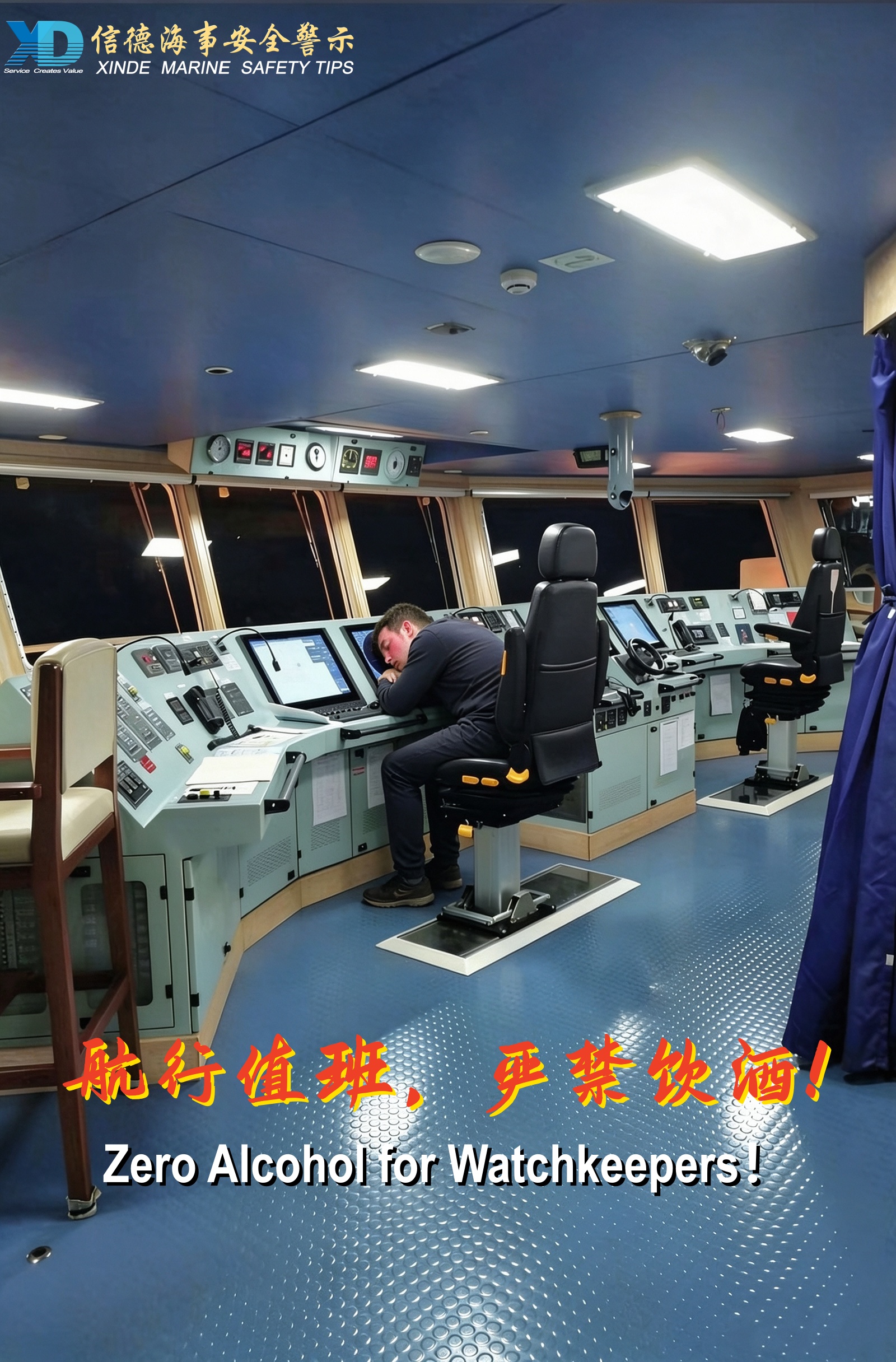
Alcohol‑Control for Seafarers and Key Points for PSC Inspections
 Safety
The accident often starts when the job feels safe
 Safety
Opinion:Why a Rapid Return to Calm in the Middle East Looks Unlikely
 Safety
Shipping May Be Waiting for a World That Is Not Coming Back
 Safety
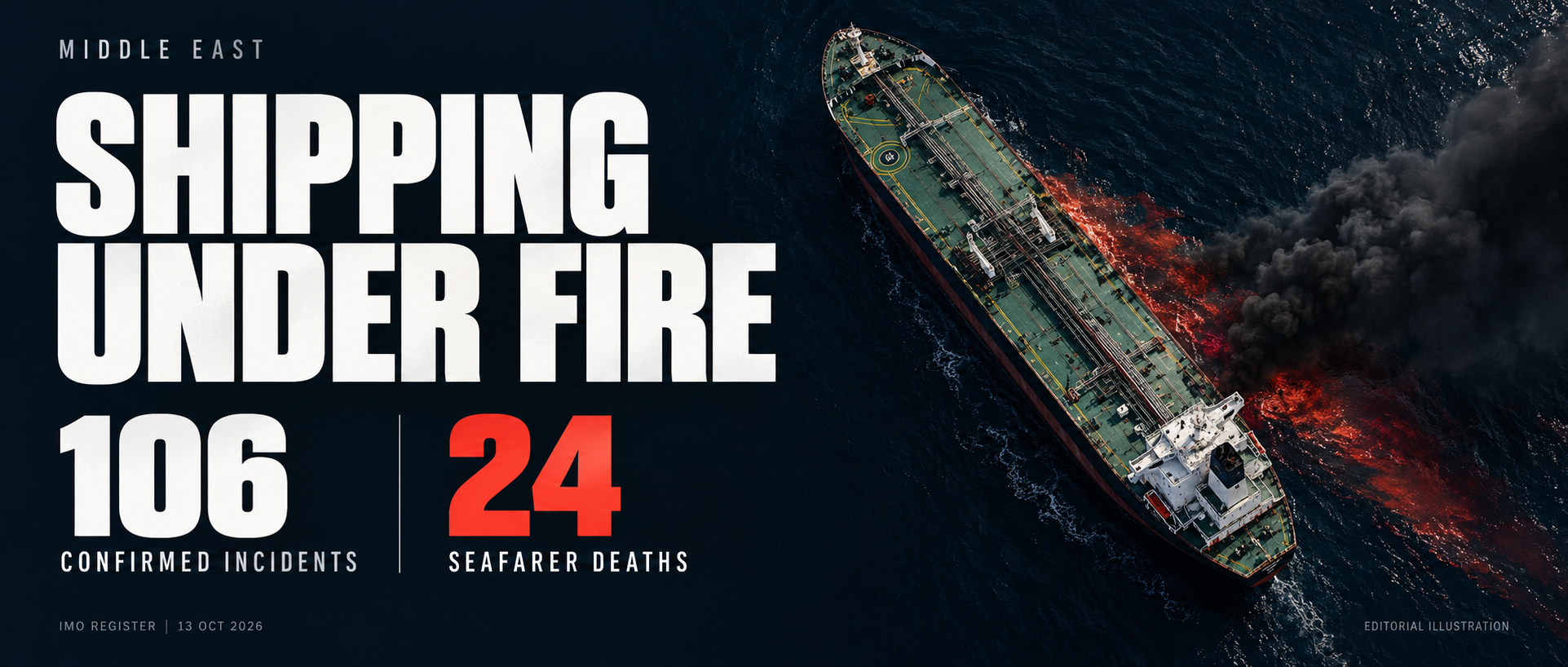
Middle East war leaves mounting toll on merchant shipping
 Safety
US Says It Disabled Hong Kong-Owned Bulker off Oman
 Safety
Attacked Just 42Days After Delivery: George Prokopiou’s 115,000-Dwt Tanker Hit in Hormuz
 Safety
Five Seafarers Reported Dead as Puntland Retakes Hijacked Tanker Honour 25
 Safety
China-U.S. Consensus Highlights Free Navigation: No Country or Entity Should Impose Transit Fees on International Waterways
 Safety