


Dalian Launches Local Deep-Sea Shipping Platform, Securing 1.5 Million Tonnes of Cargo and 500,000 DWT of Capacity
.
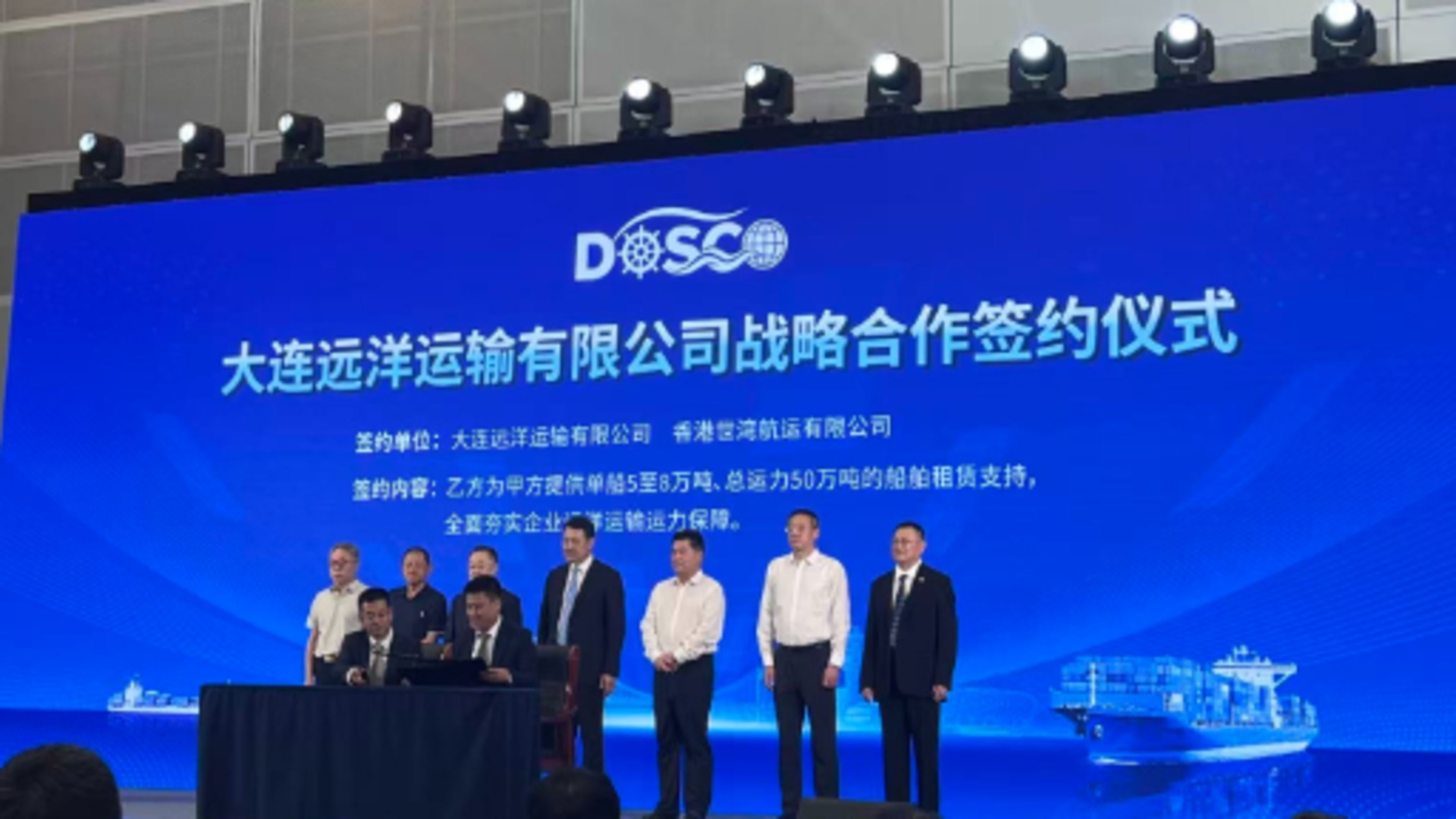

Dalian Ocean Shipping Co., Ltd. has been officially inaugurated, with China Dalian International Economic & Technical Cooperation Group, or CDIG, leading its establishment.
Built around the integrated development concept of “Liaoning cargo, Liaoning ships and Liaoning ports,” the company plans to enter the market through deep-sea transportation before expanding into shipping investment, shipmanagement and supply chain services.
On July 22, the inauguration and cooperation agreement signing ceremony for Dalian Ocean Shipping was held at the Dalian International Conference Center.
The establishment of the company is positioned as an important step in addressing Dalian’s shortage of locally based professional deep-sea shipping operators and developing independently controlled ocean-going capacity.
Dalian Ocean Shipping will focus on deep-sea cargo transportation, international route operations, shipmanagement, freight forwarding, cross-border logistics and related maritime services. It aims to build a coordinated business system connecting local cargo, shipping capacity and regional ports under the “Liaoning cargo, Liaoning ships and Liaoning ports” strategy.
Public corporate registration information shows that Dalian Ocean Shipping was incorporated on June 3, 2026, with registered capital of RMB120 million. Zhao Jieni is listed as its legal representative, and the company is registered in Dalian’s Xigang District.
Its business scope covers international general cargo and container shipping, domestic and international shipmanagement, vessel chartering and sales, international freight forwarding, non-vessel-operating common carrier services, warehousing, customs declaration and import-export activities.
Initial Agreements Secure Both Cargo and Shipping Capacity
During the inauguration ceremony, Dalian Ocean Shipping signed cooperation agreements with Dalian Dongfang Tangu New Materials Group and Hong Kong Shiwan Shipping Co., Ltd.
Under the publicly disclosed arrangements, Dalian Dongfang Tangu New Materials Group will provide approximately 1.5 million tonnes of fixed petroleum coke cargo annually, while Hong Kong Shiwan Shipping will make available ocean-going vessels with an aggregate capacity of around 500,000 dwt.
The agreements give the newly established company access to both a basic cargo portfolio and deployable shipping capacity at the beginning of its operations, creating an initial business framework combining cargo organisation with vessel operation.
For a new platform entering the deep-sea shipping market, this structure has practical significance.
Shipping companies at an early stage commonly face two major risks: investing in vessels without securing stable cargo, or controlling cargo without having access to long-term and predictable shipping capacity.
By bringing both a cargo owner and a vessel operator into its cooperation framework, Dalian Ocean Shipping can reduce its exposure to cargo volatility and vessel deployment risks during the initial stage of its development.
Based on the current cooperation structure, the company may initially enter the market through chartering, joint operations or other forms of controlled capacity, rather than immediately purchasing a large fleet of owned vessels.
Once its cargo base, route network and cash flow become more stable, the company could gradually expand into shipping investment and the development of its own fleet. This represents a viable route for a local shipping platform seeking to control its initial capital expenditure while shortening the time required to begin commercial operations.
Liu Xiqing, general manager of Dalian Ocean Shipping, said the company will focus on deep-sea transportation, shipping investment and international route operations, while gradually extending its business into freight forwarding, supply chain management and other upstream and downstream services.
CDIG Expands from Seafarer Services into Deep-Sea Shipping
The new company has been established under the leadership of China Dalian International Economic & Technical Cooperation Group, commonly known as CDIG.
Approved by China’s State Council in 1984, CDIG has long been involved in international engineering contracting, overseas labour services, international trade, property development, ocean transportation and deep-sea fishing.
The group has conducted business in more than 30 countries and regions, including Russia, Japan, Singapore, Suriname and Equatorial Guinea.
Although CDIG has not previously been widely recognised by the market as a major commercial shipowner, it has accumulated substantial experience in maritime services and international operations.
The history of its maritime business can be traced to Dalian International Marine Technical Service Company, which was established in 1981. The company has long provided seafarer deployment and marine technical services and has supplied crews for hundreds of vessels operated by clients in Japan, Singapore, the United States, India, Europe and Hong Kong.
The new shipping platform is therefore not starting entirely from scratch.
CDIG’s existing seafarer resources, overseas network, international contract management experience and maritime service capabilities can provide a foundation for shipmanagement, crew deployment, international customer development and overseas operations.
Zhao Xijin, chairman of CDIG, said the group will draw on more than four decades of international business experience to develop Dalian Ocean Shipping into a benchmark local deep-sea shipping company.
Liu added that the company plans to expand Dalian’s locally controlled ocean-going fleet, optimise its global route network and support the foreign trade and logistics requirements of Liaoning Province and the wider northeastern region of China.
Moving Beyond Cargo Handling to Cargo and Capacity Organisation
Dalian has a comprehensive maritime industrial base covering ports, shipyards, maritime universities, shipmanagement, seafarer services and marine equipment manufacturing. It is also one of northeastern China’s most important gateways for foreign trade.
From the perspective of the local industrial chain, however, port throughput and the scale of port-related industries do not automatically translate into ocean-going capacity controlled by locally based shipowners.
Large volumes of cargo originating in Liaoning and other parts of northeastern China are imported or exported through the Port of Dalian, but the actual transportation, vessel deployment, route planning and freight-rate decisions may be controlled by shipping companies headquartered outside the region.
The port city can generate revenue from cargo handling, warehousing and agency services, but it may capture less of the value created through vessel operations, route organisation, shipping investment and global supply chain management.
The central purpose of establishing a professional deep-sea shipping platform is therefore to strengthen Dalian’s ability to organise both cargo and shipping capacity.
Local authorities have described this as a transition from a cargo-handling-oriented shipping economy to an organisational model. In addition to possessing port infrastructure, Dalian aims to develop stronger capabilities in cargo aggregation, capacity control, route operation and the allocation of maritime resources.
The concept of “Liaoning cargo, Liaoning ships and Liaoning ports” does not necessarily mean that all cargo must be carried by wholly owned vessels registered in Liaoning.
A more practical interpretation is to connect local cargo, regional ports and stable shipping capacity through a combination of owned vessels, bareboat charters, long-term time charters, voyage charters, joint operations and supply chain contracts.
Should the model reach sufficient scale, Dalian Ocean Shipping could move beyond the transportation of bulk commodities such as petroleum coke and serve a wider range of Liaoning’s key industries.
Potential cargo segments include machinery and equipment, steel products, minerals, grain, new-energy materials and heavy-lift or project cargo. The company could ultimately offer shippers an integrated portfolio covering ocean transportation, port services, freight forwarding, warehousing and cross-border logistics.

READ MORE
 Ports & Terminals
Chancay Port: Defending Legitimate Investment Through the Rule of Law
 Ports & Terminals
Chancay Port: A Gateway for Trade, Competition and Shared Prosperity
 Ports & Terminals
Can a 134-Kilometre Canal Redraw China’s Shipping Map?
 Ports & Terminals
HONG KONG MARITIME WEEK 2026 10TH ANNIVERSARY 15-21 NOVEMBER
 Ports & Terminals
Yantian Port plans RMB3.79bn Zhangjiagang terminal
 Ports & Terminals
Vietnam’s Cai Mep Terminals Open 1,200-Metre Shared Berth
 Ports & Terminals
Ningbo Port’s September Box Volumes Rebound 9.3%
 Ports & Terminals
Germany Blocks COSCO’s Zippel Deal, Testing Inland Logistics Expansion
 Ports & Terminals
Keep buying!Inside the Maersk Family’s Infrastructure Buying Spree——From 70-Plus Ships to 50-Plus Terminals
 Ports & Terminals