


Greek Shipowner Orders 3+1 Newcastlemaxes at Dajin Heavy in US$309m Deal
The latest contract lifts Dajin Heavy’s disclosed Newcastlemax backlog to 17 firm vessels plus one option, with deliveries extending into 2030
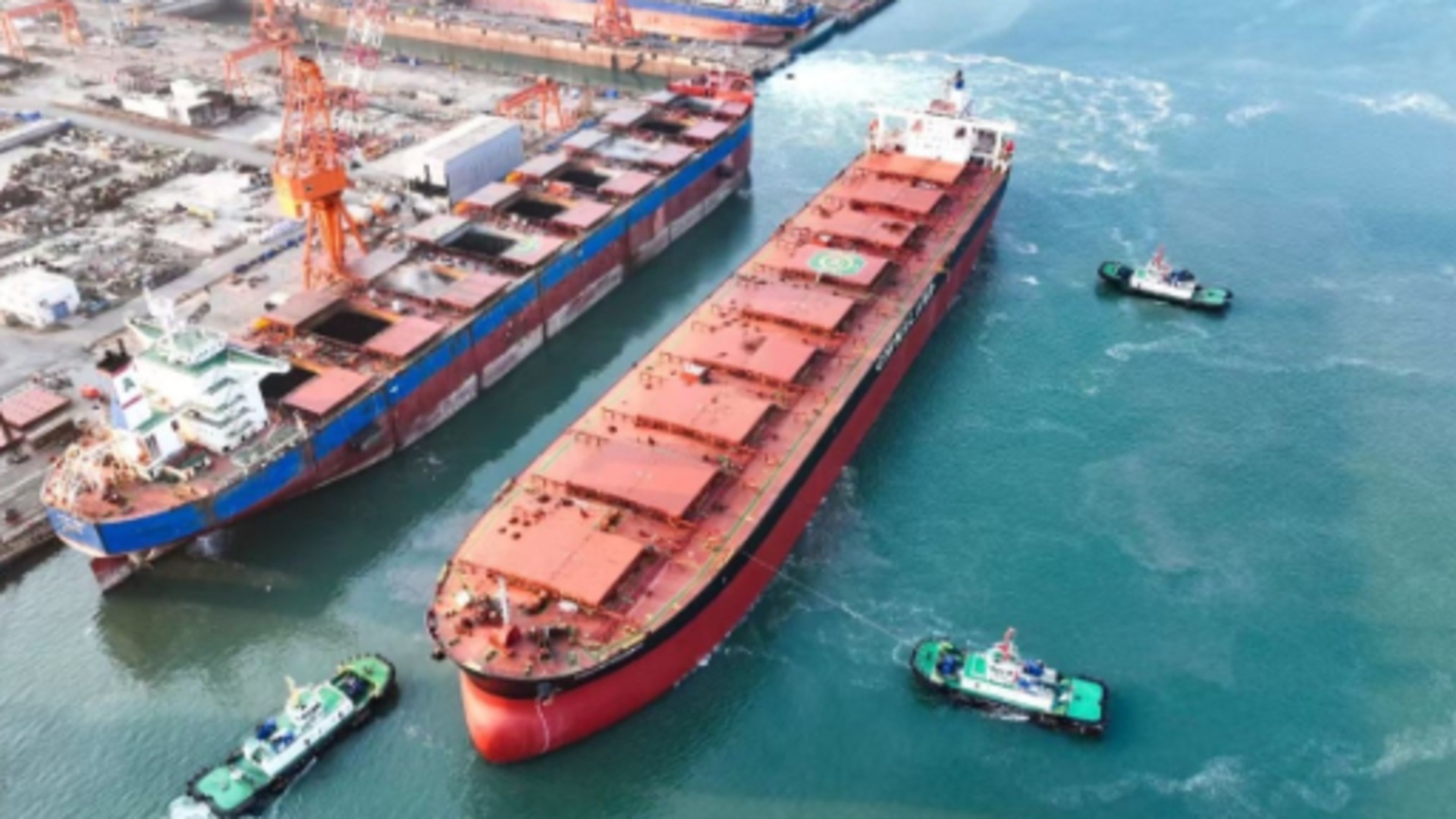

Dajin Heavy Industry has secured a new order from an unnamed Greek shipowner for three firm Newcastlemax bulk carriers plus one option, in a deal worth approximately US$309m.
The contract further strengthens the Chinese offshore engineering specialist’s position in mainstream merchant shipbuilding, less than two years after it began expanding beyond vessels directly related to offshore wind and project cargo transportation.
Dajin Heavy announced on 21 July that its subsidiary, Tangshan Dajin Offshore Engineering Co, had signed contracts for three firm 211,000-dwt bulk carriers and one optional vessel.
The three firm ships are valued at approximately US$232m in total, while the optional vessel is worth about US$77m. The buyer has two months from the signing date to exercise the option.
The firm vessels are scheduled for phased delivery between 2029 and 2030.
Each ship will have an overall length of approximately 299.95 metres, a breadth of about 50 metres and a moulded depth of around 25 metres. The design falls within the Newcastlemax segment, one of the largest conventional dry bulk carrier categories used primarily in long-haul iron ore, coal and other major commodity trades.
Based on the disclosed contract value, the agreed price is approximately US$77m per vessel, broadly in line with Dajin Heavy’s earlier contracts for ships of the same type.
Greek buyer remains unidentified
Dajin Heavy did not disclose the name of the shipowner.
The company described the customer as a diversified Greek shipping group with a longstanding presence in the tanker and gas carrier sectors, an active newbuilding programme and a history of cooperation with leading shipyards across the Asia-Pacific region.
Dajin Heavy also stated that it had completed similar transactions with the same shipowner during the past three years, suggesting that the latest contract could represent a repeat order or an expansion of an existing relationship.
Based on the owner’s exposure to tankers, gas carriers and dry bulk shipping, together with its active investment in Asian newbuildings, the description appears to have several similarities with the shipping interests controlled by George Procopiou.
Procopiou’s group operates across three principal platforms: tanker company Dynacom Tankers Management, LNG carrier operator Dynagas and dry bulk owner Sea Traders.
Another possible candidate is George Economou’s TMS Group, which is active in tankers, gas carriers and bulk shipping. Evangelos Marinakis-controlled Capital Maritime also has a diversified fleet and an extensive newbuilding programme at Asian shipyards.
However, neither Dajin Heavy nor the shipowner has confirmed the identity of the buyer. Any attribution therefore remains speculative.
Newcastlemax becomes Dajin Heavy’s core merchant ship product
The latest contract further establishes the 210,000-dwt to 211,000-dwt Newcastlemax as the largest and most concentrated ship type in Dajin Heavy’s commercial orderbook.
On 24 April 2026, the company announced two separate contracts with a Norwegian shipowner and a Greek shipowner, each covering four 210,000-dwt bulk carriers.
The eight ships were valued at a combined US$591m and are scheduled for delivery between 2028 and 2029.
Market sources subsequently linked the Norwegian order to John Fredriksen’s Seatankers Management and the Greek contract to New York-listed Danaos Corporation. Danaos later confirmed that it had four 211,000-dwt Newcastlemax bulk carriers under construction for delivery in 2028.
In May, Dajin Heavy secured another contract from a Greek shipowner for two 211,000-dwt bulk carriers. The ships were valued at approximately US$153m and are scheduled for delivery in 2029. Shipbroking reports identified the buyer as Greece’s Cape Shipping.
In early June, Dajin Heavy announced orders for two additional pairs of Newcastlemax vessels, one placed by a Norwegian owner and the other by a Greek owner.
The four ships carried a combined contract value of approximately US$300m and were also scheduled for delivery in 2029. The Norwegian order was widely associated with Seatankers, while the Greek customer remained unidentified.
Including the latest contract, Dajin Heavy has now formally disclosed orders for 17 firm Newcastlemax bulk carriers, together with one optional vessel.
The 17 firm ships have an aggregate disclosed contract value of approximately US$1.29bn. Including the latest option, the total value rises to around US$1.36bn.
The firm orderbook represents approximately 3.58m dwt of future capacity, with deliveries extending from 2028 to 2030.
For a relatively new entrant to large merchant ship construction, concentrating orders around a standardised design could provide significant production advantages.
Series construction can support repeatable engineering, bulk procurement of machinery and equipment, a more predictable production rhythm and more efficient supply-chain management. It may also allow the yard to reduce construction risks as experience gained from the first vessels is applied to subsequent ships.
The Newcastlemax order count in this article follows Dajin Heavy’s formal stock exchange disclosures. Commercial vessel databases may show different totals depending on whether earlier buyer options have already been recorded as firm orders.
Expansion began with offshore wind transportation
Dajin Heavy’s entry into shipbuilding originated from the logistics requirements of its offshore wind business.
As European offshore wind contracts increasingly shifted from free-on-board delivery arrangements towards models under which manufacturers assume greater responsibility for transportation and overseas delivery, Dajin Heavy needed access to specialised vessels capable of carrying oversized monopiles, jackets and floating foundations.
These structures can be exceptionally long and heavy. Their transportation requires vessels with large unobstructed deck areas, high deadweight capacity and specialised loading, securing and stability arrangements.
Dajin Heavy initially responded by developing its own deck transport vessels at its Panjin facility.
The company’s first 40,000-dwt deck carrier reached a major launching milestone in October 2025 and began its first transport assignment in February 2026.
The project allowed Dajin Heavy to connect offshore equipment production, ocean transportation and overseas delivery within a more integrated industrial chain.
After developing vessels for its own logistics requirements, the company began accepting third-party orders.
In 2025, Dajin Heavy secured a contract from a South Korean shipowner for a 23,000-dwt heavy offshore wind deck carrier. The contract was valued at approximately US$44m.
It later received an order from a Norwegian shipowner for a 43,000-dwt non-propelled semi-submersible barge, worth approximately US$42m.
Both vessels are scheduled for delivery in 2027.
These initial third-party projects remained closely connected to offshore engineering, heavy transportation and Dajin Heavy’s established capabilities in manufacturing large steel structures.
Moving into mainstream merchant shipping
The series of Newcastlemax orders secured during 2026 marked a much broader expansion into conventional international merchant shipbuilding.
Newcastlemax bulk carriers serve global iron ore, coal and other major dry bulk trades. Their construction requires a different commercial, technical and operational support system from offshore wind foundations, deck carriers and project cargo units.
Dajin Heavy therefore needs to extend its capabilities beyond large-scale steel fabrication into full vessel design, machinery and equipment integration, commissioning, sea trials, regulatory compliance and after-sales support.
At the same time, the company has secured orders for two 25,000-dwt green intelligent multipurpose heavy-lift vessels from Dutch heavy transport specialist Jumbo Maritime.
The two ships are valued at approximately US$156m and are scheduled for delivery in 2028 and 2029.
Each vessel will be equipped with two 1,200-tonne cranes, providing a combined lifting capacity of up to 2,400 tonnes. The ships will be capable of transporting offshore wind components, oil and gas modules and other large industrial cargoes.
The Jumbo order provides a natural bridge between Dajin Heavy’s offshore engineering expertise and its expanding commercial shipbuilding activities. Multipurpose heavy-lift ships require advanced structural engineering, high deck-strength specifications and detailed project cargo integration, all of which are closely related to the company’s existing manufacturing experience.
Dajin Heavy’s disclosed shipbuilding portfolio now covers 40,000-dwt self-propelled deck carriers, 23,000-dwt heavy offshore wind transport vessels, 43,000-dwt non-propelled semi-submersible barges, 25,000-dwt multipurpose heavy-lift ships and 210,000-dwt to 211,000-dwt Newcastlemax bulk carriers.
The development path is becoming increasingly clear. Dajin Heavy first constructed ships to support its own offshore wind logistics, then entered the third-party offshore and heavy transport market, before moving into standardised large commercial vessels.
The next test will be delivery
Dajin Heavy enters shipbuilding with several relevant industrial capabilities.
The company has extensive experience in manufacturing ultra-large offshore wind monopiles, jackets and floating foundations. These products require thick-plate processing, large-scale structural welding, international quality certification, heavy lifting and complex port-side delivery.
Its Tangshan Caofeidian marine engineering base covers more than 1,300 mu and is located next to deepwater port facilities. The site includes four heavy-load berths, together with substantial fabrication, assembly and storage areas.
The company is now extending these capabilities into complete shipbuilding processes, including vessel design, block fabrication, erection, equipment installation, commissioning, sea trials and delivery.
Its current merchant ship orderbook remains concentrated in large bulk carriers and offshore-related heavy transport vessels. Dajin Heavy has not yet publicly disclosed orders for tankers, containerships or large gas carriers.
The decisive stage will begin as the projects move from contract signing into construction and delivery.
Dajin Heavy is scheduled to deliver its first externally contracted offshore specialised vessels in 2027. Its first Newcastlemax bulk carriers and Jumbo heavy-lift ships are expected from 2028. The large-bulker programme will enter its most intensive delivery phase between 2029 and 2030.
The steady flow of orders from established European shipowners shows that Dajin Heavy has successfully gained access to the international shipbuilding market.
Its ability to deliver the first vessels on schedule, stabilise series production and establish mature quality-control, equipment procurement and after-sales systems will determine whether shipbuilding can develop into a sustainable second growth platform alongside its offshore wind equipment business.

READ MORE
 Shipbuilding
Another Chinese Bridge Builder Moves Into Shipbuilding
 Shipbuilding
Amid China’s Shipbuilding Boom, a State-Owned Yard Quietly Enters Liquidation
 Shipbuilding
Yichang Changyun plans RMB120m inland bulker programme
 Shipbuilding
MISC Signs for Five More LNG Carriers at Hudong-Zhonghua
 Shipbuilding
Steel Giant Shagang Eyes Shipbuilding as a Booming Market Draws Industrial Capital
 Shipbuilding
Hengli Secures 12 Tanker Orders, Retaining World’s Largest VLCC Orderbook
 Shipbuilding
Hengli Signs 11 VLAC Contracts in One Week
 Shipbuilding
China ZWI Enters Ocean Shipping with VLGC Acquisition and Chemical Tanker Newbuild Project
 Shipbuilding
World’s First 325,000-DWT Methanol Dual-Fuel Ore Carrier Delivered
 Shipbuilding