


World’s First 325,000-dwt Methanol Dual-Fuel Ore Carrier Named in China
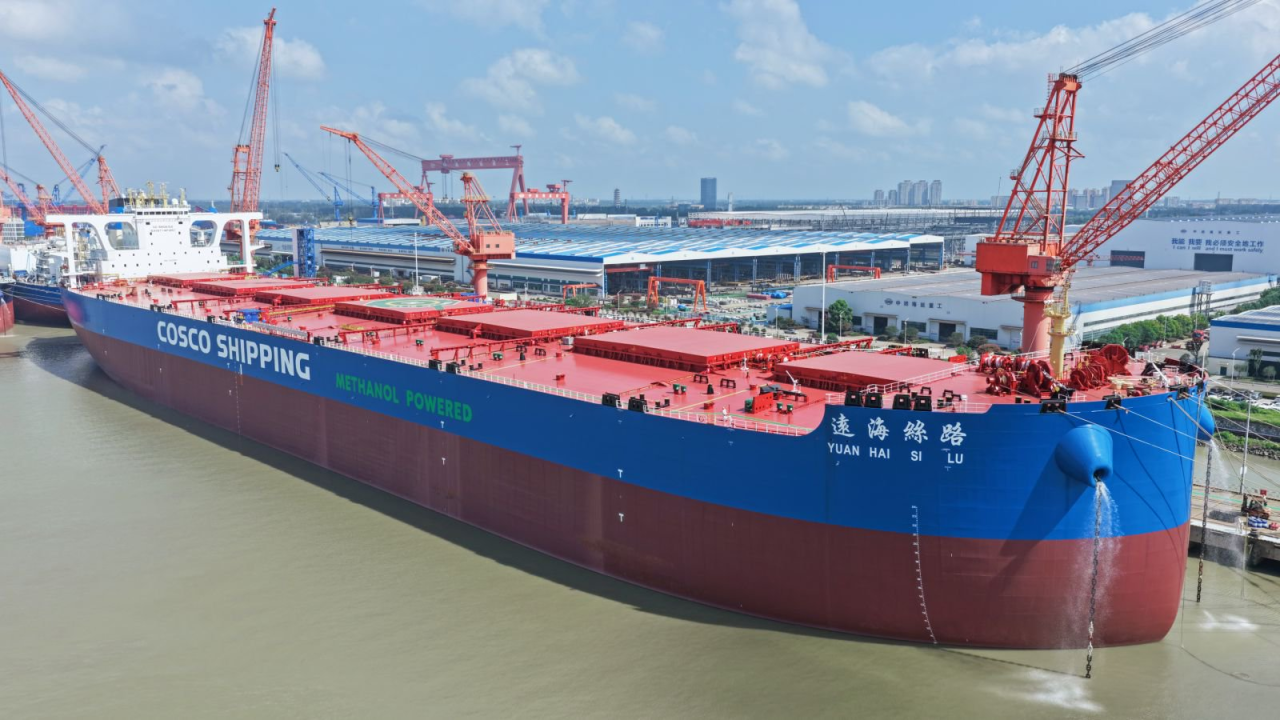
COSCO SHIPPING’s new “YUAN HAI SI LU” combines methanol propulsion, autonomous navigation capabilities and a pioneering digital delivery system, marking a major step in the green and digital transformation of very large ore carriers.
(My colleague on site:https://www.linkedin.com/posts/zhongkai-xu-7a8b573b2_xindemarinenews-shipping-drybulk-activity-7500413209993150464--kiA?utm_source=share&utm_medium=member_desktop&rcm=ACoAAAaK7Z8BykxVE0cJAeK6m6PhQT008T0zL8s)
A new milestone in the decarbonisation of large bulk shipping was reached in China on September 1, when the world’s first 325,000-dwt methanol dual-fuel ore carrier was officially named YUAN HAI SI LU in Yangzhou, Jiangsu Province.
Jointly designed by COSCO SHIPPING Heavy Industry and Shanghai Merchant Ship Design and Research Institute (SDARI), a subsidiary of China State Shipbuilding Corporation, the vessel was built by COSCO SHIPPING Heavy Industry and will be operated by COSCO SHIPPING Bulk.
Beyond its methanol dual-fuel propulsion system, YUAN HAI SI LU also incorporates another global first: according to the project partners, it is equipped with the world’s first ship digital delivery system of its kind. The combination makes the vessel an unusually significant project for the bulk shipping sector, bringing together alternative-fuel propulsion, intelligent navigation, advanced hull optimisation and lifecycle digitalisation on one of the largest classes of dry bulk carrier.
The vessel is scheduled for formal delivery and entry into commercial service in October 2026.
A 325,000-dwt Methanol-Powered Giant
YUAN HAI SI LU measures 339.9 metres in length, with a beam of 62 metres, a moulded depth of 30 metres and a structural draught of 21.25 metres. Its deadweight capacity reaches approximately 325,000 tonnes, placing it firmly within the very large ore carrier segment used primarily for long-haul transportation of major mineral commodities.
The most important distinction is its methanol dual-fuel propulsion configuration. While methanol has rapidly gained momentum in containership newbuilding programmes and has increasingly appeared in other vessel segments, its application on an ore carrier of this scale represents a significant extension of the technology into the deep-sea bulk transportation market.
Building such a vessel involves substantially more than installing a different main engine. The project required dedicated engineering work covering the methanol fuel supply and auxiliary systems, fuel tank structural arrangements, coating technologies and vessel vibration characteristics, among other areas.
Several energy-saving, resistance-reduction and modular construction technologies were also introduced during the project. These improvements are intended to reduce fuel consumption and improve operational efficiency, an increasingly important consideration as shipowners face tighter emissions regulations and growing pressure to reduce the carbon intensity of deep-sea transportation.
For bulk carriers operating on long intercontinental routes, the challenge is particularly demanding. Large ore carriers transport enormous cargo volumes over long distances and therefore consume substantial amounts of fuel. Introducing alternative fuels into this segment has the potential to produce meaningful emissions reductions at fleet level, while also providing valuable operational experience for the broader transition towards lower-carbon fuels.
Designed for Both Iron Ore and Bauxite
Another notable feature of YUAN HAI SI LU is its cargo flexibility.
Compared with conventional ore carriers of similar dimensions, the vessel’s cargo hold capacity has been increased by more than 40%, according to the project developers. The enlarged hold arrangement allows the ship to transport not only high-density cargoes such as iron ore but also lower-density commodities such as bauxite while still making efficient use of its available deadweight.
That distinction is commercially relevant.
Very large ore carriers were historically developed around highly specialised iron ore trades, particularly long-haul routes connecting major mining regions with Asian steelmaking centres. Increasing cargo flexibility potentially gives operators greater freedom in fleet deployment and allows vessels to participate in a broader range of mineral transportation trades.
The hull form has also been specifically optimised for the operating environment expected on long-distance voyages.
Drawing on years of operating data from very large ore carriers, the vessel incorporates a hull design intended to reduce added resistance in waves, particularly under the wind and sea conditions encountered in the mid- and higher-latitude regions of the Indian Ocean. COSCO SHIPPING says the resulting design improves overall vessel performance by more than 5%.
For a ship of more than 300,000 dwt, even relatively modest improvements in hydrodynamic performance can translate into significant fuel savings over the vessel’s operating life.

Intelligent Navigation Moves Into the VLOC Segment
YUAN HAI SI LU also represents a significant step in the application of intelligent shipping technologies to very large bulk carriers.
The vessel complies with the China Classification Society i-Ship (N, M, E, I) intelligent ship notation requirements and is fitted with an integrated display and situational-awareness system.
The platform combines navigation, machinery and electrical-system information from multiple onboard sources into an integrated operational environment. It is designed to provide panoramic situational awareness, graded safety warnings and intelligent decision-support functions for the crew.
According to the project developers, the vessel has also achieved what they describe as China’s first autonomous open-water navigation demonstration involving a large cargo vessel.
Autonomous navigation in this context does not necessarily imply an unmanned commercial ship. Instead, the technology increasingly functions as an advanced layer of decision support, combining sensor information, navigation data and shipboard systems to improve situational awareness and reduce human workload.
For an ultra-large bulk carrier operating on intercontinental routes, such systems may ultimately become particularly valuable. Digital navigation assistance, machinery monitoring and predictive analytics can improve safety while supporting more efficient vessel operation.
From Physical Delivery to “Digital Delivery”
The vessel’s most distinctive technological feature may ultimately extend well beyond its methanol propulsion system.
YUAN HAI SI LU is equipped with a ship digital delivery platform developed by COSCO SHIPPING Heavy Industry, which is intended to change the way technical information moves from the shipyard into the operational phase of a vessel’s life.
Traditional ship delivery is heavily document-based. Owners receive enormous quantities of drawings, manuals, equipment records, spare-parts lists, certificates and maintenance documents, often stored across different systems and formats. Considerable work can subsequently be required to reorganise that information for fleet management and maintenance.
The new system seeks to create a much more integrated structure.
At its centre is a lightweight three-dimensional digital model of the vessel, around which equipment information, maintenance records, spare-parts data and other technical documentation can be dynamically linked.
The platform therefore connects information generated during design, procurement, construction, delivery and subsequent maintenance, creating what is effectively a continuously usable digital representation of the ship.
This changes the concept of vessel delivery. Instead of transferring only the physical asset together with a large package of technical documentation, the shipyard is also delivering a structured digital asset that can remain usable throughout the vessel’s operational life.
The platform also incorporates an AI-based multimodal intelligent search function, enabling operators to retrieve vessel documentation and analyse technical data more efficiently.
If successfully integrated into fleet management systems, such technology could eventually influence maintenance planning, troubleshooting, spare-parts management, lifecycle cost control and even future retrofit decisions.
The project has already received several classification approvals. It previously secured what the developers describe as the world’s first Approval in Principle for a conceptual digital ship based on digital delivery, followed by the first General Design Approval certificate for a ship digital delivery system issued by China Classification Society.
These approvals provide an important step towards turning digital vessel delivery from an individual shipyard project into a more standardised industrial process.
Green Fuel and Digitalisation Are Beginning to Converge
The significance of YUAN HAI SI LU extends beyond a single newbuilding.
The maritime industry has spent much of the past decade discussing the green and digital transitions as two largely separate developments. The first concerned fuel choice, vessel efficiency and emissions regulation; the second focused on sensors, connectivity, artificial intelligence and increasingly sophisticated fleet-management systems.
Projects such as this one demonstrate how those two transitions are beginning to converge.
Alternative-fuel vessels are inherently more complex. Methanol fuel systems introduce additional tanks, piping, safety systems, operating procedures and equipment-maintenance requirements. As vessels become more technically sophisticated, operators also need better control over technical data.
Digital lifecycle platforms therefore have the potential to become increasingly important precisely because future ships will become more complicated.
The same logic applies to intelligent navigation. The next generation of ships will increasingly combine low-carbon propulsion systems with onboard optimisation software, condition monitoring, energy-management systems and shore-based fleet-management platforms.
YUAN HAI SI LU provides a large-scale example of that emerging architecture.
Strengthening COSCO SHIPPING Bulk’s Long-Haul Mineral Transport Capacity
For COSCO SHIPPING Bulk, the new vessel also carries a strategic role beyond technology demonstration.
Once delivered, the 325,000-dwt ore carrier will strengthen the company’s ability to transport major mineral commodities across long-distance ocean routes. Very large ore carriers represent some of the most efficient transportation platforms available for moving iron ore and other bulk commodities between continents, particularly on high-volume routes connecting major mining regions with China.
The additional capacity is expected to strengthen COSCO SHIPPING Bulk’s long-haul transportation network while providing newer, more efficient tonnage capable of meeting increasingly demanding environmental requirements.
Such ships can also provide greater resilience against fluctuations in charter markets and external changes in vessel supply by increasing the proportion of strategically controlled transportation capacity.
Against a backdrop of growing geopolitical uncertainty and increasing attention to the security of critical mineral supply chains, the availability of large, efficient and technologically advanced bulk carriers has taken on wider strategic importance.
The naming of YUAN HAI SI LU therefore represents several developments at once: the expansion of methanol propulsion into the largest classes of dry bulk vessel, the application of autonomous-navigation technologies to large commercial ships, and an attempt to redefine how a ship is digitally transferred from builder to owner.
When the vessel enters service in October, the industry will gain something equally valuable: operating experience.
For shipping’s energy transition, that will ultimately determine the significance of projects like YUAN HAI SI LU. The challenge is no longer simply whether alternative-fuel ships can be designed and built. The industry now needs to demonstrate how these vessels perform commercially, how efficiently their fuel systems can be operated, how digital technologies affect lifecycle costs, and whether the model can eventually be replicated across large fleets.
At 325,000 dwt, YUAN HAI SI LU is a particularly large platform on which to begin answering those questions.

READ MORE
 Shipbuilding
Amid China’s Shipbuilding Boom, a State-Owned Yard Quietly Enters Liquidation
 Shipbuilding
Yichang Changyun plans RMB120m inland bulker programme
 Shipbuilding
Steel Giant Shagang Eyes Shipbuilding as a Booming Market Draws Industrial Capital
 Shipbuilding
Another Chinese Bridge Builder Moves Into Shipbuilding
 Shipbuilding
Hengli Secures 12 Tanker Orders, Retaining World’s Largest VLCC Orderbook
 Shipbuilding
Hengli Signs 11 VLAC Contracts in One Week
 Shipbuilding
China ZWI Enters Ocean Shipping with VLGC Acquisition and Chemical Tanker Newbuild Project
 Shipbuilding
World’s First 325,000-DWT Methanol Dual-Fuel Ore Carrier Delivered
 Shipbuilding
CIMC Raffles Extends NOCC Car Carrier Programme to 2030
 Shipbuilding