


Most Shipowners and Charterers Reduced Emissions Intensity in 2025


The global shipping industry continued to push ahead with decarbonisation in 2025, despite geopolitical disruption, supply chain pressure and regulatory uncertainty.
On 11 June, the Sea Cargo Charter released its 2026 Annual Disclosure Report. The report shows that SCC signatories broadly maintained their alignment with the International Maritime Organization’s climate targets in 2025. It also shows that most shipowners, charterers and operators that disclosed data in both 2024 and 2025 reduced their carbon emissions intensity during the year.
According to the report, the Sea Cargo Charter now has 32 signatories, including charterers, shipowners and operators. Together, they represent around 14% of total global seaborne trade.
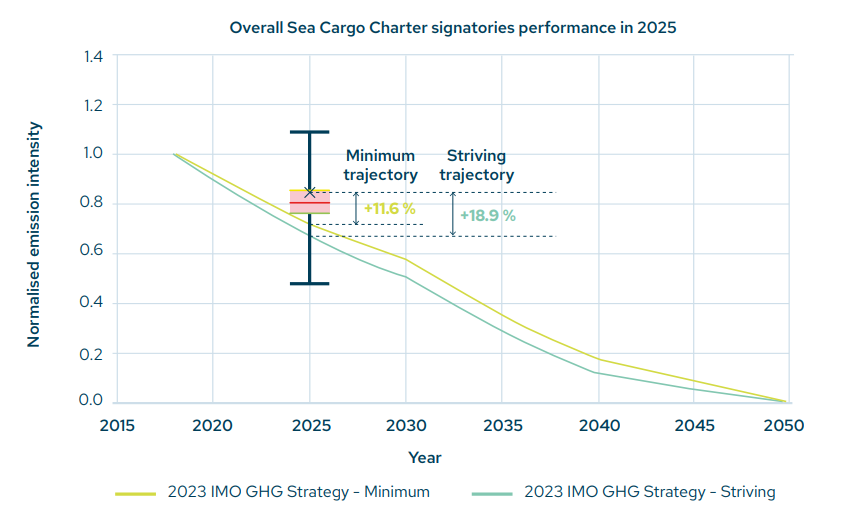
In 2025, the signatories were on average 11.6% behind the IMO minimum ambition trajectory. This was a slight improvement from 12.2% in 2024, suggesting that overall climate alignment remained broadly stable.
Among the 29 signatories that disclosed data for both 2024 and 2025, 20 achieved a reduction in emissions intensity in 2025. This marked an improvement from the previous reporting cycle, when 19 out of 33 signatories reduced their emissions intensity.
SCC said this result was encouraging. The reason is that the IMO climate alignment trajectory becomes more stringent each year. Even maintaining the same level of alignment requires companies to keep improving operational efficiency.
At the same time, 2025 was a difficult year for emissions reduction. Shipping companies had to operate amid geopolitical tensions, supply chain volatility and uncertainty over future regulation. These factors made decarbonisation more challenging.
In terms of practical measures, several signatories attributed lower emissions intensity to operational efficiency improvements within their own control. These included speed optimisation, weather routing and real-time vessel performance monitoring.
These measures do not usually depend on large-scale new fuel supply. They also do not require immediate fleet replacement. As a result, they remain some of the most practical tools for shipowners and charterers to reduce emissions in the near term.
However, SCC also warned that voluntary corporate action alone will not be enough to support deep long-term decarbonisation. External market conditions, fuel availability, infrastructure development, cost-sharing mechanisms and regulatory incentives continue to limit what the industry can achieve on its own.
James Lewis, Chair of the Sea Cargo Charter and Global Head of Operations at Cargill Ocean Transportation, said it was a very positive signal that SCC signatories had not slowed their decarbonisation efforts during a highly turbulent year.
He also warned that continued stable performance should not be taken for granted. As the IMO climate alignment targets become increasingly stringent, the industry will find it more difficult to stay close to those targets without practical incentives and a level playing field created by a global regulatory framework.
The report shows that SCC signatories remained behind both the IMO minimum ambition trajectory and the striving trajectory. In 2025, signatories were on average 11.6% behind the minimum ambition trajectory and 18.9% behind the striving trajectory. Compared with 2024, the gap to the minimum ambition trajectory narrowed slightly, while the gap to the striving trajectory widened from 18.1% to 18.9%.
At the same time, nearly half of signatories were within 10% of the IMO minimum ambition trajectory. Almost one quarter were within 10% of the striving trajectory. The report said this indicates that some companies already have a solid operational foundation for emissions reduction, but the industry as a whole still needs stronger systemic support.
On data transparency, SCC signatories disclosed an average of around 91% of eligible activities in 2025. Thirteen signatories achieved 100% activity disclosure. SCC said this high level of data coverage helps improve transparency in shipping decarbonisation and allows clearer performance comparison among charterers, shipowners and operators.
Engebret Dahm, Vice Chair and Treasurer of the Sea Cargo Charter and CEO of Klaveness Combination Carriers, said the SCC has evolved from a framework for measuring and disclosing progress into a platform for peer learning and cross-sector collaboration between shipowners and charterers.
Before a full industry-wide regulatory mechanism is in place, voluntary initiatives will remain an important way to maintain decarbonisation momentum.
The Sea Cargo Charter has now been in operation for six years. Over the past year, the initiative has further expanded its focus from transparency and disclosure to implementation. It has encouraged signatories to exchange case studies, business models and practical experience around emissions reduction.
From an industry perspective, the latest report sends two clear signals.
First, operational efficiency remains the most realistic short-term tool for shipping decarbonisation.
Second, as the IMO decarbonisation trajectory continues to tighten, the room for voluntary corporate action alone is becoming smaller. To achieve deeper emissions reductions, shipping will need stronger support from global regulation, fuel supply chains, financial mechanisms and cargo owner demand.
The 2026 Annual Disclosure Report of the Sea Cargo Charter was prepared by the Global Maritime Forum, with expert support from CE Delft, Smart Freight Centre and Stephenson Harwood.


READ MORE
 Sustainability
COSCO , CMA CGM and SIPG Join Launch of International Green Shipping Corridor Alliance
 Sustainability
Zero-Emission-Capable Ship Orders Slide as IMO Uncertainty Weighs on 2030 Target
 Sustainability
Fueling Now and the Future: IBIA Hong Kong Forum on Alternative Marine Energy
 Sustainability
Fleet Management Lights Up Anchor Plaza in Blue for World Maritime Day 2026
 Sustainability
WMMF 2026 Promotional Film Debuts in London
 Sustainability
Xinde Marine Forum London 2026: Green Shipping Enters a Strategic Reset
 Sustainability
Shipping Has a Net-Zero Target — but Still Lacks the Rules to Deliver It
 Sustainability
Chimbusco completes first ammonia bunkering operation
 Sustainability
324 days ahead of schedule — another milestone for China’s shipbuilding industry
 Sustainability