


Up to $380 per Tonne of CO₂e: Four Rival IMO Proposals Raise the Stakes for Chinese Shipping

From abolishing fixed compliance payments to pricing almost all remaining emissions—and allowing shipowners to choose where compliance money is invested—the battle over the IMO Net-Zero Framework is no longer simply about the pace of decarbonisation. It will determine how much shipowners pay, what vessels shipyards build, and whether green methanol, green ammonia and other alternative-fuel projects can secure bankable returns.
At the International Maritime Organization’s headquarters on the River Thames in London, negotiations are approaching a decisive stage for a regulatory regime that could affect tens of thousands of commercial vessels worldwide.
At the centre of the debate is a global decarbonisation system covering oceangoing ships above 5,000 gross tonnage. It is designed to achieve two objectives simultaneously.
First, ships would be required to progressively reduce the lifecycle greenhouse gas intensity of the energy they use. Second, ships that fail to meet the prescribed standards would face a financial cost, with the resulting revenue used to support low-emission fuels, green technologies and the maritime transition in developing countries.
Known as the IMO Net-Zero Framework, the package received approval in principle in April 2025. Its formal adoption was then postponed when the IMO’s extraordinary Marine Environment Protection Committee session was adjourned in October 2025.
Governments have since put forward sharply different proposals covering reduction thresholds, carbon prices, compliance units and the future of the IMO Net-Zero Fund.
On the surface, the dispute concerns percentages, timelines and different price tiers. In practice, it will shape the direction of shipping investment for the next decade:
-
Will shipowners continue burning conventional fuel and purchase compliance units, or move early into green fuels?
-
Should shipyards prioritise methanol, ammonia and onboard carbon-capture designs, or preserve a broader range of transitional-fuel options?
-
Should fuel producers begin building large-scale green ammonia and e-methanol plants now, or wait for a clearer demand signal?
For China—which combines one of the world’s largest merchant fleets with the world’s largest shipbuilding industry and a rapidly expanding green-fuel sector—the outcome will be particularly significant.
How Would the Framework Make Shipowners Pay?
Before examining the competing proposals, it is necessary to understand how the original framework is intended to operate.
The system does not simply measure how many tonnes of carbon dioxide a ship emits during a year. Instead, it assesses a vessel’s GHG Fuel Intensity, or GFI: the quantity of greenhouse gases produced for each unit of energy consumed.
The calculation follows a well-to-wake lifecycle approach. It covers not only carbon dioxide released when fuel is burned onboard, but also emissions generated during extraction, production and transportation. Methane and nitrous oxide are included alongside carbon dioxide.
This is especially important for LNG.
LNG normally produces less carbon dioxide than conventional marine fuel at the combustion stage. But if methane leakage is high across the supply chain or during engine operation, its lifecycle emissions advantage can narrow considerably.
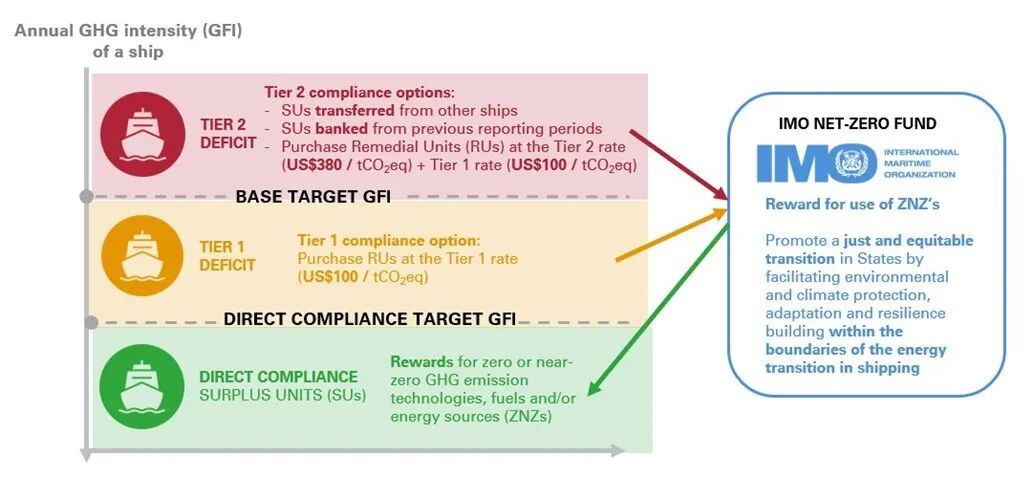
Under the version of the Net-Zero Framework approved in 2025, each ship would face two progressively tightening annual GFI thresholds:
-
A relatively less stringent Base Target; and
-
A more demanding Direct Compliance Target.
A ship performing better than the Direct Compliance Target could generate surplus units. These units could be sold to other vessels or banked for use in future compliance periods.
If a ship failed to meet the Direct Compliance Target but still achieved the Base Target, it would create a Tier 1 compliance deficit. Under the original draft, the Tier 1 remedial-unit price for 2028–2030 would be $100 per tonne of CO₂ equivalent.
If the vessel also failed to meet the Base Target, the emissions exceeding that threshold would fall into Tier 2, where the remedial-unit price would reach $380 per tonne of CO₂ equivalent.
Payments for remedial units would flow into the IMO Net-Zero Fund. The fund is intended to reward ships using zero- or near-zero-emission fuels, support clean-fuel and infrastructure projects, and help Small Island Developing States and Least Developed Countries manage the economic effects of the transition.
The framework is therefore not a uniform tax on every tonne emitted.
A shipowner’s actual cost would depend on the vessel’s annual energy consumption, the lifecycle emissions of its fuels, the size of its gap against the two GFI thresholds and the market price of surplus units.
Changing any part of this structure would alter the relative economics of conventional fuel, LNG, biofuels, green methanol and green ammonia.
Four Proposals—and Four Very Different Cost Models
The most closely watched alternatives have come from Liberia, Brazil, Tuvalu and Japan.
Australia, Canada, South Africa and the United Kingdom have also submitted a joint proposal that would largely preserve the original framework while postponing its implementation dates. That proposal can be regarded as the negotiating baseline.
These are negotiating positions, not changes that the IMO has already accepted.
The proposals from Liberia, Brazil and Tuvalu, together with the four-country joint proposal, were circulated within the relevant deadline as proposed MARPOL amendments. Japan submitted its proposal later, creating procedural uncertainty over whether it could move directly into the formal adoption process in December 2026.
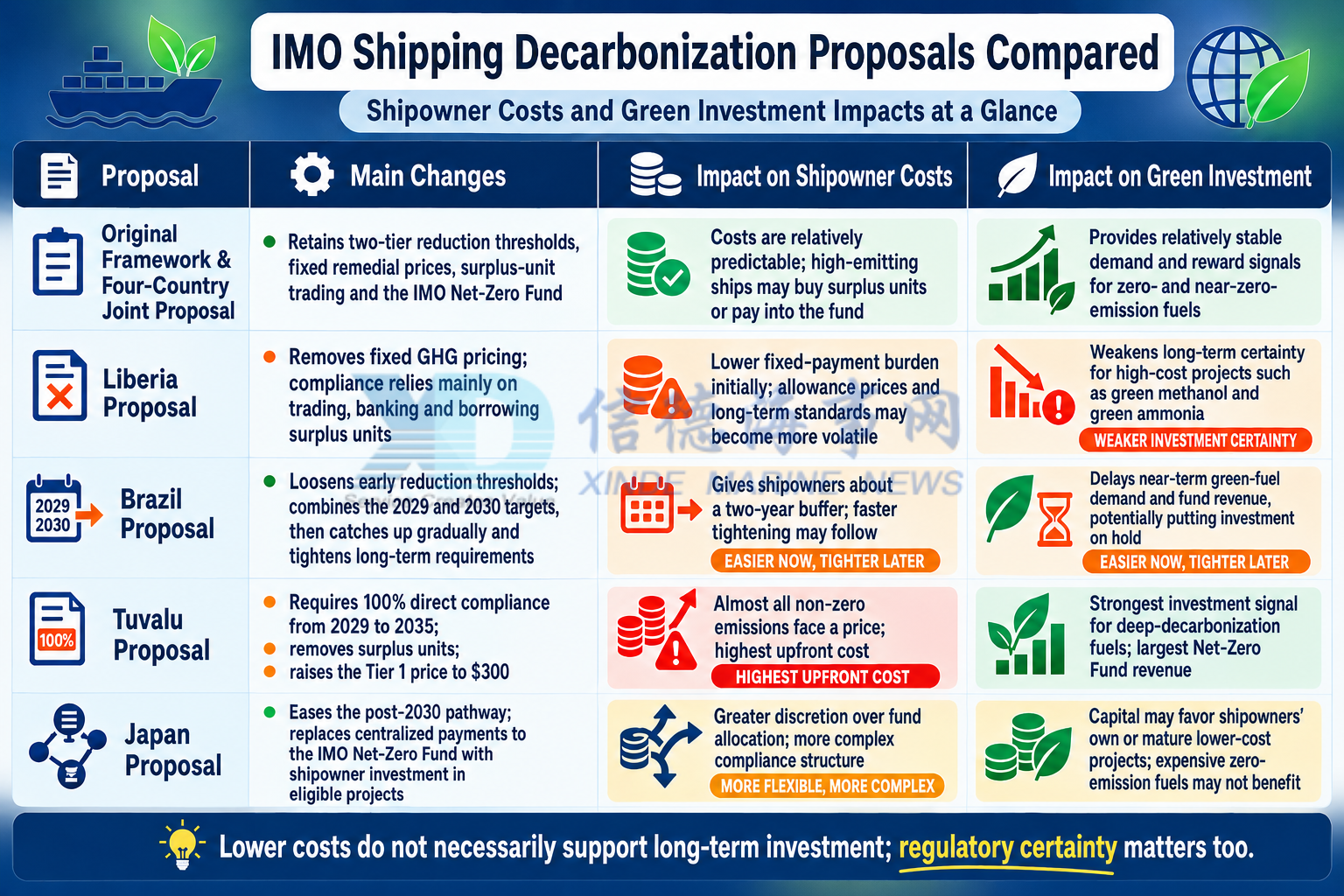
Proposals at a Glance
Liberia: Would Abolishing Fixed Carbon Prices Really Make Compliance Easier?
Liberia’s proposal sits at the more flexible end of the spectrum.
It would remove the fixed GHG remedial prices in the original framework. Ships would no longer be required to purchase remedial units and make corresponding payments into the IMO Net-Zero Fund. Compliance would instead depend primarily on the trading, banking and borrowing of surplus units between vessels.
Future reduction thresholds would also be less closely tied to the IMO’s established 2030 and 2040 checkpoints. They would instead be periodically reassessed against the price, supply, commercial viability and market share of lower-emission fuels.
The immediate attraction for shipowners is clear: fixed payments would fall, the expensive Tier 2 remedial cost could disappear, and existing fleets could receive more time to adjust.
But lower fixed charges would not eliminate risk.
If too few vessels generated surplus units—or if those units became concentrated among a small number of large fleets using lower-carbon fuels—the market price of compliance units could rise rapidly.
Shipowners would then face a different kind of cost. Instead of being clearly defined in the regulation, it would be determined by a market whose future liquidity and transparency remain untested.
The greater concern is the effect on green-fuel investment.
Green methanol and green ammonia projects require long-term and predictable price signals to secure financing. If future reduction standards are repeatedly adjusted according to fuel prices and availability, investors may continue waiting.
That could create a self-reinforcing cycle: green-fuel standards are not tightened because supply remains limited, while producers refuse to invest because the standards are not demanding enough to guarantee demand.
Under this pathway, conventional fuels, LNG, some biofuels and incremental energy-efficiency upgrades could enjoy a longer commercial window. Capital-intensive green ammonia and synthetic-fuel projects, however, could struggle to reach final investment decisions.
Brazil: Breathing Space First, Faster Reductions Later
Brazil would not dismantle the original framework. Instead, it proposes a slower start followed by faster catch-up.
Its central objective is to reduce early compliance pressure.
In 2029 and 2030, the Base Target and Direct Compliance Target would effectively be merged, with reduction levels of approximately 3% and 4%, respectively. The Tier 1 compliance zone between the two thresholds would therefore largely disappear during the first two years.
Shipowners would not need to purchase the original $100-per-tonne Tier 1 remedial units for that part of their compliance deficit.
From 2031 onwards, the two thresholds would separate again and gradually catch up with the original framework. Brazil has also proposed more ambitious longer-term requirements to compensate for the earlier easing.
This approach would give shipowners, fuel suppliers and ports more time to prepare. It could also attract support from governments concerned about excessively high costs during the opening years.
The problem is that near-term demand is precisely what green-fuel developers lack.
If the 2029 and 2030 thresholds remain relatively modest, shipowners may be able to comply through energy-efficiency improvements, limited biofuel blending or purchases of inexpensive surplus units. They may not need to sign long-term green methanol or green ammonia supply agreements immediately.
Demand originally expected to emerge near the end of this decade could therefore be pushed into 2031 and beyond.
For Chinese green-fuel producers, that creates a difficult mismatch. The long-term market may still look enormous, but insufficient near-term offtake would make project financing difficult.
When the regulations eventually tighten, the industry could suddenly discover that certified fuels and bunkering infrastructure are in short supply—driving prices sharply higher.
Tuvalu: The Highest Cost—and the Clearest Investment Signal
Tuvalu represents the most stringent negotiating position.
Its proposal would retain the Base Target but raise the Direct Compliance Target to 100% between 2029 and 2035. In practical terms, only a genuinely zero-emission ship could achieve full direct compliance.
Because conventional vessels would no longer outperform an intermediate threshold and generate surplus units, the existing surplus-unit trading mechanism would be abolished.
Tuvalu would also raise the Tier 1 remedial price from $100 to $300 per tonne of CO₂e, while retaining the Tier 2 price of $380.
This would embed something close to broad carbon pricing within the two-tier structure. As long as a vessel continued producing lifecycle greenhouse gas emissions, it would face a corresponding financial cost.
The consequences would be immediate.
Ships burning conventional fuel would see the fastest increase in operating costs. Methane emissions would become an even more significant issue for LNG. Biofuels delivering only limited lifecycle reductions would also face closer scrutiny.
Green methanol, green ammonia, wind-assisted propulsion and highly efficient vessel designs would gain a much larger relative advantage.
Environmental campaigners estimate that this approach could generate more than $100 billion annually during the 2030s, compared with roughly $10 billion to $12 billion under the original framework.
The higher estimate, however, is an advocacy-group calculation. Its full model and underlying assumptions have not been published in the available material, and it should not be presented as an official IMO forecast.
For shipowners, Tuvalu’s proposal would mean the highest short-term cash cost. For fuel developers and equipment suppliers, it would provide the clearest long-term demand signal.
That is the central tension running through the entire negotiation: reducing the immediate burden on shipowners often weakens incentives for green investment, while strengthening the investment signal inevitably makes transition costs visible sooner.
Japan: Let Shipowners Choose Where the Money Goes
Japan is seeking a compromise between abolishing a central fund and retaining a degree of carbon-price discipline.
Its proposal would ease the post-2030 GFI trajectory and remove the requirement for non-compliant ships to purchase remedial units and make centralised payments into the IMO Net-Zero Fund.
A ship failing to meet the target could instead purchase surplus units generated by other vessels or invest directly in projects recognised by the IMO.
In principle, member states would nominate eligible projects, the IMO would confirm their eligibility, and the relevant flag state would oversee and audit implementation.
Direct contributions could still be calculated using the $100 and $380 price levels, but shipowners would gain much greater control over where the money was invested.
The model could address concerns about the IMO managing a very large international fund. It may also appeal to shipowners seeking to keep compliance capital within the maritime industry.
Corporate investment decisions, however, tend to favour projects that reduce the investor’s own costs or generate a commercial return.
A shipowner might prefer to finance a related fuel project, a vessel retrofit or infrastructure at a frequently used port rather than support maritime-transition programmes in Small Island Developing States with little connection to its own operations.
If LNG, biofuels, efficiency retrofits, green methanol and green ammonia compete for the same pool of direct investment, mature technologies with lower costs and faster returns could enjoy an advantage.
Japan’s proposal may therefore improve corporate flexibility without creating a unified signal in favour of genuinely zero-emission fuels.
The Biggest Risk for Chinese Shipowners Is Cost Uncertainty
The consequences for Chinese shipowners cannot be reduced to the simple formula that stringent proposals are expensive while flexible proposals are cheap.
Tuvalu’s pathway would be costly, but comparatively easy to model: the higher the vessel’s lifecycle emissions, the larger the payment.
Liberia’s proposal appears less demanding but transfers more risk to the market for surplus units. Japan’s approach requires owners to evaluate fuel prices, unit prices, project eligibility and direct-investment returns simultaneously.
Brazil’s proposal reduces early pressure but could produce a much steeper cost curve in the early 2030s.
Chinese shipowners should therefore build at least three compliance scenarios into fleet planning:
-
A strong fixed-carbon-price scenario;
-
An early easing followed by accelerated tightening scenario; and
-
A market-led scenario dominated by surplus-unit trading.
Charter-party clauses will also need to evolve.
Fuel selection, vessel speed, route and cargo load can all affect annual GFI performance. If technical management remains with the owner while commercial operation is controlled by the charterer, contracts must clearly establish who pays for any resulting compliance deficit.
This allocation will need to be addressed across time charters, voyage charters and long-term contracts of affreightment.
Once the system enters into force, the industry’s first major disputes may not concern which green fuel to use. They may concern who is responsible for paying the compliance bill.
For Chinese Shipyards, Optionality May Be More Valuable Than Picking the Winning Fuel
Ships ordered today will operate throughout the 2030s and, in many cases, well into the 2040s.
Decisions now being made about engines, fuel tanks, fuel-supply systems and hull designs will determine whether vessels can adapt when carbon costs rise.
If the final agreement resembles Tuvalu’s proposal or the original Net-Zero Framework, methanol and ammonia readiness, wind-assisted propulsion, shaft generators, highly efficient hull forms and onboard carbon capture could gain substantial commercial value.
A ship capable of meeting the Direct Compliance Target early would not only avoid payments. Depending on the final system, it might also generate revenue through surplus units or command a premium for lower-emission transportation.
If a Liberia- or Japan-style system gains greater support, LNG, biofuels and incremental efficiency retrofits may retain a longer commercial window.
That would not make conventional vessel designs safe again. Regional regulations, particularly in Europe, are continuing to tighten, while the commercial life of an oceangoing vessel commonly exceeds 20 years.
For Chinese shipyards, the more resilient strategy is to turn convertibility, retrofitability and verifiability into genuine product capabilities.
That means preserving multi-fuel interfaces and adequate tank-space options, adopting modular machinery arrangements, and providing owners with lifecycle GFI calculations under different fuel pathways.
Simply adding an “alternative-fuel ready” label to a technical specification will not be enough.
The Green-Fuel Race Will Be Decided by Long-Term Offtake
The greatest obstacle confronting green methanol, green hydrogen and green ammonia projects is often not whether the fuel can be produced. It is whether developers can secure long-term offtake contracts sufficient to support financing.
The original Net-Zero Framework seeks to narrow the cost gap between green and fossil fuels through fixed compliance prices and rewards from the Net-Zero Fund.
If those mechanisms are retained or strengthened, shipowners will have a greater incentive to sign long-term fuel-supply agreements. Ports, in turn, will have more confidence to invest in storage and bunkering infrastructure.
If fixed prices are abolished, reduction thresholds postponed or the central fund weakened, buyers may continue to wait. Without committed buyers, fuel projects will struggle to reach final investment decisions.
For Chinese companies investing in renewable methanol, green ammonia, green hydrogen and port bunkering networks, the proposals imply very different development timelines:
-
Tuvalu’s proposal would provide the strongest support for deep-decarbonisation fuels, but it would also raise shipping costs most quickly.
-
Brazil’s proposal would give the supply side more time to expand, but could create a near-term demand gap.
-
Liberia’s proposal would favour lower-cost fuels and fleets capable of generating surplus units.
-
Japan’s proposal could direct money towards owner-backed fuel, retrofit and port projects, but would increase project-selection and emissions-verification risks.
Fuel certification will be equally important.
If lifecycle accounting, feedstock origin, renewable-power attributes and methane-leakage data are not governed by consistent standards, two fuels carrying the same “methanol” or “ammonia” label could have very different compliance values.
If China wants to become a global hub for green marine fuels, it will be competing on more than production cost. Certification credibility and cross-border traceability will also be decisive.
What China Really Needs Is a Rulebook That Can Support Investment
China is simultaneously a major shipowning nation, the world’s largest shipbuilder and a potential green-fuel production centre.
That places the country on both sides of the transition.
China needs to control the compliance burden on its fleet and export supply chains. At the same time, its shipyards, equipment manufacturers, fuel producers and ports could gain substantially from rising demand for green ships and infrastructure.
Carbon prices that rise too far and too quickly would increase costs for shipowners and cargo interests. Prices that are too low—or too unpredictable—could undermine the competitive advantage created by China’s existing investment in green vessels and alternative fuels.
The priority should therefore extend beyond securing the lowest possible near-term cost. China also needs regulatory certainty.
First, reduction thresholds and pricing mechanisms must give shipowners a long-term boundary against which costs can be modelled.
Second, lifecycle fuel certification and supply-chain tracing must be transparent and consistent, preventing low-quality fuels from receiving an artificial advantage through weak accounting.
Third, whether compliance money is channelled through a central fund or direct investment, it must produce genuine and verifiable emissions reductions while mobilising investment in green fuels, ports and infrastructure in developing countries.
The negotiating timetable is now tight.
According to the IMO’s latest published schedule, intersessional negotiations are scheduled for September 1–4 and November 23–27, 2026.
MEPC 85 will meet from November 30 to December 3, while the adjourned second extraordinary session is scheduled to resume on December 4, subject to confirmation by MEPC 85.
There is little time left to find a compromise.
What shipping lacks is not another polished decarbonisation slogan. It needs a credible rulebook that gives shipowners the confidence to order vessels, fuel producers the confidence to build plants, ports the confidence to invest and banks the confidence to provide financing.
Whatever pathway emerges, the question for Chinese shipping is no longer whether it will bear the cost of transition.
The real question is whether the industry can calculate that cost early enough—and turn it into an entry ticket for the next round of competition in ships, fuels and global supply chains.

READ MORE
 Sustainability
COSCO , CMA CGM and SIPG Join Launch of International Green Shipping Corridor Alliance
 Sustainability
Zero-Emission-Capable Ship Orders Slide as IMO Uncertainty Weighs on 2030 Target
 Sustainability
Fueling Now and the Future: IBIA Hong Kong Forum on Alternative Marine Energy
 Sustainability
Fleet Management Lights Up Anchor Plaza in Blue for World Maritime Day 2026
 Sustainability
WMMF 2026 Promotional Film Debuts in London
 Sustainability
Xinde Marine Forum London 2026: Green Shipping Enters a Strategic Reset
 Sustainability
Shipping Has a Net-Zero Target — but Still Lacks the Rules to Deliver It
 Sustainability
Chimbusco completes first ammonia bunkering operation
 Sustainability
324 days ahead of schedule — another milestone for China’s shipbuilding industry
 Sustainability