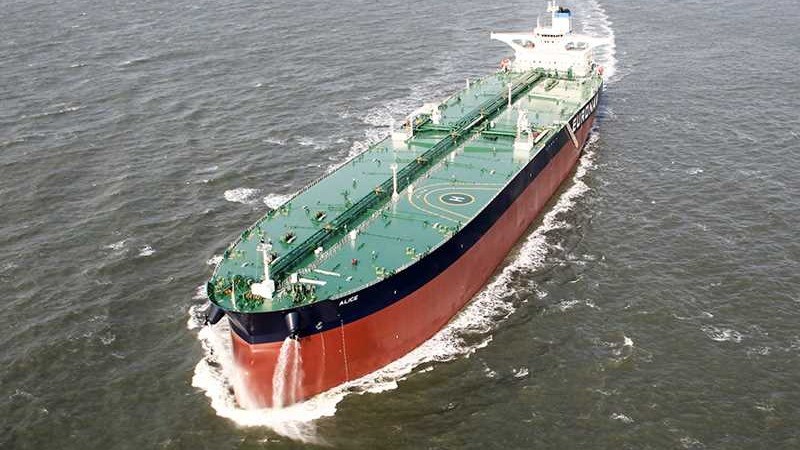


Emarat Maritime Adds Six LR1s as China Newbuilding Programme Reaches 22 Ships


Dubai-based shipowner Emarat Maritime, LLC has expanded its newbuilding programme with six 74,000 dwt LR1 product tankers, taking its planned fleet additions at Chinese shipyards to 22 vessels. Market information links the latest six ships to Jiangsu New Hantong Ship Heavy Industry, with two scheduled for delivery in 2029 and four in 2030.
As of 14 October 2026, the company’s fleet register lists 19 vessels in operation and 22 newbuildings. The programme comprises 12 product tankers, four very large ammonia carriers (VLACs) and six feeder containerships across New Hantong, Hengli Heavy Industries and Hubei Guangji Xinneng Shipbuilding. For an owner whose operating fleet has centred on tankers and dry bulk carriers, the investment combines fleet renewal with expansion into additional shipping markets.

LR1 deliveries extend to 2030
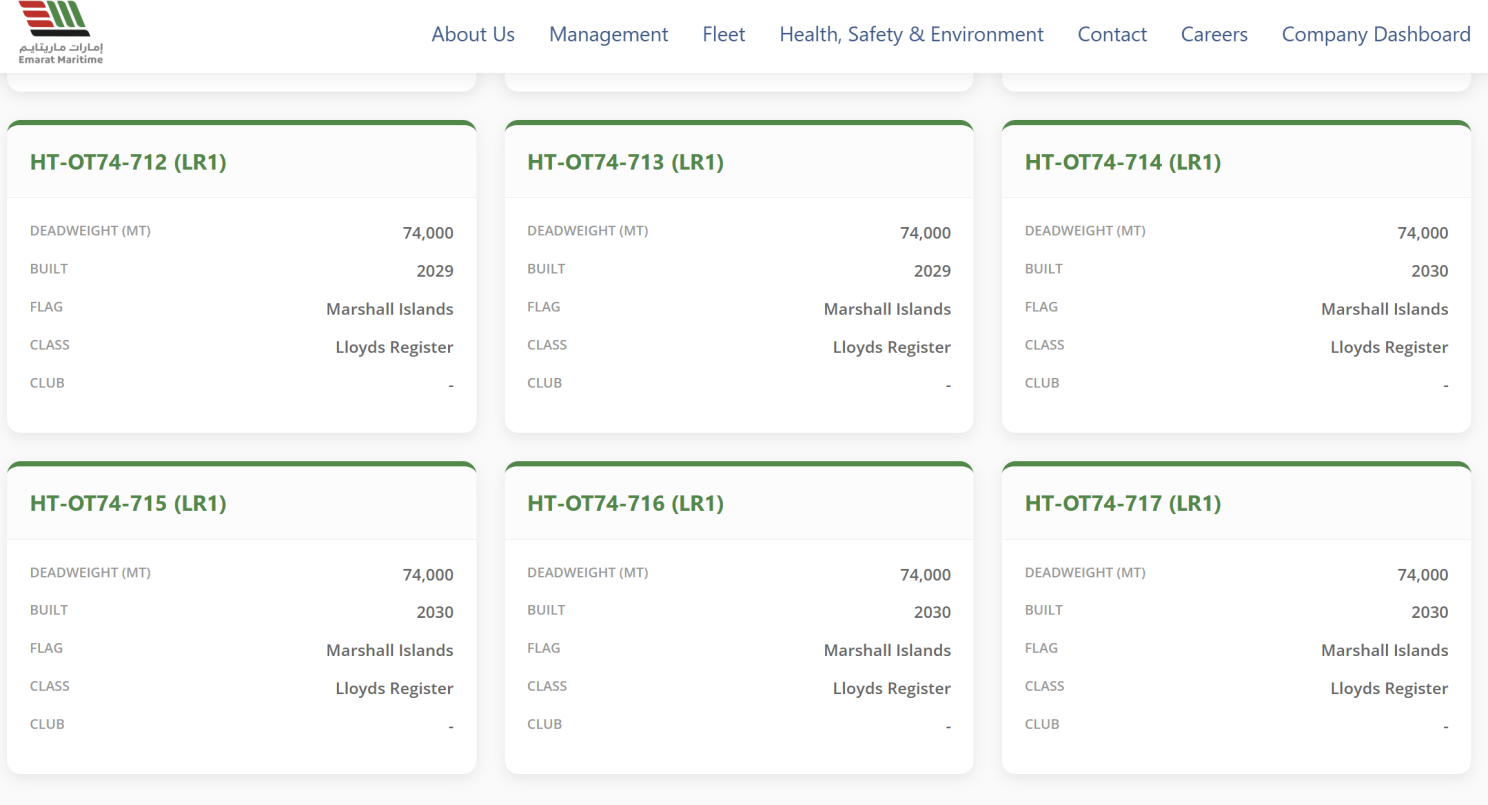
The six new LR1s appear in Emarat’s fleet register under hull numbers HT-OT74-712 to HT-OT74-717. All are listed for Marshall Islands registration and Lloyd’s Register class. Their contract prices have not been disclosed.
Emarat currently operates three LR1 tankers: the 2007-built Dubai Diamond and Dubai Gold, and the 2005-built Dubai Green. These vessels would be approximately 22 to 25 years old during the newbuildings’ scheduled delivery window. The additional ships therefore give the owner scope both to replace ageing tonnage and to expand its presence in the LR1 market.
An established owner backed by Sharaf Group
Established in 1990, Emarat Maritime is part of Dubai-based Sharaf Group, a diversified business that began as a shipping agency in 1968. The group has since expanded into shipping and logistics, supply chain services, retail, travel, financial services and real estate, with operations spanning 69 countries, according to its website.
Emarat operates and manages vessels in worldwide tramp trades, serving international and national oil companies, commodity traders and industrial customers. Its cargoes include energy, food and construction-related commodities. The current fleet consists of nine tankers and ten geared dry bulk carriers. The tanker fleet includes six Aframax/LR2 vessels of approximately 115,000 dwt and three LR1s, while the bulkers range from about 55,000 to 64,400 dwt.
Six bulkers already delivered by New Dayang
Emarat’s recent investment in Chinese newbuildings began before the latest tanker and gas carrier commitments. In 2023, it ordered six Crown 63 version 3.0 bulk carriers from New Dayang Shipbuilding, part of China’s SUMEC Marine. The final vessel, Dubai Sky, was named and delivered on 17 November 2025, completing the series. SUMEC said all six ships were delivered ahead of schedule, with the first five already trading internationally before the final handover.
The project included changes tailored to the owner’s cargo requirements. According to SUMEC, the yard strengthened the cargo hold structure to accommodate steel coils of particular dimensions and installed exhaust gas cleaning systems, alongside other design improvements. These changes connected the newbuilding specification directly to the vessels’ intended employment.
The six approximately 64,400 dwt vessels now account for 60% of Emarat’s operating bulker fleet by number. Its tanker fleet is older: the six Aframax/LR2 vessels were built between 2009 and 2011, while the LR1s date from 2005 and 2007. Following the completed bulker expansion, tanker deliveries are set to become the next major addition to its operating fleet.
Hengli relationship expands from tankers to gas carriers
Hengli Heavy Industries accounts for ten vessels in the current programme: six 114,000 dwt LR2 product tankers and four 93,000 cbm VLACs. Market reports identified Emarat as the owner behind the six-tanker series in November 2025. Its latest fleet register schedules one LR2 for delivery in 2026 and the other five in 2027.
The gas carrier programme developed in two stages during 2026. Market reports indicate that Emarat acquired an initial pair of VLACs in March, taking over vessels previously commissioned by Hengli Group, and added two further ships in April. The four vessels are listed under hull numbers HL-G93K-3 to HL-G93K-6, with two scheduled for delivery in 2027 and two in 2028.
The initial pair formed part of a four-ship VLAC series ordered by Hengli Group from its shipbuilding operation in September 2024 and subsequently resold to overseas owners. Emarat’s participation illustrates how an existing tanker customer became a buyer of another vessel type, first through the acquisition of existing projects and then through a follow-on order.
Emarat lists the four vessels in its LPG/ammonia carrier category. Their delivery will establish a large gas carrier fleet alongside its existing oil and dry bulk operations, requiring the owner to develop the commercial relationships and specialised operating capabilities needed for that market.
Feeder containerships add another business segment
On 12 June 2026, Emarat signed a contract with Hubei Guangji Xinneng Shipbuilding, a state-owned yard in Wuxue, central China’s Hubei province, for three firm feeder containerships plus three options. The ships were described at signing as 900 TEU-class vessels, while the owner’s fleet register gives their capacity as 930 TEU.
The register now includes all six ships, numbered S0001 to S0006, in the newbuilding programme. Four are scheduled for delivery in 2028 and two in 2029, with China Classification Society listed as their classification society. They will add feeder container assets to a fleet previously concentrated on bulk commodities and oil cargoes.
Guangji has also been expanding its international feeder business. On 1 October 2026, a subsidiary of Greek feeder owner Contships Logistics signed a letter of intent with the yard covering up to 30 containerships of around 1,300 TEU. Emarat’s programme is part of the yard’s growing involvement in this vessel segment.
Newbuilding programme and indicative investment
The current programme brings together the following projects, based on Emarat’s fleet register and publicly reported shipyard information.
Vessel type and sizeShipsShipyardScheduled deliveries74,000 dwt LR1 product tankers6Jiangsu New Hantong2 in 2029; 4 in 2030114,000 dwt LR2 product tankers6Hengli Heavy Industries1 in 2026; 5 in 202793,000 cbm VLACs4Hengli Heavy Industries2 in 2027; 2 in 2028930 TEU feeder containerships6Hubei Guangji Xinneng Shipbuilding4 in 2028; 2 in 2029
Market estimates have placed the LR2s at approximately $71.5m each and the VLACs at $105m to $110m per vessel. Comparable LR1 orders at Chinese yards have been reported at around $55m per ship, implying a benchmark value of approximately $330m for the latest six vessels, although Emarat’s actual contract terms remain undisclosed.
Using those figures, the 12 product tankers and four VLACs have a combined indicative value of approximately $1.18bn to $1.20bn, excluding the six containerships. Deliveries are spread across 2026 to 2030, allowing the additional tonnage and new business segments to enter the fleet progressively.
Fleet renewal alongside diversification
The programme addresses two distinct parts of Emarat’s development. The LR1 and LR2 investments provide a route to renew and expand its established tanker business, whose operating vessels were built between 2005 and 2011. The four gas carriers and six containerships extend its investment into markets beyond the tanker and bulker operations on which the company has historically relied.
Its shipyard relationships have developed through different routes. New Dayang delivered a series of bulkers with cargo-specific modifications. Hengli’s relationship expanded across vessel types through resales and follow-on orders. Guangji provides the feeder containership programme, while New Hantong is linked to the latest LR1 series. Together, these projects show an owner assembling its future fleet across several builders and delivery windows.
As the ships enter service, Emarat is set to gain exposure to four shipping segments: dry bulk, oil tankers, gas carriers and containers. Developing employment for the new vessels and the operational expertise to support a broader fleet will become central to that expansion, with the latest LR1 commitments extending its delivery programme through 2030.


READ MORE
 Tankers
Guohang expands Hong Kong platform for tanker and heavy-lift push
 Tankers
A 15-Year-Old VLCC Sells for $161 Million as Tanker Asset Prices Surge
 Tankers
VLCC Benchmark Tops $1 Million a Day: How Are Owners Using the Windfall?
 Tankers
China Merchants Energy Shipping Establishes European Marketing Hub in London to Expand Global Reach
 Tankers
An $81 Million Quote for One Voyage: How Long Can the Tanker Market Frenzy Last?
 Tankers