


VLCC Benchmark Tops $1 Million a Day: How Are Owners Using the Windfall?

VLCC Benchmark Tops $1 Million a Day: How Are Owners Using the Windfall?
Standard Chartered’s analysis finds that around 80% of the companies reviewed are combining investment and shareholder returns with debt repayment or asset disposals.
Tanker earnings have surged since US-Israeli strikes on Iran on 28 February 2026 severely disrupted traffic through the Strait of Hormuz. By 18 September, the Baltic Exchange’s TD3C benchmark for a standard 270,000-tonne voyage from the Middle East Gulf to China implied round-trip time charter equivalent (TCE) earnings of $1.21 million per day.
The benchmark is a route-based market assessment, not a guarantee of what any individual vessel earns. Meanwhile, asset values have also climbed. A five-year-old very large crude carrier (VLCC) was assessed at around $151 million, compared with approximately $130 million for a newbuilding contract, putting immediately available tonnage at a premium to a newly ordered ship.
With earnings and asset values rising sharply, a key question for shipowners is how to deploy the additional cash flow: expand fleets, reward shareholders, repay debt or preserve financial flexibility for the next market downturn?
At Marine Money Week Asia in Singapore on 23 September, Dieu Anh Khuat, Executive Director, Capital Structure & Rating Advisory, ASEAN & South Asia at Standard Chartered, examined how the Middle East conflict was affecting tanker and gas owners’ balance sheets. Her presentation, Navigating the High Seas: Tanker Markets & the Middle East Conflict, highlighted how exposure to spot markets and long-term charters shapes both earnings and capital allocation.
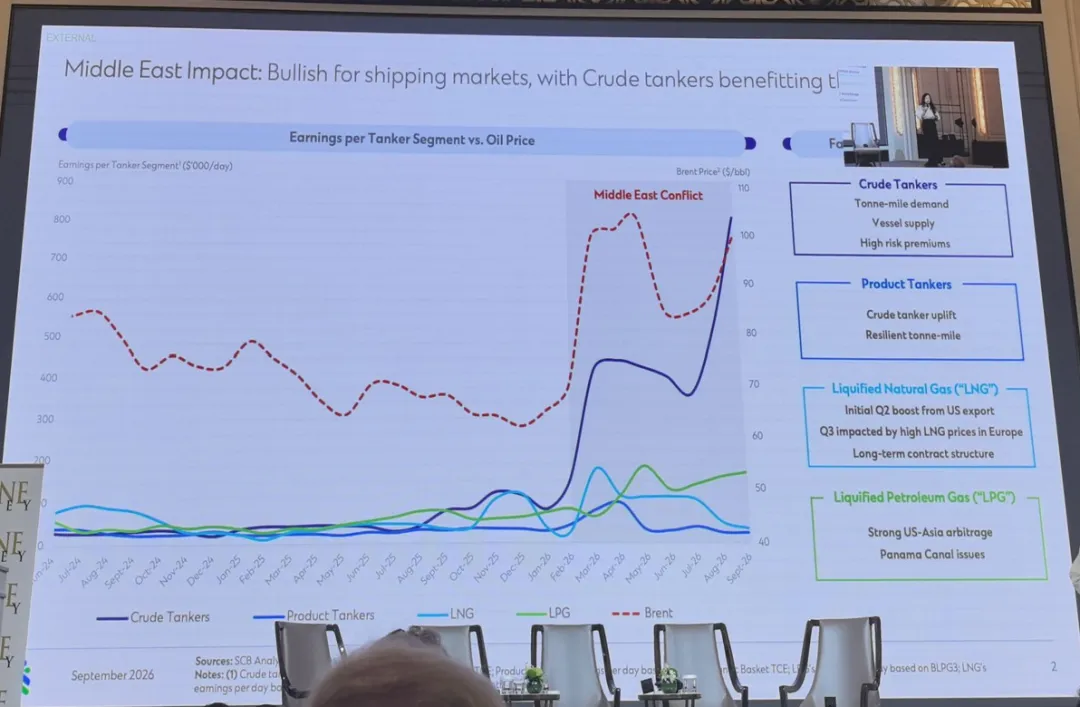
Spot Exposure Drives Upside; Long-Term Charters Provide Visibility
The impact of the market rally varies considerably between companies. Owners with greater spot exposure can capture more of the upside when freight rates surge, while those with larger long-term charter books generally have greater visibility over future cash flows.
Standard Chartered’s review of publicly available information estimated the following spot-market and charter exposure across 19 companies.
| Company | Spot (%) | Charter (%) |
|---|---|---|
| State-linked and diversified owners | ||
| COSCO SHIPPING | 50 | 50 |
| ADNOC Logistics & Services | 58 | 42 |
| MISC Berhad | 31 | 69 |
| Bahri | 76 | 24 |
| Nakilat | 13 | 87 |
| ASYAD | 16 | 84 |
| Crude and product tankers | ||
| Frontline | 93 | 7 |
| Hafnia | 90 | 10 |
| CMB.TECH | 80 | 20 |
| International Seaways | 84 | 16 |
| Scorpio Tankers | 70 | 30 |
| DHT Holdings | 53 | 47 |
| TORM | 35 | 65 |
| Teekay Tankers | 96 | 4 |
| LNG | ||
| FLEX LNG | 22 | 78 |
| Capital Clean Energy Carriers | 8 | 92 |
| LPG | ||
| BW LPG | 60 | 40 |
| Dorian LPG | 81 | 19 |
| Navigator Gas | 55 | 45 |
Note: Spot and charter exposure figures are estimates based on publicly available information. They are not necessarily equivalent to each company’s share of revenue, earnings or fleet capacity.
For spot-oriented owners, the rally creates an opportunity to reinvest in vessels, strengthen balance sheets and return cash to shareholders. Long-term charter-oriented companies may capture less of the immediate spot-market upside, but contracted earnings can provide a foundation for investment and financing decisions.
Recent company results illustrate the different approaches.
Frontline reported a profit of $559.1 million in the first quarter of 2026. Its adjusted profit was $344.9 million, the strongest since the fourth quarter of 2004. It declared a dividend of $1.55 per share for the quarter. In the second quarter, reported profit reached $659.2 million, adjusted profit hit a record $580.2 million, and the dividend was $2.61 per share.
Hafnia also returned substantial cash to shareholders, distributing $143.8 million in dividends for the first quarter, equivalent to an 80% payout ratio. Its second-quarter distribution rose to $250 million, representing a 90% payout ratio.
Investment activity has been equally striking. By 26 January, Sinokor had been involved in 35 of the 45 reported VLCC sale-and-purchase deals recorded in 2026 to that point, accounting for 78% of transaction volume. MSC’s planned investment in Sinokor subsequently received regulatory approval in June. During the regional crisis, ADNOC also chartered around 25 crude tankers from Sinokor, including vessels used for shuttle operations within the Strait of Hormuz.
BW LPG offers another example of capital allocation under strong market conditions. In the first half of 2026, the company generated $346.7 million in adjusted free cash flow, up 106% year on year, while capital expenditure was $24.7 million. It reported $120 million in profit attributable to shareholders for the second quarter and declared a dividend of $0.95 per share, equivalent to 100% of the quarter’s shipping net profit after tax.
Bahri, meanwhile, combined fleet expansion with balance-sheet improvement. Its first-half net profit reached SAR 4.90 billion. Net debt fell 34% year on year to SAR 6.62 billion, and its net debt-to-EBITDA ratio stood at 0.72 times at the end of June. The company acquired five IMO 2 MR chemical tankers and sold an older VLCC, bringing its owned fleet to 107 vessels.
China Merchants Energy Shipping reported first-half net profit attributable to shareholders of RMB 6.96 billion and announced an interim dividend plan in late August.
Around 80% Are Combining Investment with Financial Discipline
Beyond individual company decisions, Standard Chartered identified a broader pattern in its analysis: around 80% of the companies reviewed were balancing investment and shareholder returns with debt repayment or asset disposals.
The analysis grouped capital allocation into four broad categories: investment, shareholder returns, debt repayment and asset disposals. Asset sales are not strictly a use of cash; they generate proceeds and form part of capital recycling.
The finding suggests that strong earnings have not simply prompted a spending spree. Many owners are using the additional cash flow to pursue growth while also reducing financial risk or recycling capital from existing assets.
The balance differs by business model. Spot-oriented owners have generally prioritised investment and debt repayment, with some also increasing shareholder returns. Companies with greater long-term charter exposure have used the visibility of contracted cash flows to support investment decisions.
These strategies are not mutually exclusive. The central issue is whether owners can capture the upside of a strong market without weakening their balance sheets or committing too much capital at elevated asset prices.
Most Owners Retain Substantial Liquidity
Standard Chartered’s analysis also pointed to ample liquidity across the companies reviewed. Its model estimated that the sector’s liquidity requirements for 2026 amounted to only around one-quarter of available liquidity, implying coverage of roughly four times.
Most companies in the sample had net leverage below two times. Under a scenario in which the conflict persisted through the end of 2026 and into early 2027, the analysis projected that only around two companies would move into a more pressured zone.
Product tanker owners appeared particularly well positioned. Their available liquidity was estimated at approximately 6.7 times their modelled requirements, reflecting both strong earnings potential and substantial financial capacity.
LPG and other energy-related shipping companies may have more room to reinforce their liquidity buffers. However, many also benefit from long-term contracts that provide greater visibility over cash flows and flexibility in managing market volatility.
These figures are model-based assessments rather than guarantees. Actual liquidity and leverage will depend on how long the disruption lasts, how freight markets evolve and how individual companies deploy their cash.
The broader message is that exceptional earnings create an opportunity, but do not by themselves guarantee long-term value. Owners can use the windfall to expand fleets and reward shareholders, while also reducing debt, recycling assets and maintaining liquidity.
A strong market is not only a time to spend; it is also a time to optimise. Companies that use the current upswing to strengthen their balance sheets and preserve strategic flexibility will be better positioned when market conditions eventually turn.

READ MORE
 Tankers
From Dubai Property to Tankers: TOP Ships Signs Four-Ship GSI Deal
 Tankers
Two Voyages Pay for a New VLCC?
 Tankers
4 Delivered, 4 More Ordered: Schoeller Returns to Chengxi for MR Tankers
 Tankers
An $81 Million Quote for One Voyage: How Long Can the Tanker Market Frenzy Last?
 Tankers
Tianjin Southwest Maritime Chairman Liu Jichun Targets Asphalt Tanker Owner Xin Yuan
 Tankers
US Sanctions 17 Ships in Iran Crackdown, Naming China-Linked Owners
 Tankers
PIF Energy Plans $2 Billion VLCC Fleet for Gulf Crude Trade
 Tankers
TOP Ships’ Four-Tanker Deal Links Chinese Leasing With Long-Term Charters
 Tankers
“We Have Become a Security Company”: Shipping’s Painful Supercycle
 Tankers