


Two Voyages Pay for a New VLCC?
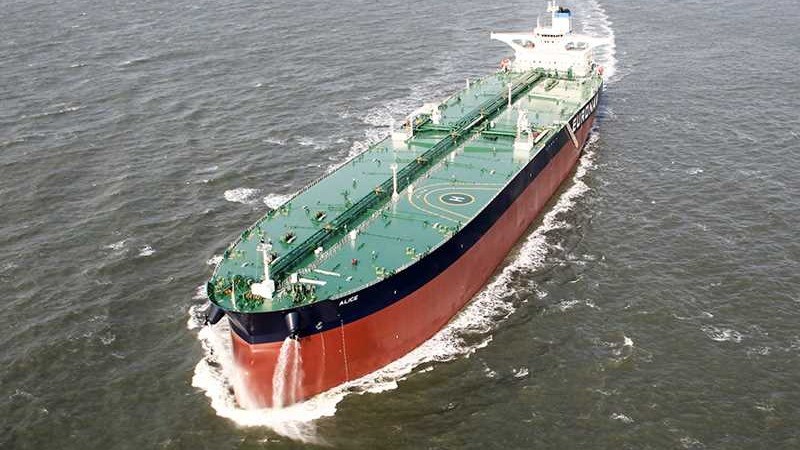

VLCC freight from the US Gulf to Asia has reached a level at which the earnings from two round voyages can be compared with the price of a new ship. An $81 million freight quote has emerged for a single cargo, while the Baltic Exchange’s US Gulf–China time charter equivalent assessment reached $637,675 per day on 8 October.
For an owner trading its own VLCC, two approximately 110-day round voyages at that TCE would generate about $138.6 million after voyage expenses and the Baltic’s benchmark daily operating costs. That exceeds the $125.875 million VLCC newbuilding price indicator displayed on 9 October. Using a higher operating cost assumption of $10,000 per day, reflecting industry feedback, the estimate remains about $138.1 million. Both calculations assume that the ship secures the same TCE on its second voyage.

Asian crude buying, longer routes around Africa and transshipment near the Strait of Hormuz are increasing demand for tanker time while slowing the return of ships to the chartering market. Their combined effect is being felt across freight rates, vessel earnings and the price of immediately available tonnage.
Two round voyages: approximately $138 million after operating costs
The calculation starts with the Baltic’s TD22 US Gulf–China TCE of $637,675 per day. TCE expresses freight earnings after voyage expenses, including bunkers, port charges and commissions, divided by the voyage’s duration. Routine vessel operating expenses—such as crew wages, conventional marine insurance, maintenance and spares—still have to be paid.

Using the Baltic’s published VLCC OPEX assessment of $7,796 per day gives:
$637,675 − $7,796 = $629,879 per day after routine OPEX.
The voyage estimate assumes an average speed of 12.5 knots via the Cape of Good Hope. Including the ballast passage from China to the US Gulf, the laden return passage, cargo handling and an allowance for waiting gives a rough round-voyage duration of 110 days. On that assumption, the earnings calculation is:
$629,879 × 110 days = $69,286,690 per round voyage.
$629,879 × 220 days = $138,573,380 across two round voyages.
Two such voyages would occupy the vessel for slightly more than seven months. The resulting $138.6 million exceeds the $125.875 million newbuilding indicator by approximately $12.7 million, or 10.1%.
Industry participants consider the Baltic OPEX assessment low and suggest budgeting at least $10,000 per day under current conditions. At that level, earnings after routine OPEX would be $627,675 per day, or $138,088,500 over 220 days—approximately $12.2 million above the newbuilding indicator.
Financing interest, corporate overheads, taxes and additional dry-docking expenditure would still need to be paid from these earnings. Loan principal repayments also affect the cash an owner can allocate to another vessel. Accounting net profit would require a deduction for depreciation, although depreciation itself creates no current cash outflow. Actual results would also depend on the vessel’s speed, fuel consumption, waiting time and operating costs.
An $81 million quote for a November cargo
Argus market reporting on 7 October showed a charterer placing a Sinokor-owned VLCC on subjects at $81 million lumpsum for a US Gulf–Asia-Pacific voyage loading in late November. It was the highest rate recorded on the route since Argus began assessing it in 2017. The fixture remained subject to the outstanding conditions being lifted.
CNBC reported on the same day, citing a source familiar with the transaction, that Trafigura had chartered the Alexandros for $76 million to carry crude from the US Gulf Coast to China, with loading expected around 19 November. The report put typical pre-war freight on the route at $7 million–$10 million. For a cargo of two million barrels, the reported $76 million freight bill works out at $38 per barrel.
Argus also reported a Sea Jade VLCC placed on subjects at $77 million for a US Gulf–South Korea voyage loading in early November. Together, the reports cover loading windows from early to late November, showing charterers competing for vessels well ahead of the cargo dates. Refiners seeking reliable crude arrivals have to arrange shipping alongside their purchases, particularly when suitably positioned ships are scarce.
Composite VLCC TCE approaches $938,000 per day
The Baltic’s composite VLCC TCE reached $937,767 per day on 8 October, up another $14,039 from the previous assessment. Route assessments included $1,412,594 per day for Middle East Gulf–China TD3C, $763,031 for West Africa–China TD15, $912,660 for Gulf of Oman–China TD34 and $637,675 for US Gulf–China TD22.
The TD22 lumpsum freight assessment for a 270,000-tonne cargo reached $79,611,111, equivalent to $294.86 per tonne and an increase of approximately $2.61 million from the previous day. Elevated freight across the US Gulf, West Africa and Middle Eastern loading areas means that Asian buyers seeking alternative crude supplies also face expensive shipping from those origins.
Asian buying shifts demand back toward VLCCs
According to Argus, renewed Chinese crude restocking demand has strengthened since late September. With crude transportation from the Middle East Gulf disrupted, refiners have sought additional feedstock to sustain production and meet Asia-Pacific demand for refined products. Increased purchases from distant suppliers such as the US Gulf require each cargo to occupy a tanker for longer, adding pressure to the Atlantic chartering market.
Demand has also moved between tanker sizes. Aframax and Suezmax vessels initially attracted more cargoes, and their freight rates reached successive records. Argus reported that only three VLCCs entered the fixing process for US Gulf loadings in the second half of September, while demand for smaller tankers increased. As smaller-vessel freight rose, their cost advantage over VLCCs narrowed, bringing some cargo demand back to large tankers and adding to an already tight market.
Detours and transshipment keep ships occupied
Changes in voyage duration are directly reducing the fleet’s available transport capacity. Argus reported a $73.9 million lumpsum charter for DHT Opal on 7 October, covering a Yanbu–South Korea cargo loading in late October. For the planned voyage, Red Sea security risks require the vessel to sail north through the Suez Canal, cross the Mediterranean westwards and then round southern Africa before proceeding to Asia.
The usual passage via Bab el-Mandeb takes approximately 23 days. The alternative route takes more than 50 days, adding roughly a month to the laden leg. Citing Vortexa, Argus reported that 29 VLCCs were using routes avoiding Bab el-Mandeb as of 7 October to transport Saudi crude from Yanbu or Egypt’s Sidi Kerir to Asia-Pacific destinations. Sidi Kerir is an important loading point for crude exported through the SUMED pipeline. These arrangements help maintain crude deliveries while keeping vessels occupied for longer.
Shuttle movements and ship-to-ship transfers around the Strait of Hormuz also require additional ships. Under some arrangements, one tanker carries crude through the strait and transfers it in the Gulf of Oman to another vessel for the onward voyage to Asia. Connecting schedules, transfer operations and waiting consume vessel time. With more VLCCs committed to these regional movements, fewer can reposition promptly to the US Gulf or West Africa, transmitting the effects of Middle Eastern disruption into the wider tanker market.
Sinokor’s fleet expansion and MSC’s involvement
The Sinokor-owned vessel linked to the $81 million quote follows a substantial expansion of the South Korean group’s VLCC exposure earlier this year. Xinde Marine previously reported how Sinokor used both secondhand purchases and time charters to secure close to 30 VLCCs. The acquisitions included eight Frontline vessels built in 2015–2016. Frontline’s announcement on 8 January confirmed an aggregate sale price of $831.5 million for the eight ships.
MSC has also moved into the business. On 4 June, the Hellenic Competition Commission approved a transaction changing control of Sinokor Maritime from sole control by Ga-Hyun Chung to joint control with SAS Shipping Agencies Services, an MSC Group subsidiary. The regulator identified Sinokor Maritime’s activities as liquid bulk shipping, particularly VLCC transportation. With expensive cargoes now entering the market, operators that secured vessels earlier have the capacity to compete for those fixtures when their ships can meet the required loading windows.
Immediately available ships command a premium
The strength of spot earnings is also reflected in vessel asset indicators. The Baltic figures displayed on 9 October valued a five-year-old VLCC at $182.5 million and a ten-year-old ship at $156.619 million, compared with $125.875 million for a newbuilding. The five-year-old value was approximately 45% above the newbuilding indicator, while even the ten-year-old assessment was substantially higher.
Existing ships can enter service much sooner and earn freight in the current market; newbuildings require time for construction and delivery. When charterers are competing for prompt capacity, the date on which a vessel becomes available carries considerable commercial value. The Baltic’s five-year time charter indicator of $71,833 per day also shows the substantial gap between current spot earnings and longer-term contracted hire.
Whether an owner can repeat the two-voyage earnings calculation will depend on the rate secured for the second cargo. Asian buying patterns, shipping arrangements through Hormuz and the extent of Red Sea diversions will continue to shape demand and vessel availability. Shorter routes, less transfer-related waiting and faster returns to loading areas could release substantial capacity from the existing fleet, changing the prices charterers face when they next seek a ship.


READ MORE
 Tankers
Tianjin Southwest Maritime Chairman Liu Jichun Targets Asphalt Tanker Owner Xin Yuan
 Tankers
US Sanctions 17 Ships in Iran Crackdown, Naming China-Linked Owners
 Tankers
PIF Energy Plans $2 Billion VLCC Fleet for Gulf Crude Trade
 Tankers
4 Delivered, 4 More Ordered: Schoeller Returns to Chengxi for MR Tankers
 Tankers
TOP Ships’ Four-Tanker Deal Links Chinese Leasing With Long-Term Charters
 Tankers
“We Have Become a Security Company”: Shipping’s Painful Supercycle
 Tankers
Tanker Captains Paid Up to $100,000 a Month—Plus $50,000 per Voyage
 Tankers
As Erasmus Targets 100 Ships, John Su Keeps Returning to Survival
 Tankers
Oil Majors Are Eyeing Ships Delivering in 2030. What Are They Worried About?
 Tankers