

Xinde Marine Forum London 2026: Shipping Moves from Lean Logistics to Resilience by Design
Walter (宏利)
Published 17:12

Geopolitical conflict, sanctions, canal restrictions and policy intervention are turning resilience from a crisis response into a permanent commercial requirement, speakers at the Xinde Marine Forum London 2026 said.

The global shipping industry has spent decades optimising for efficiency. Cargo was expected to move through predictable routes, inventories were kept lean and supply chains were designed around just-in-time delivery.

That operating model is being reassessed.

At the Xinde Marine Forum London 2026, held at the Four Seasons Hotel London at Tower Bridge on 16 September under the theme Shipping in Transition: Resilience, Risk and Repricing, industry leaders examined how shipping is adapting to a world in which geopolitical and regulatory disruptions have become structural rather than exceptional.

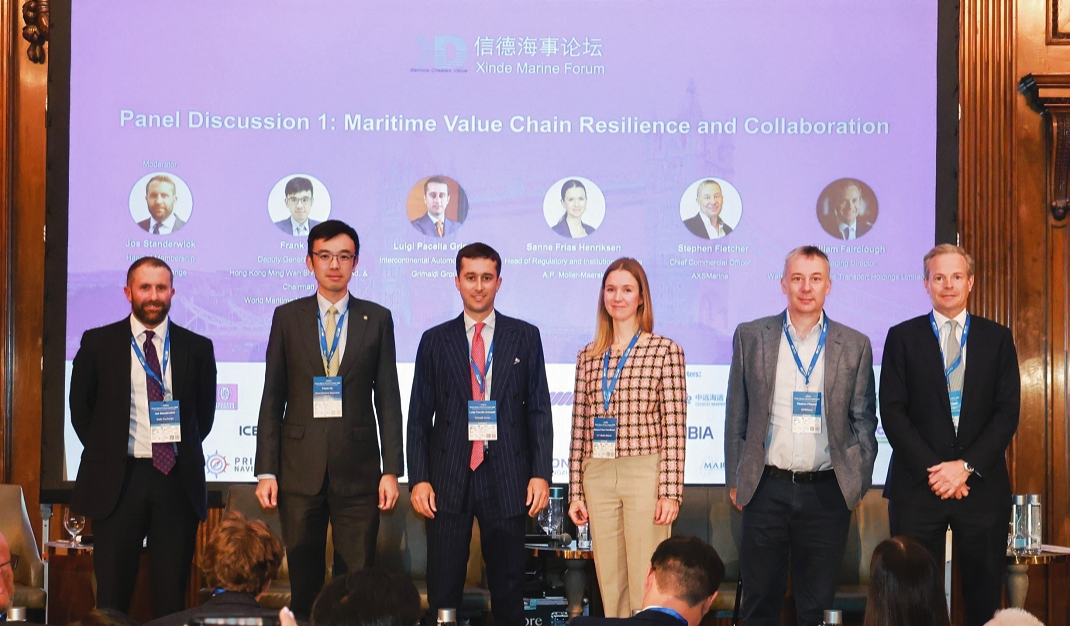
The first panel, titled Maritime Value Chain Resilience and Collaboration, was moderated by Jos Standerwick, Head of Membership at the Baltic Exchange.

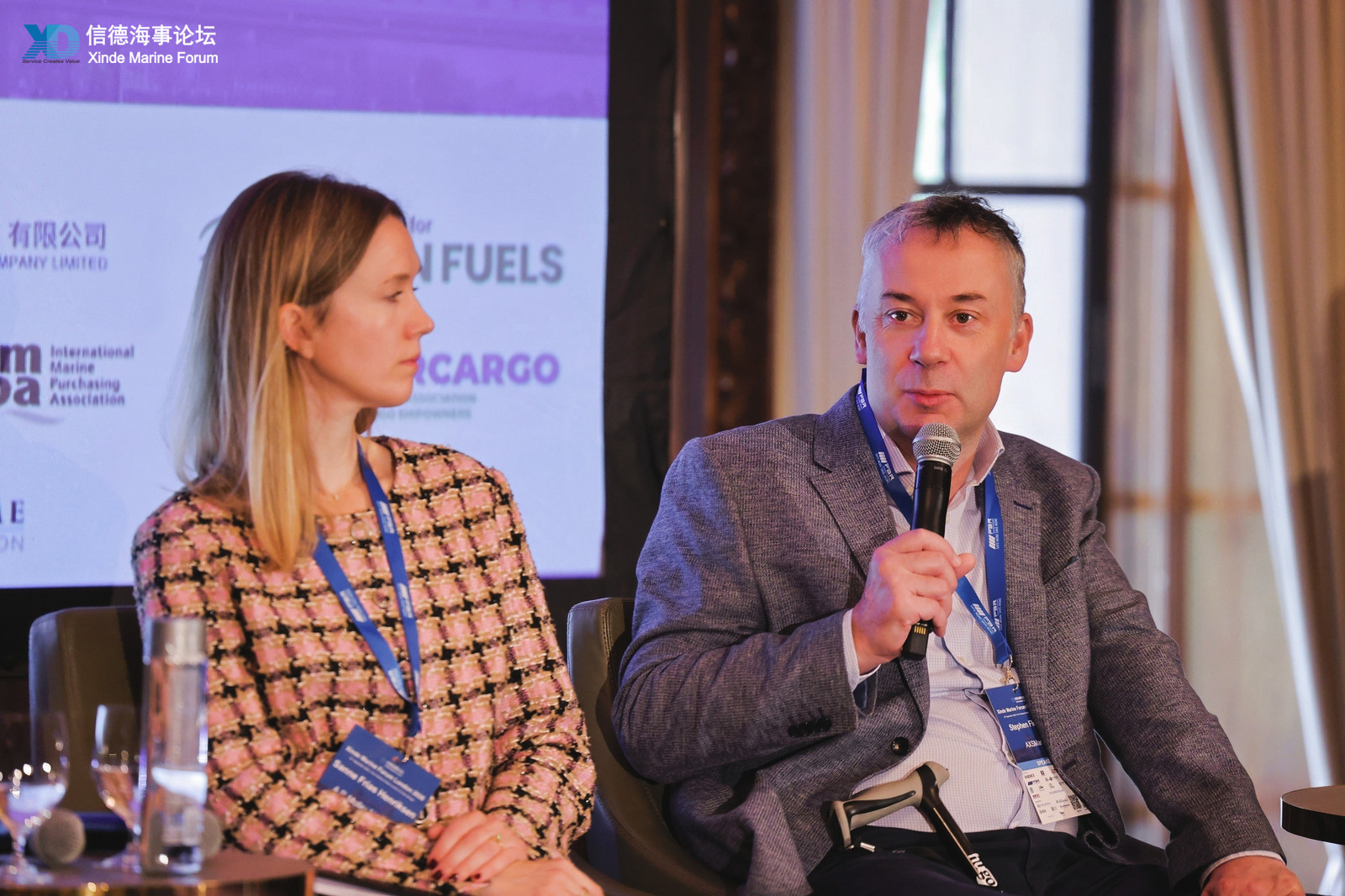
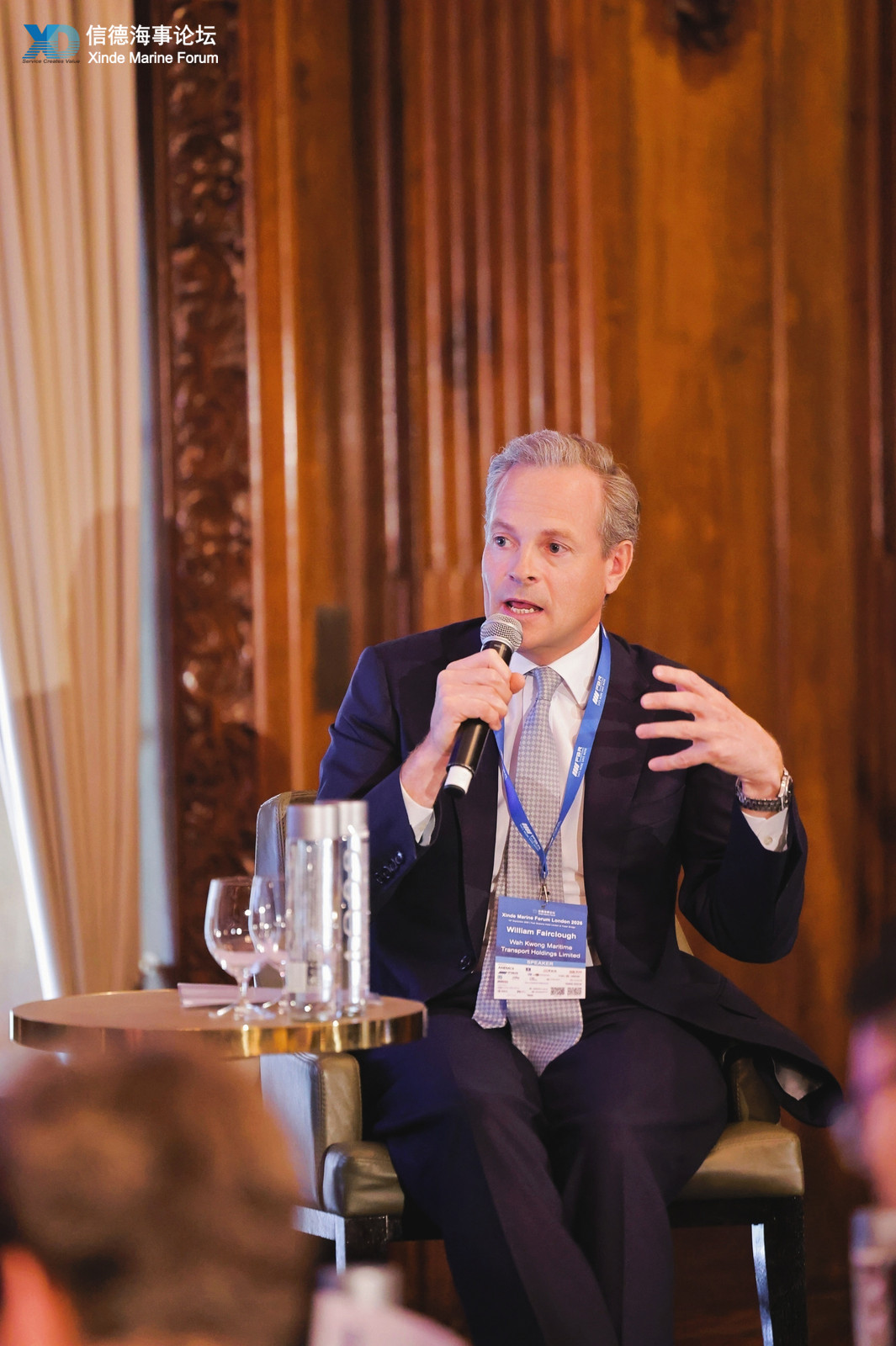
The participants were Frank He, representing Hong Kong Ming Wah Shipping and the World Maritime Merchants Forum; Luigi Pacella Grimaldi of the Grimaldi Group; Sanne Frias Henriksen of A.P. Moller–Maersk; Stephen Fletcher of AXSMarine; and William Fairclough of Wah Kwong Maritime Transport Holdings.

Their discussion produced a clear conclusion: shipping has not abandoned efficiency, but efficiency alone is no longer sufficient. Companies must now decide how much redundancy, alternative routing, data-sharing capability and financial protection they are prepared to maintain in order to keep cargo moving when normal conditions fail.

Frank He: Lean supply chains are being replaced by resilience

Frank He said the language of logistics has changed significantly.

When he noticed logistics, the emphasis was on lean supply chains, door-to-door efficiency and the assumption that globalisation would continue with limited interruption. Today, companies are increasingly discussing resilience, strategic storage and the cost of losing confidence in transport links.

The change reflects the cumulative effect of the Covid-19 pandemic, canal restrictions, armed conflicts, sanctions and regional policy differences.

In a lean system, the objective is to remove spare capacity and minimise inventory. That can reduce costs during stable periods, but it also leaves less room to absorb disruption. When a route closes or a port becomes inaccessible, cargo owners may have to pay for longer voyages, alternative transport modes, additional inventory and higher insurance premiums.

He also highlighted the growing visibility of marine insurance.

When a shipment is delayed, rerouted or exposed to a war-risk area, the cost does not remain with the shipowner. It can spread across the vessel operator, charterer, cargo owner, insurer, logistics provider and, eventually, the consumer.

That does not mean that every company should build unlimited redundancy into its network. Resilience has a cost, and the commercial challenge is to decide which risks justify paying for additional routes, inventory, insurance or capacity.

Luigi Pacella Grimaldi: Vehicle logistics shows why the whole chain matters

Luigi Pacella Grimaldi argued that disruption should be anticipated rather than addressed only after it occurs.

The automotive sector provides a useful example. Vehicle logistics depends not only on ships but also on terminals, inland transport, production schedules, distribution networks and the location of manufacturing facilities.

A disruption affecting one part of the system can therefore create consequences across the entire chain. A shortage of vehicle-carrying capacity, for example, may be aggravated by terminal congestion or a mismatch between vessel arrivals and factory production schedules.

Grimaldi also noted that tariff changes do not always produce a simple decline in global trade. A reduction in one trade lane may be offset by new export flows from another region.

Chinese vehicle exports have created significant additional demand for pure car and truck carrier capacity. This illustrates how trade policy, production geography and shipping demand can interact in unexpected ways.

For shipping companies, the implication is that geopolitical analysis cannot be separated from cargo analysis. Understanding where products are manufactured, where sourcing is changing and how tariffs influence trade flows may be as important as monitoring vessel supply.

For ports and logistics providers, resilience means connecting maritime capacity with inland transport, storage and distribution rather than treating the port as an isolated asset.

Sanne Frias Henriksen: Volatility is becoming structural

Sanne Frias Henriksen said volatility is increasingly becoming a permanent condition for shipping.

When conflict affects a region, the immediate priorities are the safety of people, the security of assets and the continuity of customer supply chains. During recent disruption in the Gulf, Maersk had to protect employees and facilities, reroute cargo and use alternative modes and corridors.

She said tens of thousands of containers were affected, although most were ultimately delivered through operational flexibility and coordination with authorities and customers.

The example illustrates an important distinction between resilience and simple disruption avoidance. Shipping companies cannot prevent every geopolitical event, but they can improve their ability to respond by maintaining alternative routes, communicating rapidly with customers and working with governments.

Henriksen also emphasised the importance of timely official information. Companies may have vessels, terminals and logistics partners ready to respond, but decisions become more difficult when government guidance is delayed, inconsistent or unclear.

The same issue applies to longer-term investment.

Companies can invest in shore power, vessel efficiency, alternative fuels and digital systems when regulatory direction, standards and implementation timelines are understandable. When policy signals remain uncertain, even technically available solutions may not attract sufficient capital.

This is particularly important for decarbonisation. Shipowners are being asked to invest in assets that may operate for decades, while the availability of future fuels, infrastructure and compliance mechanisms remains uncertain.

Stephen Fletcher: The data exists, but the system is fragmented

Stephen Fletcher focused on one of the less visible weaknesses in the maritime value chain: the limited and inconsistent exchange of operational data.

Commercial companies already exchange the information they need to trade. Brokers, shipowners and market participants in dry bulk and tanker markets have developed effective information networks.

Container shipping is different in scale and structure. Millions of containers move through complex schedules involving carriers, terminals, ports, cargo owners, inland operators and customs authorities. Yet these participants do not always receive timely, standardised operational data.

Information about vessel arrivals, berth availability, equipment, cargo release and inland connections may exist in different systems, formats and commercial environments. The problem is therefore not only whether data is available, but whether it can be shared and used in time.

Industry initiatives such as the Digital Container Shipping Association have developed common standards. Adoption, however, remains uneven.

Fletcher said technology is not necessarily the principal obstacle. Commercial sensitivity, implementation costs and uncertainty over who benefits from data-sharing systems can be more important barriers.

This has direct consequences for resilience.

During a disruption, a company with accurate and timely information can reroute cargo, adjust inventory, change transport modes or warn customers earlier. A company receiving fragmented or delayed information may only discover the impact after congestion, missed connections or additional charges have already occurred.

Data-sharing arrangements will therefore become part of the commercial infrastructure of resilience. They will need to address not only technical standards, but also confidentiality, liability, data ownership and incentives for participation.

William Fairclough: Markets create flexibility, but cannot solve everything

William Fairclough said shipping has adapted to extraordinary physical and political disruption, including restrictions affecting the Panama Canal, reduced traffic through the Suez route, sanctions and the redirection of Russian energy flows.

The market has responded through thousands of individual commercial decisions. Ships have changed routes, cargoes have been redirected, new suppliers have emerged and freight rates have adjusted to reflect scarcity and risk.

Those price signals are important. They help determine whether a longer voyage, an alternative port or a different source of cargo is commercially viable.

Fairclough warned against assuming that industry associations should replace the market by attempting to set freight rates or dictate commercial outcomes.

At the same time, he argued that the market cannot solve every collective problem.

Decarbonisation, data standards, safety rules and infrastructure development often require common frameworks, finance and coordination. Individual companies may have no incentive to invest in systems whose benefits are shared across the industry.

This distinction is increasingly important. Markets are effective at reallocating vessels and cargo when prices change. They are less effective at building a common data architecture, establishing global safety standards or coordinating infrastructure investment across jurisdictions.

Shipping therefore needs both commercial flexibility and institutional cooperation.

Frank He and Sanne Frias Henriksen: Government policy must become more predictable

The panel also considered the changing role of governments.

Sanctions, tariffs, maritime security decisions and climate regulation now have a direct effect on vessel deployment, cargo flows, freight costs and asset values.

Henriksen said communication with governments is essential during an immediate crisis. Over the longer term, however, authorities create resilience by establishing stable and understandable frameworks.

Shore power was cited as an example. Shipowners and ports may be prepared to invest in the technology, but the business case depends on clear technical standards, port requirements, electricity availability and a reasonable implementation timetable.

The same applies to decarbonisation. Shipowners cannot make rational investment decisions if fuel standards, economic measures and regional rules change faster than assets can be designed, financed and delivered.

Frank He added that the relationship between shipowners and insurers also needs to become more transparent.

Underwriters are now assessing unfamiliar vessel types, alternative fuels, batteries, new cargo configurations, sanctions exposure and rapidly changing trading patterns. If insurers do not fully understand the operation, pricing may become more conservative or inconsistent.

Owners, in turn, need to provide better technical and operational information. The quality of information available to insurers can influence not only premiums, but also whether a particular trade remains commercially viable.

The China dimension: resilience requires connectivity

The panel’s conclusions have direct implications for China’s maritime economy.

China is a major shipowning and shipbuilding country, the world’s largest manufacturing base and home to several of the most important ports in global trade. Chinese exporters and manufacturers are therefore exposed to the full range of risks discussed in London, from route disruption and sanctions to higher insurance costs and shifting tariff regimes.

For Chinese ports, resilience will increasingly depend on their ability to connect maritime operations with inland rail, road, warehouses, customs systems and cargo-owner planning.

For Chinese shipowners, route flexibility and accurate information may become as important as fleet size. Vessels capable of switching between routes, ports or cargoes can have greater strategic value during periods of disruption.

For shipyards and equipment suppliers, the market opportunity extends beyond building larger or more fuel-efficient ships. Owners will also require systems that improve visibility, optimise voyages, manage compliance and support alternative operating arrangements.

For cargo owners, the traditional focus on the lowest freight rate may need to be balanced against reliability, route diversity and the ability to secure capacity during a disruption.

For insurers, banks and other financial institutions, resilience will increasingly become part of credit and risk assessment. A company’s ability to maintain liquidity, protect data, access alternative routes and communicate with counterparties may influence financing terms alongside vessel values and freight earnings.

Resilience is becoming a commercial capability

The first panel at the Xinde Marine Forum London 2026 did not suggest that shipping should abandon efficiency.

Rather, it showed that the meaning of efficiency is changing.

A supply chain that minimises every spare day, route and inventory unit may appear efficient in stable conditions but become extremely expensive when disruption occurs. A more resilient system may carry higher routine costs, but it can preserve service continuity and protect relationships when markets are under stress.

The most effective companies will not simply accumulate spare capacity. They will decide which risks they are prepared to retain, which risks they can transfer through insurance and contracts, and which risks require cooperation with governments, ports, customers and technology providers.

The central question for shipping is no longer whether disruption will occur. It is how quickly the industry can detect it, coordinate a response, reprice the risk and keep cargo moving.

At the Xinde Marine Forum London 2026, the message from the value chain was clear: resilience is no longer an emergency measure. It is becoming a core commercial capability.

PURCHASE MEMBERSHIP

You need to purchase a membership to read this article

Payment