


Forged PSC Follow-Up Inspection Leads to Vessel Detention and Fines
A Panama-flagged 200,000-deadweight-tonne ore carrier has been detained at a Shanghai port, with its operating company and master handed administrative fines, after Chinese maritime authorities discovered the master and a local agent had falsified Port State Control (PSC) follow-up records to prematurely close out inspection deficiencies.
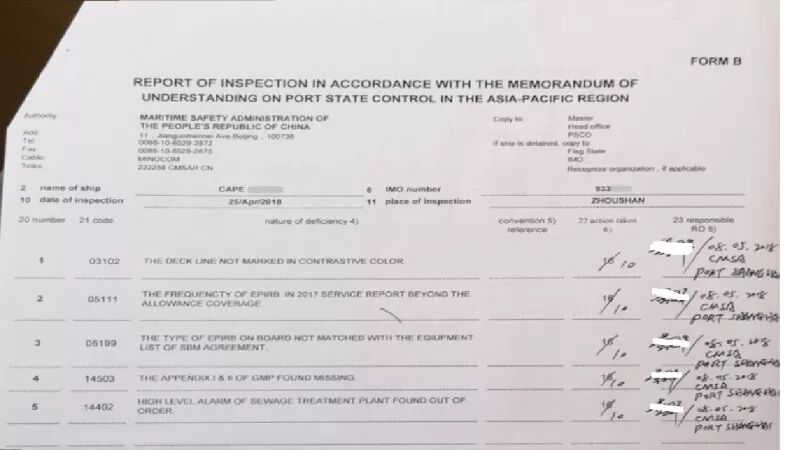

Background: Initial Inspection and Rectification
The case traces back to April 2018, when the vessel — identified as *CAPE ** — underwent a routine PSC inspection at a coastal port in China. Inspectors identified five safety deficiencies, all marked with action code 16, requiring full rectification within 14 days. During the subsequent voyage to a terminal under the jurisdiction of Baoshan Maritime Safety Administration (MSA), the master organized the crew to complete all corrective measures on board.
Rejected Follow-Up Application
With the vessel scheduled to call at an Australian port next — a jurisdiction widely recognized for its strict PSC enforcement — the master was eager to have the five outstanding deficiencies officially closed before departure. Upon berthing in Baoshan in May 2018, the master commissioned a local shipping agent to submit a formal application for an on-board PSC follow-up inspection.
Baoshan MSA was unable to arrange the inspection due to conflicting law enforcement duties, and clearly communicated standard procedures to the agent:
Substantive rectification of deficiencies falls under the ship’s responsibility, to be completed in line with the vessel’s Safety Management System (SMS) with full records retained on board;
Official closure of deficiencies in the PSC database is only granted after verification by a PSC Officer (PSCO), either during the next routine inspection or via a separate follow-up arranged at a subsequent port of call.
Deliberate Forgery of Endorsement
Driven by concerns over potential Australian PSC scrutiny, the master insisted on achieving a "paper-based closure" of the deficiencies prior to leaving Shanghai. After confirming no official inspection could be scheduled, the master produced an Australian PSCO-signed follow-up report as a reference, and instructed the Chinese agent to imitate the endorsement format used by Chinese PSCOs.
The agent forged the signature of a non-existent Chinese inspector and added false closure remarks to the PSC inspection report, fabricating a record that all deficiencies had been verified and signed off by Chinese maritime authorities.
Forgery Uncovered During Routine Check
The falsification came to light in July 2018, when the vessel underwent another routine PSC inspection. While reviewing the ship’s historical deficiency records, inspectors immediately identified inconsistencies: the endorsement format did not comply with China’s official PSC protocols, and the named signatory was not an authorized maritime inspector.
Following cross-verification of official system records, document examination and interviews with the master and agent, both parties admitted full responsibility for the forged follow-up record.
Penalties Imposed
Baoshan MSA ordered the vessel’s detention in accordance with Chinese maritime regulations. The authority stated that the falsified PSC records constituted a serious violation of established PSC procedures, and reflected a systemic failure of the company’s safety management system on board — both valid grounds for port state detention. The vessel was unable to depart as scheduled, resulting in voyage delays.
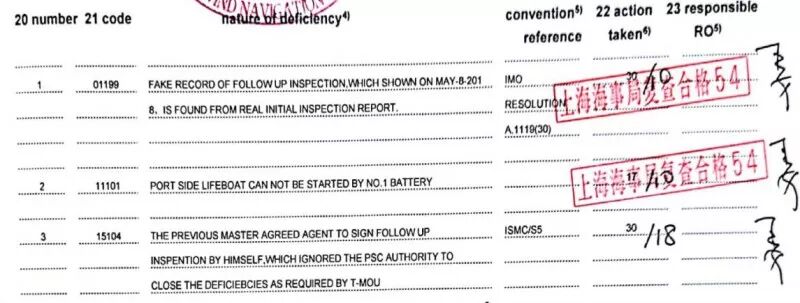
Administrative penalties were also issued pursuant to Chinese maritime law:
The shipping company was fined 25,000 yuan;
The master personally received a fine of 3,000 yuan.
The penalties were issued under Article 37 and Article 50(1)(5) of the Regulations of the People's Republic of China on Vessel Safety Supervision, and Article 9(1)(1) of the Provisions of the People's Republic of China on Administrative Penalties for Maritime Affairs. The regulations explicitly prohibit any entity or individual from making endorsements on PSC inspection reports other than competent maritime authorities.
Industry-Wide Preventive Measures
An official investigation concluded the incident stemmed from two core factors: unfamiliarity with Tokyo MOU PSC follow-up procedures, and weak legal awareness among the master and local agent.
Under Tokyo MOU rules, outstanding deficiencies can only be formally closed in the regional database after on-board verification by a duly authorized PSCO. Port state authorities are not obligated to conduct follow-up inspections on request, and vessels may carry rectified deficiencies until their next scheduled inspection.
To prevent similar incidents, Shanghai MSA has updated its Notice to Master to explicitly clarify PSC follow-up protocols. The revised notice confirms that PSCOs will only sign off on rectified deficiencies after an on-board verification, and will affix an official rectangular follow-up stamp next to each closed deficiency action code.
Maritime authorities have also issued industry recommendations:
Ship masters and operators must fully understand PSC inspection and deficiency closure procedures, and prioritize legal compliance. Companies should reinforce relevant training through their SMS frameworks.
Shipping agents must strengthen professional training on PSC regulations and Chinese maritime law, and ensure all agency activities strictly comply with national requirements.


READ MORE
 Safety
Opinion:Why a Rapid Return to Calm in the Middle East Looks Unlikely
 Safety
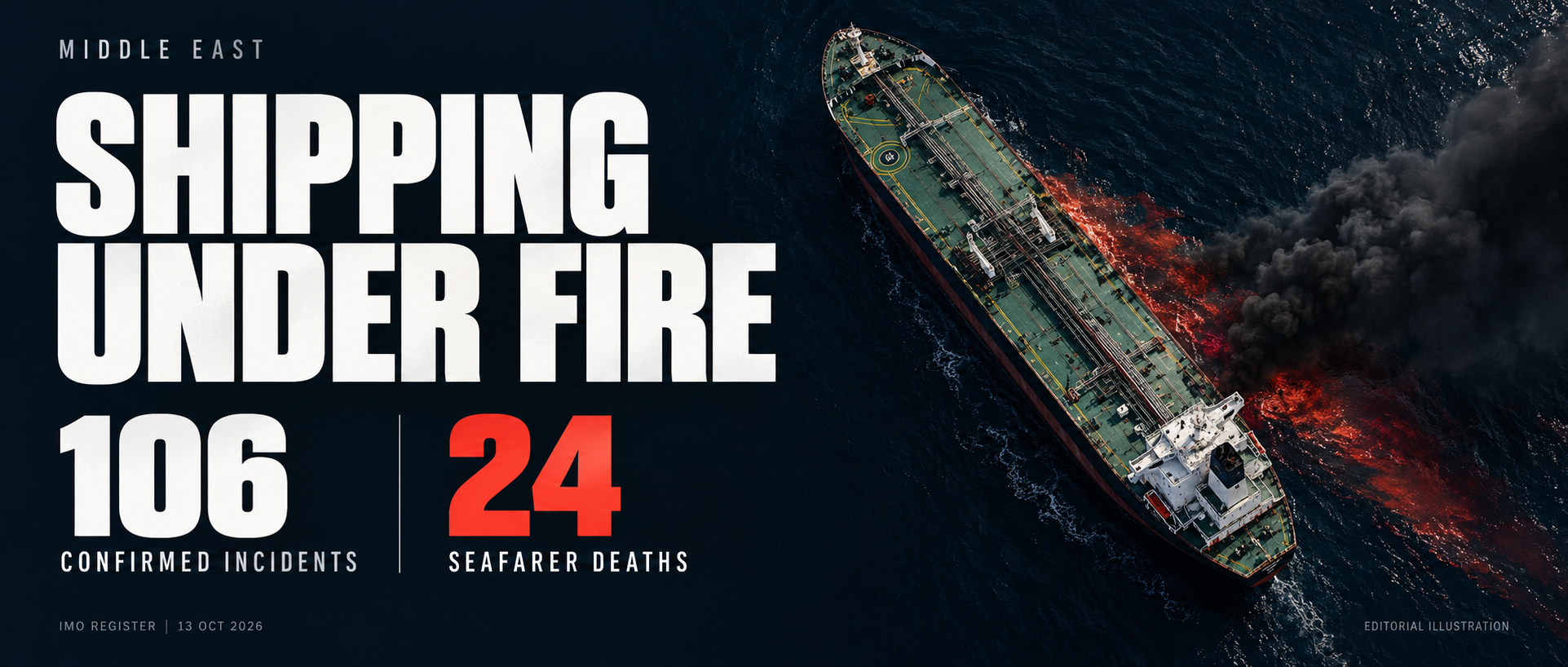
Middle East war leaves mounting toll on merchant shipping
 Safety
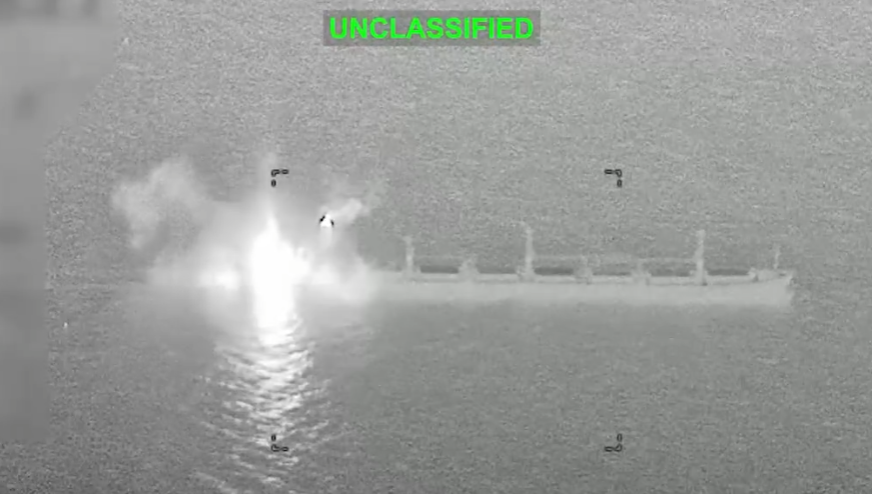
US Says It Disabled Hong Kong-Owned Bulker off Oman
 Safety
Alcohol‑Control for Seafarers and Key Points for PSC Inspections
 Safety
Attacked Just 42Days After Delivery: George Prokopiou’s 115,000-Dwt Tanker Hit in Hormuz
 Safety
Five Seafarers Reported Dead as Puntland Retakes Hijacked Tanker Honour 25
 Safety
China-U.S. Consensus Highlights Free Navigation: No Country or Entity Should Impose Transit Fees on International Waterways
 Safety
1 seafarer killed, Fatal attack in the Strait of Hormuz: Capesize bulker CAPE DAO hit by unknown projectile
 Safety
25 Crew Abandon MSC Container Ship in the South China Sea — All Rescued, Vessel Still Adrift
 Safety