


MSC Adds 15 Firm ULCVs at Chinese Yards, With Five More on Option

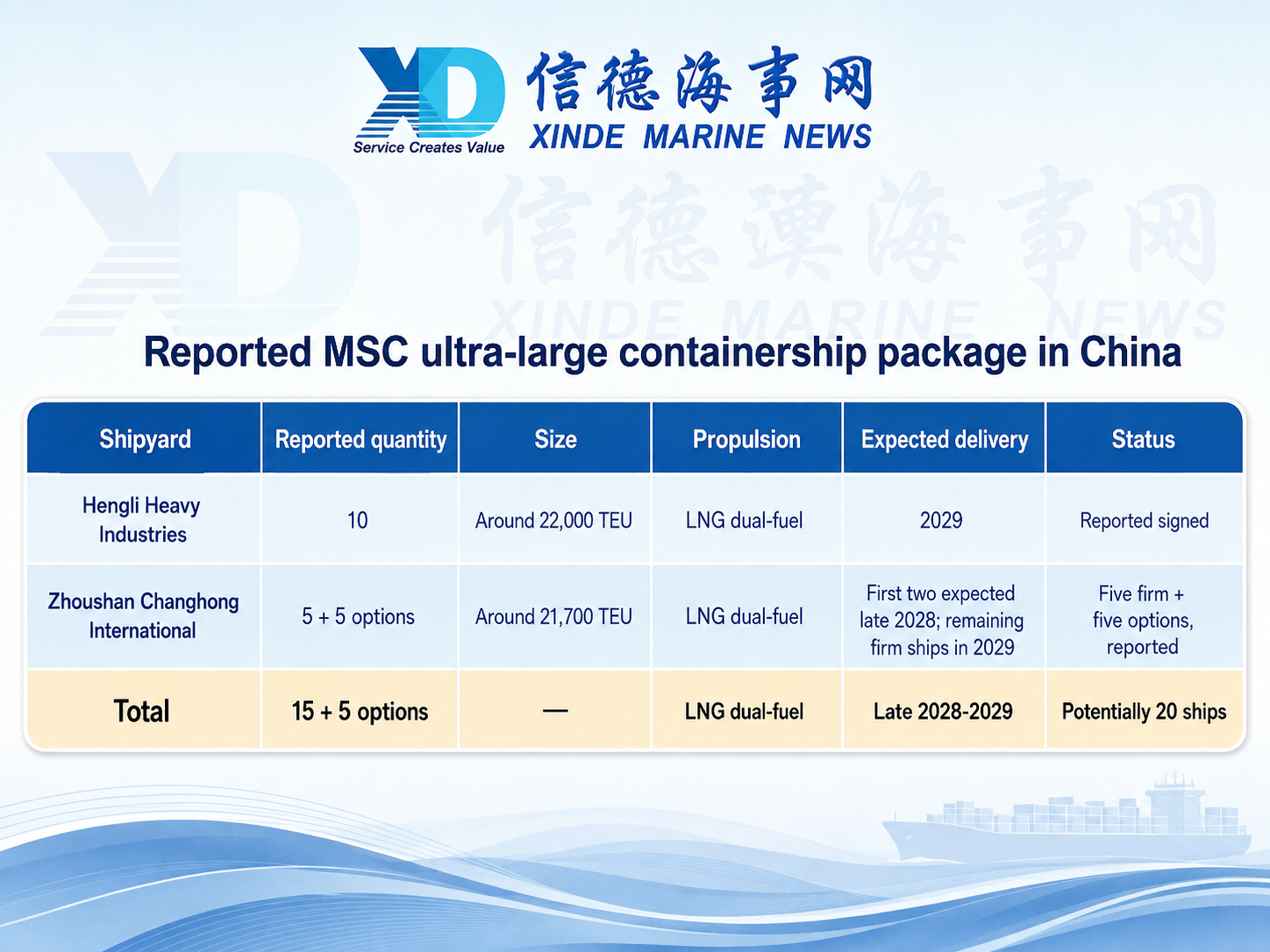
MSC is reported to have added 10 LNG dual-fuel ultra-large containerships at Hengli Heavy Industries and five firm vessels plus five options at Zhoushan Changhong International. The latest package could reach 20 ships and about $4.4bn if all options are exercised, extending MSC’s already unprecedented newbuilding programme while securing large-vessel delivery capacity into 2028-2029.
Mediterranean Shipping Company is continuing to lock in ultra-large containership capacity at Chinese shipyards, with the latest reported deals covering 15 firm vessels and five options at Hengli Heavy Industries and Zhoushan Changhong International Shipyard.
According to New-Ships’ Aug. 31 report, Hengli is set to build 10 additional LNG dual-fuel vessels of around 22,000 TEU, while Zhoushan Changhong has secured a 5+5 agreement for 21,700-TEU LNG dual-fuel ships. If all five options at Changhong are declared, the package would reach 20 ships, with an estimated potential value of about $4.4bn.
The headline number, however, needs qualification. The Changhong package includes five options rather than 10 firm ships, while neither MSC nor the two yards has publicly disclosed a combined $4.4bn contract value. The figure should therefore be treated as a market estimate for the potential full package, not as an officially confirmed contract amount.
Reported MSC ultra-large containership package in China
Market reporting broadly supports the 15-firm-vessel interpretation. The Loadstar, citing Linerlytica, reported in August that MSC had placed 10 vessels of 21,850 TEU at Hengli and five of 21,750 TEU at Changhong, with deliveries scheduled for 2029. The small differences in quoted capacities illustrate why the ships are better described as approximately 22,000 TEU and 21,700 TEU until final specifications are disclosed.
Hengli orders require careful counting
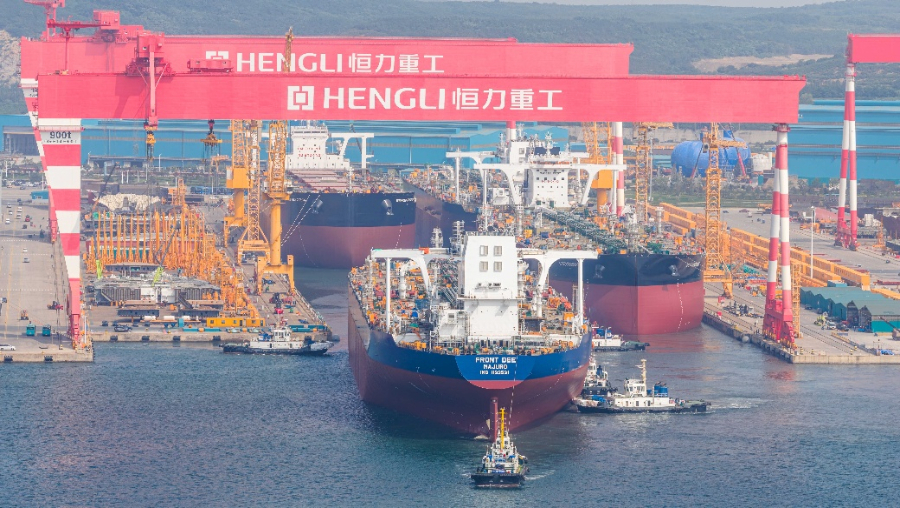
The Hengli portion is part of a much broader build-up of MSC tonnage at the Dalian shipyard.
Chinese industry reporting, citing TradeWinds and Clarksons, says MSC exercised options for 10 additional 22,000-TEU vessels, with the contracts recorded on July 30. That report describes the ships as an extension of an earlier 12-vessel series and says all 22 are scheduled for delivery in 2029. International Ship Network’s report states that the Changhong 5+5 agreement had not yet appeared in Clarksons’ database at the time of publication.
There is, however, some inconsistency between industry reports on MSC’s cumulative Hengli order tally.
On July 1, Lloyd’s List reported a separate 10-ship LNG-fuelled contract at Hengli, with deliveries in 2029 and no options attached, saying the agreement lifted MSC’s backlog at the yard to 40 ultra-large and mega containerships. Later reports describe another 10 ships as options exercised following an earlier 12-vessel series.
Without a detailed order schedule from MSC or Hengli identifying hull numbers and contract dates, it would be risky to reconstruct the carrier’s total Hengli exposure simply by adding every reported batch together.
What is clearer is the direction of travel. MSC has established Hengli as one of the key Chinese yards in its large-containership newbuilding programme.
The relationship dates back at least to August 2024, when Hengli disclosed that the two companies had signed a strategic cooperation framework covering newbuilding, marine engines, ship repair and conversion. Hengli’s official account of the cooperation provides the clearest company-level confirmation of the wider relationship.
Changhong’s 21,700-TEU design is already moving into production
Zhoushan Changhong is also building a deeper relationship with MSC across several containership sizes.
Construction began on another MSC 21,700-TEU LNG dual-fuel vessel, hull CHB2052, on Aug. 18, according to recent industry reporting. The ship is described as 366 metres long, 61.3 metres wide and designed for 19 knots.
The underlying design has a more authoritative technical reference.
In December 2025, DNV awarded Approval in Principle to Zhoushan Changhong and CIMC ORIC for a 21,700-TEU multi-fuel-ready containership developed with MSC. DNV said the platform was designed to accommodate different alternative-fuel configurations, including LNG and potentially ammonia propulsion, and was optimised for high container utilisation while maintaining port and operational compatibility.
MSC’s Head of Newbuildings Giuseppe Gargiulo said at the time that LNG remained the company’s most proven alternative fuel for containership operations, while the joint development work would allow MSC to retain flexibility around future technologies.
That makes the latest reported Changhong order less of a standalone transaction and more an extension of an established design and development programme.
Why around 22,000 TEU rather than 24,000-plus?
One of the more interesting elements of MSC’s latest ordering is vessel size.
MSC already operates ships above 24,000 TEU. Its MSC Michel Cappellini, for example, has capacity of 24,346 TEU and measures 400 metres in length. MSC has also deployed 24,000-TEU ships into markets beyond the traditional Asia-Europe trades, including West Africa.
The latest Chinese orders, by contrast, cluster around 21,700-22,000 TEU.
New-Ships attributes MSC’s choice of this size range to better port compatibility and operating flexibility. MSC has not, however, publicly announced a strategic move away from 24,000-TEU ships, so it would be premature to frame the orders as a formal change in fleet policy.
There is nevertheless a practical trade-off.
Once containerships move beyond 20,000 TEU, incremental economies of scale have to be balanced against draft, berth length, crane outreach, terminal productivity, cargo concentration and the number of ports that can handle the ship efficiently. MSC itself notes that ultra-large containerships can deliver lower unit transport costs when utilisation is high, but the economics depend on how effectively their capacity can be deployed. MSC’s overview of ultra-large vessel economics discusses those scale benefits.
The Changhong design illustrates that balance particularly well. At 366 metres, it remains firmly within the ultra-large category, but is shorter than MSC’s 400-metre, 24,000-plus-TEU ships. DNV’s description of the design specifically highlights both cargo utilisation and port compatibility.
For MSC, therefore, the latest orders appear less about abandoning megamax vessels than about broadening the range of very large ships available for different network requirements.
The other scarce asset is the delivery slot
The timing of the orders is just as important as their size.
Hengli says its own newbuilding schedule is already booked through 2030. In July, the company said it had accumulated more than 500 ship orders and had expanded annual steel-processing capacity to 3m tonnes, with four main building docks able to handle large vessels simultaneously. Hengli’s July 2026 orderbook update confirms that delivery slots now extend to 2030.
New-Ships likewise argues that limited availability of suitable 2028-2029 slots is encouraging major liner operators to secure berths well in advance.
This creates an apparent contradiction in the containership market.
There is no shortage of ships on order. According to Alphaliner data cited in Xinde Marine News’ latest orderbook analysis, the global containership orderbook had reached 1,724 vessels and 13.97m TEU by mid-August, against an operating fleet of around 34.16m TEU. That puts the orderbook at roughly 40% of existing fleet capacity, the highest ratio since 2009.
Yet shipowners wanting a specific ultra-large, dual-fuel design for delivery before the end of the decade still face a finite number of suitable yards and building positions.
For MSC, booking the ships now is therefore also a way of reserving industrial capacity for the fleet it expects to operate several years from today.
Chinese yards are taking a larger role in MSC’s megamax programme
The choice of Hengli and Zhoushan Changhong also shows how MSC’s sourcing strategy has broadened.
Ultra-large containership construction was once concentrated among a relatively narrow group of major South Korean and Chinese yards. MSC’s latest programme shows newer or rapidly expanding Chinese builders moving deeper into that market, including technically more demanding LNG dual-fuel projects.
Hengli is an especially notable case. The former STX Dalian complex returned to shipbuilding under Hengli ownership only a few years ago and has since expanded quickly across tankers, bulkers, containerships and gas carriers. Hengli said it secured 207 new ships in the first half of 2026 alone, including 56 containerships, while its production plan now runs into 2030.
Zhoushan Changhong, meanwhile, has developed several containership series with MSC and is now involved in the 21,700-TEU multi-fuel platform with CIMC ORIC and DNV.
For a carrier ordering at MSC’s scale, spreading work among more yards offers an obvious practical advantage: access to more delivery slots and less dependence on a single builder.
MSC’s orderbook is approaching the size of a major carrier
The latest ships also need to be viewed against MSC’s overall expansion.
New-Ships, citing Alphaliner data, put MSC’s operated fleet at around 7.39m TEU and 21.5% of global liner capacity, with 166 ships on order.
Lloyd’s List similarly reported in July that MSC’s newbuilding backlog stood at 166 ships totalling just under 3m TEU, including more than 2m TEU across 99 vessels above 20,000 TEU. Lloyd’s List described the programme as unprecedented in scale.
Linerlytica uses slightly different numbers: The Loadstar reported 170 ships and around 3m TEU on order. The difference reflects database timing and methodology rather than a materially different view of MSC’s strategy.
Either way, MSC is adding enough capacity for its orderbook alone to resemble a major global liner company.
That does not necessarily mean all of the new capacity will translate directly into net fleet growth. New ships can replace older tonnage, allow chartered vessels to be returned, or support new services and network changes. But the scale gives MSC considerably more flexibility over ownership, fuel technology and vessel deployment than a carrier relying heavily on the charter market.
The 2028-2029 equation
The economics of the latest Chinese orders will ultimately depend on the market into which they are delivered.
The first reported Changhong vessels are expected in late 2028, with most of the package entering service during 2029. By then, a substantial portion of today’s global orderbook will also have reached the water.
Three variables will determine how much capacity the market can absorb.
A continued diversion around the Cape of Good Hope would keep ships tied up on longer rotations. A broad return to Suez would shorten voyages and release effective capacity back into the network. At the same time, demolition of ageing tonnage could offset part of the newbuilding wave, while global container-trade growth will determine how much additional nominal capacity is actually required.
For the latest MSC package, the nearer-term milestones are more straightforward: whether the five Changhong options are exercised, whether MSC and the yards provide formal confirmation of the reported contracts, and how the vessels are allocated across the 2028-2029 delivery schedule.
Those developments will make it easier to distinguish between headline orderbook growth and the amount of capacity that is actually committed.

READ MORE
 Shipbuilding
Amid China’s Shipbuilding Boom, a State-Owned Yard Quietly Enters Liquidation
 Shipbuilding
Yichang Changyun plans RMB120m inland bulker programme
 Shipbuilding
Steel Giant Shagang Eyes Shipbuilding as a Booming Market Draws Industrial Capital
 Shipbuilding
Another Chinese Bridge Builder Moves Into Shipbuilding
 Shipbuilding
Hengli Secures 12 Tanker Orders, Retaining World’s Largest VLCC Orderbook
 Shipbuilding
Hengli Signs 11 VLAC Contracts in One Week
 Shipbuilding
China ZWI Enters Ocean Shipping with VLGC Acquisition and Chemical Tanker Newbuild Project
 Shipbuilding
World’s First 325,000-DWT Methanol Dual-Fuel Ore Carrier Delivered
 Shipbuilding
CIMC Raffles Extends NOCC Car Carrier Programme to 2030
 Shipbuilding