


6 VLCCs Reroute via the Cape of Good Hope
Bahri’s Saudi-flagged tankers are sailing thousands of extra miles in ballast as the Houthi threat turns vessel identity itself into a Red Sea risk factor
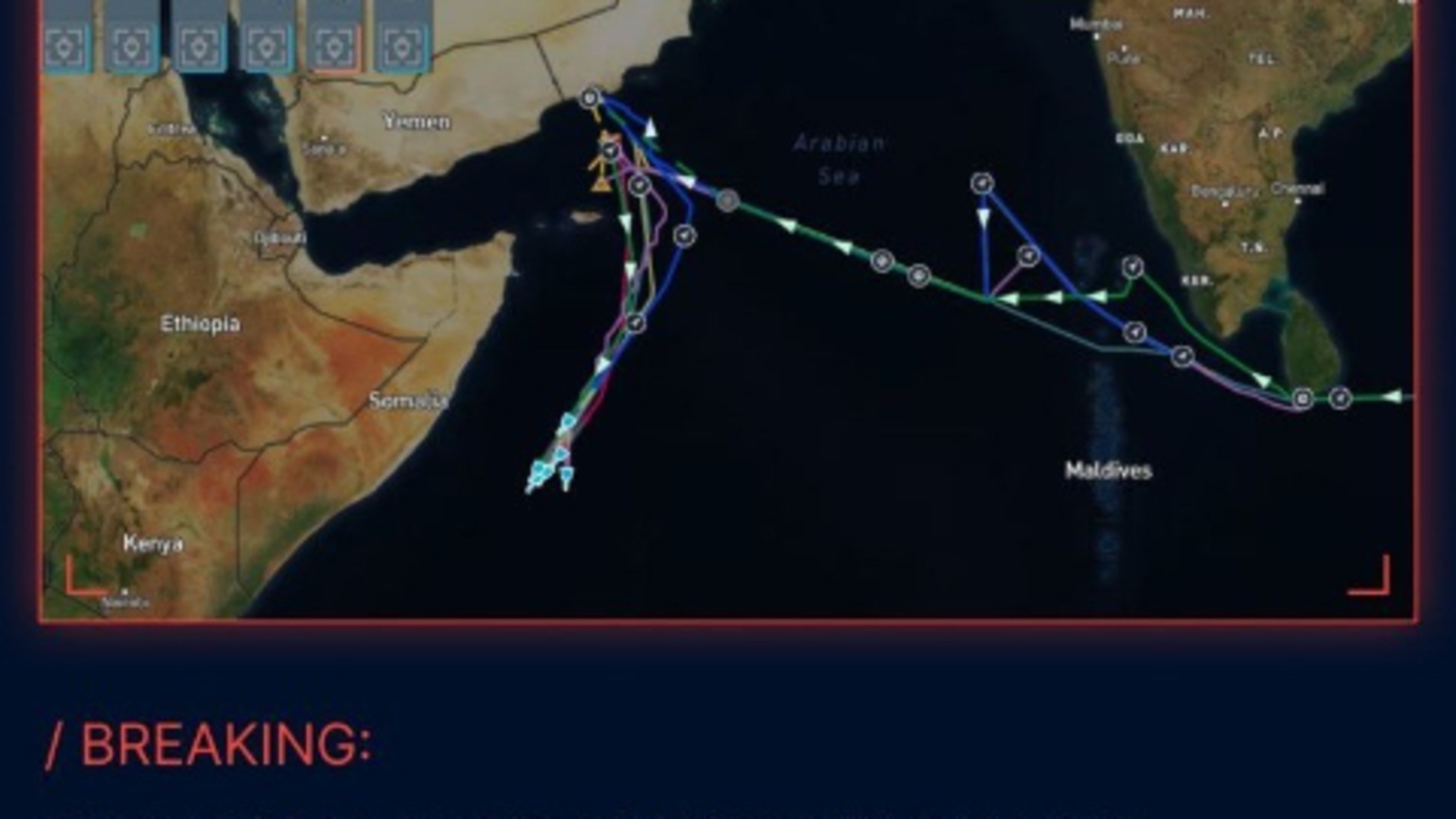

A group of six Saudi-flagged very large crude carriers, with a combined capacity of close to 1.9 million dwt, has embarked on an extraordinary long-distance diversion around Africa.
All six vessels are sailing in ballast.
According to maritime intelligence company Windward, the VLCCs have avoided the Bab el-Mandeb Strait and the Red Sea and are instead routing around the Cape of Good Hope amid an active Houthi threat against Saudi-linked shipping.
Five of the tankers are understood to be heading for the US Gulf Coast, including the Corpus Christi and Southtex lightering areas, where they are expected to load crude oil. Windward estimates that the diversion will add approximately six to seven days to each voyage compared with a more direct route through the Bab el-Mandeb, the Red Sea and the Suez Canal.
The sixth vessel, LAYNAH, faces a much longer journey.
The tanker is understood to be returning from Taiwan to Yanbu, Saudi Arabia. Under normal circumstances, it could sail west across the Indian Ocean and enter the Red Sea through the Bab el-Mandeb Strait.
By avoiding the strait, however, LAYNAH must continue southwest around the Cape of Good Hope, sail north through the Atlantic, pass the Strait of Gibraltar, enter the Mediterranean and transit the Suez Canal before reaching Yanbu from the north.
Windward estimates that the diversion will add roughly 30 days to the voyage, approximately doubling the duration of the direct passage.
All six vessels linked to Bahri
A review by Xinde Marine News of contemporaneous vessel-tracking information indicates that the six VLCCs are:
HAZM, DILAM, GHINAH, LAYNAH, SALAM and BURQAN.
All six are part of the fleet of Saudi Arabia’s national shipping company, Bahri.
DILAM and GHINAH were built in 2010, SALAM in 2016 and HAZM in 2019. LAYNAH and BURQAN were both delivered in 2022. Their individual capacities range from approximately 300,000 dwt to 320,000 dwt.
A typical Bahri VLCC is capable of carrying around 2.2 million barrels of crude oil.
Windward did not publicly name the vessels in its original graphic. The identities were established through a cross-check of the six-vessel group reported during the same period, their Saudi flag status, ownership links and AIS movements.
Earlier vessel-tracking reports showed HAZM and DILAM declaring Gibraltar as their AIS destination, while GHINAH, LAYNAH, SALAM and BURQAN indicated Durban or Algoa Bay in South Africa.
These declarations should not necessarily be interpreted as the ships’ final commercial destinations. AIS destination fields are manually entered and may identify an interim waypoint, bunkering location, supply stop or temporary routing instruction.
For the five vessels ultimately bound for the US Gulf, there is no operational need to pass through the Strait of Gibraltar. Their likely route is around the Cape of Good Hope and across the South Atlantic toward the Caribbean and the Gulf of Mexico.
LAYNAH, by contrast, would need to pass Gibraltar and the Suez Canal in order to reach Yanbu while continuing to avoid the Bab el-Mandeb.
The fact that vessels ranging from 2010-built units to modern 2022-built VLCCs have adopted the same diversion suggests that the decision is part of a wider risk-control policy for Saudi-linked tonnage, rather than a response to the technical condition of any individual ship.
The strongest signal: all six are in ballast
The diversion of six VLCCs is significant in itself. The more important signal is that every vessel is sailing in ballast.
When a laden tanker carrying crude oil reroutes around a conflict zone, the commercial logic is clear. The owner, charterer and insurer are seeking to protect the vessel, its cargo and the surrounding marine environment from a potentially catastrophic incident.
An empty tanker has no crude cargo to protect.
Bahri and the vessels’ commercial operators are nevertheless accepting additional sailing time, higher bunker consumption, schedule disruption and reduced fleet efficiency to keep the ships away from the Bab el-Mandeb.
This indicates that the risk assessment has moved beyond the question of what a vessel is carrying.
The vessel’s flag, ownership, management structure, trading history, port calls and wider links to Saudi Arabia are becoming central factors in determining whether it can safely use the Red Sea corridor.
Windward described the six ballast diversions as an important warning signal. When operators reroute laden tankers, they are protecting cargo. When they also reroute ballast vessels, the flag and national association of the ship have themselves become risk factors.
For Saudi-linked tonnage, the Red Sea corridor is increasingly approaching a state of effective commercial closure, even though the waterway remains physically open to other vessels.
Houthi blockade threat begins reshaping shipping routes
The immediate background to the diversions is the Houthi movement’s declaration on July 20 of a maritime blockade targeting Saudi Arabia.
The group threatened ships trading with or linked to Saudi ports, raising the risk of attacks against vessels identified through their flag, ownership, management, chartering arrangements or trading patterns.
The Saudi-led coalition rejected the threat and described it as an act of piracy and a violation of international law. It also said measures were being taken to protect merchant shipping in the Bab el-Mandeb area.
For shipowners and operators, however, political declarations are only one part of the calculation.
Operational decisions are shaped by whether an attacker has demonstrated the capability to strike merchant vessels, how targets are selected, whether identity-screening methods are reliable, how naval protection is provided and whether war-risk insurers are prepared to cover the voyage on commercially acceptable terms.
Windward data indicates that the Houthi declaration is already affecting actual vessel movements.
Since July 20, average daily traffic through the Bab el-Mandeb has reportedly fallen by approximately 22%. Tanker traffic has declined by around 39%, while movements involving Saudi-linked vessels have dropped by roughly 46%.
The sharper decline among Saudi-associated ships suggests that the threat is no longer confined to statements and warnings. It is being translated into concrete fleet-deployment and routing decisions.
The Red Sea is becoming a selective corridor
The Bab el-Mandeb has not been completely closed to commercial shipping.
Windward said that between July 20 and August 2, 22 China-linked vessels passed through the strait and subsequently called at Saudi ports without incident. During the same period, four Saudi tankers were reportedly attacked.
The contrast points to an increasingly selective operating environment in the Red Sea.
Ships linked to certain countries, ownership structures or commercial networks may continue to transit, while Saudi-flagged and Saudi-associated tonnage faces a materially higher threat level.
The status of the Bab el-Mandeb can therefore no longer be described simply as “open” or “closed.”
From a navigational perspective, vessels are still passing through. From a commercial, security and insurance perspective, the route may already be unusable for parts of the Saudi-linked fleet.
Six Bahri VLCCs choosing to sail thousands of additional miles while empty provide one of the clearest indications yet of how the market is assessing that risk.
Five ballast VLCCs to the US Gulf
The decision by five of the vessels to sail toward the US Gulf also shows that the impact extends beyond Saudi crude exports from Yanbu.
It is now affecting Bahri’s global ballast-positioning strategy.
After discharging a cargo, a VLCC must reach its next loading area as efficiently as possible. The shorter the ballast leg, the sooner the vessel can return to revenue-generating employment.
Longer ballast voyages absorb time and fuel without generating freight income.
For the five vessels heading to the Corpus Christi and Southtex lightering areas, an additional six to seven days at sea will increase bunker costs, delay loading windows and potentially affect subsequent discharge dates and follow-on employment.
LAYNAH’s diversion is more commercially significant. An additional month in ballast is comparable to the time required for a substantial portion of a normal long-haul VLCC voyage cycle.
Should more Saudi-associated VLCCs adopt similar routing, the number of vessels nominally in the fleet would remain unchanged, but the amount of tonnage available at a particular loading area and time would decline.
This “hidden absorption” of capacity could tighten vessel supply and support VLCC freight rates, particularly if the disruption affects both laden and ballast legs.
The impact would not necessarily appear immediately in fleet statistics. It would instead emerge through longer tonne-mile demand, reduced scheduling flexibility, missed loading windows and fewer ships available for prompt employment.
Saudi Arabia’s Hormuz alternative faces another bottleneck
The disruption also has broader implications for Saudi Arabia’s energy-export strategy.
As navigation through the Strait of Hormuz has become more difficult, Saudi Arabia has increasingly relied on its East-West crude oil pipeline to move barrels from the Gulf side of the country to the Red Sea port of Yanbu.
The pipeline and Yanbu terminal serve as a strategic alternative to export routes through Hormuz.
That alternative, however, still depends heavily on the Bab el-Mandeb for crude shipments moving from Yanbu toward Asian markets.
If Saudi-linked tankers cannot safely use the strait, eastbound cargoes from Yanbu may be forced to sail north through the Suez Canal, cross the Mediterranean, exit through Gibraltar and round the Cape of Good Hope before returning to the Indian Ocean.
Other cargoes may require alternative arrangements involving Egyptian terminals and pipeline infrastructure.
According to Kpler data cited in market assessments, Saudi exports of crude oil and refined products from Yanbu have averaged more than 4.5 million barrels per day since April 2026, with around 70% destined for Asia.
Analysts have estimated that an effective closure of the Bab el-Mandeb to Saudi shipping could force more than 3 million barrels per day onto longer routes and delay some deliveries to Asian refiners by approximately one month.
The strategic problem is clear.
Restrictions around Hormuz undermine Saudi Arabia’s eastern export corridor. Threats around the Bab el-Mandeb simultaneously weaken the Red Sea alternative designed to reduce dependence on Hormuz.
Saudi Arabia’s two-direction energy-export system is therefore facing pressure at both ends.
A vote with ships
The diversions involving HAZM, DILAM, GHINAH, LAYNAH, SALAM and BURQAN remain, for now, a limited fleet-management event involving six vessels.
Their significance is much larger than the number of ships involved.
All six fly the Saudi flag. All six are linked to Bahri. All six are sailing in ballast. All six have rejected the shorter route through the Bab el-Mandeb.
Together, they demonstrate that a vessel’s Saudi identity alone may now be sufficient to trigger a major diversion.
The next question is whether the same pattern spreads to other Bahri vessels, tankers controlled by Saudi charterers and third-party ships that have recently called at Saudi ports.
Should laden tankers, ballast vessels and ships positioning for future employment all begin avoiding the Red Sea, the consequences will extend well beyond individual voyage costs.
They will affect effective fleet supply, freight rates, war-risk insurance, bunker demand, crude-delivery schedules and the wider structure of global oil transportation.
The long journey now being undertaken by six 300,000-dwt VLCCs is the shipping market voting with its ships on the risks surrounding the Bab el-Mandeb.


READ MORE
 Safety
Engine Room Fire Epidemic Prompts Global Safety Alert After Qingdao Shipyard Tragedy
 Safety
Major Collision Off India: 21 Crew Evacuated After KMAX EMPEROR Suffers Heavy Damage
 Safety
Houthis Seize Mocha as Bab el-Mandeb Risks Rise — but Signal “Safe Passage” for Non-Saudi Shipping
 Safety
Saudi pipeline attack exposes limits of Hormuz bypass strategy
 Safety
Shipping’s New Risk Equation: Flexibility Becomes the Premium Asset
 Safety
25 Killed in Fire Aboard Ocean Melody at Qingdao Beihai Shipyard
 Safety
Hormuz Crisis Exposes Shipping’s Three Fault Lines. Shipping Leaders Confront the Lessons of the Hormuz Crisis
 Safety
Forged PSC Follow-Up Inspection Leads to Vessel Detention and Fines
 Safety
Two Tankers Collide Off Yangtze River Estuary
 Safety