


China’s Modular “Rescue Carrier” Evacuates More Than 6,000 Students from Flooded Campus
.
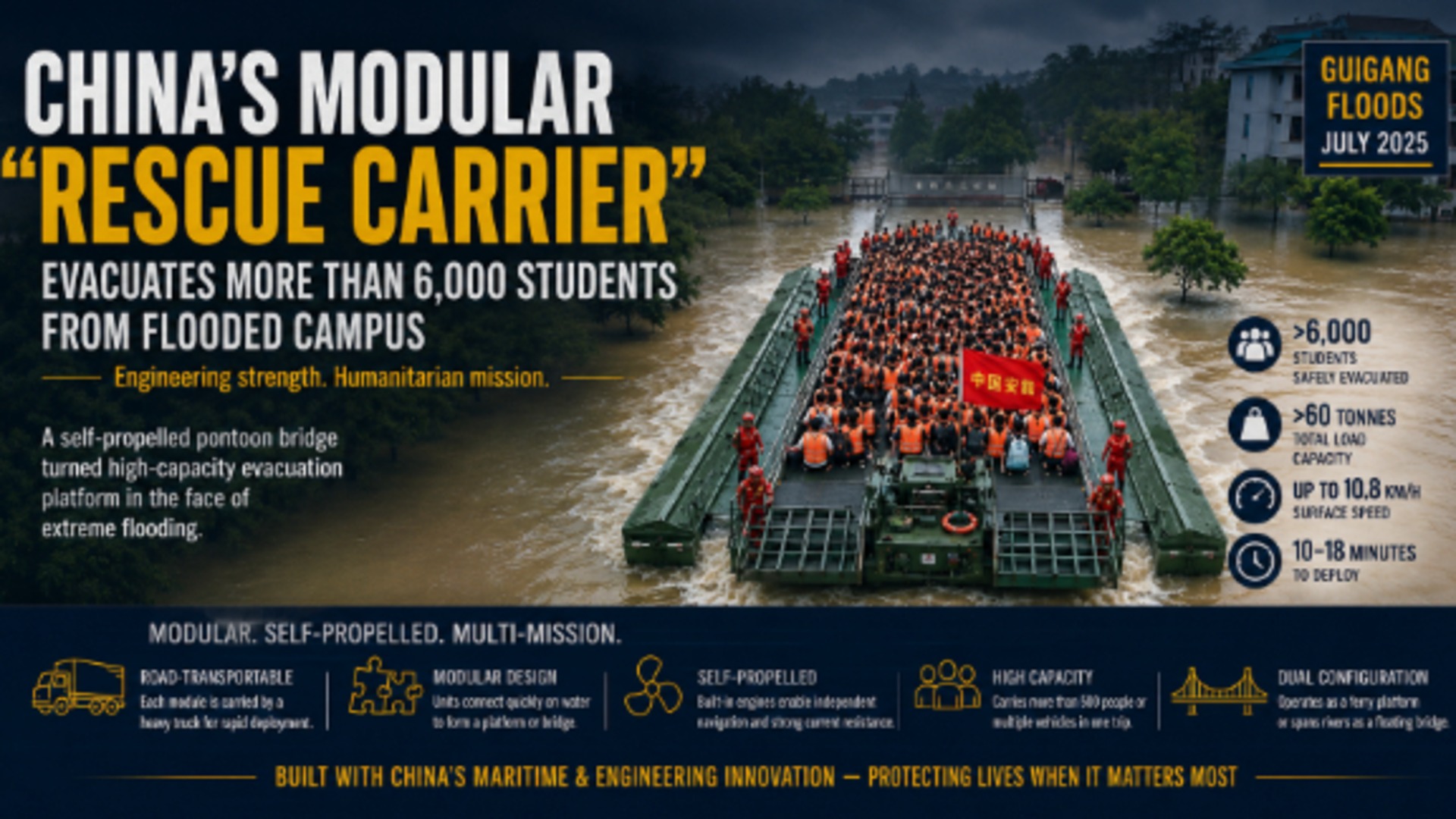

A truck-deployable powered pontoon bridge became a high-capacity evacuation platform in Guigang, demonstrating how shipbuilding, bridge engineering and emergency logistics can be integrated into a single rescue system.
A broad, low-profile platform carrying hundreds of students moved slowly through muddy floodwater inside a campus in Guigang, a city in southern China’s Guangxi Zhuang Autonomous Region.
The unusual craft was quickly nicknamed a “rescue aircraft carrier” on Chinese social media. In engineering terms, however, it was a self-propelled modular pontoon bridge—an emergency transport system that can travel to a disaster zone by road and then be assembled into a powered floating platform.
The equipment was deployed after severe flooding inundated the Guangxi Vocational and Technical College of Logistics, leaving more than 6,000 students stranded. China Anneng Construction Group began assembling the pontoon system on the afternoon of 8 July. By 12:30 on 9 July, more than 6,000 students had been transferred to safety, according to reports citing the rescue team.
A bridge that can operate as a vessel
The platform used in Guigang measured approximately 60 metres in its assembled configuration and had a total load capacity of more than 60 tonnes. Its stated carrying capacity exceeds 500 people per trip, although the number transported during individual Guigang runs was generally several hundred because of restricted access, submerged obstacles and the complex conditions inside the flooded campus.
Unlike a conventional rescue boat, the equipment consists of multiple transportable pontoon modules. Individual units are carried on heavy road vehicles, launched near the affected area and connected on the water. The modules can be assembled side by side to form a powered ferry platform or linked into a temporary floating bridge.
Each floating section can be fitted with its own propulsion system. Once connected, the units operate together as a much larger platform capable of moving people, vehicles, engineering machinery and emergency supplies.
The exact model deployed in Guigang has not been publicly identified. Available information describes it only as an emergency powered pontoon bridge. CSSC information cited in the Chinese source material attributes the equipment’s development and manufacture to China Harzone Industry Corp., Ltd., a subsidiary of China State Shipbuilding Corporation specialising in emergency bridging and transport systems. China Anneng was responsible for transporting, assembling and operating the system during the rescue.
This distinction is important. The platform was neither an improvised barge nor a large rescue ship brought in from a nearby waterway. It was transported over land, launched close to the flooded district and converted into a high-capacity waterborne evacuation platform at the scene.
Why the system changed the pace of the evacuation
Before the powered pontoon bridge arrived, rescue teams relied heavily on inflatable boats and small powered craft. These remained essential for reaching individual buildings and navigating confined areas, but their passenger capacity was limited.
The larger platform substantially increased evacuation throughput. Xinhua reported that floodwater in parts of the education district approached five metres and concealed road signs, fencing, branches and other hazards. Where the pontoon platform could not safely approach a building, smaller boats transferred students between the buildings and the larger craft.
The operation therefore combined several types of equipment rather than relying on one platform alone. Inflatable boats handled the final connection to difficult locations, while the pontoon system provided the high-capacity transport leg.
Its wide waterplane and shallow draught were particularly suited to flooded urban terrain. A wide platform offers greater initial stability than a narrow rescue boat, an important consideration when hundreds of passengers are moving and changing position on deck. Shallow draught also allows the system to operate above submerged roads and in areas inaccessible to conventional vessels.
The pontoon bridge must nevertheless withstand many of the same forces considered in commercial and specialised ship design: changing passenger loads, water current, floating debris, localised deck loads, contact during landing operations and the possibility of damage to individual compartments.
Its engineering therefore draws on several disciplines familiar to the maritime sector, including buoyancy and stability calculations, structural strength, propulsion integration, watertight subdivision, corrosion protection, electrical control and modular connection design.
Shipbuilding technology beyond commercial shipping
Powered pontoon bridges have their origins in military and civil-engineering applications, where they are used to move heavy vehicles across rivers after permanent infrastructure has been damaged or destroyed.
Their value in civilian disaster response lies in their ability to combine road mobility with marine capability. Conventional vessels generally need navigable waterways, launching facilities or port infrastructure to reach an emergency area. A modular pontoon system can approach by road, enter the water at a suitable location and begin operating without a conventional terminal.
That capability is particularly relevant during urban flooding, earthquakes and infrastructure failures. The same platform used to evacuate residents can also carry ambulances, excavators, mobile generators, drainage equipment and emergency repair vehicles.
For ports and inland waterway operators, the technology also has potential applications in contingency planning. A modular pontoon platform could provide temporary access to an isolated terminal, connect a damaged quay with an operational road, support emergency ro-ro movements or serve as a temporary work platform during repairs.
The system’s modularity is central to this flexibility. Individual units can be transported separately, replaced if damaged and configured according to the task. A group of modules can operate as a ferry, a floating bridge, a construction platform or a temporary landing facility.
A practical demonstration of maritime engineering
The images from Guigang attracted attention because the platform appeared unusually large for an inland flood rescue. Its wider significance, however, lies in the speed with which a transport system designed around shipbuilding and bridge-engineering principles was converted into a working evacuation route.
Large rescue platforms cannot replace small boats, local responders or careful route assessment. The Guigang operation showed how different capabilities can be combined: small craft for access, a modular platform for mass transport, road vehicles for onward evacuation and rescue personnel to manage loading and passenger safety.
For the maritime industry, the deployment is also a reminder that shipbuilding expertise extends well beyond oceangoing merchant vessels. The same knowledge used to design barges, workboats, floating docks and offshore platforms can support emergency transport, disaster relief and the protection of life ashore.
In Guigang, that engineering capability helped turn a flooded campus into an organised waterborne evacuation route—and enabled more than 6,000 students to reach safety within hours.

READ MORE
 Safety
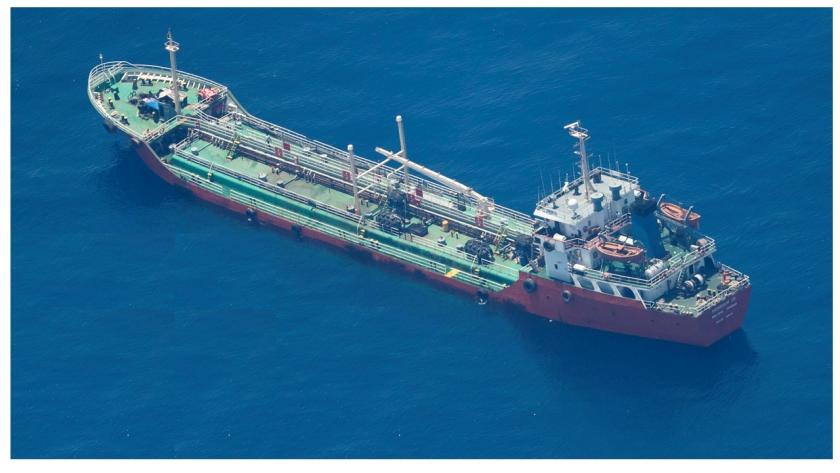
Five Seafarers Reported Dead as Puntland Retakes Hijacked Tanker Honour 25
 Safety
China-U.S. Consensus Highlights Free Navigation: No Country or Entity Should Impose Transit Fees on International Waterways
 Safety
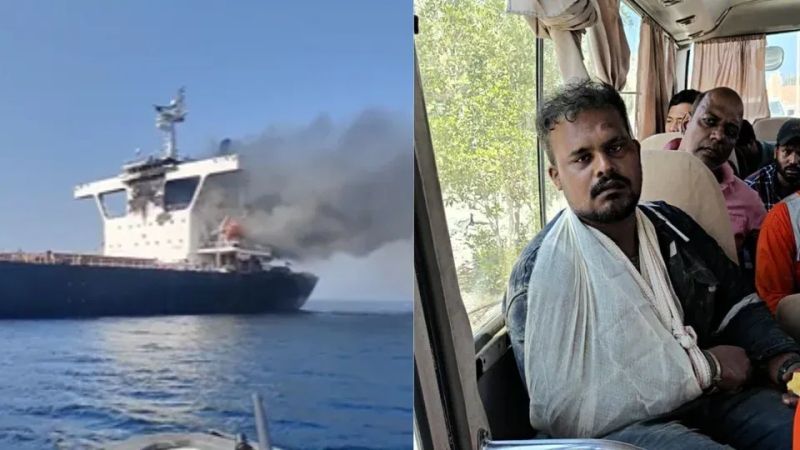
1 seafarer killed, Fatal attack in the Strait of Hormuz: Capesize bulker CAPE DAO hit by unknown projectile
 Safety
Attacked Just 42Days After Delivery: George Prokopiou’s 115,000-Dwt Tanker Hit in Hormuz
 Safety
25 Crew Abandon MSC Container Ship in the South China Sea — All Rescued, Vessel Still Adrift
 Safety
MSC Hermes III Adrift Unmanned in South China Sea After 25 Crew Abandon Ship
 Safety
Dangerous Goods Container Fire Reported at NPCT1 Terminal in Jakarta
 Safety
Suspected Cyber Incident Diverts LNG Carrier After Cargo-Control Failure
 Safety
Xinde Marine Forum London 2026: Shipping Moves from Lean Logistics to Resilience by Design
 Safety