


A.P. Moller Holding is buying the 70-vessel ship leasing platform from KKR, bringing more than $5 billion of long-term contracted cash flows into the A.P. Moller maritime portfolio
Xinde Marine News — A.P. Moller Holding is making another major move in maritime assets.

On 2 July, A.P. Moller Holding and global investment firm KKR announced that a subsidiary of A.P. Moller Holding has signed an agreement to acquire 100% of Norwegian ship leasing company Ocean Yield AS from funds managed by KKR.
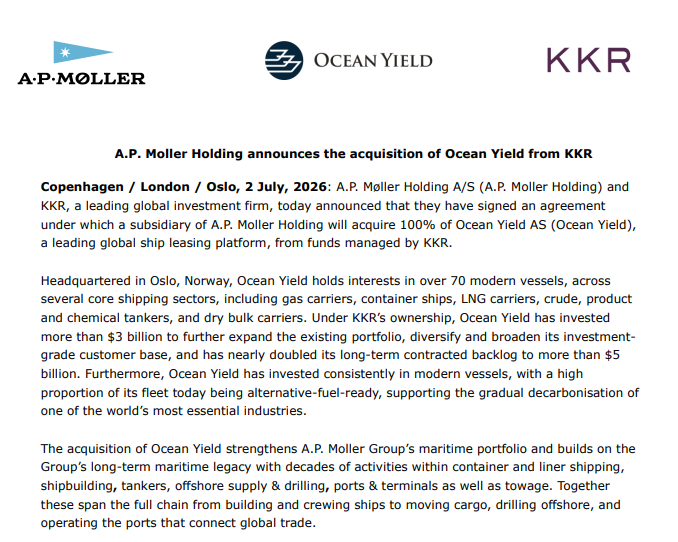
Financial terms were not disclosed. The transaction remains subject to customary regulatory approvals and is expected to close by the end of the year.
Once completed, the acquisition will give A.P. Moller Holding control of a global, diversified ship leasing platform built around long-term contracted cash flows. Ocean Yield currently has interests in more than 70 modern vessels across LNG carriers, gas carriers, container ships, crude tankers, product tankers, chemical tankers and dry bulk vessels.
The distinction is important. The buyer is A.P. Moller Holding, the parent company of the A.P. Moller Group, rather than the listed container shipping company A.P. Moller - Maersk. A.P. Moller Holding is the long-term investment platform linked to the Maersk family and the A.P. Moller Foundation. Its largest asset is its stake in A.P. Moller - Maersk, while its wider portfolio includes Danske Bank, Maersk Tankers, Svitzer, Noble, DOF and other financial, shipping, offshore and maritime service assets.
More than 70 vessels and over $5 billion in contracted backlog
Headquartered in Oslo, Ocean Yield was established in 2012. It originated from offshore service assets with long-term charters previously owned by the Aker system in Norway. In 2013, Ocean Yield was listed on the Oslo Stock Exchange. In 2021, KKR took the company private through a voluntary cash offer.
Since then, Ocean Yield has grown from an offshore-linked asset platform into one of the world’s significant maritime leasing companies.
According to Ocean Yield’s first-quarter 2026 materials, the company had a fleet of 73 vessels, an adjusted EBITDA backlog of around $5 billion, and an average remaining charter period of 11 years. In the first quarter, Ocean Yield reported adjusted EBITDA of $82.3 million, net profit of $21.9 million, available liquidity of $268.2 million and an equity ratio of 31.7%.
Its fleet has become increasingly diversified. The first-quarter materials showed a portfolio including 30 LNG carriers, 10 container vessels, 12 crude oil tankers, eight dry bulk vessels, four product and chemical tankers, five offshore-related vessels and four other gas carriers.
The structure of this portfolio is clear. Ocean Yield does not primarily depend on short-term spot market exposure. Its business model is built on long-term lease contracts, counterparty quality, asset residual value and financing structure. In that sense, Ocean Yield operates closer to a maritime finance and vessel asset management platform than to a traditional commodity shipowner.
TradeWinds quoted Pareto Securities head of research Eirik Haavaldsen as saying that Ocean Yield is “more like a shipping bank than a commodity shipowner”. That description captures the company’s risk-return profile well.
KKR scaled the platform during five years of ownership
KKR entered Ocean Yield in 2021. At that time, KKR launched an offer of NOK 41 per share, valuing Ocean Yield’s equity at around NOK 7.2 billion, or approximately $829 million. Ocean Yield was still listed in Oslo, and Aker Capital, which held around 61.65% of the shares, agreed to accept the offer.
During KKR’s ownership, Ocean Yield continued to expand its fleet and customer base.
According to the companies, Ocean Yield invested more than $3 billion during KKR’s ownership period to expand and modernise its fleet, diversify its asset portfolio and broaden its investment-grade customer base. Over the same period, the company nearly doubled its long-term contracted revenue backlog to more than $5 billion.
Vincent Policard, Partner and Co-Head of European Infrastructure at KKR, said KKR and Ocean Yield’s management team had significantly scaled and diversified the platform, strengthened its long-term contracted revenue base, and supported its transition towards a more modern and sustainable fleet.
From an investment perspective, KKR acquired Ocean Yield as a maritime asset platform with an existing long-term charter base and room for further growth. Five years later, A.P. Moller Holding is taking over a larger, more diversified and more mature platform with greater LNG exposure, a broader customer base and higher cash flow visibility.
KKR will still retain a link to Ocean Yield-related maritime assets. According to the announcement, KKR will continue as a strategic partner through its joint investment with Ocean Yield in CapeOmega Gas Transportation AS. CapeOmega Gas Transportation holds interests in LNG carriers operated by Knutsen LNG and has been part of Ocean Yield’s recent LNG expansion.
Why A.P. Moller Holding is buying Ocean Yield
Martin Larsen, Chief Financial Officer of A.P. Moller Holding, said the company was impressed by Ocean Yield’s performance and management team. He also said Ocean Yield’s stable cash flow business model would be an excellent complement to A.P. Moller Holding’s existing maritime portfolio.
That statement explains the core logic of the deal.
A.P. Moller Holding already owns or holds significant interests in a range of maritime-related businesses, including A.P. Moller - Maersk, Maersk Tankers, Svitzer, Noble and DOF. Its maritime exposure spans container shipping, tanker commercial management, towage, offshore drilling, offshore vessels and logistics infrastructure.
Ocean Yield adds a different piece to that portfolio: ship leasing and long-term vessel cash flows.
Ship leasing platforms are exposed to shipping cycles in a different way from operators in a single shipping segment. They manage risk through long-term contracts, counterparty credit, asset values, residual value assumptions and financing structure. For a long-term capital owner such as A.P. Moller Holding, Ocean Yield can provide more stable and more diversified maritime asset returns.
TradeWinds quoted Arctic Securities head of credit research Alexander Jost as saying that the introduction of a strategic maritime owner with a long-term investment horizon and substantial liquidity should be positive from a bondholder perspective. Arctic also suggested that A.P. Moller Holding is likely to be a more bondholder-friendly owner than a financial sponsor, given lower exit risk and potentially less focus on shareholder distributions.
Ocean Yield has several outstanding bonds. For bondholders, the quality and investment horizon of the owner is an important credit factor. A.P. Moller Holding brings a strong balance sheet, deep maritime experience and a long-term capital profile, all of which may strengthen market confidence in Ocean Yield’s financing stability.
Ocean Yield management: no change to strategy or organisation
Ocean Yield Chief Executive Andreas Røde told TradeWinds that A.P. Moller is a “fantastic ecosystem”. He said the history, footprint and knowledge within the A.P. Moller system make it an ideal owner for Ocean Yield.
He also said there would be no changes to Ocean Yield’s organisation, business or strategy.
That point matters. Ocean Yield’s core strength lies in its management team, customer relationships, vessel selection capability, contract structuring expertise and financing execution. Under A.P. Moller Holding, Ocean Yield is expected to remain an independent platform while gaining access to a broader industrial network.
Røde said that since 2021, Ocean Yield had been strengthened as a globally diversified maritime leasing platform with long-duration, high-quality contracted cash flows and a modern fleet positioned for the energy transition. He said private ownership had allowed the company to think and act long term while partnering with leading shipping companies and end users to provide critical infrastructure assets to the maritime industry.
The next phase will now take place under A.P. Moller Holding.
Shipowner capital is looking for new allocation channels
The transaction also reflects a broader shift in shipping capital allocation.
Over the past few years, container shipping, tankers and parts of the dry bulk market have generated exceptional cash flows. Many traditional shipowners and shipping groups have built large cash positions. The strategic question is now how that capital should be deployed: back into the same shipping segments, or into more diversified, longer-duration maritime asset platforms.
Pareto Securities noted that A.P. Moller is not the first shipowning parent to branch out. Idan Ofer has acquired a similar platform from Oaktree, while Gianluigi Aponte’s MSC has been investing heavily in tankers.
These moves show that some shipping capital is shifting from single-segment vessel cycle investment towards broader maritime asset allocation. Long-term leases, financial asset platforms, energy transition vessels, ports, towage, offshore and fuel-related infrastructure are becoming increasingly relevant to major shipping groups and family capital.
A.P. Moller Holding’s acquisition of Ocean Yield fits into this trend. The attraction lies in long-term vessel cash flows, customer quality, financing capacity and cross-segment diversification.
Ocean Yield’s fleet also reflects the energy transition. The companies said the platform has continued to invest in modern vessels, with a high proportion of its fleet being alternative-fuel-ready. In this context, “ready” should be understood as a design and conversion-prepared status. It does not mean these vessels are already operating on the relevant alternative fuels.
From operating companies to vessel investment platforms
Ocean Yield’s acquisition should also be viewed in the context of how A.P. Moller Holding has been reshaping its maritime asset model.
A.P. Moller Holding has long moved beyond simple ownership of traditional shipping companies. In recent years, its maritime strategy has increasingly involved long-term capital, vessel asset platforms, professional commercial management and external co-investors.
In 2017, A.P. Moller Holding acquired Maersk Tankers from A.P. Moller - Maersk. After that, A.P. Moller Holding and Japan’s Mitsui & Co. jointly owned Maersk Product Tankers. This company functions as a product tanker asset platform headquartered in Copenhagen. Its fleet is commercially and corporately managed by Maersk Tankers, while technical management is handled by Synergy Group. This structure separates vessel ownership, commercial operation and technical management more clearly.
In energy transition vessel assets, A.P. Moller Holding and Mitsui & Co. also jointly own Ammonia Carriers A/S. The company is an asset-holding platform with 10 very large ammonia carriers, with deliveries scheduled to start from mid-2026. Maersk Tankers is responsible for commercial and corporate management of the vessels and is also involved in overseeing the newbuilding programme.
This shows that A.P. Moller Holding has already extended its vessel asset platform model from conventional product tankers into future clean energy transportation.
There is also a wider Maersk family capital ecosystem around maritime investment. Navigare Capital Partners was founded in 2017 by Robert Maersk Uggla and several shipping industry veterans. Its Maritime Investment Fund series invests in diversified maritime assets, with a focus on long-term contract coverage, operating yield and the green transition.
Ocean Yield now takes this logic to a much larger scale. A.P. Moller Holding has already used joint-investment structures and professional management models to hold product tankers and ammonia carriers. Ocean Yield brings an established, multi-segment ship leasing platform covering LNG carriers, gas carriers, container ships, tankers, chemical tankers and dry bulk vessels, together with more than $5 billion of long-term contracted cash flows.
This explains the deeper value of the transaction. A.P. Moller Holding is extending its maritime asset allocation from traditional shipping company equity into vessel ownership platforms, long-term leasing, co-investment structures, energy transition fleets and maritime finance. Ocean Yield will strengthen its capabilities in multi-segment ship leasing and long-duration contracted cash flows.
What the deal signals for shipping
The deal sends several clear signals to the shipping market.
First, the value of ship leasing platforms is rising. The shipping industry is facing high newbuilding prices, changing financing costs, regulatory uncertainty and the capital intensity of the energy transition. Owners will continue to need long-term asset financing and lease structures. Platforms that can provide long-term capital, diversified asset exposure and professional transaction structuring will remain attractive to industrial capital.
Second, long-term cash flow assets are becoming more attractive to shipping capital. After several volatile and highly profitable cycles, large shipping groups and family capital are allocating part of their gains to assets with higher cash flow visibility. Ocean Yield’s more than $5 billion contracted backlog is one of the most important attractions in this transaction.
Third, traditional shipping groups are redefining their own boundaries. The A.P. Moller system already covers liner shipping, tankers, towage, offshore, drilling, logistics and port-related capabilities. With Ocean Yield, its maritime portfolio will also cover ship finance and leasing at a larger scale. The focus is expanding from operating ships to organising maritime assets.
Fourth, the energy transition is changing vessel asset valuation. Future fuel pathways remain uncertain. The ability of a vessel to accommodate future conversion, fuel tank arrangements, system upgrades and regulatory compliance will affect its long-term value. Ocean Yield’s emphasis on a modern fleet and alternative-fuel-ready designs shows that leasing platforms are already factoring future regulation and fuel uncertainty into asset selection.
Long-term capital takes over a long-term cash flow platform
Ocean Yield is entering a new ownership stage.
KKR helped private Ocean Yield expand its asset base, increase contracted cash flows and complete a phase of value creation. A.P. Moller Holding will now bring the company into the long-term industrial capital system of the Maersk family.
The broader industry message is clear. Cash flows generated during the recent strong shipping cycle are pushing leading maritime capital towards more stable, diversified and longer-duration asset platforms. Ship leasing sits directly at that intersection.
Ocean Yield has more than 70 vessels, over $5 billion in contracted backlog, an average remaining charter period of around 11 years and a diversified fleet profile. For A.P. Moller Holding, it is a maritime asset with long-term cash flow, industrial synergies and energy transition relevance. For the wider shipping industry, the deal shows that maritime finance and ship leasing are moving closer to the core of large shipping groups’ asset allocation strategies.

READ MORE
 Finance
Cetus Maritime Advances Oslo IPO Plans with $133.6 Million Seacon Deal
 Finance
Overtaken by Shanghai, How Can London Keep Shipowners and Capital?
 Finance
Shipowners Have Made a Fortune. How Will They Spend It?
 Finance
“We Are Buying Ships”: NORDEN Raises 2026 Profit Guidance for the Fourth Time
 Finance
HEIDMAR - Scaling for Growth: Capitalizing on Favorable Market
 Finance
Shipping’s Risk Equation Is Being Repriced as Finance, Insurance and Contracts Adapt
 Finance
Shandong Shipping and OSM Thome Form Singapore JV
 Finance
From RMB 1.87 Billion to RMB 4.55 Billion: What Changed at COSCO Shipping Energy in One Year?
 Finance
Net Profit Jumps 42% as NJTC Reshapes Its Liquid-Bulk Shipping Network
 Finance