


Tanker Captains Paid Up to $100,000 a Month—Plus $50,000 per Voyage


Tanker captains undertaking high-risk voyages through the Strait of Hormuz are reportedly receiving pay equivalent to as much as $100,000 a month, with an additional $50,000 bonus per voyage. Ordinary seafarers can earn four to six times their normal pay during transits.
The figures, reported by the Financial Times on 6 October—early on 7 October in Beijing—show how the prolonged Hormuz crisis is reshaping seafarers’ employment conditions. Alongside these payments, war-risk insurance for a supertanker entering the Persian Gulf can reportedly cost up to $20 million per voyage, while freight rates for some services have reached around $1.3 million a day.

Oil continues to leave the Gulf, but the conditions supporting its movement have changed substantially. Fewer ships and crews are willing to enter exposed waters, insurance has become more expensive, and transport arrangements have grown more complex. Producers, cargo interests and shipowners are paying more to maintain shipments. Seafarers face the immediate risk of attack, injury or death.
The recent attack on the newly delivered tanker Lipsi illustrates the exposure behind these prices. Just weeks after leaving a Chinese shipyard, the vessel sustained engine-room damage in Hormuz. Its experience connects the extraordinary figures for pay, insurance and freight to the operational consequences of sailing through a conflict zone.
Finding crews willing to enter the Gulf
The Financial Times put a tanker captain’s usual monthly pay at approximately $15,000, while pay for some ordinary crew members can start at around $1,500. The reported $100,000 monthly equivalent applies to particular high-risk assignments, with voyage bonuses adding to remuneration.
Such arrangements depend on the work undertaken and the time spent in exposed areas. For crews repeatedly assigned to cross the strait, higher earnings can continue over an extended period, alongside repeated exposure to danger.
Ship managers were confronting a shrinking and increasingly expensive pool of seafarers prepared to enter the area. A technically suitable vessel and a customer willing to pay exceptional freight are therefore only part of what is needed to begin a voyage. An operator must also assemble a qualified crew willing to undertake it.
Crewing has become a constraint on effective transport capacity. A tanker capable of carrying oil becomes commercially available for a particular voyage only when its personnel, insurance and operating arrangements are in place. Escalating danger payments reflect the pressure on that process.
For seafarers, the decision can also involve employment and financial pressures. The Financial Times cited an Indian seafarers’ union representative describing cases in which crew feared being replaced if they refused to sail, or being made to bear their own repatriation costs. Those concerns bring the practical arrangements for receiving risk information, declining an assignment and leaving a ship into the discussion about pay.
Shipowners need to maintain services, and seafarers need employment and income. Their exposure to the consequences of a voyage, however, differs. Additional wages increase a crew member’s earnings; they do not reduce the physical impact of a missile or drone strike.
Six months’ additional wages: an earlier Sinokor offer
The latest figures follow earlier reports of substantial incentives. On 21 July, Xinde Marine News reported a special payment offered by South Korea’s Sinokor, citing a document obtained by Bloomberg.
The reported arrangement offered an additional six months’ wages to crew willing to take a tanker through Hormuz, load crude in Saudi Arabia or Iraq, and return to the Gulf of Oman to discharge. The round voyage was expected to take approximately one month.
At a captain’s monthly wage of $15,000, the calculation produced a $90,000 bonus, or approximately $105,000 including one month’s regular pay. For a support-level seafarer earning $1,500 a month, the additional payment would amount to $9,000.
That report shows that remuneration exceeding $100,000 for a captain over a roughly month-long assignment was already being discussed in July. It also reported that some seafarers declined the work despite the offer. The larger payments were attracting personnel into a market where willingness to sail remained a limiting factor.
A new tanker attacked six weeks after delivery
As previously reported by Xinde Marine News, the 115,000-dwt LR2 tanker Lipsi, operated and managed by George Prokopiou’s Dynacom Tankers Management, was struck by an unidentified projectile in the Strait of Hormuz on 4 October. Its engine room was damaged, and the vessel was subsequently reported drifting. Initial reports said the crew were safe and no pollution had been reported.
Lipsi was built by Shanhaiguan Shipbuilding, part of CSSC’s Dalian Shipbuilding group, and delivered on 24 August. The attack occurred on its 42nd calendar day after delivery, counting the delivery date as day one—approximately six weeks into service.
According to the earlier reporting, it was the third Dynacom-managed tanker reported struck in the Hormuz area and nearby waters in less than three months. The 306,000-dwt VLCC Acheloos, recently delivered by Hengli Heavy Industries, had also been attacked. Another vessel, the approximately 75,000-dwt LR1 tanker Kavomaleas, was evacuated after a strike and fire. The International Maritime Organization’s confirmed-incident list records damage to both vessels on 19 July.
A young fleet, modern equipment and sound technical condition can improve efficiency and reliability. Armed conflict introduces an external threat that those advantages cannot remove. Damage to machinery or steering equipment can impair navigation and lead to towing, repairs or evacuation. The interruption can also disrupt the vessel’s next employment and the delivery schedule for its cargo.
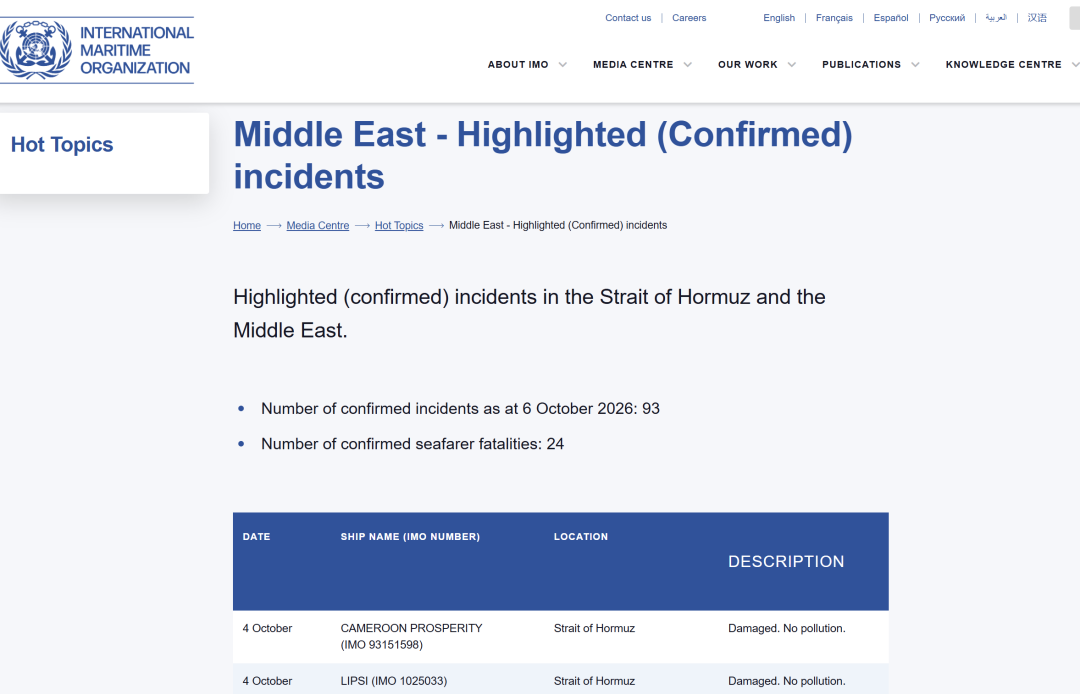
As of 6 October, the IMO’s list for the Strait of Hormuz and the wider Middle East recorded 93 confirmed incidents and 24 seafarer fatalities. Continuing attacks and casualties form the background against which insurers reassess exposure, owners reconsider employment and crews seek additional compensation.
Exceptional freight reflects constrained capacity
Demand for Persian Gulf transportation persists despite the attacks. Producers need export outlets and refiners need feedstock, while some owners reduce their participation or avoid exposed waters. The resulting shortage of willing and available vessels supports exceptional freight assessments.
The Baltic Exchange’s Week 40 tanker report, published on 2 October, showed the following round-trip time-charter-equivalent assessments for VLCCs:
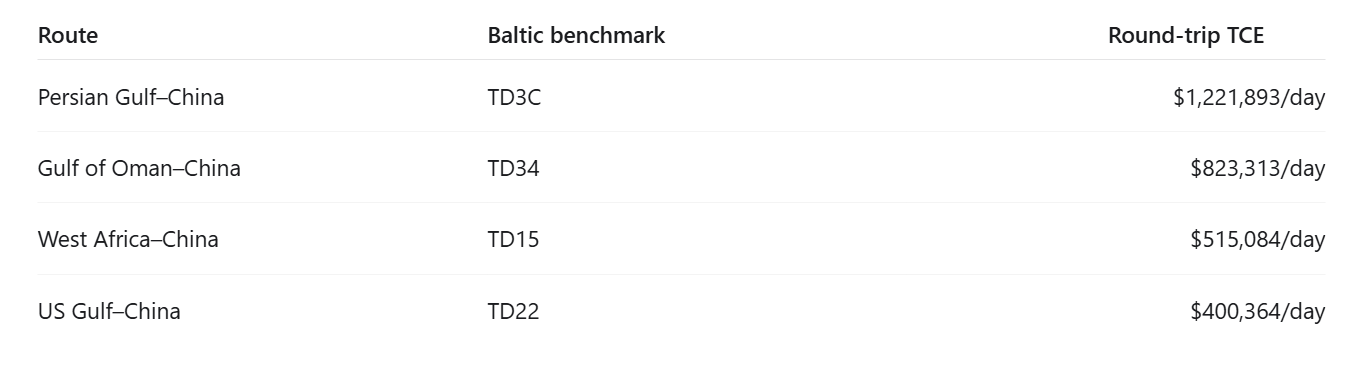
On those assessments, Persian Gulf–China earnings were approximately 3.05 times the US Gulf–China level and around 48% higher than the Gulf of Oman–China assessment. Such differences influence vessel positioning and strengthen the bargaining position of owners continuing to offer Persian Gulf transportation.
The LR2 segment, to which Lipsi belongs, showed a similar regional contrast. In the same report, the Persian Gulf–Japan TC1 route generated a round-trip TCE of approximately $268,877 a day, against $67,781 a day on the Mediterranean–East TC15 route—almost four times as much.
These are benchmark daily earnings calculated using standard vessel and voyage assumptions, after deducting assumed fuel and other voyage expenses. Actual operating results also depend on crewing, maintenance, capital and other costs, as well as the freight agreed and the voyage’s execution.
Route length, vessel position and regional supply and demand contribute to the differences. Persian Gulf assessments provide a substantial commercial incentive, but delays, damage and additional expenditure can alter the return anticipated when a fixture is agreed.
War-risk insurance changes the voyage calculation
The Financial Times cited insurance brokers putting war-risk premiums for the relevant voyages at between 6% and 10% of a ship’s hull value, with a supertanker’s cover for entering the Gulf potentially costing as much as $20 million. Individual quotations vary with vessel characteristics, insured value, terms and exposure.
The escalation predates the latest pay reports. On 27 July, Lloyd’s List reported that war-risk cover for a single VLCC voyage had exceeded $10 million, with premiums returning to double-digit percentages for some owners. Insurance has become a central element of negotiations between cargo interests and operators.
How the cost is allocated depends on the contract. Reimbursement of additional war-risk premiums, responsibility for crew bonuses, payment for waiting and transfer time, and the consequences of damage or interruption can all affect the final result.
Cargo interests seeking to move oil out of the Gulf must weigh expensive transportation against delayed exports, delivery commitments and the alternatives available. Their willingness to accept exceptional freight reflects the importance of securing a workable route to market.
High freight, insurance premiums and crew payments therefore appear within the economics of the same operation. Their cash-flow effects may differ: cover and other expenses can fall due before freight or contractual reimbursements are received.
Insurance may meet covered losses, but repairs still take time and injured seafarers still require treatment. Financial protection and the physical safety of a voyage remain distinct operational considerations.
Shuttle voyages keep oil moving, at a cost
The crisis has also changed how crude is transported. Some tankers repeatedly cross Hormuz, bring cargoes out of the Persian Gulf and transfer them to other vessels near Fujairah or elsewhere in the Gulf of Oman. Those receiving vessels then carry the oil to its final destination.
Lloyd’s List’s September analysis described how this shuttle-and-transfer system increased waiting time and tied up VLCC capacity. Higher returns for Gulf of Oman loadings also drew ships away from the Atlantic basin, affecting availability in other export regions.
Additional handovers require coordination, vessel time and suitable transfer arrangements. Receiving ships can reduce their need to enter the Gulf, while the shuttle vessels and their crews may face repeated, concentrated exposure to the strait.
The system helps sustain exports while spreading the disruption through offshore waiting, transfer operations and global vessel deployment. Lower transport efficiency can absorb more tonnage even without a corresponding increase in the quantity of oil shipped.
Reuters reported on 5 October, citing preliminary Kpler data, that Middle Eastern crude exports exceeded pre-war levels on 14 days in September. That regional measure includes Hormuz and other export routes, reflecting producers’ use of several channels to restore shipments.
Attacks nevertheless continued as exports recovered. In a separate commentary that day, Reuters columnist Ron Bousso identified logistics as an increasingly important constraint on the oil market. Cargo can continue to move while requiring more expenditure, more transport resources and less predictable execution.
For crews assigned to repeated crossings, the arrangement also brings sustained pressure. Fatigue, psychological wellbeing, rest and crew-change planning remain important to safe operations alongside the negotiation of danger pay.
The distribution of risk—and the ability to choose
Shipowners, charterers, insurers and seafarers all participate in the transport chain, but their risks take different forms.
Owners may receive higher freight while facing damage, downtime and commercial losses. Charterers pay more to secure delivery. Insurers assume liabilities within the agreed cover. Seafarers receive additional compensation while remaining physically present aboard the vessel exposed to attack.
An owner can adjust exposure across ships, trades and contracts. A seafarer cannot diversify the personal consequences of a strike in the same way. For crew members and their families, a serious injury can have effects extending far beyond the duration of an employment contract.
Access to information, willingness to accept an assignment and practical arrangements for leaving and returning home therefore shape the meaning of any danger-pay package. Wages and protections together determine the conditions under which the work is undertaken.
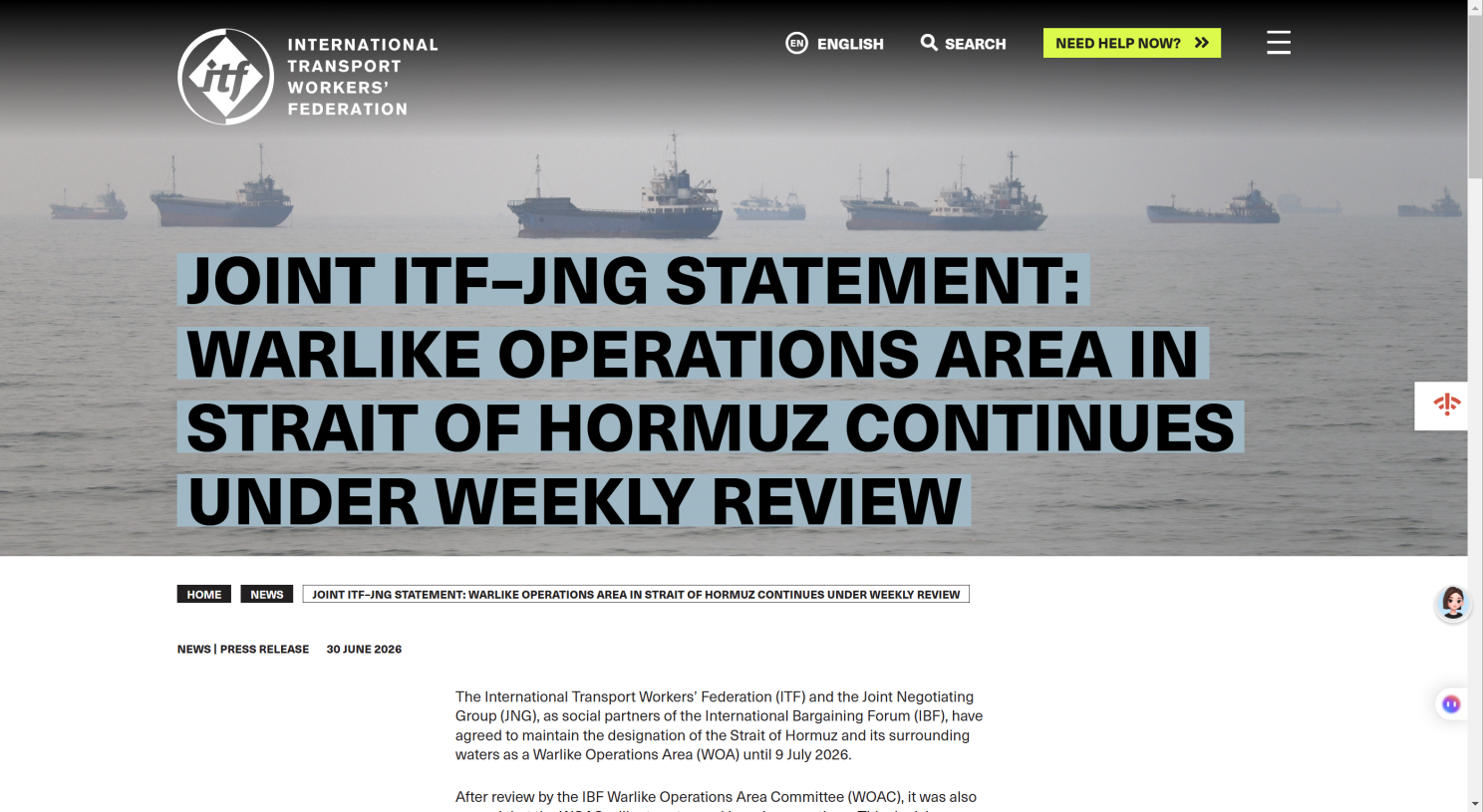
In a joint statement on 30 June, the International Transport Workers’ Federation and the Joint Negotiating Group outlined the protections then applicable to IBF-covered vessels in the designated Warlike Operations Area. These included additional basic-wage payments, increased death and disability compensation, and the right to refuse entry with repatriation at the company’s expense. The designation was subject to regular review, with entitlements linked to the applicable agreements.
Higher remuneration can form part of a negotiated assignment. Risk information, repatriation arrangements and personnel protection also need to be established before it begins. For crews already making repeated crossings, relief, rest and support after exposure to danger affect the sustainability of the operation.
Profit, risk and consequences that cannot be transferred
The coexistence of extreme freight rates and dangerous voyages recalls a passage by the British trade unionist T. J. Dunning, published in 1860 and later quoted by Karl Marx in Capital:
“With adequate profit, capital is very bold. A certain 10 per cent. will ensure its employment anywhere; 20 per cent. certain will produce eagerness; 50 per cent., positive audacity; 100 per cent. will make it ready to trample on all human laws; 300 per cent., and there is not a crime at which it will scruple, nor a risk it will not run, even to the chance of its owner being hanged. If turbulence and strife will bring a profit, it will freely encourage both. Smuggling and the slave-trade have amply proved all that is here stated.”
The passage raises an enduring question about how potential rewards change the willingness to accept risk. In the current tanker market, the withdrawal of some owners leaves fewer vessels available and supports higher quotations. Those quotations, in turn, influence the decisions of operators that continue to participate.
Commercial returns and personal harm follow different paths. Damaged ships can be repaired and some financial losses recovered. Death, serious injury and their consequences for families cannot be reversed by subsequent earnings. Exceptional wages indicate the difficulty and danger of an assignment; they provide no assurance of a safe outcome.
Lipsi’s attack roughly six weeks after delivery illustrates the exposure of new ships. Monthly-equivalent captain’s pay reaching $100,000 reflects pressure on crewing. War-risk cover reportedly costing up to $20 million shows the financial burden of arranging a voyage.
Together, these figures describe a transport system that continues to serve global oil demand while distributing its costs and risks unevenly among cargo interests, shipowners, insurers and seafarers.
A more stable Hormuz trade will depend on safe passage, effective crew protection and predictable operations. High pay and freight rates record the market’s response to the crisis. Continuing attacks and casualties record the consequences that response has yet to overcome.


READ MORE
 Tankers
Oil Majors Are Eyeing Ships Delivering in 2030. What Are They Worried About?
 Tankers
Uni-Tankers Secures Eight Stainless Steel Chemical Tankers to Be Built at Haidong
 Tankers
Tankers Are Earning $1 Million a Day. Why Shipowners Fear “World Peace”
 Tankers
As Erasmus Targets 100 Ships, John Su Keeps Returning to Survival
 Tankers
Transpetrol Makes LR1 Debut with Two 75,000-dwt Tankers at Yangzijiang
 Tankers
Nanjing Tanker Seeks Four More LR2s as Product Tanker Expansion Accelerates
 Tankers
Trafigura Moves Deeper into Shipowning as Volare Shipping Heads for an Oslo Listing
 Tankers
$64,569 !!! Record ClarkSea Index Masks a Shipping Boom Built on Different Forces
 Tankers
Trump angin. US Shadow Fleet Law Raises New Risks for China’s Russian Oil Trade
 Tankers