


From LR2s to 3,200-TEU Boxships: Hengli Expands Its Greek Owner Footprint
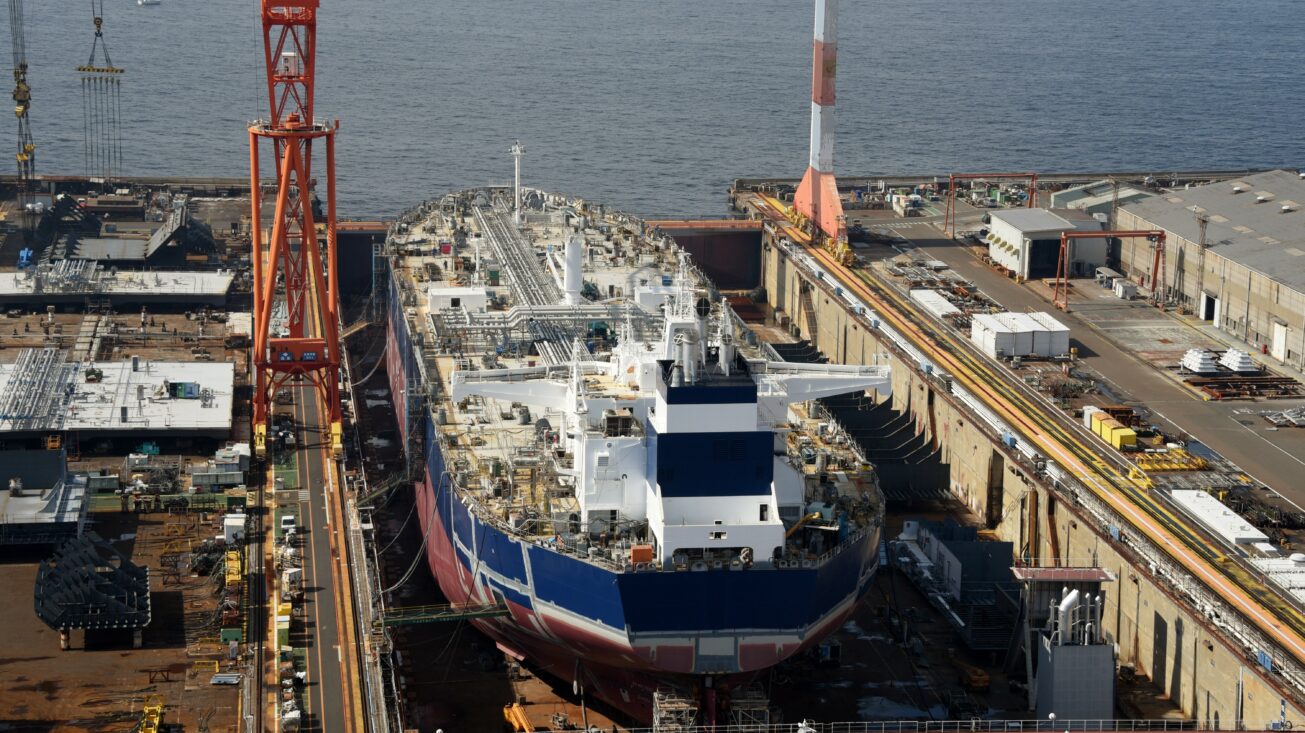

Thenamaris has confirmed four 3,200-TEU containership newbuildings at Hengli Shipbuilding for 2028 delivery, extending a relationship that already includes three LR2/Aframax tankers. The move increases the Greek owner’s limited container exposure while highlighting Hengli’s growing ability to win repeat, cross-segment business from international shipowners.
Greek shipping group Thenamaris is expanding its containership exposure with four 3,200-TEU newbuildings at Hengli Shipbuilding in Dalian, China, deepening a relationship with the yard that began with tanker orders.
According to Thenamaris’ official containership newbuilding page, the vessels carry hull numbers HL-C3100-13, HL-C3100-14, HL-C3100-22 and HL-C3100-23 and are all scheduled for delivery in 2028.
Thenamaris is currently coordinating the construction of 19 newbuildings
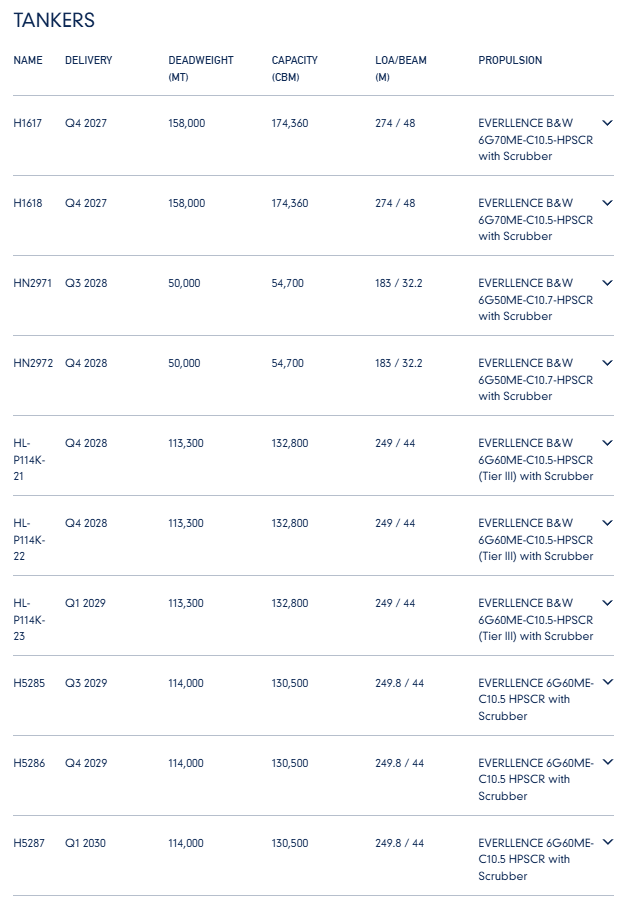
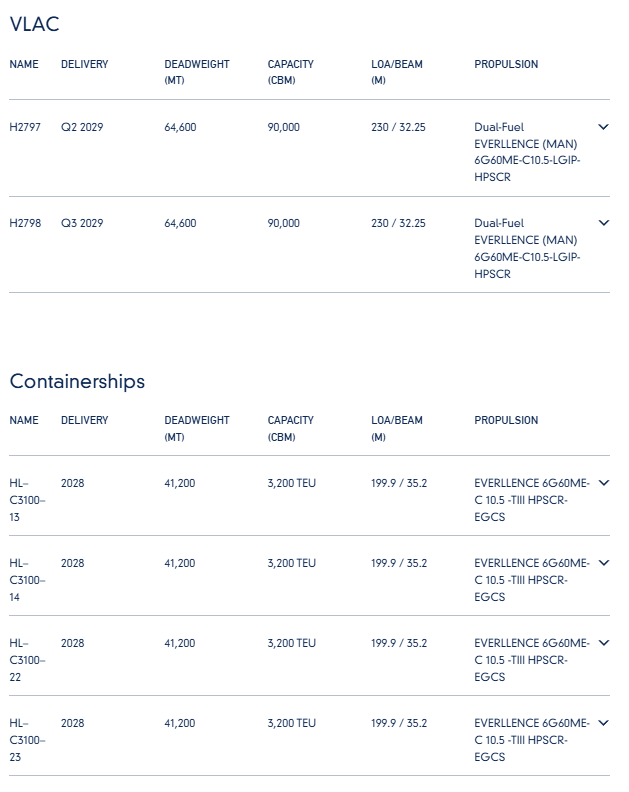
Each ship will have a deadweight of 41,200 tonnes, a length of 199.9 metres and a beam of 35.2 metres. The vessels will be powered by Everllence 6G60ME-C main engines and equipped with open-loop scrubbers, shaft generators and alternative maritime power systems for shore-side electricity.
No contract price has been disclosed, and there has been no official confirmation of additional options, financing arrangements, future charterers or intended deployment.
For Thenamaris, the order is significant because its container exposure remains relatively small. For Hengli, it is equally notable because the deal extends an existing owner relationship from tankers into a second major vessel segment.
From Two Boxships to Potentially Six
Thenamaris ConBulk currently operates just two containerships: SEADREAM and SEASMILE.
Both are 5,071-TEU Post-Panamax vessels built by Hyundai Samho Heavy Industries, with SEASMILE delivered in 2013 and SEADREAM in 2014. Each has a deadweight of 62,603 tonnes. Their specifications are listed on Thenamaris’ official containership fleet page.
The four 3,200-TEU newbuildings are therefore not direct like-for-like replacements for the existing ships.
If SEADREAM and SEASMILE remain in the fleet when the new vessels arrive, Thenamaris ConBulk’s containership fleet would increase from two vessels to six.
That would still represent a relatively small container platform compared with major tonnage providers, but for an owner whose ConBulk business is dominated by dry bulk tonnage, it marks a clear increase in containership asset exposure.
Thenamaris has not disclosed whether the new ships are backed by long-term charters, intended for the open time-charter market or being built around the requirements of an existing liner customer.
It would therefore be premature to conclude that the company is building a large-scale container platform, and there is no indication that it intends to enter liner shipping operations itself.
A more measured conclusion is that Thenamaris is materially increasing its ownership exposure to the containership sector.
Hengli Moves From LR2s Into a Second Thenamaris Segment
The relationship between Thenamaris and Hengli had already been established in tankers.
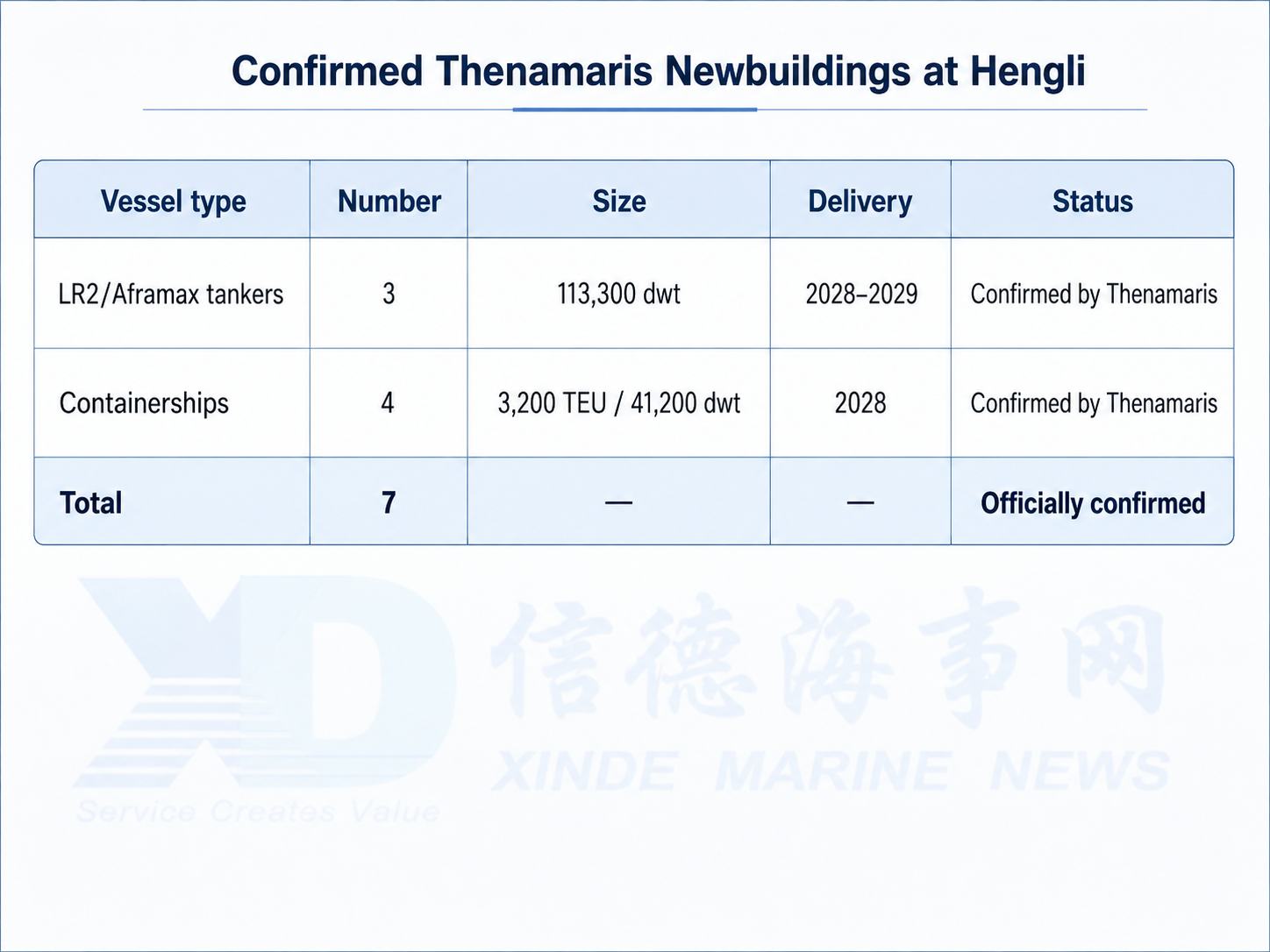
Thenamaris currently has three 113,300-dwt LR2/Aframax tankers under construction at Hengli, with hull numbers HL-P114K-21, HL-P114K-22 and HL-P114K-23.
The first two are scheduled for delivery in 2028 and the third in 2029, according to Thenamaris’ official tanker newbuilding page.
With the addition of the four containerships, Thenamaris has now confirmed seven vessels at Hengli across two segments.
The importance lies not just in the vessel count.
For international owners, placing a second series at the same shipyard in a completely different segment is usually influenced by more than price alone. Design maturity, construction quality, equipment sourcing, supervision, financing structure, berth availability and confidence in delivery performance all matter.
Thenamaris first entrusted Hengli with LR2s. It has now added containerships.
That does not yet amount to a formal strategic partnership, but it does show that Hengli has progressed from being a single-segment supplier to a broader newbuilding partner for the Greek group.
Seven of Thenamaris’ 19 Newbuildings Are at Hengli
The relationship looks more significant when viewed against Thenamaris’ wider newbuilding programme.
Thenamaris currently lists 19 vessels under construction across its businesses, according to its official newbuilding overview.
The programme includes:
-
12 tankers;
-
three 90,000-cu-m very large ammonia carriers;
-
four 3,200-TEU containerships.
Of the 12 tanker newbuildings, six are Aframax/LR2 vessels, including the three being built at Hengli. The four containerships are also all at Hengli.
That means seven of Thenamaris’ 19 publicly listed newbuildings are being built by Hengli, representing more than one-third of the group’s current orderbook by vessel count.
For Hengli, that makes Thenamaris an especially useful case study in repeat business.
If the relationship eventually expands into a third or fourth vessel type, it would provide stronger evidence that the yard has developed a longer-term position with the owner. It is too early to make that claim today, but the direction is notable.
Greek Owners Are Appearing More Frequently in Hengli’s Orderbook
Thenamaris is not the only Greek owner linked to containership projects at Hengli.
Industry reports have connected Minerva Dry with a series of 6,000-TEU newbuildings at the Dalian yard for 2028 delivery.
Because the project has not been fully disclosed by both owner and yard, its commercial terms should still be treated cautiously. Riviera Maritime reported Minerva Dry’s move into larger containerships at Hengli.
Centrofin Management has also been linked by industry sources to two 6,000-TEU Hengli newbuildings, likewise reportedly for 2028 delivery.
If confirmed, the move would represent an entry into containership ownership for a company historically focused on tankers and dry bulk. For now, the project should remain described as market-reported rather than officially disclosed. Riviera Maritime reported the Centrofin-Hengli project here.
These reported orders are not on the same evidentiary footing as the Thenamaris vessels, which are already listed on the owner’s website.
Taken together, however, they point to a broader trend: Greek owners are appearing increasingly often in Hengli’s containership pipeline.
Hengli Signed 21+4 Vessels During Posidonia
Hengli’s own disclosures provide additional context.
During Posidonia in Greece in June 2026, Hengli said it signed agreements covering 21 firm vessels plus four options, involving six owners and five ship types, with a headline project value approaching RMB15 billion.
The vessels included:
-
6,000-TEU containerships;
-
Kamsarmax bulk carriers;
-
Capesize bulk carriers;
-
LR2 product tankers;
-
Suezmax crude tankers.
The company said effective contracts represented more than RMB10 billion and that its 6,000-TEU containership orderbook was approaching 40 ships after the latest deals. The figures come from Hengli’s official Posidonia disclosure.
These are company-reported figures and should be distinguished from vessel-by-vessel counts compiled by independent databases.
Even so, the trend is clear.
Hengli is turning mid-sized containerships into an increasingly important serial product alongside bulk carriers and tankers, and the Greek market is becoming an important source of international business.
Why 3,200 TEU Still Attracts Investment
The timing of the Thenamaris order is notable because the global containership orderbook is already very large.
By August 2026, industry data showed the global orderbook had moved above 40% of the existing fleet in TEU terms, underlining the scale of new capacity due to enter the market over the next several years.
But the supply picture differs sharply by vessel size.
Euroseas, citing Clarksons Research, showed that as of May 2026 around 29.4% of the 3,000–7,999 TEU fleet was more than 20 years old, while another 36.3% was between 15 and 19 years old.
In other words, almost two-thirds of the fleet in that size range was already at least 15 years old.
At the same time, the orderbook for the 3,000–7,999 TEU segment stood at about 21.7% of the existing fleet, materially below the headline orderbook ratio for the containership market as a whole. The figures are contained in Euroseas’ Q1 2026 investor presentation, based on Clarksons Research data.
That distinction matters.
A large overall containership orderbook does not mean every size segment faces the same supply pressure.
Ships in the 3,000–4,000 TEU range remain useful across regional, north-south and secondary mainline trades. They are also less constrained by port depth, berth length and terminal infrastructure than the largest mainline vessels.
The investment case is therefore partly about replacement.
By 2028, a significant portion of the existing mid-sized fleet will be approaching ages at which fuel consumption, maintenance costs, CII performance, carbon costs and residual values become increasingly important.
That does not remove risk. Large newbuildings entering the main trades could push older vessels into secondary routes through cascading, intensifying competition in the mid-sized market.
The key question is therefore whether ageing tonnage exits faster than redistributed larger ships move down into regional trades.
Charter Market Remains Supportive — For Now
Current charter earnings also provide a supportive backdrop.
Harper Petersen’s HARPEX data for August 28 showed the following daily assessments:
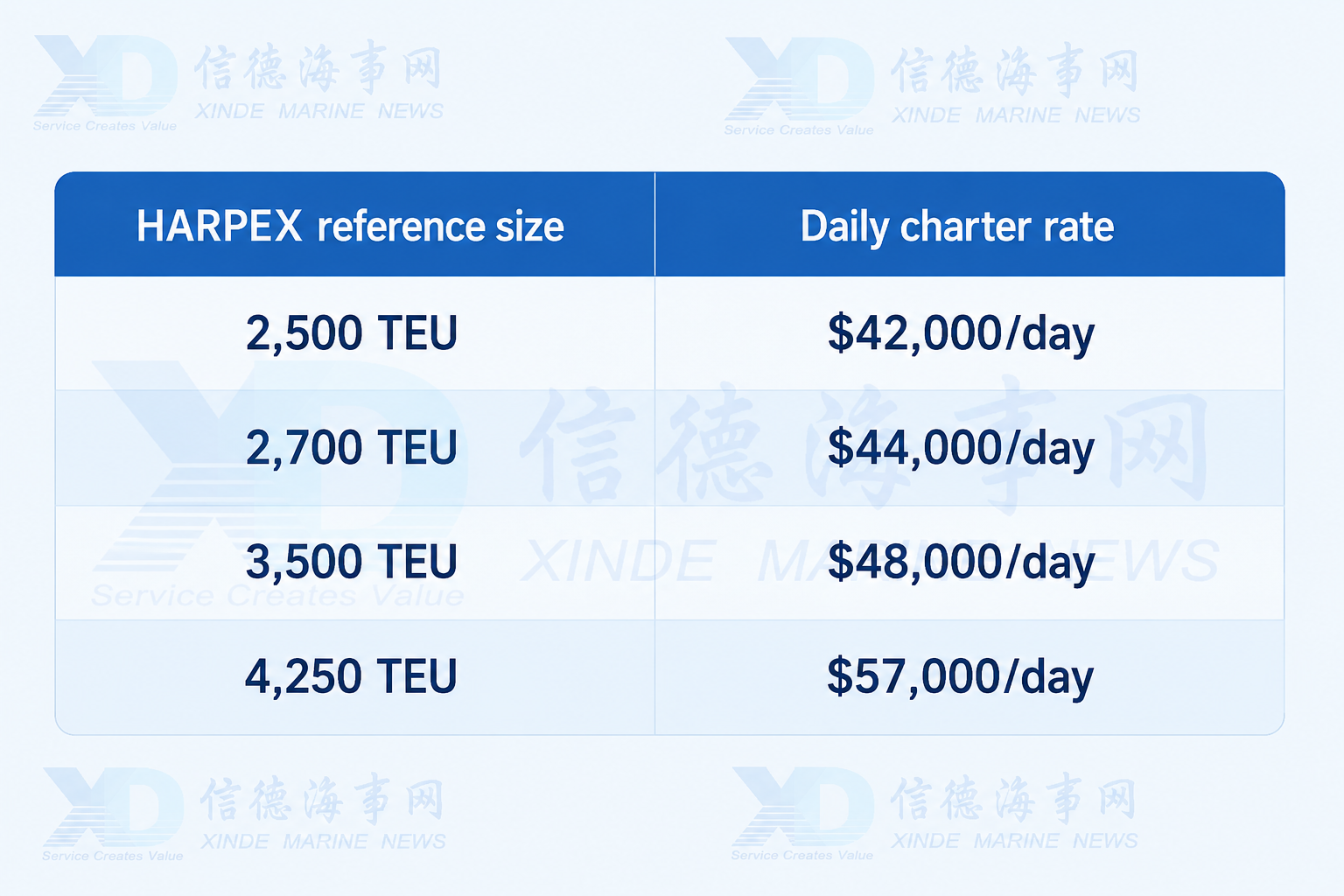
The overall HARPEX index stood at 2,413 points, according to Harper Petersen’s official container charter index.
These numbers should not be used as an earnings forecast for Thenamaris.
There is no exact 3,200-TEU HARPEX category, and the vessels will not be delivered until 2028.
By then, charter levels will depend on cargo growth, newbuilding deliveries, vessel recycling, Red Sea routing, port congestion and the pace at which larger ships cascade into secondary trades.
The current market is therefore more useful in explaining why owners are still willing to commit capital to mid-sized boxships today than in predicting what the ships will earn in two years.
Hengli Is Competing for Repeat Business
The wider significance of the Thenamaris order also lies in Hengli’s rapid development.
Hengli Group established Hengli Heavy Industry in 2022 after acquiring the former STX Dalian shipbuilding assets. The yard resumed large-scale operations in 2023 and delivered its first newly built vessel in 2024, according to Hengli Heavy Industry’s official company profile.
Since then, the group has expanded aggressively across bulk carriers, tankers, containerships and gas carriers.
Hengli said it secured 207 vessel orders in the first half of 2026, including 56 containerships, 94 tankers, 49 bulk carriers and eight VLACs. It also said its cumulative contracted backlog had exceeded 500 vessels and delivery slots now extended into 2030. Those figures are from Hengli’s own first-half 2026 disclosure.
For a yard expanding at that pace, however, total order intake is not the only measure that matters.
The more important question is whether international owners return after placing their first contracts.
And even more importantly: whether they are willing to place different ship types at the same yard.
Thenamaris now provides exactly that kind of test case.
From three LR2s to four 3,200-TEU containerships, Hengli has moved from supplying tankers to participating in a second Thenamaris newbuilding segment.
That is more strategically meaningful than winning a single isolated order.
2028 Will Be the Real Test
It is still too early to say that Thenamaris is building a major containership platform.
It is also too early to conclude that Greek owners are broadly shifting their newbuilding programmes toward Hengli.
The seven Thenamaris vessels can be verified directly through the owner’s website, while some Minerva Dry and Centrofin projects remain based primarily on industry reporting and broking sources. The distinction matters.
What can be said with greater confidence is narrower:
Thenamaris is materially increasing its containership exposure, while Hengli has successfully extended an existing Greek owner relationship from LR2 tankers into a second major commercial ship segment.
The real test will come around 2028.
By then, the market will be able to judge whether Hengli can deliver its growing pipeline of 3,000–6,000 TEU containerships on schedule and at the expected performance levels, whether fuel consumption and technical reliability meet owners’ expectations, and whether Greek customers such as Thenamaris return with further orders.
For Thenamaris, the key questions will be whether the four ships are secured on long-term charters, who the eventual charterers are, which trades they enter and whether the existing two 5,071-TEU vessels remain in the fleet.
If Hengli continues to win repeat and cross-segment orders from the same international owners after the first vessels enter service, the four 3,200-TEU ships will mean more than another undisclosed newbuilding contract.
They will represent another step in Hengli’s transition from winning international orders to building repeat international owner relationships.

READ MORE
 Shipbuilding
Yichang Changyun plans RMB120m inland bulker programme
 Shipbuilding
Steel Giant Shagang Eyes Shipbuilding as a Booming Market Draws Industrial Capital
 Shipbuilding
Hengli Secures 12 Tanker Orders, Retaining World’s Largest VLCC Orderbook
 Shipbuilding
Amid China’s Shipbuilding Boom, a State-Owned Yard Quietly Enters Liquidation
 Shipbuilding
Hengli Signs 11 VLAC Contracts in One Week
 Shipbuilding
China ZWI Enters Ocean Shipping with VLGC Acquisition and Chemical Tanker Newbuild Project
 Shipbuilding
World’s First 325,000-DWT Methanol Dual-Fuel Ore Carrier Delivered
 Shipbuilding
CIMC Raffles Extends NOCC Car Carrier Programme to 2030
 Shipbuilding
Grimaldi Advances New ConRo and Multipurpose Projects as Fleet Renewal Continues
 Shipbuilding