


CMB.TECH Earns $733m in H1 as Saverys Sells Tankers at the Top and Bets on Dry Bulk

CMB.TECH is entering what may be described as the harvesting phase of an expansion cycle that has transformed the company over the past several years.
The diversified shipping group reported revenue of $703.9 million for the second quarter of 2026, EBITDA of $552.8 million and net profit attributable to shareholders of $364.4 million, equivalent to $1.26 per share. For the first half of the year, revenue reached $1.224 billion, EBITDA totaled $1.111 billion and net profit came in at $733.2 million. Operating cash flow rose to $417.3 million, compared with just $73.1 million in the same period of 2025.
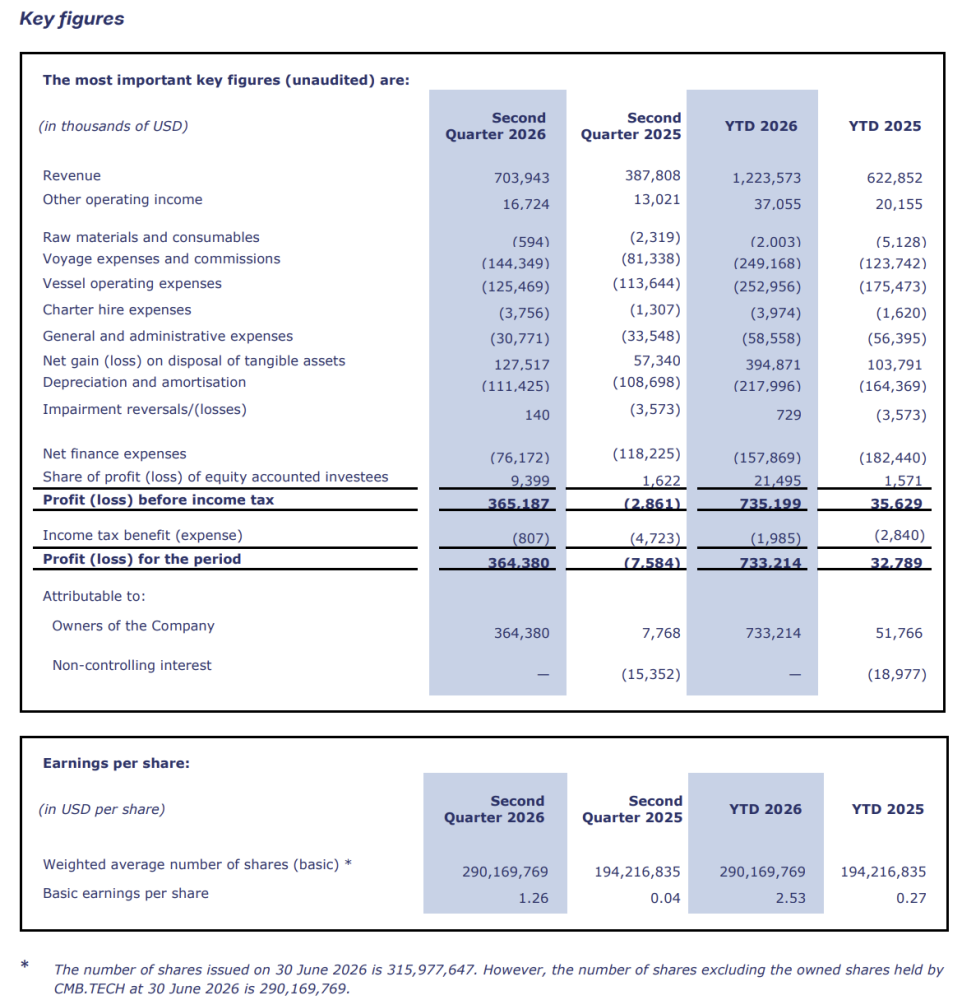
The headline numbers are striking, but they tell only part of the story. The stronger result comes as the former Golden Ocean fleet is increasingly reflected in the group, newly delivered vessels begin generating earnings, tanker and large dry bulk markets remain highly profitable, and CMB.TECH continues to monetize vessels at elevated secondhand prices.
The company titled its second-quarter presentation “Making Hay”, and CEO Alexander Saverys repeatedly returned to the same idea during the earnings call: while market conditions remain exceptionally favorable, CMB.TECH intends to maximize operating cash generation, realize asset gains where valuations justify selling, reduce financial leverage and return an increasing portion of cash to shareholders.
That represents a notable change from the CMB.TECH of the past few years. During the expansion phase, capital was being deployed aggressively into acquisitions, newbuildings and alternative-fuel projects. Today, the emphasis is progressively shifting from capital deployment to capital recycling.
At the time of the earnings call, CMB.TECH had 206 vessels in operation and another 26 newbuildings still to be delivered, with an average fleet age of less than six years. Contracted revenue backlog stood at around $3.3 billion. Management placed the broker value of its fleet at approximately $11.2 billion, compared with a stock market capitalization of about $5.2 billion at the time.
The two figures cannot be compared directly because the fleet value does not account for debt and other liabilities. But they illustrate the scale of the asset base CMB.TECH has assembled through the combination of Euronav, Golden Ocean and a substantial newbuilding program across tankers, dry bulk carriers, containerships, chemical tankers and offshore support vessels.
More importantly, the heavy investment phase is now approaching its end. Remaining newbuilding capex stood at about $890 million, of which approximately $770 million had already been financed. Only around $119 million remained unfunded. By the end of 2026, total remaining capex is expected to fall further to roughly $375 million-$390 million.
That transition has major implications for free cash flow. Cash that previously had to be recycled directly into shipyards will increasingly become available for debt reduction, dividends or selective investment.
Earning More Than $120,000 a Day — and Still Selling Tankers
The most revealing feature of CMB.TECH’s current strategy can be seen in its tanker business.
Euronav’s VLCCs earned an average spot TCE of $126,790 per day in the second quarter, compared with $44,981 per day a year earlier. Suezmax spot earnings averaged $123,405 per day, up from $40,160 per day in the second quarter of 2025.
The strength has continued into the third quarter. At the time of the results, CMB.TECH had fixed 83% of its available VLCC days at an average of $125,404 per day, while 73% of Suezmax days had been covered at an average of $117,579 per day.
In such a market, the instinct of many tanker owners would be to retain as much spot exposure as possible.
CMB.TECH has been doing something more complicated.
During the second quarter, the group sold the 2012-built VLCCs Ilma and Ingrid, generating a combined gain of about $98.2 million. It also sold the 2007-built Suezmax Sienna, producing another gain of around $29.2 million. Further disposals are scheduled to contribute substantial earnings in the second half.
The 2023-built Suezmaxes Brest and Brugge are expected to generate approximately $100.2 million in gains when delivered to their buyers in the third quarter. The 2016-built VLCC Donoussa is expected to contribute a gain of around $74.3 million in the fourth quarter. Perhaps most strikingly, the 2024-built Suezmax Bristol has also been sold and is expected to generate a gain of about $56.9 million.
Xinde Marine News previously reported that Brest, Brugge and Bristol alone are expected to generate approximately $157.4 million in capital gains. By August, CMB.TECH had disclosed the sale of nine VLCCs and four Suezmaxes during 2026, with total expected gains from those transactions exceeding $600 million.
This is no longer conventional fleet renewal.
Saverys explained the logic in simple terms during the earnings call. For every ship, an owner effectively has three choices: keep the vessel in the spot market, lock it into a time charter, or sell it. At current asset prices, some VLCCs and Suezmaxes can be sold at valuations that make immediate monetization more attractive than retaining all of the future earnings exposure.
CMB.TECH is therefore not selling tankers because it has suddenly turned bearish on the sector. It is comparing the present market value of the vessel with the future cash flows it might generate and making asset-by-asset decisions.
That distinction is important.
The company is simultaneously benefiting from exceptionally high freight earnings and exceptionally high secondhand ship values. The ships are generating large operating cash flows, while the underlying assets themselves have appreciated substantially.
The earnings composition for the first half demonstrates how powerful that combination has become.
CMB.TECH recorded approximately $394.9 million in gains on vessel and other tangible asset disposals during the first six months of 2026. Of that, $127.5 million was recognized in the second quarter, implying roughly $267.4 million in the first quarter.
Yet despite disposal gains falling by more than half from the first quarter to the second, quarterly net profit remained almost unchanged: approximately $368.8 million in the first quarter versus $364.4 million in the second. Revenue, meanwhile, increased from about $520 million to more than $700 million.
The message is clear. CMB.TECH is not simply selling ships to manufacture earnings. Its underlying fleet operations have strengthened sufficiently to compensate for a much lower contribution from asset disposals.
The Real Concern Is the 2027-2028 Tanker Delivery Wave
CMB.TECH’s willingness to sell tankers into an exceptionally strong market is closely linked to management’s view of the supply picture beyond 2026.
Saverys said that the global orderbook currently includes approximately 370 VLCCs and around 250 Suezmaxes, or roughly 620 crude tankers in total. The combined orderbook-to-fleet ratio for the two segments is now above 30%.
The immediate delivery pressure in 2026 remains manageable. From 2027, however, the picture changes.
According to CMB.TECH’s estimates, the market could see approximately one new VLCC or Suezmax delivered every two days during 2027 and 2028.
Saverys used the word “tsunami” to describe the scale of the delivery wave.
That is a major shift from the tanker market of the past several years. For much of the recent cycle, owners could point to an ageing fleet and argue that new deliveries would be absorbed by scrapping. The concern now is that the orderbook has grown beyond the number of older vessels that could reasonably be expected to leave the market.
If the extraordinary tonne-mile support created by geopolitical disruption also moderates by the time those vessels arrive, the supply-demand balance could change quickly.
This is why CMB.TECH has become more measured in its tanker outlook. The company remains constructive on present fundamentals, but its language has shifted towards being “positive but cautious”.
It is also why the company is using today’s high asset values to realize profits while simultaneously increasing charter cover on selected vessels. In effect, CMB.TECH is beginning to prepare for the next phase of the cycle before the current one has ended.
There is another reason tanker prices remain unusually strong.
Saverys noted that some buyers in the Middle East may not be assessing tankers purely through the traditional lens of financial return. For operators concerned about guaranteeing the ability to export crude from the region, ownership of physical tanker capacity can have strategic value. In that context, paying an additional tens of millions of dollars for a ship may matter less than ensuring access to transportation capacity.
That helps explain why buyers remain willing to pay extraordinary prices even for relatively young vessels.
CMB.TECH is taking the other side of that trade.
After Hormuz, China May Decide What Happens Next
Supply is the medium-term question for tankers. In the near term, CMB.TECH believes the next major variable could be China.
During the earnings presentation, management highlighted the sharp contraction in seaborne crude trade during the first half of 2026. Global seaborne crude volumes fell from around 31 million barrels per day in January to approximately 22.3 million barrels per day by June.
Of the roughly 8.5 million barrels per day decline, China accounted for around 4.3 million barrels per day. India contributed approximately 1.8 million barrels per day, Japan around 600,000 barrels per day and the United States roughly 400,000 barrels per day.
The important distinction is how buyers responded to lower Middle Eastern availability.
India and some other Asian buyers replaced Middle Eastern crude with barrels sourced from the Atlantic Basin. That substitution increased sailing distances and supported tanker tonne-mile demand.
China behaved differently.
Rather than replacing all lost Middle Eastern supply with long-haul crude, China reduced imports from multiple regions, effectively relying more heavily on inventory and allowing purchases to slow.
Saverys therefore argued that if the US and Iran eventually reach an agreement and traffic through the Strait of Hormuz normalizes, the next phase of the tanker market could depend heavily on Chinese purchasing behavior.
If China moves quickly to rebuild inventories, substantial VLCC demand could return to the Persian Gulf and support another strong period for tanker earnings.
If China instead continues to wait for lower oil prices while India, Vietnam, Thailand and other Asian buyers resume more conventional purchases from the Middle East, the market could see the reverse. Atlantic-to-Asia voyages would be replaced by shorter Middle East-to-Asia routes, reducing tonne-mile demand and releasing effective tanker capacity.
In other words, a reopening of Hormuz would not automatically mean weaker or stronger tanker markets. The outcome would depend on who buys the crude and from where.
China could therefore become the decisive marginal buyer.
Golden Ocean Has Given CMB.TECH a Second Earnings Engine
While management has become increasingly cautious about medium-term tanker supply, it remains notably more constructive on large dry bulk shipping.
This is where the strategic impact of the Golden Ocean combination is becoming clearer.
Bocimar’s Newcastlemax fleet earned an average spot TCE of $46,198 per day in the second quarter, almost double the $23,081 per day recorded a year earlier. Capesize spot earnings averaged $39,998 per day, while Panamax and Kamsarmax vessels averaged $20,226 per day.
At the time of the results, 85% of third-quarter Newcastlemax days had already been fixed at an average of $43,096 per day. Capesize coverage stood at 77% at $32,873 per day, while Panamax and Kamsarmax coverage reached 84% at an average of $19,137 per day.
Bocimar now operates 40 Newcastlemaxes, 37 Capesizes and 30 Kamsarmax/Panamax vessels, with additional newbuildings still to come.
Following the Golden Ocean transaction, CMB.TECH has effectively become one of the world’s largest listed owners of large dry bulk tonnage.
Management’s positive stance is based on a combination of fleet supply and cargo demand.
The Capesize orderbook currently stands at around 17% of the existing fleet, while the Panamax orderbook is approximately 14%. Those numbers are not insignificant, but the deliveries are spread over several years and the existing fleet is already ageing. Around 41% of Capesize vessels are more than 15 years old, while more than one-third of the Panamax fleet is above that age.
Compared with crude tankers, the replacement profile therefore appears considerably healthier.
On the demand side, CMB.TECH continues to see support from China. Domestic Chinese iron ore production has been declining, while steelmakers are increasingly reliant on higher-quality imported ore. Management estimates that if current trends continue, these factors alone could increase Chinese iron ore import demand by around 2.5% by 2027 compared with 2026.
The larger structural opportunity, however, may come from Guinea.
CMB.TECH devoted particular attention to Simandou during the earnings presentation. The logic is straightforward: transporting iron ore from Guinea to China requires a much longer voyage than carrying ore from Australia to China.
If Simandou progressively gains market share and replaces part of the shorter-haul Australian supply, the same quantity of iron ore will absorb substantially more vessel capacity.
CMB.TECH estimates that this shift could theoretically add around 7% to global Capesize tonne-mile demand.
For a company controlling a very large Newcastlemax and Capesize fleet, that is potentially transformative.
The timing of the Golden Ocean combination therefore matters. CMB.TECH expanded its exposure to large dry bulk vessels just as the market was entering a period in which long-haul West African iron ore, Chinese import requirements and an ageing fleet could reinforce each other.
This gives the group a second major earnings engine alongside tankers, but one driven by a different set of fundamentals.
From Expansion to Capital Discipline
The most important change at CMB.TECH may ultimately be found not in freight rates, but in capital allocation.
Over the past several years, the group became associated with aggressive growth: the Golden Ocean transaction, major newbuilding orders across several ship types, investments in ammonia-ready tonnage and the development of a wider hydrogen and ammonia ecosystem.
The tone today is markedly different.
Saverys repeatedly emphasized that newbuilding prices remain high, steel prices are elevated and many potential projects simply do not offer sufficiently attractive returns.
CMB.TECH therefore sees no reason to grow for growth’s sake.
The containership division illustrates this approach.
The container market has performed better in 2026 than management originally expected. Red Sea diversions have lasted longer, security risks around the Bab el-Mandeb remain unresolved, and cargo demand has also been supportive.
But CMB.TECH remains cautious on the medium-term supply picture because the containership orderbook is equivalent to roughly 38% of the existing fleet. If Red Sea routing eventually normalizes, the capacity currently absorbed by Cape of Good Hope diversions could also return to the market.
Delphis largely avoids that risk by placing its vessels on long-term charters of 10 to 15 years.
When analysts asked why CMB.TECH was not taking advantage of current charter markets to order more containerships, Saverys’ response was simple: the company has not seen investment opportunities offering sufficiently compelling returns.
A similar approach applies to chemicals.
Bochem is building a 16-vessel chemical tanker fleet, but the majority of the ships are already covered by seven- or ten-year contracts. Only a small number are exposed to the spot market. That limits the financial impact of a potential increase in chemical tanker supply during 2027 and 2028.
Windcat sits at the other end of the spectrum.
CSOV earnings remain strong, and demand is increasingly coming not only from offshore wind but also from offshore oil and gas. CMB.TECH recently placed two CSOVs with offshore oil and gas customers on two-year contracts, demonstrating the broader application of modern walk-to-work vessels.
Across the portfolio, the strategy is increasingly differentiated by segment: retain spot exposure where fundamentals justify it, lock in long-term contracts where supply risk is rising, and sell assets where secondhand values become too compelling to ignore.
The Capex Cycle Is Ending — and Cash Is Starting to Come Back
The shift in capital allocation is also becoming visible on the balance sheet.
CMB.TECH said it intends to repay a bond maturing on September 14 directly with cash rather than refinance the debt. Saverys said the repayment should not interfere with dividend capacity.
Second-quarter net finance expenses fell to $76.2 million, reflecting lower-cost refinancing and ongoing debt repayment.
The group continues to use a through-cycle loan-to-value target of around 50% as a reference point. Management is not in a rush to alter that framework, preferring to observe another one or two strong quarters and gain greater visibility on 2027 cash generation.
The company has nevertheless provided a useful indication of what the next phase could look like.
Using 2027 forward freight agreements and internal rate assumptions, CMB.TECH estimates that the group could generate approximately $700 million to $1.0 billion of operating cash flow in 2027 even after completing its remaining newbuilding capex.
This is not formal earnings guidance. The outcome will depend heavily on future VLCC, Suezmax, Newcastlemax and Capesize rates.
But the significance is clear.
As the major newbuilding program winds down, a much greater share of EBITDA can convert into free cash flow rather than being reinvested immediately into ships.
That opens the door to both faster deleveraging and larger shareholder distributions.
A 50% Payout Is Becoming an Informal Reference Point
CMB.TECH has proposed a distribution of $0.64 per share for the quarter, consisting of a $0.21 interim dividend and a $0.43 repayment from the share premium account.
Based on approximately 290.2 million shares outstanding excluding treasury stock at the end of June, the payment represents roughly $186 million in cash.
That is close to half of second-quarter net profit.
During the earnings call, analyst Frode Morkedal pointed out that CMB.TECH has now returned approximately 50% of earnings to shareholders for two consecutive quarters, including profits generated by vessel sales. He asked whether 50% should now be seen as a de facto payout policy.
Saverys stopped short of making it a formal commitment, but described 50% as “a very good target”.
The company intends to retain a discretionary dividend policy, particularly because shipping remains cyclical and attractive investment opportunities may arise. But Saverys made clear that when the company does not see better uses for its capital, it wants to continue rewarding shareholders at a similar level.
The contrast with the recent past is substantial.
During the expansion phase, cash flowed towards acquisitions and shipyards. Now, as the platform matures and capex falls, an increasing portion of realized profits can be distributed rather than immediately reinvested.
That is perhaps the clearest evidence that CMB.TECH has moved from a capital deployment phase into a capital harvesting phase.
Ammonia Is Moving From Newbuilding Concept to Commercial Deployment
At the same time, the company’s long-term ammonia strategy is beginning to move beyond vessel design and newbuilding announcements.
One of the clearest examples is CMB.TECH’s framework agreement with Fortescue covering up to 12 Newcastlemax bulk carriers of around 210,000 dwt.
During the earnings call, Saverys provided additional detail on how the arrangement will work.
The 12 vessels will not all have identical technical configurations. The pool will include ships already capable of operating on ammonia, ammonia-ready vessels, and ships that can be converted later.
As vessels are delivered, CMB.TECH and Fortescue will determine charter duration, charter rates and which specific voyages will actually use ammonia.
That is an important distinction.
The agreement is not simply another ammonia-fuelled shipbuilding program. It is a commercial framework connecting the ships to a major cargo owner and allowing ammonia use to scale progressively as fuel availability and economics improve.
This addresses one of the central problems facing ammonia as a marine fuel.
The challenge has never been limited to whether an engine can burn ammonia. Owners need reliable green ammonia supply, cargo interests willing to support the investment, a mechanism for sharing the additional cost, and long-term visibility over how the vessels will actually be employed.
CMB.TECH is increasingly attempting to connect those pieces.
The company has already invested in green ammonia supply-chain projects, including in China, while working with cargo owners and charterers such as Fortescue and MOL. Its participation in TFG Marine also gives the group a larger fuel procurement platform.
During the latest earnings call, Saverys noted that despite disruption to fuel availability in parts of the Middle East, CMB.TECH had not experienced significant bunkering problems across its fleet. Its partnership with TFG Marine, he said, had improved access to fuel supply.
What began as a procurement and scale strategy therefore also has a resilience dimension.
The long-term regulatory environment remains uncertain. Saverys said he strongly hopes the IMO will eventually deliver a clear, simple and globally consistent decarbonization framework because shipowners need regulatory certainty before committing capital to alternative fuels.
However, he expressed relatively low expectations for near-term progress and acknowledged that the position of the United States and several other countries remains difficult. He also pointed to China as an increasingly important participant in the future direction of IMO negotiations.
For CMB.TECH, that means the commercial case for ammonia cannot depend solely on the assumption that a global carbon price will arrive quickly.
The company is instead trying to make ammonia work through a combination of vessel technology, fuel supply, cargo-owner partnerships and long-term commercial arrangements.
CMB.TECH Is Becoming a Maritime Capital Allocation Platform
Taken together, the second-quarter results and the full earnings call show how far CMB.TECH has moved from the old Euronav model.
Euronav still gives the group high operating leverage to tanker markets. Golden Ocean’s integration into Bocimar has created a second major earnings engine in large dry bulk. Delphis provides long-term containership cash flow. Bochem reduces chemical tanker volatility through multi-year contracts. Windcat gives CMB.TECH exposure to offshore wind and offshore oil and gas. Its hydrogen and ammonia activities are increasingly linking the fleet to the future marine energy supply chain.
But the most important change is how management is allocating capital across those businesses.
When tanker asset prices are exceptional, CMB.TECH is willing to sell. When dry bulk fundamentals remain constructive, it retains substantial spot exposure. Where containership and chemical tanker orderbooks are heavy, it relies more heavily on long-term charters. When CSOV demand remains healthy, it continues to build contract coverage. When newbuilding prices become too expensive, it steps away from ordering. And when there is no superior investment opportunity, it repays debt and increases shareholder distributions.
CMB.TECH is therefore becoming difficult to describe simply as a tanker company, or even as a “green shipping” company.
It increasingly resembles a diversified maritime capital allocation platform that actively manages freight cycles, ship values, charter duration, leverage and technology exposure across several shipping sectors.
The $733 million net profit generated in the first half of 2026 is the most visible result of that model operating in an exceptionally favorable market.
But the more important signal came from Saverys’ tone.
Management understands that VLCC and Suezmax earnings above $120,000 per day will not last forever. It understands that the 2027-2028 tanker orderbook is a genuine supply risk. It also understands that today’s extraordinarily high secondhand values represent an opportunity that may not remain available indefinitely.
CMB.TECH is enjoying the current shipping boom, but it is not assuming that the boom will continue indefinitely.
That may ultimately be the best interpretation of “Making Hay”: while the sun is still shining, CMB.TECH is converting as much of the current cycle as possible into realized value.

READ MORE
 Containers
China Merchants links container and bulker businesses in Australia trial
 Containers
Ningbo Containerized Freight Index Weekly Commentary North America Freight Rates Remained Elevated; Composite Index Decline Narrowed
 Containers
CMA CGM’s $1.4bn FedEx Supply Chain Deal: How Its Global Logistics Network Is Taking Shape
 Containers
Global Ambitions, Provincial Roots: China’s State-Owned JOSCO Expands Overseas
 Containers
CMA CGM vs Maersk: A New Arms Race Begins!
 Containers
COSCO SHIPPING Sets Group Methanol Bunkering Record with 7,500-Tonne Delivery
 Containers
Up to 30 New Feeders: Inside Contships’ Fleet Renewal Strategy
 Containers
COSCO SHIPPING Holdings to Launch Third Far East–ECSA Service in December
 Containers
CMA CGM Expects Car Carrier Fleet to Reach Around 21 Vessels
 Containers