


COSCO SHIPPING Orders 18 More Boxships for US$2.99 Billion, Taking 2026 Newbuild Commitments to Approximately US$8 Billion
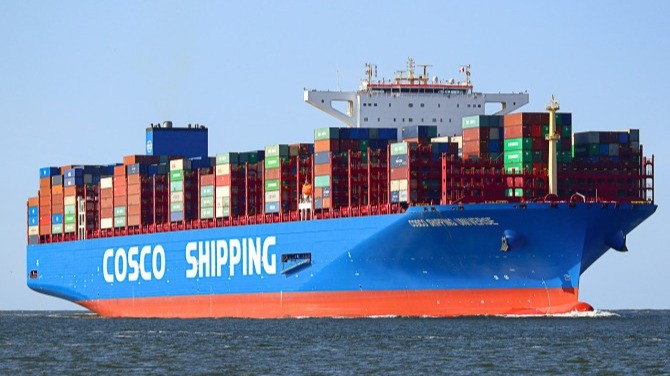
COSCO SHIPPING Holdings has accelerated its fleet renewal and expansion programme with an order for 18 containerships worth approximately US$2.99 billion, comprising 12 LNG dual-fuel vessels in the 22,000 TEU class and six 3,200 TEU wide-beam ships.
This marks the company’s third major round of newbuilding contracts in 2026. Based on announcements and interim results reviewed by Xinde Marine News, COSCO SHIPPING Holdings has contracted 48 containerships since the beginning of the year, representing a combined investment of RMB54.269 billion, equivalent to approximately US$8 billion, and total nominal capacity of around 676,800 TEU.
The US dollar conversions in this article use the reference exchange rate disclosed in the latest shipbuilding announcement—US$1 to RMB6.784—unless an original US dollar contract value was provided by the company.
Based on COSCO SHIPPING Holdings’ fleet figures at the end of July, the latest contracts would lift its owned newbuilding orderbook from 82 to approximately 100 vessels and from around 1.18 million TEU to nearly 1.46 million TEU. This is a static calculation and does not account for any subsequent deliveries, disposals or changes to the group’s chartered fleet.
Twelve ultra-large ships and six regional vessels
Under the latest agreements, wholly owned subsidiary COSCO Shipping Assets Management will order 12 LNG dual-fuel containerships from Shanghai Waigaoqiao Shipbuilding and China Shipbuilding Trading.
Although the vessels are described as being in the 22,000 TEU class, the contracts specify an actual intake of 21,700 TEU per ship. Each vessel is priced at US$224 million, taking the value of this portion of the order to US$2.688 billion.
The 12 ships are scheduled for delivery between 2028 and 2030 and will add approximately 260,400 TEU of capacity.
COSCO Shipping Assets Management has separately contracted CSSC Huangpu Wenchong Shipbuilding and China Shipbuilding Trading to build six 3,200 TEU wide-beam containerships. The vessels are priced at RMB339.8 million, or approximately US$50.1 million, each. The six-ship contract is worth around RMB2.039 billion, equivalent to approximately US$300.5 million.
The 3,200 TEU vessels are expected to be delivered between 2028 and 2029 and will contribute another 19,200 TEU. Together, the two contracts cover 18 ships with combined capacity of 279,600 TEU and a total value of approximately US$2.99 billion.
The two ship types will occupy different positions within COSCO SHIPPING Holdings’ global network. The 21,700 TEU vessels are intended to reinforce major east-west services, particularly Far East-Northwest Europe routes, where scale, slot costs and service frequency remain central competitive factors.
Their deployment will also allow the group to cascade existing tonnage into emerging markets, third-country trades and other regional services. The 3,200 TEU vessels, meanwhile, are planned for international regional and feeder operations around the group’s principal hub ports.
The combination reflects the development of a more closely connected mainline-and-feeder network. As COSCO SHIPPING Holdings expands the roles of hubs including Chancay, Yangpu, Piraeus and Abu Dhabi, regional vessels are becoming increasingly important for connecting local cargo flows with the group’s long-haul services.
Forty-eight ships ordered in 2026
COSCO SHIPPING Holdings has placed three sizeable batches of newbuilding orders during 2026.
In January, the company ordered 12 LNG dual-fuel containerships of 18,000 TEU and six 3,000 TEU wide-beam vessels. The two contracts were valued at a combined RMB18.768 billion, equivalent to approximately US$2.77 billion at the reference exchange rate used in this article.
In April, subsidiary Orient Overseas International Limited ordered 12 LNG dual-fuel vessels of 13,600 TEU for an original contract value of US$2.22 billion.
The latest US$2.99 billion investment brings COSCO SHIPPING Holdings’ announced newbuilding contracts in 2026 to 48 ships worth RMB54.269 billion, equivalent to approximately US$8 billion when converted at the reference rate of US$1 to RMB6.784.
These contracts comprise 36 LNG dual-fuel vessels with combined capacity of around 639,600 TEU and 12 smaller regional ships totalling approximately 37,200 TEU. The ordering pattern gives the company new capacity at three levels: ultra-large vessels for major east-west trades, large ships offering greater flexibility across the global mainline network, and regional ships supporting hub-and-spoke operations.
At the end of July 2026, COSCO SHIPPING Holdings operated 606 containerships with capacity of approximately 3.66 million TEU. It also reported an owned newbuilding orderbook of 82 ships and approximately 1.18 million TEU, together with around 500,000 TEU of chartered-in capacity under construction.
Based on those disclosed figures, adding the latest 18 vessels would take the owned orderbook to approximately 100 ships and 1.46 million TEU, equivalent to around 40% of the existing operated fleet. Including chartered-in newbuilding capacity, the total pipeline would amount to approximately 1.96 million TEU, or about 54% of the current fleet.
These percentages are calculations by Xinde Marine News based on the company’s end-July disclosure. The underlying figures are rounded and do not account for any fleet changes after the reporting date.
The newbuilding pipeline should not be treated as an equivalent amount of net fleet growth. COSCO SHIPPING Holdings has said it can extend or terminate certain vessel charters in response to market conditions, giving it room to balance new deliveries with the replacement of older ships and adjustments to its chartered fleet.
LNG becomes a major part of the green fleet strategy
At the end of the first half of 2026, COSCO SHIPPING Holdings had ordered 42 methanol dual-fuel containerships representing approximately 780,000 TEU and 24 LNG dual-fuel vessels totalling around 380,000 TEU. It had also completed green propulsion conversions on four 16,000 TEU ships.
According to the company, its green-energy vessel portfolio, covering conversions and new orders, stood at 70 ships and approximately 1.22 million TEU at the end of July, with nine of those vessels already in operation.
Adding the latest 12 LNG dual-fuel vessels would raise this portfolio, on the same static basis, to 82 ships and approximately 1.48 million TEU. Its LNG dual-fuel newbuilding programme alone will increase from 24 to 36 vessels.
The company’s alternative-fuel strategy is consequently becoming more diversified. Methanol remains a major component, while three batches of LNG dual-fuel ships have been contracted this year.
LNG currently offers relatively mature bunkering infrastructure and operational experience for ultra-large containerships requiring long range and substantial fuel capacity. Its longer-term emissions performance will also be influenced by the availability of bio-LNG and synthetic LNG, as well as progress in controlling methane slip. Methanol provides a separate pathway supported by an expanding supply chain for bio- and e-methanol.
Maintaining both options gives COSCO SHIPPING Holdings greater flexibility as fuel availability, carbon regulation and propulsion technologies continue to evolve.
The company’s 2026 action plan set a target of adding 36 green vessels to its orderbook, representing approximately 536,000 TEU. Following the latest contracts, COSCO SHIPPING Holdings has ordered exactly 36 LNG dual-fuel ships during 2026. Their disclosed capacity totals around 639,600 TEU, exceeding the capacity included in the original target.
Financial capacity supports the investment cycle
The scale of the programme will create substantial capital expenditure requirements through the end of the decade. As of June 30, COSCO SHIPPING Holdings had approximately RMB75.511 billion, or US$11.13 billion, in contracted vessel construction commitments that had not yet been recognised on its balance sheet.
A simple addition of the latest order would take the corresponding total close to RMB95.785 billion, equivalent to approximately US$14.12 billion. The actual balance will change as construction instalments are paid, ships are delivered and exchange rates move.
For the latest contracts, the group expects to arrange external debt financing or bank loans covering no more than 70% of the price of each vessel, with the balance funded from internal resources.
If 70% were financed externally, as illustrated in the announcement, the group would provide approximately RMB6.082 billion, or US$896.5 million, from internal resources and arrange around RMB14.192 billion, or US$2.09 billion, in external financing.
Payments will be made in instalments linked to construction progress. The large vessels will be paid for in five stages, with larger portions due at the beginning and upon delivery, while the 3,200 TEU ships will be paid for in six stages, with the largest instalment due at delivery.
COSCO SHIPPING Holdings reported cash and cash equivalents of approximately RMB141.442 billion, or US$20.85 billion, at the end of June. It generated operating cash inflow of RMB23.33 billion, equivalent to approximately US$3.44 billion, during the first half and reported a debt-to-asset ratio of 41.01%.
The illustrative US$896.5 million internal contribution for the latest order would be equivalent to around 4.3% of the company’s end-June cash position and would be distributed over several years.
Market conditions will remain a central consideration. COSCO SHIPPING Holdings expects global container shipping demand to grow by approximately 2.5%-3.0% in 2026, compared with estimated fleet supply growth of around 4.2%. The industry therefore continues to face a substantial delivery pipeline and the possibility of supply growth exceeding underlying demand.
Against this background, the performance of the latest orders will depend on disciplined deployment, the retirement or repositioning of existing vessels, charter portfolio management and the expansion of the group’s global network.
The contracts nevertheless give COSCO SHIPPING Holdings access to strategically important delivery slots between 2028 and 2030. Its emerging fleet structure combines ultra-large mainline vessels, more flexible large ships and regional feeder tonnage, supported by LNG and methanol dual-fuel technologies.
With its owned newbuilding orderbook reaching approximately 100 vessels on a static end-July basis, the group is entering a new phase of fleet development that will shape its scale, cost structure, environmental performance and global service network well into the next decade.

READ MORE
 Containers
China Merchants links container and bulker businesses in Australia trial
 Containers
Ningbo Containerized Freight Index Weekly Commentary North America Freight Rates Remained Elevated; Composite Index Decline Narrowed
 Containers
CMA CGM’s $1.4bn FedEx Supply Chain Deal: How Its Global Logistics Network Is Taking Shape
 Containers
Global Ambitions, Provincial Roots: China’s State-Owned JOSCO Expands Overseas
 Containers
CMA CGM vs Maersk: A New Arms Race Begins!
 Containers
COSCO SHIPPING Sets Group Methanol Bunkering Record with 7,500-Tonne Delivery
 Containers
Up to 30 New Feeders: Inside Contships’ Fleet Renewal Strategy
 Containers
COSCO SHIPPING Holdings to Launch Third Far East–ECSA Service in December
 Containers
CMA CGM Expects Car Carrier Fleet to Reach Around 21 Vessels
 Containers