


From 96 Containers to a Three-Storey Office Building in Just 11 Days
A three-storey multi-purpose office building has recently risen inside the yard of COSCO SHIPPING Heavy Industry (Nantong), but this was not a conventional construction project.
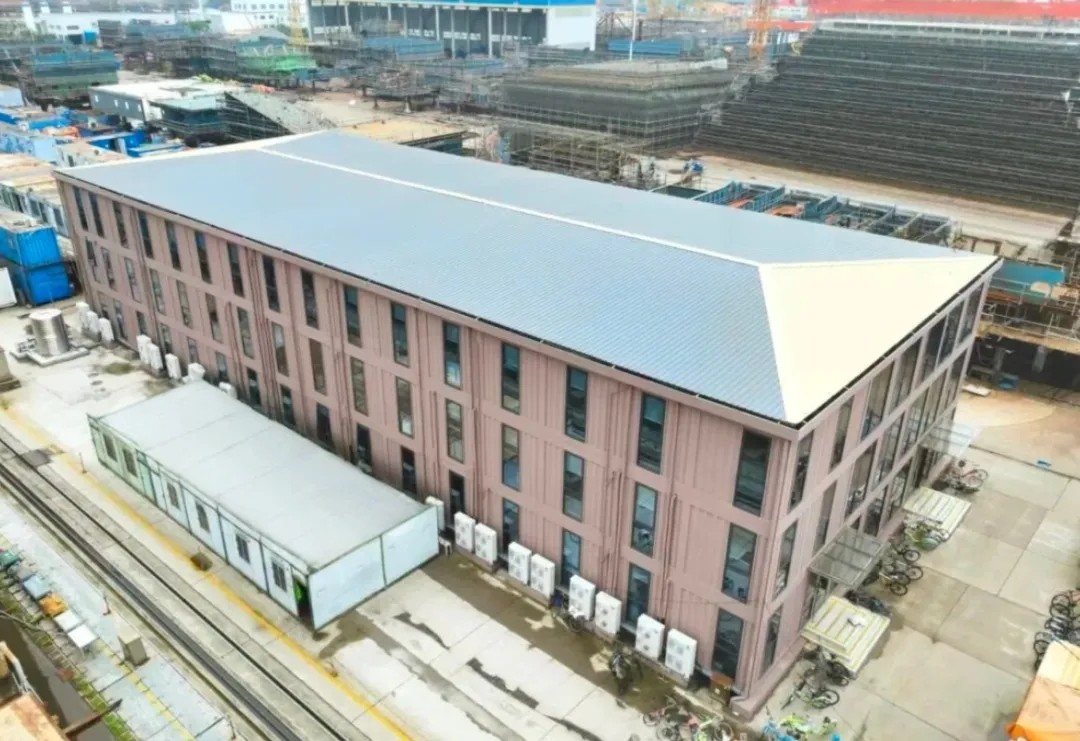

The building was assembled from 96 specially designed container-based housing modules, custom-built by Qidong Container Factory under COSCO SHIPPING Development to meet the practical needs of the site. The factory completed the production of the modules in six days, while on-site assembly took another five days. In total, the main building structure was completed in just 11 days.
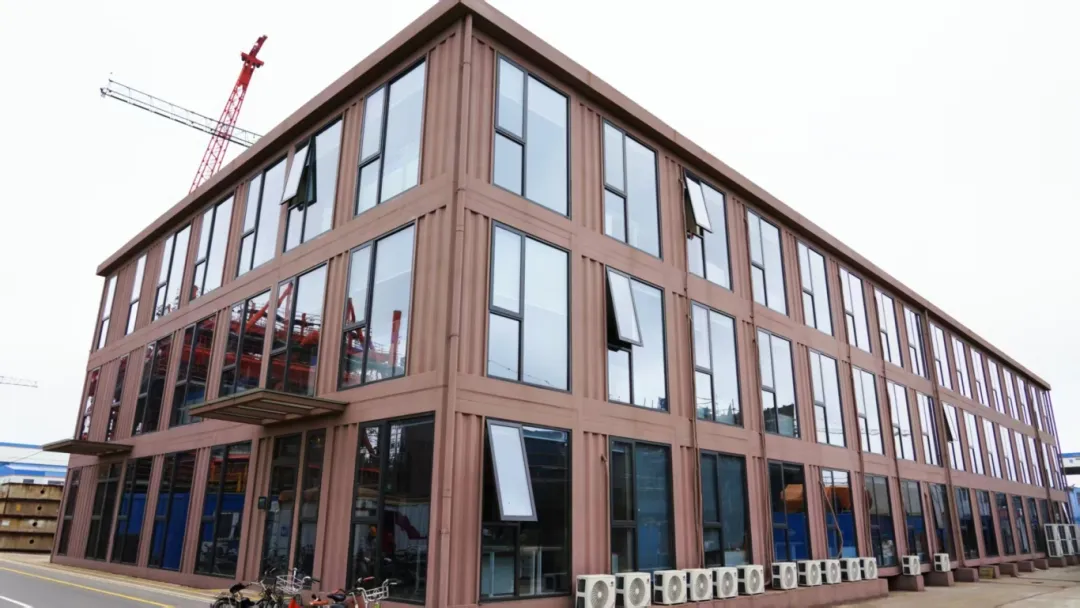
Behind this speed is not a simple act of “stacking containers”. It is a highly refined modular construction solution that combines structural design, factory prefabrication, material innovation and real industrial-site application.
This project is the 2.0 version of Qidong Container Factory’s modular office building solution. Its earlier 1.0 version was delivered for the Shanghai Changxing movable business platform office building, which proved the feasibility of the “container + building” model in shipbuilding and maritime industrial scenarios.
The Nantong project takes that model further.
The new office building is composed of 48 six-metre standard modules and 48 fourteen-metre extended modules. These modules had to be arranged to support a three-storey structure, while also meeting requirements for interior space, office functionality, lifting operations, structural connection and long-term user comfort.
What appears to be a fast modular assembly is in fact a carefully engineered system. It involves load-bearing design, dimensional control, transportation planning, on-site lifting, inter-layer connection, interior fit-out and environmental adaptation.
The first highlight is the building’s lighter and smarter structural frame.
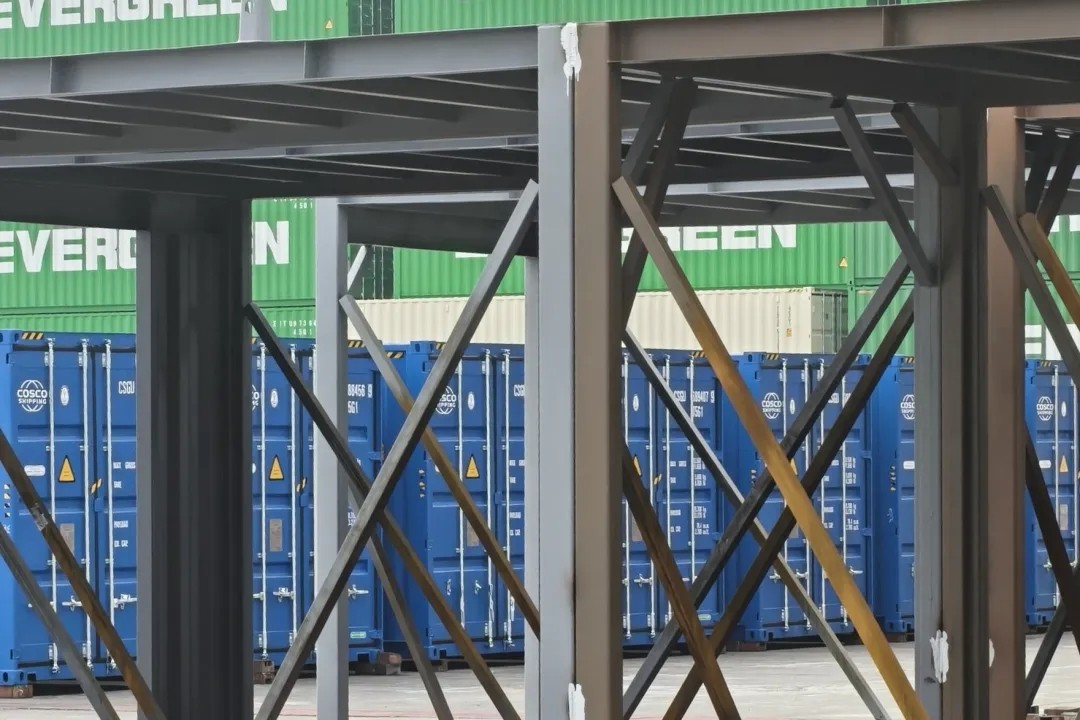
Traditional container-based buildings often rely on relatively heavy square-tube structures. In this project, Qidong Container Factory redesigned the container beams and used 6mm steel plates formed by bending to serve as the top beams, bottom beams and side beams, replacing the previous heavier square tubes.
This design makes the module frame lighter, more refined and more economical. It reduces steel consumption and also lowers transportation costs. For a three-storey building made up of nearly 100 modules, weight reduction at the level of each single module eventually translates into major advantages in cost control, lifting efficiency and site installation.
The new structural design also removes the protruding corner fittings commonly seen on traditional containers. As a result, the building façade looks cleaner and more streamlined. The overall appearance is closer to that of a modern modular building, while the integrated frame structure also improves load-bearing stability and safety performance.
The second highlight is high-precision prefabrication.
In many traditional container-building projects, much of the work is still completed on site. That means more labour, greater dimensional-control difficulty and more exposure to weather, site conditions and construction coordination.
This project used a more advanced factory-prefabrication approach. Qidong Container Factory pre-assembled the “6-metre + 14-metre” combined modules inside the factory, completing major welding and forming work before transportation.
When the modules arrived at the Nantong site, they were already relatively complete functional units. The on-site team mainly needed to carry out lifting, inter-layer connection and final installation work.
This approach greatly reduced the amount of on-site construction. It also improved dimensional accuracy, made module connections tighter, accelerated the formation of the building structure and shortened the overall delivery cycle.
For a shipyard, this matters. Production sites are busy, space is limited and project schedules are often tight. A shorter installation period means less disruption to daily operations and easier coordination with ongoing yard activities.
The third highlight is the building’s “self-healing” material.
The interior walls of the office building widely use non-painted zinc-magnesium-aluminium coated panels. This material brings together environmental performance, aesthetics, durability and corrosion resistance, making it an important upgrade in the 2.0 version of the modular office building.
The non-painted design reduces the need for coating and spraying. It helps cut VOC emissions at source. VOCs, or volatile organic compounds, are a major concern in traditional coating processes. By using non-painted materials, the project reduces emissions during manufacturing and also lowers the need for future repainting work.
More importantly, zinc-magnesium-aluminium panels have a certain “self-healing” capability.
When the surface of the material is slightly scratched, the exposed metal layer can react with oxygen and moisture in the air. This reaction gradually forms a dense protective film, which helps prevent corrosion from spreading deeper into the material.
This feature is particularly useful in a shipyard environment. COSCO SHIPPING Heavy Industry (Nantong) operates close to river and coastal conditions, where humidity is relatively high and building materials are exposed to demanding daily-use conditions. Ordinary materials may face rust, peeling and higher maintenance pressure. Zinc-magnesium-aluminium panels provide stronger long-term resistance to corrosion and moisture.
In other words, the sophistication of this office building is not only visible in its fast assembly. It is also built into the less visible details, including material selection, maintenance cost control and environmental performance.
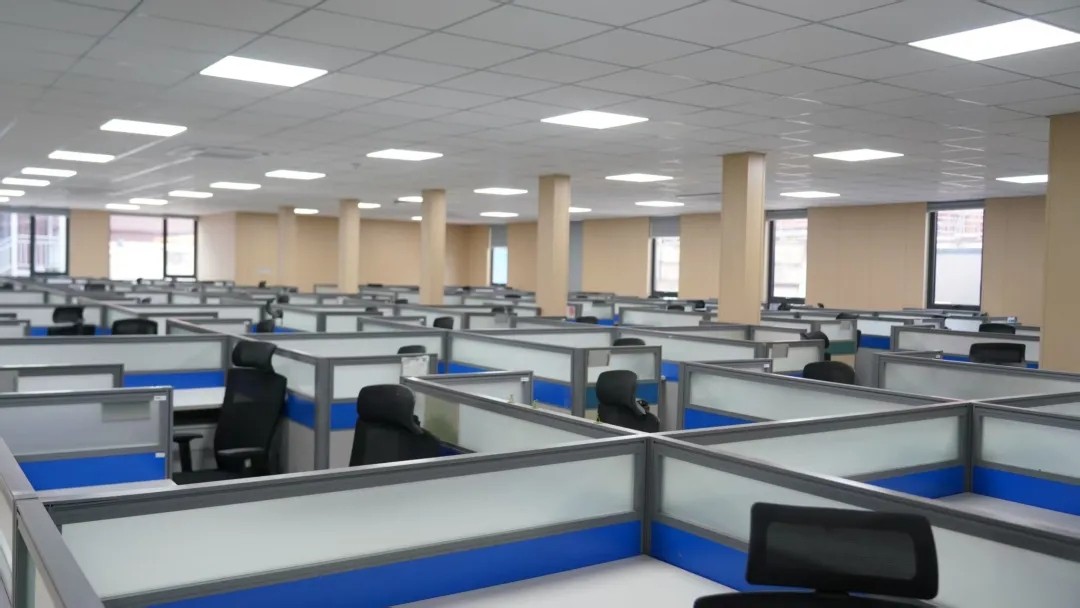
The building also takes office comfort into account. With insulated walls, thermal-insulation doors and windows, sound-reduction measures, ventilation and moisture-proof design, the office building can provide a better working environment for shipowners, site teams and other personnel. It can also accommodate more than 100 people.
This means the project goes beyond the concept of a temporary container building. It provides real office functionality, stronger durability, better environmental adaptability and a more comfortable working space.
At a broader level, the project shows that COSCO SHIPPING Development’s container manufacturing capabilities are being extended into systematic modular-space solutions.
The company’s container factories have developed a more complete “container + building” engineering system covering design and R&D, manufacturing, logistics, on-site installation and interior fit-out.
The value of this model lies in both speed and flexibility. Modules can be manufactured and integrated in the factory in advance, sharply reducing on-site construction time. At the same time, the modular structure allows different combinations for different scenarios, including office buildings, dormitories, service stations, exhibition spaces and temporary project facilities.
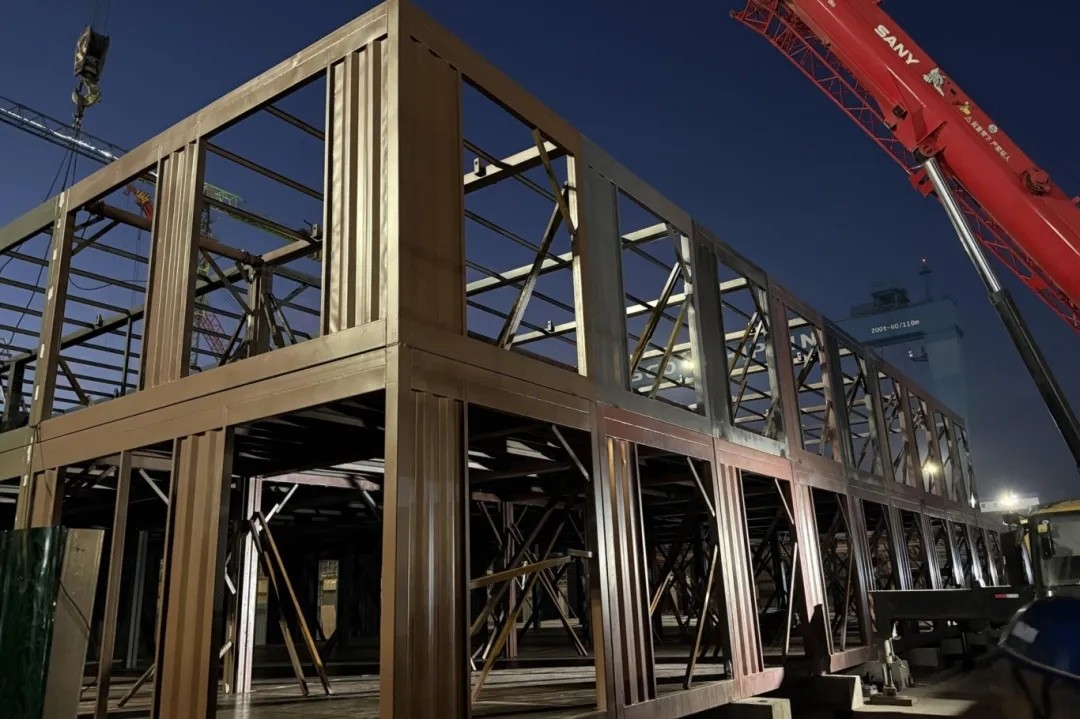
For ports, shipyards, industrial parks and project bases, modular container buildings offer clear advantages. They can be deployed quickly, adapted to different site conditions and adjusted according to the project cycle and functional needs.
This three-storey building made from 96 modules is therefore more than a fast construction story. It is a demonstration of industrialised construction capability.
The lightweight frame improves structural economy. High-precision prefabrication shortens the on-site schedule. Self-healing materials enhance long-term durability. Insulation, ventilation and moisture-proof design improve the user experience.
Together, these details define the real value of the project.
As the application boundaries of modular buildings continue to expand, containers are gaining a new role. They are no longer only transport equipment. They can also become flexible, efficient and green space carriers.
For COSCO SHIPPING Development, this project also shows how traditional container manufacturing can move further into modular building solutions. Supported by manufacturing capability, driven by real-world industrial demand and upgraded through new technology and materials, the “container + building” model is opening up wider possibilities.


READ MORE
 Containers
COSCO SHIPPING Holdings to Launch Third Far East–ECSA Service in December
 Containers
CMA CGM Expects Car Carrier Fleet to Reach Around 21 Vessels
 Containers
CMA CGM’s Reported French Flag Retreat Puts Shipping Taxes in Focus
 Containers
Up to 30 New Feeders: Inside Contships’ Fleet Renewal Strategy
 Containers
CMA CGM Chief Says Zero Carbon by 2050 May Take a Miracle
 Containers
COSCO SHIPPING Holdings Steps Up Asia-Pacific Expansion with Dual-Brand Push
 Containers
Ningbo Containerized Freight Index Weekly Commentary Overall Demand Weakened During the Holiday; Freight Rates Declined on Most
 Containers
SAIC Anji Logistics is moving into the 11,000-CEU class.
 Containers
14m TEU Orderbook Puts Container Shipping on Course for a 2027 Capacity Test
 Containers