


Is Peak Season Really Over? Asia–U.S. East Coast Rates Reach $9,400
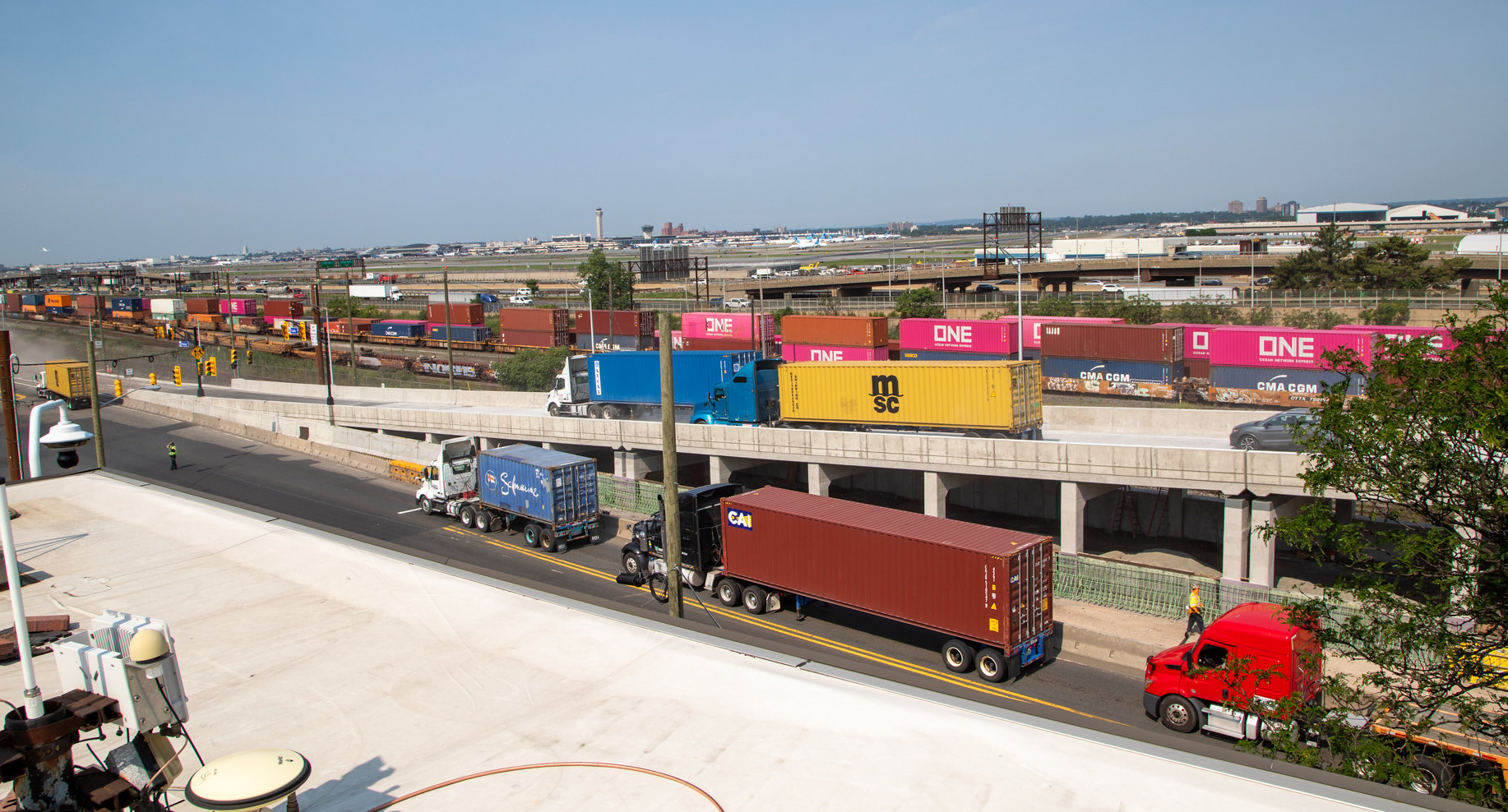

Trans-Pacific container rates are climbing again just as the market expected America’s early import rush to fade. The rebound is real—but the evidence still falls short of proving a full demand reversal.
The container shipping market has delivered an unexpected message to importers: the U.S. peak season may be fading more slowly than anticipated.
Asia–U.S. East Coast spot rates rose to about $9,400 per forty-foot equivalent unit (FEU) during the week, their highest level of 2026, according to Freightos Chief Analyst Judah Levine. Asia–U.S. West Coast prices also climbed by roughly $1,300 per FEU from the beginning of August to about $7,400.
There is an important distinction behind those headline figures. The latest formal Freightos Baltic Index readings were lower—$9,144 per FEU to the East Coast and $6,826 to the West Coast, up about 1% and 11%, respectively.
The $9,400 and $7,400 figures were intraweek market levels cited by Levine, while the index values represent a different measurement window. They point in the same direction, but they should not be treated as identical data points.
The rebound is showing up across several indices
The move is not confined to a single benchmark.
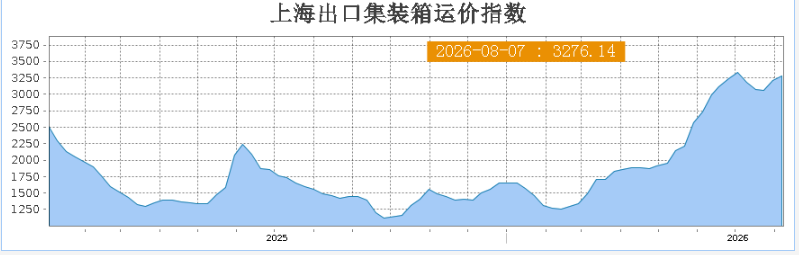
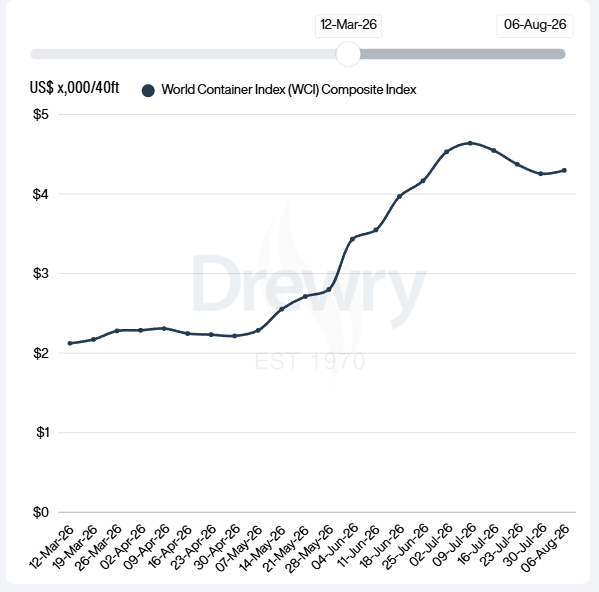
The Shanghai Containerized Freight Index rose to 3,276.14 points on August 7, up 70.17 points, or about 2.2%, from the previous week. Drewry’s World Container Index also gained 1% to $4,297 per FEU on August 6, ending three consecutive weeks of decline.
On the trans-Pacific trades, Drewry assessed Shanghai–New York rates 4% higher at $7,893 per FEU, while Shanghai–Los Angeles increased 3% to $5,894.
The methodologies and port coverage of Freightos, Drewry and the SCFI differ, so their absolute numbers cannot be compared directly. Their shared direction, however, makes it harder to dismiss the latest increase as noise in one index or one trade lane.
The more difficult question is whether this marks the return of a full-scale peak season—or merely a temporary extension of one that started early.
U.S. demand has been more resilient than expected
Part of the answer lies in the timing of American imports.
Many shippers brought cargo forward ahead of tariff changes expected in July. When the feared sharp increase in duties did not materialize in the form some companies had anticipated, a portion of that ordering appears to have continued into August and September.
Other businesses had kept inventories lean because of economic and trade-policy uncertainty. Resilient consumer spending, despite persistent inflationary pressure, may now be encouraging some of them to replenish stock.
That does not necessarily mean an exhausted peak season has suddenly restarted. A more plausible interpretation is that the expected drop in demand has been replaced by a longer, flatter plateau.
Higher rates are not solely a demand story
Freight prices can rise even when cargo volumes are not accelerating sharply.
Drewry said congestion at ports in central and southern China was constraining effective capacity. Carriers have also continued to manage available space through general rate increases, service adjustments and blank sailings. Eight trans-Pacific sailings were scheduled to be cancelled the following week, unchanged from the current week.
The earlier decline in West Coast prices may also have reflected new capacity entering the trade rather than a collapse in cargo volumes. If capacity growth is now slowing while bookings remain firm, carriers have more leverage to hold or raise rates.
Geopolitical risk is reinforcing that leverage. The war involving Iran, uncertainty around the Strait of Hormuz and renewed security concerns in the Red Sea are affecting vessel deployment, fuel costs, insurance and emergency surcharges.
These disruptions do not directly create U.S. import demand, but they absorb shipping capacity, extend voyage times elsewhere in the network and raise the cost floor for global liner operations.
The import forecast still argues for caution
The latest U.S. port forecast does not yet support the conclusion that import demand has entered a new growth phase.
The National Retail Federation’s Global Port Tracker expects major U.S. ports to handle 2.22 million TEU in August, down 4.2% year on year. September is forecast at 2.16 million TEU, up 2.8% from a year earlier but still lower than August on a month-to-month basis.
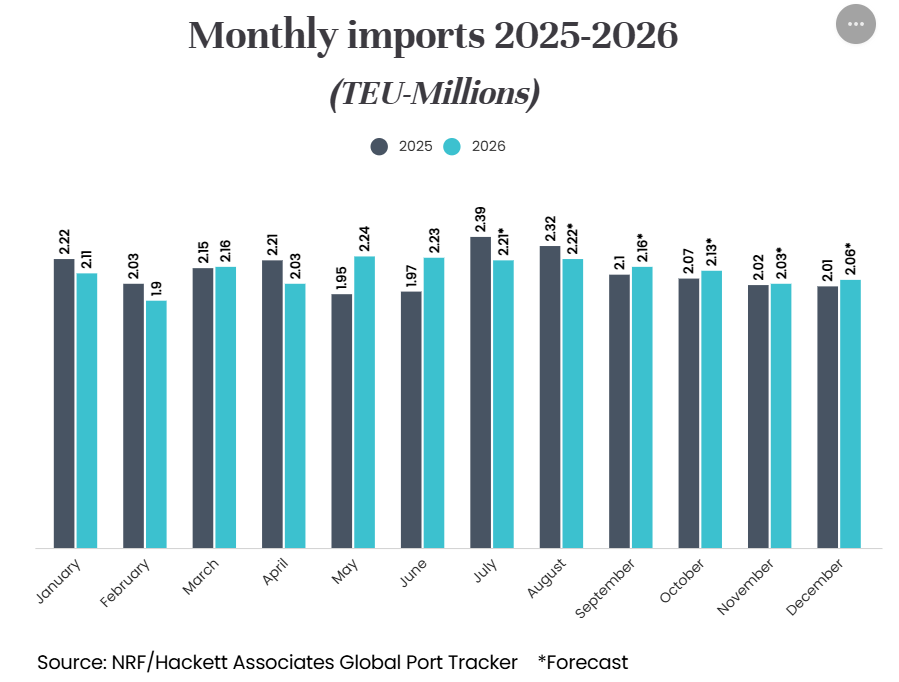
The NRF also believes the busiest month of 2026 may already have passed, with U.S. ports handling 2.24 million TEU in May.
In other words, the outlook has become stronger than the market previously expected, but that is not the same as a renewed acceleration. The clearest change is that the decline now looks slower and less severe.
Three signals will determine whether $9,400 can hold
Three indicators deserve close attention over the coming weeks.
First, bookings must continue rising for several weeks rather than spike briefly around tariff deadlines. Second, carriers’ decisions on blank sailings and added capacity will reveal how much of the price increase is being created by supply management. Third, any escalation involving Iran, Hormuz or the Red Sea could push fuel, insurance and diversion costs higher—even if underlying cargo demand begins to soften.
For now, the most accurate conclusion is neither that peak season is over nor that a new freight-rate boom has begun. Instead, the retreat from peak season has been unexpectedly delayed.
For shippers, that means freight rates and surcharges could remain under upward pressure through September. But until booking and port-volume data confirm a sustained demand shift, chasing the market at any price would carry its own risk.


READ MORE
 Containers
From Shanghai to London: A Chinese Shipping Derivative Is Going Global
 Containers
Veteran German Owner Returns to Boxship Newbuildings as Offen Moves on 2+2 7,000-TEU Ships at GSI
 Containers
Maersk’s Decade-Long Transformation: Has Its End-to-End Logistics Strategy Worked?
 Containers
14m TEU Orderbook Puts Container Shipping on Course for a 2027 Capacity Test
 Containers
Ningbo Containerized Freight Index Weekly Commentary Freight Rate Trends Continued to Diverge; Composite Index Remained Stable
 Containers
Maersk overtakes COSCO to become Asia’s largest intra-Asia liner
 Containers
COSCO SHIPPING Heavy Industry launches A-share IPO push
 Containers
Wan Hai firms up $744m order for six 11,000 teu boxships at SWS
 Containers
Wan Hai Orders Six 11,000 TEU Containerships in New Fleet Expansion Move
 Containers