


A Seafarer’s “Good Night” No Longer Has to Wait Until the Next Port Call: Even on an Ocean-Going Ship, They Can Say Good Night to Their Family
...
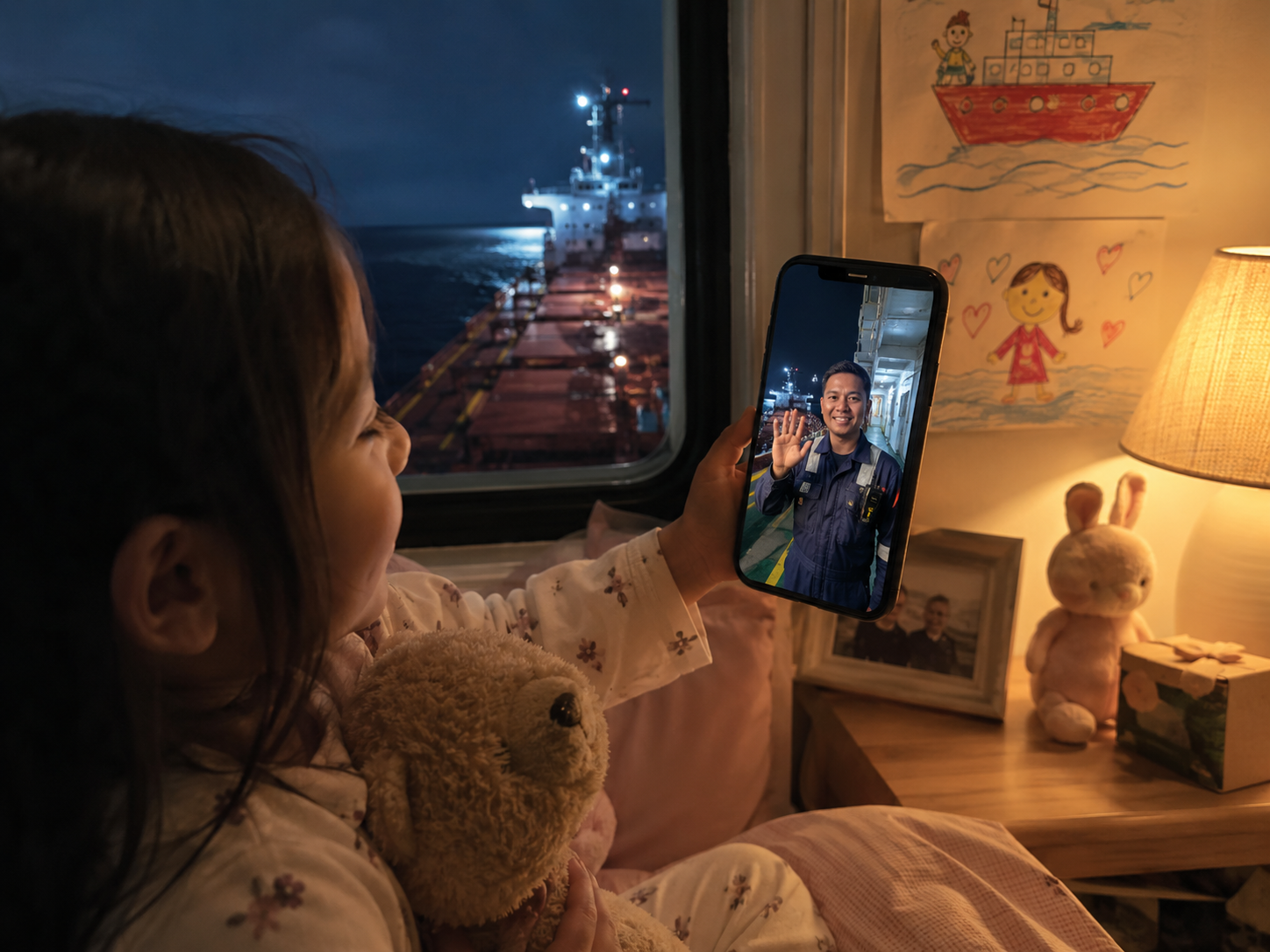

One day, before going to bed, a child picked up a phone and called out to the screen, “Good night, Dad.”
The father on the other end of the screen was not at home.
He might have been in the Pacific Ocean. He might have been in the Indian Ocean. He might have been on a merchant vessel thousands of miles away from land.
In the past, a video call like this was not easy for many seafarers’ families.
There was internet at sea, but the speed could be slow. It was possible to contact family from the ship, but video calls could freeze. Data was available, but it often had to be used sparingly. For many oceangoing seafarers, the real luxury was not watching short videos or streaming films online. It was being able to have a stable video call with family for a few minutes before their child went to sleep.
Now, that is beginning to change.
On More Than 140 Ships, Data Usage Has Doubled
Recently, after the globally known Greek shipowner Angelicoussis Group deployed Starlink Maritime across more than 140 vessels, data usage across its fleet doubled. This is one of the most important publicly disclosed cases so far of Starlink Maritime being deployed across a large commercial fleet. Starlink’s official case study page has also listed Angelicoussis Group as a commercial customer and specifically noted that data usage doubled after the group adopted Starlink on more than 140 ships.
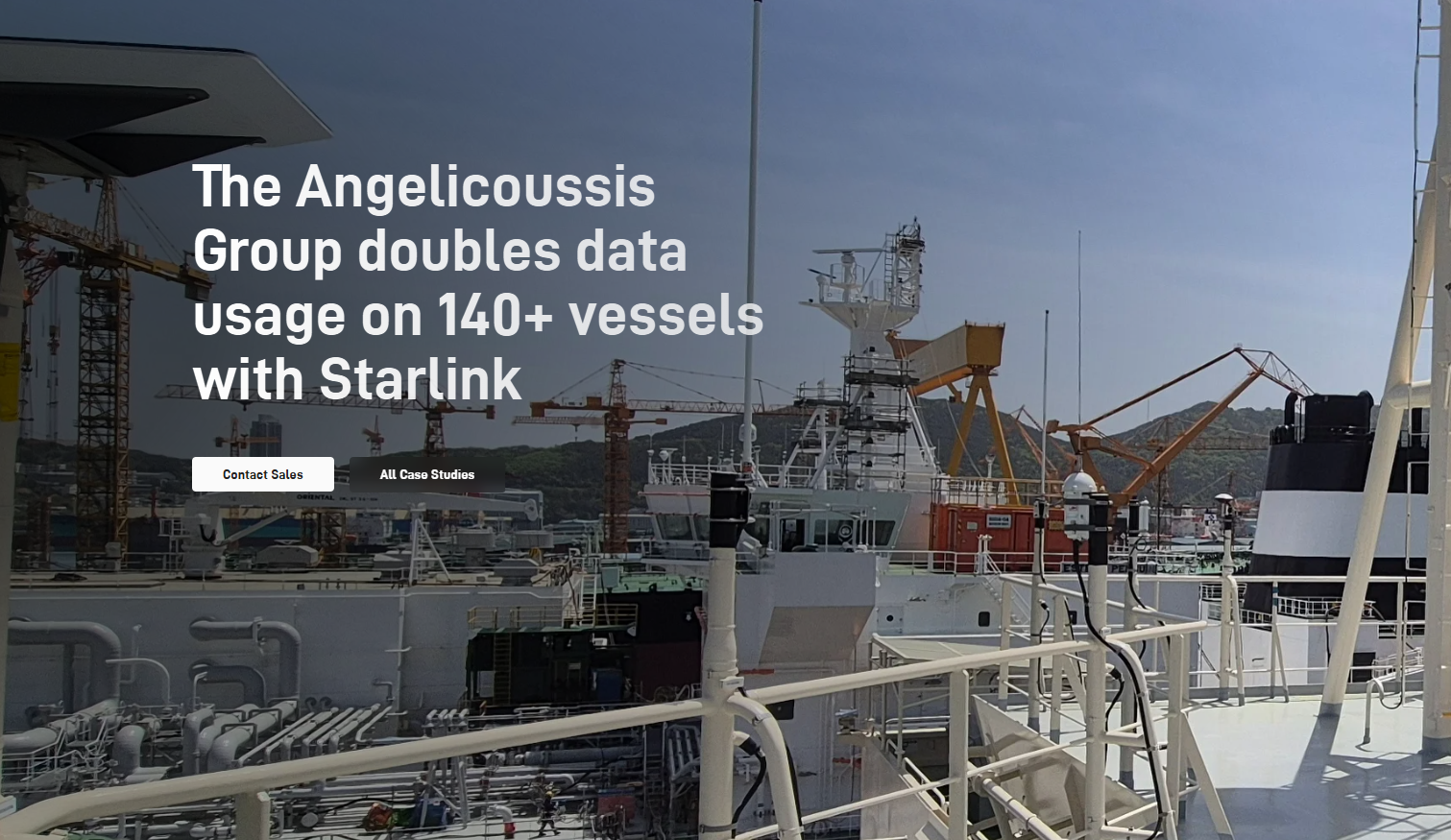
According to Splash, the deployment was carried out by Navarino, an authorized Starlink reseller.
Before this, the group had relied on traditional satellite communication services, which were constrained by limited bandwidth, high latency, and strict data caps. These limitations made it difficult to meet the app-based connectivity expectations that seafarers have now become used to, especially on long-haul routes such as trans-Pacific voyages.
After deploying Starlink, crew members could make video calls, watch streaming content, and stay in more stable contact with their families. At the same time, higher-speed links also allowed faster transfer of HD video, telemetry, and maintenance data between ship and shore. The report also said that Starlink reduced communication costs in Angelicoussis’ fleet operations by about seven times.
Efstratios Arvanitidis, ICT Manager of the Angelicoussis fleet department, made a very important point. He said Starlink had turned connectivity from a limitation into a strategic asset for Angelicoussis Group.
The high-speed, low-latency service allows real-time exchange of data, video, and telemetry across more than 140 ships. At the same time, “home-like” internet at sea has become a clear advantage in attracting and retaining young seafarers.
That goes straight to the heart of the issue.
Shipboard internet is no longer just a crew welfare benefit. It is starting to affect crew recruitment, fleet management, ship-shore coordination, and the overall attractiveness of a shipowner in the eyes of younger seafarers.
For Seafarers, the Fastest Change Is Simply “Being Able to See Their Family”
The easiest part of this latest upgrade in maritime connectivity for outsiders to overlook is this: the first thing it changes is not a data sheet, but people’s lives.
When a seafarer spends months at sea, the hardest part is often not the waves, the machinery, the watchkeeping, or the heat. It is the disconnect from family life.
If a child gets sick, they may only hear about it second-hand. If parents are getting older, they may only get to see them once in a long while. A wife or husband may be handling the household alone, and many emotions can only be briefly passed on in a message.
In the past, seafarers often said one thing: once you are on board, many things can only be carried by your family back home.
That is one of the truest parts of the profession.
Seafarers connect global trade, yet many times they struggle to stay steadily connected with their own families.
So when shipboard internet starts to support more stable video calls, the meaning goes far beyond “the internet is faster.”
It means seafarers can see their children more often.
It means families can more directly know that their loved one is safe.
It means that a father far away at sea can watch his child do homework, and can also say good night before bedtime.
For many seafarers’ families, this is not a small matter.
It is a real improvement in the quality of life at sea.
What Is the Standard of Shipboard Internet Today?
It is important to be clear: oceangoing ships did not only gain internet today.
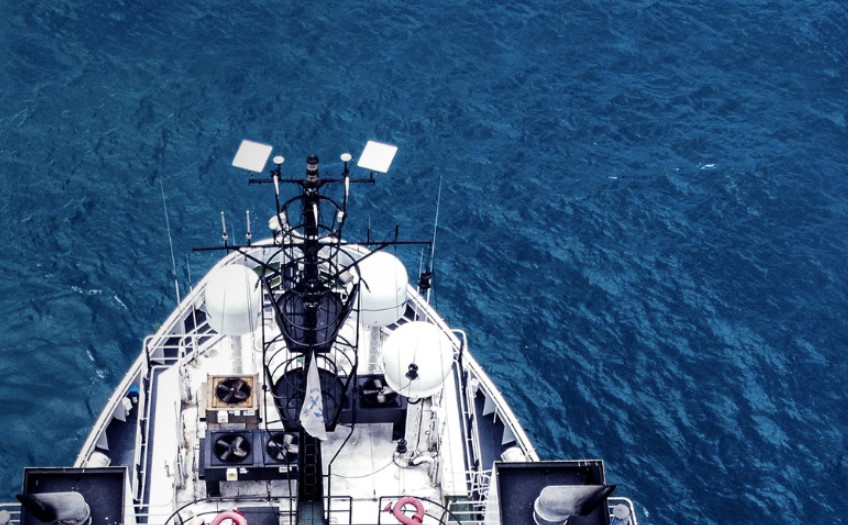
Many commercial ships have long been equipped with satellite communication systems, and they have been able to provide some degree of internet access to crew members. The problem is that shipboard internet has long been constrained by three factors: limited bandwidth, relatively high latency, and expensive data.
As a result, the logic of internet use on many ships has often been closer to “just enough.”
Operational communication comes first. Safety communication comes first. Ship-shore management systems come first. Personal use by crew members usually has to fit within whatever bandwidth and data allowance remain.
Under those conditions, text messaging is relatively easy. Voice calls depend on the situation. Video calls are often restricted.
This can also be seen in market data. In an analysis published in January 2026, Valour Consultancy noted that interviews with commercial shipping operators showed that 1TB data plans still remain statistically common, many ships opt for 500GB plans, and very few commercial vessels consume anything close to 5TB per month.
In other words, for most merchant ships, “having internet on board” and “being able to use it like at home” are still two different things.
The arrival of low-Earth-orbit satellite internet solutions such as Starlink is beginning to close that gap.
The key advantages of low-Earth-orbit satellites are lower latency and greater bandwidth. That makes many applications possible that were previously difficult to support, including HD video calls, streaming media, real-time ship-shore systems, remote technical support, video monitoring transmission, and equipment condition monitoring.
That also explains why data usage doubled after Angelicoussis deployed Starlink.
When internet speed improves, people do not simply do the same things as before. They begin to do things they did not dare to do before, could not do before, or did not want to do before because of cost or limitations.
Crew members start making video calls. Ship and shore start exchanging data in real time. Managers begin to use more digital tools. Ships begin to operate in a genuinely high-bandwidth environment.
“Unlimited Internet Access” Has Appeared — But It Is Still Not the Reality for All Seafarers
So, can seafarers now access unlimited internet?
The answer needs to be broken down.
From a technical and commercial perspective, the maritime connectivity market has indeed started to offer unlimited data plans for merchant vessels. According to Valour Consultancy, Starlink began offering unlimited data plans to IMO-registered commercial ships in 2025. The direct purchase price is about US$2,150 per month, while prices through reseller channels are around US$2,300 to US$2,500 per month. Starlink has also confirmed that the current unlimited data plan will remain available at least until the end of 2026.
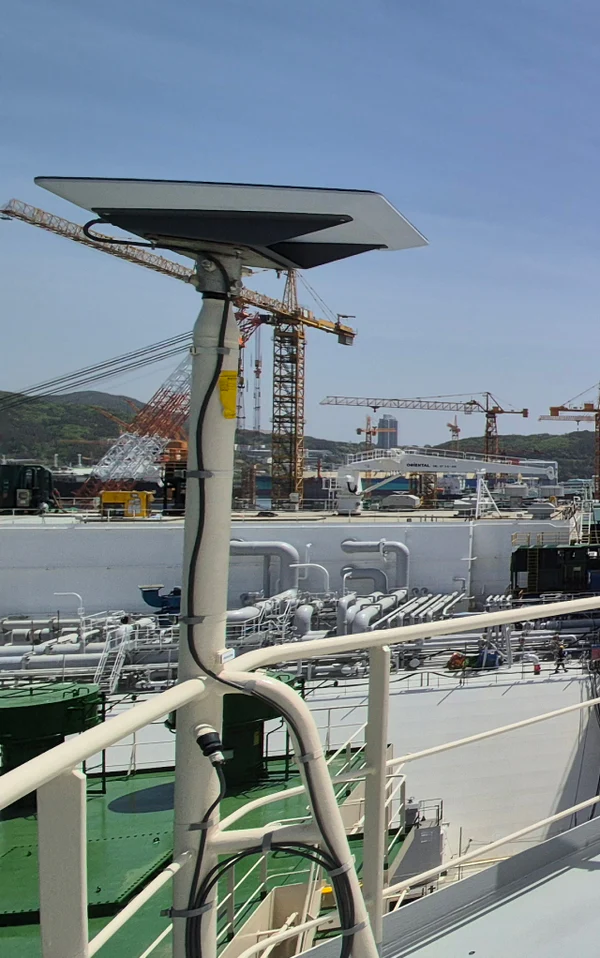
This points to an important trend: ship connectivity services are moving away from strict traffic budgeting and toward higher capacity, larger bandwidth, and an experience closer to land-based internet.
But for individual seafarers, that does not mean that all ships have already achieved free, unlimited, and completely unrestricted internet access.
The reasons are simple.
First, shipowners buy different packages. Not every shipping company will immediately choose an unlimited data plan.
Second, ships usually separate operational networks from crew welfare networks. Vessel safety systems, navigation systems, ship-shore communications, monitoring data, and management systems usually need to be prioritized.
Third, even if a ship has purchased a high-capacity or unlimited plan, the company may still manage individual usage through user accounts, speed limits, time limits, or segmented access because of cybersecurity requirements, bandwidth allocation, work discipline, and content management.
So a more accurate way to describe the situation today is this: some leading shipowners have already begun to enter the “maritime broadband era,” where video calls and streaming are shifting from occasional luxuries to everyday services. But for the entire industry to achieve universal, stable, affordable, and high-quality internet access for seafarers will still take time.
An International Labour Rights Framework
Internet access for seafarers is no longer just a matter of corporate welfare choice.
The International Labour Organization has confirmed that the 2022 amendments to the Maritime Labour Convention, 2006 (MLC 2006) entered into force on 23 December 2024. These amendments state that seafarers should have appropriate social connectivity on board; shipowners should provide internet access on board where reasonably practicable, and if charges apply, they should remain reasonable; port states should also provide internet access for seafarers in ports and at anchorages.
Gard’s interpretation of the amendments also points out that the MLC provisions on accommodation and recreational facilities now include “social connectivity,” including ship-shore communication and internet access.
This points to a clear direction: internet access is gradually moving from being a welfare issue of “whether it is better to have it” toward a more fundamental question of “whether it should be part of modern maritime working conditions.”
Of course, the MLC language still preserves the boundary of what is “reasonably practicable.” It does not simply require all ships to immediately provide free, unlimited, high-speed internet. But the regulatory direction is already very clear: seafarers work at sea for long periods, and they should not be excluded from modern social connectivity.
That is also one of the deeper reasons why this round of Starlink deployment has attracted so much attention.
It is not just a commercial communications product entering a fleet.
It sits at the intersection of four issues: crew welfare, digital operations, young seafarer recruitment, and international labour rights.
In an Era of Crew Shortages, Internet Access Will Become a New Competitive Advantage
In the past, when seafarers chose a shipowner, they first looked at wages, ship condition, routes, and management.
In the future, they will also look at internet access.
That may sound very everyday and practical, but behind it lies a very real industry issue.
A younger generation of seafarers has grown up in the mobile internet era. They are used to communicating at any time. They are used to online entertainment. They are used to handling personal matters remotely. They are also used to maintaining frequent contact with their families.
If a job at sea means spending months with only limited connection to the outside world, no stable video calls, and long forced interruptions to family life, then the attractiveness of that job will fall sharply.
When Angelicoussis management describes “home-like” internet at sea as an advantage in attracting and retaining young seafarers, that is not just a promotional slogan. It speaks directly to one of the real pain points in the global crewing market.
Against the backdrop of crew shortages, an ageing seafarer workforce, and declining willingness among younger people to go to sea, competition among shipowners is no longer confined to the wage table alone.
Better ships, safer management, more stable leave arrangements, more decent living conditions, and better internet connectivity will all become parts of competitiveness.
Internet access may even become the most visible one.
Because it connects seafarers to the people they care about most.
Maritime Broadband Is Also Changing Ship Operations
If we look at Starlink only from the angle of crew welfare, the picture is still incomplete.
This round of maritime connectivity upgrades is also changing how ships are operated.
Take Goldenport Shipmanagement as an example. After deploying Starlink via Navarino across around 31 bulk carriers and containerships, the company saw vessel data consumption more than double. Splash, citing the case, said that these ships now frequently use more than 2TB of data per month and support a much wider range of digital tools and operational monitoring systems, including high-frequency telemetry, real-time ERP ship-shore systems, IoT updates, shipboard CCTV, and video calling.
This means ships are moving from “periodic reporting” to “real-time online presence.”
In the past, much of the information exchanged between ship and shore was transmitted through emails, phone calls, reports, and periodic data packages. Now, high-bandwidth connections are turning ships into much more real-time operational nodes.
Equipment condition can be sent back more quickly.
Live video from the scene can be sent to shore teams more quickly.
Maintenance data can be used for faster assessment.
Insurance claims can be supported with more on-site material.
Responses to safety incidents can be more timely.
Fleet managers can stay closer to the actual situation on board.
That is also why Angelicoussis described connectivity as a “strategic asset.”
For large shipowners, high-speed internet is not just about letting crew watch videos. It changes the basic conditions for ship management, maintenance strategy, incident response, claims handling, voyage optimization, and the use of digital applications.
Ocean-Going Ships Are No Longer Communication Islands
Ships carry out one of the most important transport functions in global trade, yet ships themselves have long operated in one of the most communications-constrained working environments.
Ships are at sea, far from land.
People on those ships are also far from home.
That is the special nature of shipping.
Today, low-Earth-orbit satellite internet is beginning to shorten that distance.
It allows seafarers to see their families more steadily, and it allows ship-shore teams to see ships more directly and in real time.
It makes an ocean-going vessel no longer just an isolated floating space at sea, but something more like a continuously connected work and living unit.
The industry impact of this change may only just be beginning.
In the future, the standard of a “good ship” may not be judged only by its main engine, fuel consumption, cargo holds, energy efficiency, or compliance certificates.
It may also include this: whether crew can stay steadily connected with their families; whether ship and shore can collaborate in real time; whether data can move securely; whether a vessel can truly plug into a company’s digital management system.
And for an ordinary seafarer’s family, the most direct meaning of this technological change may not be so complicated.
It may simply mean that a person at sea can finally open a video call at night, look at their child, and say:
Good night. Dad is on board. Everything is fine.


READ MORE
 Sustainability
Yantian and Felixstowe Sign Green Shipping Corridor Cooperation Initiative
 Sustainability
Japan Completes Methanol Transport and Bunkering Vessel
 Sustainability
Maersk Bunkers U.S.-Produced Corn Ethanol
 Sustainability
Maersk Completes First U.S. Ethanol Bunkering for a Deep-Sea Containership
 Sustainability
‘While I am President, there will be no global taxes’
 Sustainability
When the Future Can No Longer Be Predicted, How Do Shipping Companies Survive?
 Sustainability
Fleet Management Lights Up Anchor Plaza in Blue for World Maritime Day 2026
 Sustainability
COSCO , CMA CGM and SIPG Join Launch of International Green Shipping Corridor Alliance
 Sustainability
Zero-Emission-Capable Ship Orders Slide as IMO Uncertainty Weighs on 2030 Target
 Sustainability