


Seaspan Enters Newcastlemax Market, with Yangzijiang Set to Build Two Tri-Fuel Ore Carriers
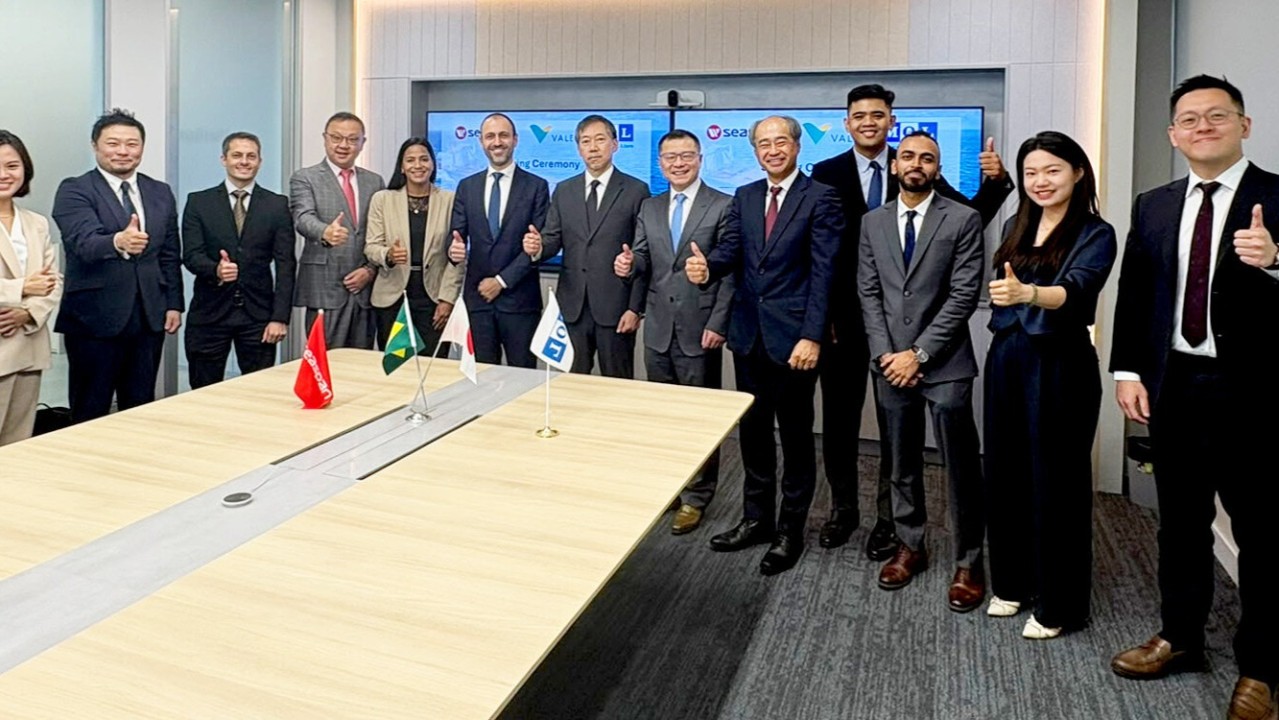
Seaspan Corporation is expanding into the 210,000-dwt ore carrier segment with two tri-fuel newbuildings to be constructed by Yangzijiang Shipbuilding and chartered to Mitsui O.S.K. Lines, Ltd. (MOL), supporting a 25-year iron ore transportation agreement with Brazilian mining group Vale .
Seaspan confirmed its role as shipowner and Yangzijiang’s expected involvement to Xinde Marine News, adding an important dimension to the project announced by MOL on October 2.
Under the arrangement, Seaspan will own the vessels and charter them to MOL. MOL Ocean Bulk (MOLOB), the group’s Singapore-based platform for its overseas Capesize business, will fulfil the transportation contract with Vale International Limited . Delivery is scheduled for 2030, with the ships carrying Brazilian iron ore to destinations worldwide, primarily China.
The vessels will be capable of operating on ethanol, methanol and conventional heavy fuel oil, with designs allowing for future conversion to LNG or ammonia.
For MOL, the project secures long-term transportation business with a major cargo owner. For Vale, it adds another component to its growing programme of ethanol-capable ore carriers. For Seaspan, it extends a fleet diversification strategy already encompassing car carriers, open-hatch vessels and very large ethane carriers.
Across these different ship types, the underlying commercial approach remains consistent: invest in assets around long-term customer requirements and contracted employment。

MOL secures transportation business extending towards 2055
MOL’s position in the project is as the transportation counterparty to Vale, supported by vessels supplied by Seaspan. The arrangement separates ownership of the ships from the contractual obligation to move the cargo, allowing the parties to contribute different capabilities.
Assuming operations begin on delivery in 2030, a 25-year transportation agreement would extend to around 2055. Decisions made today must therefore account for changing fuel availability, environmental requirements and operating economics over much of the vessels’ working lives.
The tri-fuel specification provides flexibility from the outset, while LNG- and ammonia-ready designs preserve potential conversion options. These design provisions will still require technical assessment and investment before either fuel can be used. Actual fuel choices will depend on availability, cost and the emissions benefits achievable in service.
MOL has also said its collaboration will extend across the ethanol and methanol supply chain, covering procurement, supply and bunkering. The project consequently involves more than securing two ships: it requires coordination between vessel capability, fuel access and the cargo owner’s long-term transport needs.
For Vale, service quality encompasses reliable delivery, energy efficiency and the ability to respond to future fuel requirements. For MOL, bringing these capabilities together can strengthen a relationship that extends well beyond individual voyages.
The two contractual relationships should nevertheless be distinguished. The publicly announced 25-year term applies to the transportation agreement between MOLOB and Vale. The precise charter structure, duration and allocation of costs between Seaspan and MOL have not been disclosed.
Vale’s ethanol-capable fleet takes shape
MOL’s agreement follows a series of projects through which Vale is encouraging the development of large ore carriers capable of using ethanol.
A common structure is emerging: Vale commits long-term cargo demand, shipowners and asset investors arrange the vessels, and alternative-fuel capability and energy-saving technologies are incorporated into the newbuilding specification.
On April 9, 2026, Vale announced an agreement with Shandong Shipping for two 325,000-dwt Guaibamax vessels, with options for additional ships. The first is expected to enter service from 2029. Supported by 25-year contracts, the vessels will be capable of using ethanol, methanol and conventional marine fuel, with provision for future conversion to LNG or ammonia.
That project follows a separate series of ten methanol/conventional-fuel dual-fuel vessels that Shandong is scheduled to deliver for Vale service from 2027. Although the programmes reflect an evolving technology strategy, they require separate accounting: the earlier ten ships should not automatically be counted as ten additional ethanol tri-fuel orders, and unexercised options should not be treated as firm commitments.
The 210,000-dwt Newcastlemax segment is also gathering momentum:
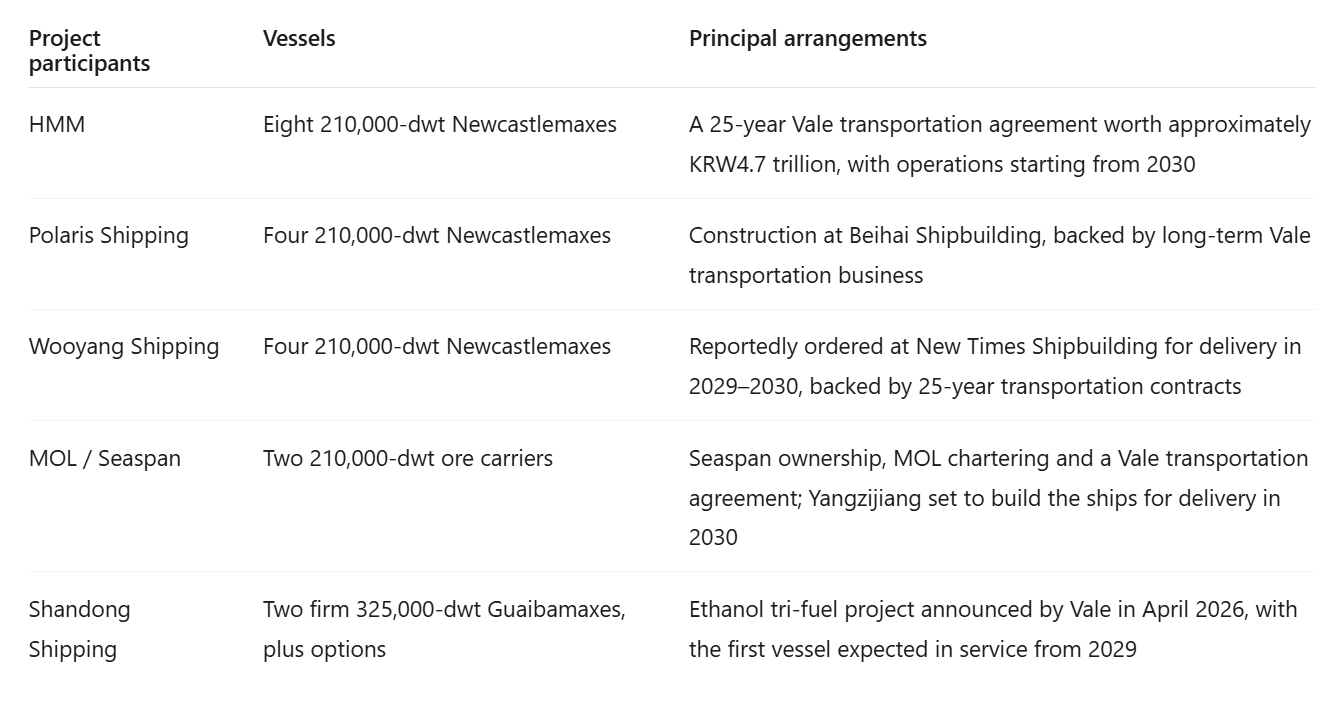
The first four programmes account for 18 vessels in the 210,000-dwt segment. MOL and Seaspan participate in the same two-ship project, with different contractual roles.
Xinde Marine News has previously tracked a wider programme of approximately 30 alternative-fuel ore carriers, comprising around 20 Newcastlemaxes and ten Guaibamaxes. That figure represents the reported programme scale; individual projects still need to be assessed according to firm commitments, options and fuel specifications.
Even with those distinctions, the direction is clear: ethanol-capable ore carriers are attracting a widening group of shipping companies and asset investors.
Why ethanol fits Vale’s shipping requirements
Vale’s interest in ethanol has a practical foundation in both geography and industrial capacity. Brazil has established large-scale ethanol production, while Vale generates substantial and recurring outbound iron ore cargoes.
Connecting those two supply chains creates opportunities to coordinate fuel procurement and bunkering with predictable transportation requirements.
There is also a technical link with methanol. The two alcohol fuels share certain combustion and handling characteristics. Engine designer WinGD has said it began ethanol testing in 2014, while engine orders associated with Shandong Shipping’s project have taken that development further into commercial application.
The emissions benefit, however, depends on the fuel’s production pathway. Vale’s reference to potential reductions of up to approximately 90% is based on a full lifecycle comparison with heavy fuel oil and is conditional on the ethanol used, with second-generation ethanol cited in its announcement. It is not a universal reduction factor for every ethanol supply, nor does it mean that combustion produces no carbon dioxide.
Commercial deployment requires answers to equally practical questions: can compliant fuel be supplied consistently, at what delivered price, with what effect on vessel schedules, and under what emissions-accounting arrangements?
Brazil’s production base provides a favourable starting point. Turning that advantage into dependable marine fuel supply still requires coordination among producers, ports, suppliers and vessel operators.
Vale’s multi-fuel approach accommodates that uncertainty. Ships delivered around 2030 could remain in service well into the 2050s. Access to ethanol, methanol and conventional fuel, together with potential future conversions, offers room to adjust as supply and economics evolve.
Energy-efficiency measures complement that flexibility. Rotor sails, hull improvements and propulsion-related technologies can reduce energy demand across different fuel choices.
For the long Brazil–Asia trade, fuel expenditure and vessel efficiency directly affect the delivered cost of iron ore. Viewed commercially, Vale’s approach combines emissions reduction with an effort to maintain competitive and adaptable transport capacity.
Long-term cargo commitments support newbuilding investment
Alternative-fuel vessels require substantial upfront investment, while future fuel costs remain uncertain. Shipowners evaluating these projects must consider employment, contractual income, construction expenditure and financing together.
Vale’s long-term transportation commitments provide a basis for that assessment. A contract covering a substantial portion of a vessel’s expected working life allows investors to evaluate debt service and capital recovery against a defined commercial requirement.
Lenders can likewise examine the customer’s credit quality, contractual arrangements and underlying assets when assessing financing.
Contract duration alone does not guarantee returns. Freight terms must be sufficient to cover the relevant costs, while fuel expenditure, carbon costs, off-hire exposure and future upgrades must be allocated between the parties. The economic outcome depends on those provisions and on execution over time.
The distinction between contract revenue and vessel investment is also important. HMM’s approximately KRW4.7 trillion agreement and the approximately US$1.65 billion reported for Wooyang’s Vale contracts represent transportation revenue over many years. Neither figure is a newbuilding price or a measure of guaranteed profit.
The MOL–Vale–Seaspan project illustrates how responsibilities can be distributed: Vale provides long-term transportation demand, MOL arranges and performs the transport service, and Seaspan provides the ship assets.
This gives the vessels an identifiable commercial role before delivery and creates a route through which cargo commitments can support investment in new propulsion technologies.
Seaspan expands across several shipping segments
Seaspan’s participation brings the project into a broader pattern of fleet diversification.
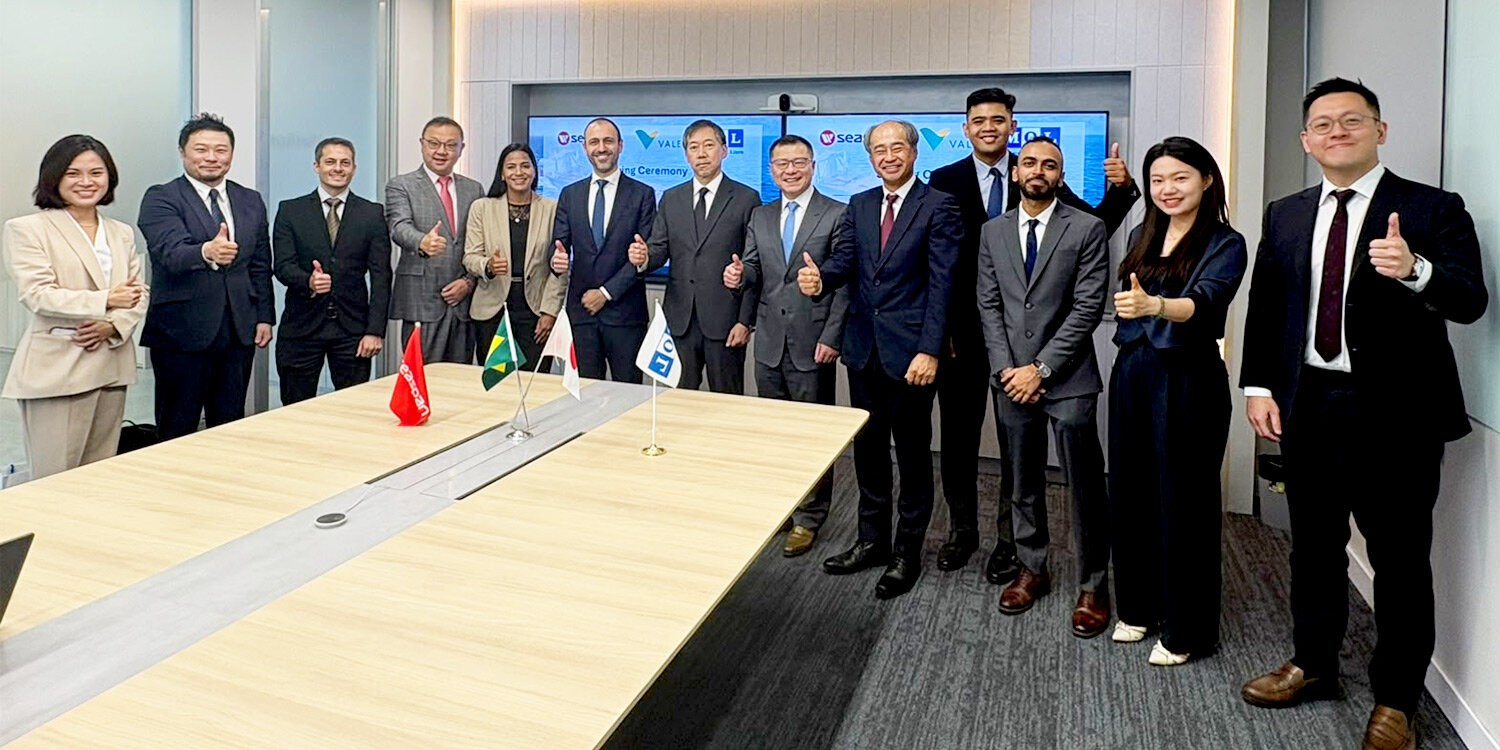
The company told Xinde Marine News that it would act as shipowner, that Yangzijiang would receive the newbuilding order, and that the vessels would be chartered to MOL for the Vale transportation business.
In discussing the expansion, Seaspan also emphasised continuity in its investment approach: long-term contracted employment and a non-speculative commercial basis remain central across vessel types.
Containerships provide the foundation for that model. Seaspan invests in ships and supplies them to major liner operators under long-term charters. In one example, OOCL signed agreements in 2024 for six new 13,000-TEU vessels, scheduled for delivery between the fourth quarter of 2026 and the first quarter of 2028, with 15-year charters commencing on delivery.
The ships’ deployment was therefore linked to customer demand from the newbuilding stage.
Car carriers represent another application. Seaspan’s website identifies a six-ship programme of 10,800-CEU LNG dual-fuel pure car and truck carriers. In June 2026, it announced that the first vessel in the series, Glovis Lighthouse, had begun its maiden voyage under a long-term time charter to Hyundai Glovis.
The division of responsibilities is familiar: Seaspan provides the vessel asset, while an established automotive logistics operator brings cargo relationships and transportation capabilities.
The open-hatch project extends that approach into specialised industrial cargo transportation. In May, G2 Ocean announced that six 65,400-dwt open-hatch gantry crane vessels would join its pool from 2029. Two will be owned by Grieg Maritime Group; the other four will be owned by Seaspan and bareboat chartered to Gearbulk before entering the G2 Ocean pool.
Open-hatch shipping depends on matching vessel configuration, cargo characteristics, port access and handling requirements. The relationship with Gearbulk and G2 Ocean connects Seaspan’s investment to an established operating platform and customer network.
Gas transportation is a further area of expansion. Seaspan’s corporate milestones identify a programme of five 100,000-cbm very large ethane carriers (VLECs). COSCO SHIPPING Energy’s disclosures provide a specific example of the associated long-term arrangements: its subsidiary Yuanhai agreed to charter two large gas carriers from Seaspan’s vessel-owning subsidiaries for 20 years, subject to charterer options, with delivery expected in 2028. Separate disclosures cover their long-term onward time charter to a Chinese customer.
Seaspan’s published fleet and project figures list 227 containerships, six 10,800-CEU PCTCs, four 65,400-dwt open-hatch gantry crane vessels and five 100,000-cbm VLECs, excluding the two newly confirmed ore carriers. These figures include newbuildings and come from disclosures with different reporting dates; they should not be treated as a single current operating-fleet snapshot.
Together, the projects show an asset portfolio extending across containers, vehicles, specialised dry cargoes, gas and now large ore carriers.
A wider vessel portfolio built around the same commercial discipline
Seaspan’s diversification changes the types of ships it owns, the technical requirements it encounters and the customers it serves. Its underlying investment sequence remains recognisable: identify long-term demand, secure contractual employment, commit capital and manage the asset and financing arrangements over time.
The model can extend across sectors because specialised shipping companies share a common challenge: renewing and expanding their fleets while managing capital expenditure.
An operator with cargo relationships and commercial expertise can secure suitable vessels through charter arrangements. An asset owner can assess the investment against contracted income and organise construction, financing and ownership accordingly.
The contractual details still matter. Seaspan’s PCTC project uses long-term time charters, while its open-hatch vessels will be bareboat chartered. Those structures allocate responsibilities for crewing, technical management and maintenance differently. The detailed terms of the MOL ore carrier charter have yet to be disclosed.
Consistency in commercial principles therefore allows for differences in contract structure and operational responsibility.
From a portfolio perspective, entering additional sectors can reduce dependence on one freight market or customer group. The extent of that benefit depends on counterparty quality, charter maturities and the correlation between the underlying businesses.
Credit-market assessments provide another indication of the importance of contracted cash flow. In August 2026, KBRA upgraded Seaspan’s issuer and senior unsecured debt ratings from BB+ to BBB-, citing factors including increased contracted cash flows, longer average charter duration and improved funding flexibility. Its assessment referred to approximately US$34.9 billion in gross contracted cash flows supporting earnings visibility.
Predictable contractual income can support financing access and investment planning. Financing capacity and a record of execution can, in turn, help the asset owner serve additional long-term customers.
The risks remain material. Charterer credit quality, construction performance, financing costs, residual values and future technical requirements all influence returns. KBRA also identified customer concentration, rechartering and residual-value exposure among the constraints on Seaspan’s credit profile.
For vessels arriving in 2030 and supporting transportation commitments that could run to around 2055, aligning those factors is particularly important. Fuel flexibility preserves options; long-term employment provides a commercial foundation; the allocation of costs and responsibilities determines how that foundation performs through changing conditions.
The two ore carriers bring these themes together. MOL secures long-term transportation business, Vale advances its ethanol-capable fleet programme, and Seaspan applies its asset investment model to another shipping segment, with Yangzijiang set to provide the newbuildings.
Seaspan’s fleet is becoming more diverse. The conditions supporting sustainable returns remain familiar: dependable customers, well-structured contracts, disciplined costs and the ability to execute throughout the vessel’s working life.

READ MORE
 Dry Cargo
“We Are Buying Ships”: Why Dry Bulk Is Beating Expectations
 Dry Cargo
40 Days from Brazil to China: COSCO SHIPPING Bulk’s New Grain Fleet Takes Shape
 Dry Cargo
Wooyang orders four triple-fuel Newcastlemax bulkers at China’s New Times for Vale contracts
 Dry Cargo
Shipowners Bet on Ultramaxes: 42 Ships for Chinese Yards, Deliveries Stretch into 203
 Dry Cargo
Shipowners Are Raising Capital to Buy Ships Again: Safe Bulkers Signals Dry Bulk’s Shift from Freight Recovery to Asset Expansion
 Dry Cargo
NORDEN Shows Why Ships Alone Are No Longer Enough
 Dry Cargo
Vale’s 30-Vessel Triple-Fuel Ore Carrier Plan Takes Shape as 25-Year Contracts Reshape Iron Ore Shipping
 Dry Cargo
HMM Locks in $3.5bn Vale Iron Ore Deal for Eight Triple-Fuel Newcastlemaxes
 Dry Cargo
Capesize Rates Hit Highest Since 2021 as Strength Spreads Into Asset Values and Newbuildings
 Dry Cargo