


Even Two-Year-Old Tankers Are for Sale: CMB.TECH Banks $157m Gain on Three Suezmaxes
CMB.TECH Sells Two-Year-Old Suezmax as Asset Values Surge, Taking Expected Gains on Three Young Ships to $157.4m
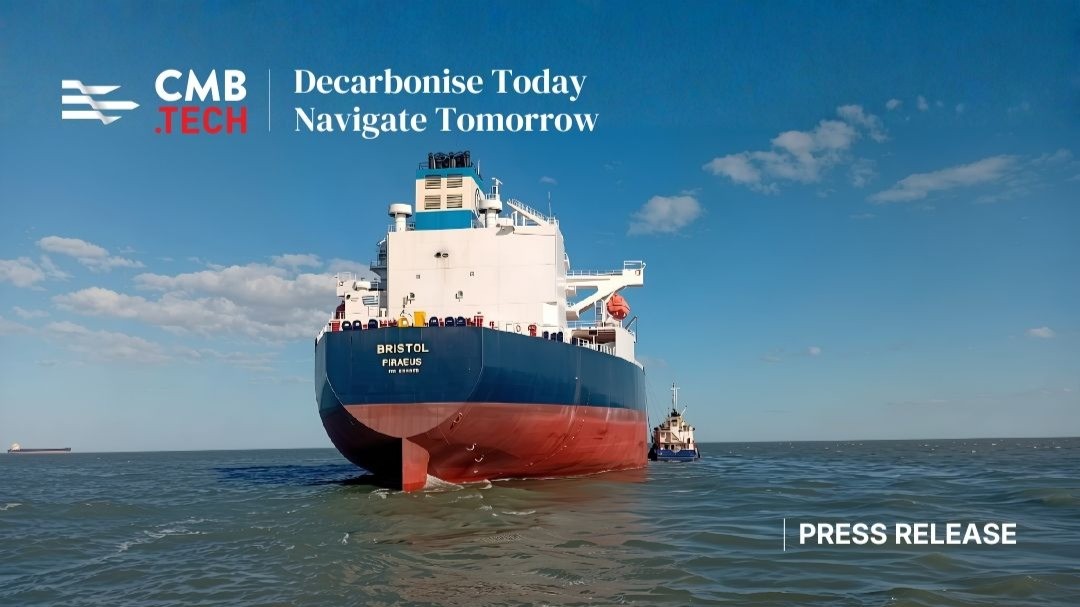

The 2024-built Bristol is the latest young Suezmax to leave the CMB.TECH fleet, with the sale expected to generate a $56.9 million capital gain. Two 2023-built sister ships were reportedly sold earlier for around $110 million each, as strong spot earnings and tight availability continue to lift Suezmax asset values.
CMB.TECH is once again cashing in on strong tanker asset prices, this time by selling a Suezmax that is only two years old.
On 11 August, the Belgian shipping group announced the sale of the 156,851-dwt Bristol, built in 2024. The company did not disclose the buyer or the sale price, but said the vessel is expected to be delivered to its new owner in the fourth quarter of 2026.
CMB.TECH expects the transaction to generate a capital gain of approximately $56.9 million in the fourth quarter, calculated on the basis of the vessel’s net sale price and book value.
The $56.9 million figure should not be confused with the vessel’s actual sale price. It represents the expected accounting gain arising from the difference between the net proceeds from the sale and Bristol’s carrying value on CMB.TECH’s balance sheet.
For a vessel delivered only two years ago, that is already a striking number.
The Bristol sale also comes just weeks after CMB.TECH disposed of two other very young Suezmaxes, the 2023-built Brest and Brugge. All three ships are 156,851-dwt units.
The two 2023-built vessels were reportedly sold for around $110 million each, with Greek owner Naftomar linked by brokers to the acquisition. CMB.TECH said the pair would generate a combined capital gain of approximately $100.5 million.
Including Bristol, CMB.TECH has therefore agreed to sell three 2023-2024-built Suezmaxes in less than two months, with expected combined capital gains of approximately $157.4 million.

From a 19-year-old Suezmax to a two-year-old ship
Earlier in the year, CMB.TECH’s Suezmax disposals were still focused largely on older vessels.
In May, the company disclosed the sale of the 2007-built, roughly 150,000-dwt Sienna, with an expected capital gain of around $29.2 million.
That transaction fitted a conventional fleet-renewal strategy: sell an older ship into a strong secondhand market, realise the gain and reduce fleet age.
By late June, however, the profile of the vessels being sold had changed sharply.
The 2023-built Brest was sold.
The 2023-built Brugge followed.
Now the 2024-built Bristol has also been sold.
These are not ageing vessels approaching replacement. They are relatively new ships with many years of trading life ahead of them.
CMB.TECH’s recent transactions therefore point to a more active asset-management approach. When secondhand prices become sufficiently attractive, even very young vessels can be monetised.
Put simply: the prices have become too attractive to ignore.
Alexander Saverys made that logic clear when CMB.TECH announced the sale of Brest and Brugge, referring to historically strong Suezmax valuations and the opportunity to unlock value at an attractive point in the cycle.
Two 2023-built Suezmaxes reportedly fetched around $110m each
The sale of Brest and Brugge provides an important benchmark for the current Suezmax asset market.
Both vessels were built in 2023 and are 156,851 dwt, making them just three years old.
Market reports suggested that several buyers showed interest, with both Naftomar and MSC linked to discussions before brokers ultimately associated Naftomar with the deal.
The reported price was around $110 million per vessel, implying a combined consideration of roughly $220 million.
CMB.TECH expects the two transactions to generate about $100.5 million in capital gains.
The latest sale is even more notable because Bristol is one year younger.
CMB.TECH has not disclosed its sale price, and the $56.9 million expected gain cannot be used on its own to calculate the transaction value. The final accounting gain depends on the vessel’s book value, net sale proceeds and transaction-related adjustments.
Still, Bristol’s expected $56.9 million gain is higher than the roughly $50.25 million average gain expected on each of Brest and Brugge.
That alone highlights how much value has accumulated in very young Suezmax assets.
Five-year-old Suezmaxes are now valued above newbuildings
Recent broker assessments help explain why CMB.TECH is willing to sell young ships.
According to MB Shipbrokers’ Tanker Weekly – Week 32, eco Suezmax spot earnings stood at approximately $161,566 per day as of 7 August, while one-year time-charter rates were assessed at around $75,000 per day.
The asset-price comparison is even more striking.
MB Shipbrokers assessed a Korean-built new Suezmax at approximately $90 million, while a five-year-old Suezmax was valued at around $100 million.

In other words, a five-year-old secondhand Suezmax is currently worth around $10 million more than a newbuilding, a premium of more than 11%.
The reason lies in immediate earning capacity.
A newbuilding may carry a lower headline price, but the buyer must wait for the shipyard slot and delivery. A relatively young secondhand vessel can enter the market immediately.
When spot earnings are running at tens of thousands of dollars per day—and on some high-risk routes at several hundred thousand dollars per day—the ability to deploy a ship today carries a substantial premium.
High freight rates are increasingly being capitalised into higher ship values.
That helps explain how Brest and Brugge could reportedly command around $110 million each while still allowing CMB.TECH to book more than $100 million in combined gains.
Black Sea Suezmax earnings have moved above $400,000 per day
The sharp rise in Suezmax asset values is occurring against an exceptionally strong spot-market backdrop in certain regions.
According to the latest weekly market update from SSY’s Singapore tanker team, the 135,000-tonne Black Sea-Mediterranean Suezmax route had climbed to around WS535, equivalent to approximately $406,016 per day in TCE earnings.
The contrast with the Atlantic market is extreme.
At the same time, the 130,000-tonne West Africa-UK Continent route was assessed at only around WS170, or approximately $73,033 per day.
The same class of vessel is therefore generating a difference of more than $330,000 per day depending on trading area, with Black Sea earnings more than five times those available on the West Africa-UK Continent route.
The Black Sea spike is being driven largely by rising war risk and a shrinking pool of owners willing to accept exposure to the region.
Security risks surrounding CPC-related loadings and wider Black Sea operations have increased, prompting some owners to demand much higher freight while others avoid the trade entirely.
Even as CPC loading volumes have faced disruption, the number of ships genuinely willing to enter the region has tightened more quickly than cargo demand.
Charterers are therefore paying heavily for what has become a scarcer commodity: a Suezmax whose owner is prepared to go there.
The result is a sharply segmented market.
West African Suezmax rates can weaken when vessel supply is ample, while Black Sea rates can surge because a large part of the nominal fleet is effectively unavailable for that trade.
Freight is increasingly being priced on the basis of where owners are willing to send their ships, rather than simply how many vessels exist globally.
Higher spot earnings are feeding into period rates and ship values
The strength is also spreading beyond the spot market.
SSY currently assesses one-year rates for eco Suezmaxes at around $73,000 per day, rising to around $75,000 per day for eco vessels fitted with scrubbers.
The broker has also noted tight availability in the Suezmax period market, strong third-quarter spot conditions and rising bids for 12-month employment.
MB Shipbrokers independently places one-year eco Suezmax rates at the same $75,000-per-day level.
The convergence between two major brokerage houses suggests that the market is no longer treating the strength purely as a short-lived spot phenomenon.
Once charterers are prepared to pay around $75,000 per day for one-year employment, expectations for future earnings inevitably feed into secondhand vessel values.
Black Sea earnings above $400,000 per day may remain an extreme regional phenomenon, but they reinforce the broader repricing of Suezmax earning potential.
That repricing is now visible not only in freight, but also in period rates and asset values.
CMB.TECH is converting high asset values into cash
CMB.TECH’s recent transactions show a clear approach to managing the tanker cycle.
The company could have retained Bristol, Brest and Brugge within the Euronav fleet and continued to benefit from strong charter earnings.
At the same time, however, the sharp rise in vessel values has created an opportunity to crystallise years of future earnings expectations into an immediate sale gain.
CMB.TECH has chosen to monetise part of that value.
The group has already sold a series of VLCCs and Suezmaxes this year, including older VLCCs sold earlier in 2026, the 2007-built Sienna, the 2023-built Brest and Brugge, the 2016-built VLCC Donoussa, and now the 2024-built Bristol.
The sale of Donoussa is expected to generate a capital gain of approximately $74.4 million.
The disposal of Brest and Brugge is expected to generate approximately $100.5 million.
The Bristol transaction is expected to add another $56.9 million.

By the time the Bristol sale was announced, CMB.TECH had disclosed the sale of nine VLCCs and four Suezmaxes during 2026.
Based on the capital-gain figures initially announced for those transactions, the tanker disposals are expected to generate roughly $620 million in capital gains.
The pattern is increasingly clear.
CMB.TECH is benefiting from the tanker market in two ways: through the strong operating cash flows generated by the Euronav fleet, and through the substantial appreciation in the value of the ships themselves.
The progression from the 2007-built Sienna to the 2023-built Brest and Brugge, and now the 2024-built Bristol, shows how far the company is prepared to extend its asset-sale strategy when valuations justify it.
With five-year-old Suezmaxes now valued at around $100 million and two 2023-built sister ships recently reported at approximately $110 million each, the eventual sale price of the two-year-old Bristol will provide another useful benchmark for just how far the Suezmax secondhand market has moved.


READ MORE
 Tankers
Nanjing Tanker Seeks Four More LR2s as Product Tanker Expansion Accelerates
 Tankers
Trafigura Moves Deeper into Shipowning as Volare Shipping Heads for an Oslo Listing
 Tankers
$64,569 !!! Record ClarkSea Index Masks a Shipping Boom Built on Different Forces
 Tankers
Transpetrol Makes LR1 Debut with Two 75,000-dwt Tankers at Yangzijiang
 Tankers
Trump angin. US Shadow Fleet Law Raises New Risks for China’s Russian Oil Trade
 Tankers
Seven Months, $78 Million: George Procopiou Reaps Windfall on Hengli-Built VLCC
 Tankers
VLCCs top $1m a day — but what price is TD3C actually discovering?
 Tankers
Nearly $1 Billion: Dynacom Orders 8More Ships as Hengli Tops Global 2026 VLAC Orders
 Tankers
$862,150 a Day: VLCC Rates Set Another Record as Global Composite Nears $500,000
 Tankers