


$438,000 a Day: Suezmax Earnings Overtake VLCCs as Black Sea Risk Premium Hits Record Levels

The Black Sea tanker market has produced another extraordinary number.
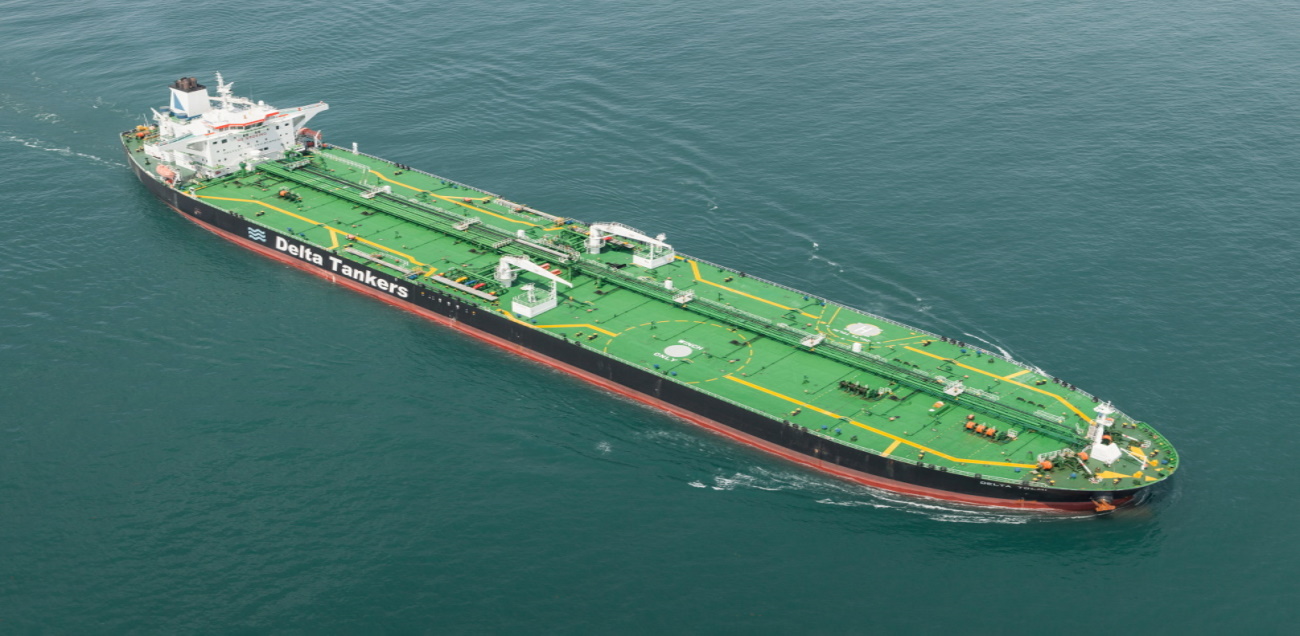
According to TradeWinds, Greek shipowner Diamantis Diamantidis’ Delta Tankers has fixed its 159,000-dwt Suezmax Delta Supreme to Chevron for a voyage carrying CPC crude from Russia’s Black Sea coast to the Mediterranean at WS 570.
If confirmed, the fixture would appear to set a new record for the Black Sea Suezmax market.
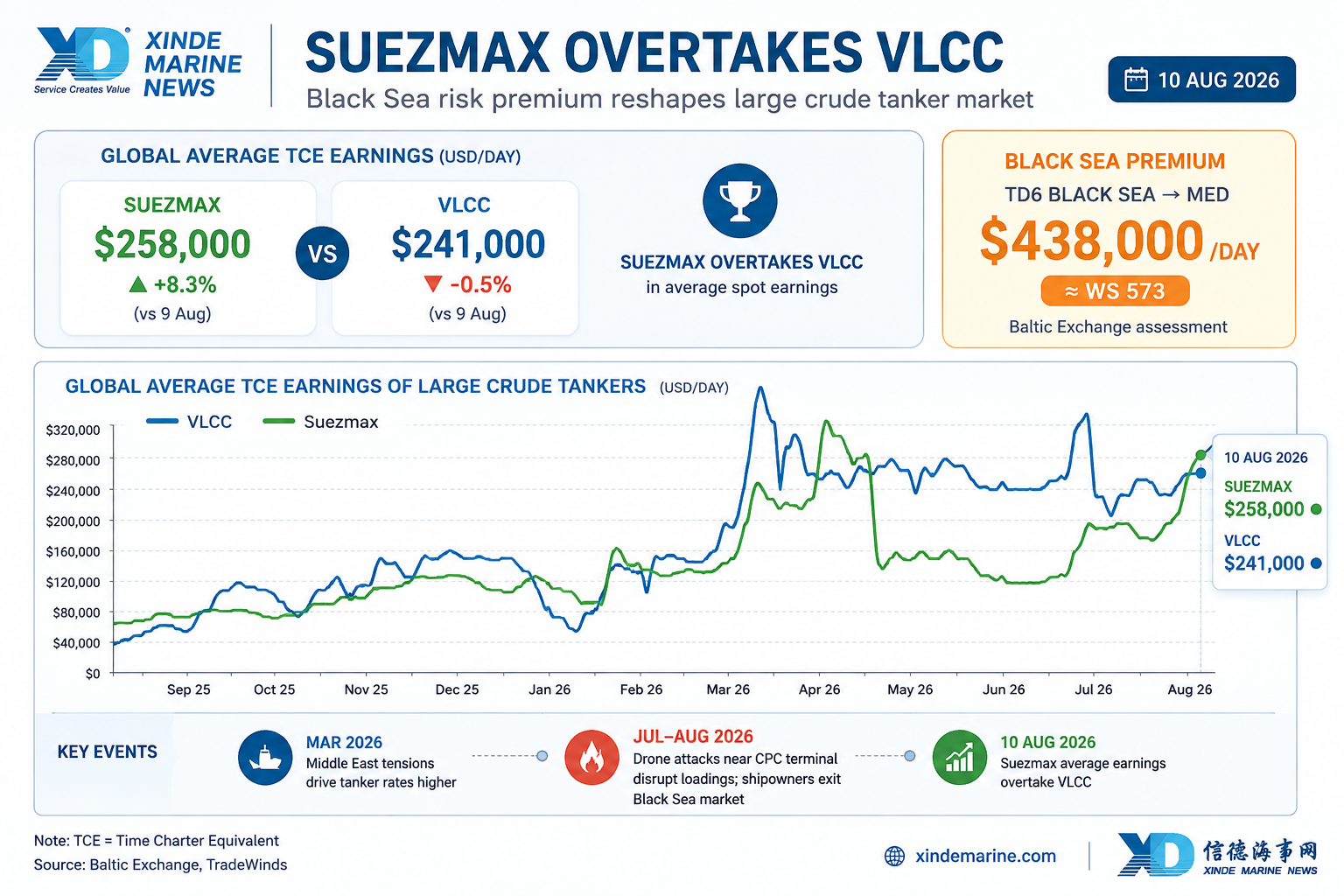
On the same day, the Baltic Exchange’s TD6 assessment — the benchmark route for 135,000 tonnes of crude from the Black Sea to the Mediterranean — surged to nearly WS 573, equivalent to just under $438,000 per day in time-charter-equivalent earnings, following a one-day increase of about 9%.
The Delta Supreme fixture remained on subjects at the time of reporting, while Delta Tankers had not immediately confirmed the deal.
This is no longer merely a local Black Sea market anomaly.
Baltic Exchange data showed average Suezmax spot earnings rising to nearly $258,000 per day on 10 August, up 8.3% in a single day.
Average VLCC earnings, meanwhile, slipped slightly to around $241,000 per day.
In other words, even with VLCC earnings already at exceptionally high levels, Suezmaxes have now moved ahead on average spot earnings.
Robert Boles, global head of Suezmax at Simpson Spence Young, said the latest TD6 spot earnings were around 930% above the 10-year average, describing the current market as “sky-high.”
Black Sea Rates Have More Than Doubled in Six Weeks
The speed of the move becomes even clearer when compared with levels just over a month ago.
On 26 June, the Baltic Exchange’s TD6 route stood at around WS 266, corresponding to TCE earnings of approximately $169,700 per day.
By 10 August, the route was
approaching WS 573 and almost $438,000 per day.
That means that in roughly six weeks, the Worldscale assessment had increased by about 115%, while TCE earnings had risen by approximately 158%.
What is particularly striking is that the rally has not been driven by a sudden surge in crude volumes from the Black Sea.
In fact, CPC export volumes have been under pressure.
Reuters has reported that repeated drone attacks and interruptions to loading operations reduced CPC crude loadings in July by more than 20% from normal levels, equivalent to roughly 400,000 barrels per day.
Normally, lower cargo volumes should weaken freight rates.
Instead, the opposite has happened.
The reason is straightforward:
More ships have left the market than cargoes have disappeared.
The Scarce Commodity Is Now the Ship Willing to Go There
Over recent weeks, tankers operating near the CPC terminal have been repeatedly exposed to drone attacks and other security incidents.
The growing risk has increasingly affected the supply side of the tanker market.
Some shipowners have reduced or suspended their exposure to the region, while charterers and crude sellers have faced greater difficulty finding vessels willing to enter the Black Sea.
This explains what might otherwise appear to be a contradiction.
CPC exports have fallen, yet freight rates have surged.
The decisive factor is no longer the nominal size of the global Suezmax fleet.
It is how many owners are actually prepared to send their ships into the region.
The Black Sea risk environment has effectively removed part of the available fleet from the market.
The vessels that remain willing and able to trade there are therefore in a much stronger negotiating position.
At the same time, CPC barrels cannot simply disappear from the market.
The Caspian Pipeline Consortium remains a crucial export route for Kazakhstan and handles a significant share of the country’s crude exports.
Chevron itself is a major CPC shareholder, with a 15% interest.
The cargo still needs to move.
But if fewer owners are willing to carry it, the result is inevitable:
the security risk is being directly priced into freight.
Delta Tankers Is Capturing the Risk Premium
That makes Delta Tankers one of the most interesting owners to watch in the current market.
Delta has long been a significant participant in large crude tanker markets and is particularly active in the Suezmax segment.
TradeWinds noted that Delta is a dominant player in the Black Sea market and has demonstrated a willingness to operate in geopolitical hotspots.
That willingness is now being rewarded with exceptional freight levels.
But the returns are tied to very real risks.
For owners entering the Black Sea, the equation includes not only freight income but also war-risk insurance, crew safety, potential vessel damage, operational disruption, delays, terminal shutdowns and the possibility of rapidly changing security conditions.
The current TD6 earnings of almost $438,000 per day therefore should not simply be interpreted as extraordinary shipowner profit.
They are also a very explicit form of risk compensation.
Delta Supreme’s WS 570 fixture illustrates how high that compensation has become.
And there may still be further upside.
Italy’s Eni is reportedly seeking a tanker for another CPC export cargo, and brokers believe the next fixture could push the market even higher.
A New Variable Has Entered the Market
There is, however, one development that could eventually change the direction of the market.
Recent diplomatic efforts have sought to reduce attacks on non-Russian tankers and CPC-related infrastructure.
If such arrangements prove durable, perceptions of Black Sea risk could gradually improve, encouraging more international shipowners to return.
In theory, that would bring previously withdrawn Suezmax tonnage back into the market and compress the extraordinary risk premium now embedded in freight rates.
But so far, the market is clearly not pricing in a full return to normality.
Even after signs of possible de-escalation, TD6 has still pushed towards WS 573 and Delta Supreme was fixed at WS 570.
For shipowners, insurers and crews, there remains an important distinction between a political commitment to improve maritime security and a sustained period of safe commercial navigation.
That distinction will be critical in determining what happens next.
If a meaningful number of mainstream owners return to the Black Sea, freight rates above WS 500 would be difficult to sustain for long.
But if another major security incident occurs, or if owners and insurers continue to view the region as unacceptable risk, the small pool of Suezmaxes still willing to enter the market could retain extraordinary pricing power.
This points to a broader change now becoming increasingly visible across tanker shipping.
Traditionally, freight markets were analysed through three basic variables:
cargo volumes, vessel supply and voyage distance.
Today, another variable is becoming just as important:
How many ships are actually willing to go?
In the Black Sea today, that question may matter more than conventional supply-and-demand calculations.
And WS 570 is simply the latest price attached to it.


READ MORE
 Tankers
Nanjing Tanker Seeks Four More LR2s as Product Tanker Expansion Accelerates
 Tankers
Trafigura Moves Deeper into Shipowning as Volare Shipping Heads for an Oslo Listing
 Tankers
$64,569 !!! Record ClarkSea Index Masks a Shipping Boom Built on Different Forces
 Tankers
Transpetrol Makes LR1 Debut with Two 75,000-dwt Tankers at Yangzijiang
 Tankers
Trump angin. US Shadow Fleet Law Raises New Risks for China’s Russian Oil Trade
 Tankers
Seven Months, $78 Million: George Procopiou Reaps Windfall on Hengli-Built VLCC
 Tankers
VLCCs top $1m a day — but what price is TD3C actually discovering?
 Tankers
Nearly $1 Billion: Dynacom Orders 8More Ships as Hengli Tops Global 2026 VLAC Orders
 Tankers
$862,150 a Day: VLCC Rates Set Another Record as Global Composite Nears $500,000
 Tankers