


Pilot Was on a 39-Minute Personal Call Before Fatal Tug Collision, NTSB Finds
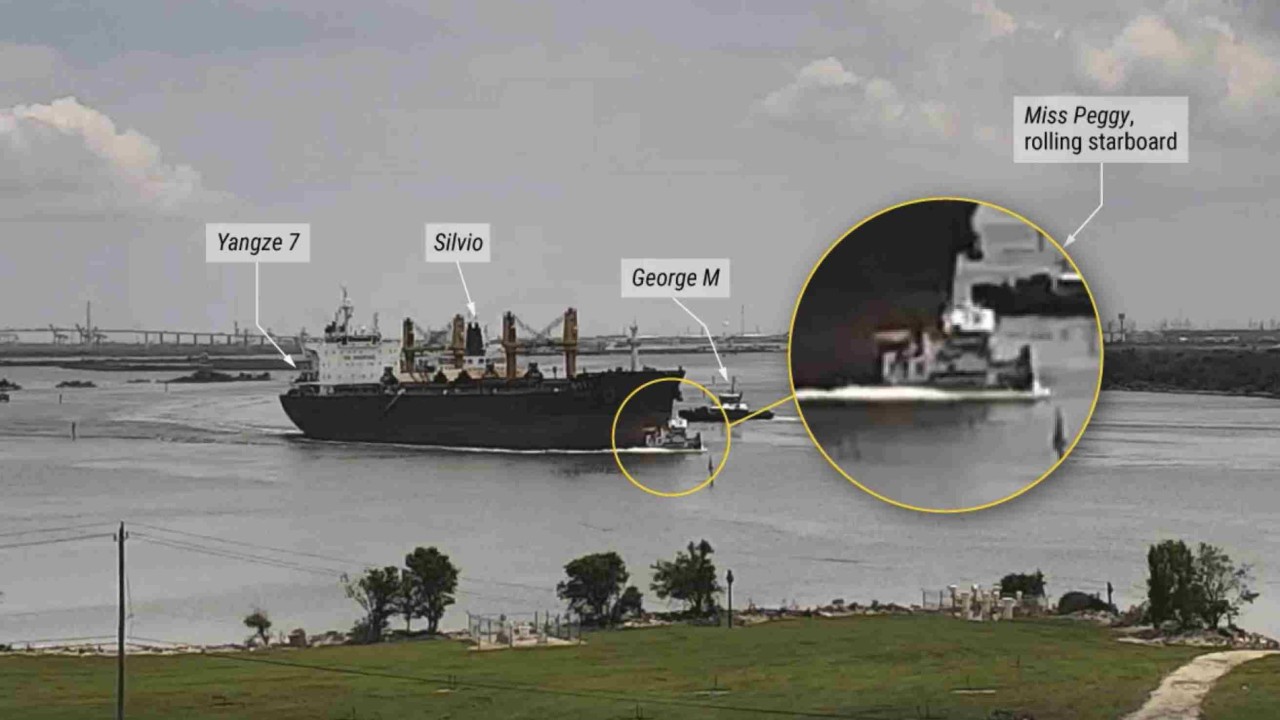

The call ended just 2 minutes and 16 seconds before bulk carrier YANGZE 7 struck and sank tug Miss Peggy in the Houston Ship Channel, killing one crew member. The NTSB said the accident exposed not only the dangers of mobile-phone distraction, but a broader failure of bridge resource management and situational awareness.
A Houston pilot spent more than 39 minutes on a personal phone call while directing a bulk carrier through one of the busiest waterways in the United States, ending the call just 2 minutes and 16 seconds before the vessel collided with and sank a tugboat.
That is one of the most striking findings in the US National Transportation Safety Board’s investigation into the fatal collision between the Liberia-flagged bulk carrier YANGZE 7 and the tug Miss Peggy in the Houston Ship Channel on July 19, 2024.
The NTSB completed its investigation in July 2026 and subsequently released its findings in Marine Investigation Report MIR-26-24.
The agency concluded that the Houston pilot, the bridge team aboard YANGZE 7 and the master of Miss Peggy all failed to maintain a proper lookout, resulting in a breakdown of situational awareness on both vessels.
The pilot’s prolonged use of a mobile phone for a non-operational conversation was identified as an important factor in his failure to detect the tug ahead.
Miss Peggy capsized rapidly following the collision.
Five crew members were aboard the tug. Four were rescued, including one who suffered serious injuries and another who sustained minor injuries. The fifth crew member was later found dead inside the wreck.
Damage, salvage and pollution-response costs were estimated at approximately $3.7 million. YANGZE 7 reported no damage.
But the significance of the accident extends well beyond one pilot making a phone call.
For the NTSB, the collision became a case study in distraction, normalization of unsafe practices, ineffective bridge resource management and the danger of assuming that somebody else on the bridge will intervene.
A 39-minute personal call while conning the ship
YANGZE 7 is a 2014-built, Liberia-flagged bulk carrier with an overall length of 199.9 metres and gross tonnage of 36,426. The vessel is classed by ClassNK.
There were 22 people aboard on the day of the accident.
At about 0956, YANGZE 7 departed an anchorage near Galveston in ballast, bound for the Kinder Morgan bulk terminal in Houston to load coal.
A Houston Pilots pilot boarded at approximately 1027 and subsequently took responsibility for directing the vessel through the Houston Ship Channel.
Investigators reviewing mobile-phone records and voyage data recorder information found that the pilot had already been using his phone during the transit.
Bridge personnel recalled seeing him conduct an earlier call lasting about 10 minutes. The second officer also told investigators that he had seen the pilot watching a video unrelated to the navigation of the vessel.
The most important call began at 1322:39.
It came from another Houston pilot.
Significantly, the other pilot was himself on duty at the time, conning the laden tanker Petrel outbound through the Houston Ship Channel.
The two pilots, both actively directing large commercial vessels, then spoke for 39 minutes and 5 seconds.
According to the NTSB, evidence from the second officer and the VDR established that the conversation was personal in nature and unrelated to vessel safety, traffic coordination or pilotage operations.
The call ended at 1401:44.
The collision occurred only 2 minutes and 16 seconds later.
During the conversation, the pilot continued to direct YANGZE 7.
He would interrupt the call to issue helm or engine orders, then resume the conversation.
The NTSB also found occasions when the pilot did not acknowledge the helmsman’s or officer’s repeat-back of his orders and instead continued talking on the phone.
For investigators, this raised a wider concern: using a personal electronic device while conning a ship may no longer have been regarded as particularly unusual.
The NTSB referred to the concept of “normalization of deviance” — the process by which an unsafe practice can gradually become accepted when it repeatedly occurs without immediate consequences.
At the time of the accident, Houston Pilots did not prohibit pilots from using personal electronic devices for non-work purposes while conducting a vessel.
The NTSB said that absence of a clear prohibition could have allowed unsafe behaviour to become normalized.
When the call ended, the tug was already hidden by the bow
The final minutes before impact are particularly revealing.
When the pilot ended the phone call at 1401:44, investigators determined that Miss Peggy was already so close ahead of YANGZE 7 that the smaller vessel was obscured by the bulk carrier’s bow from the pilot’s normal viewing position.
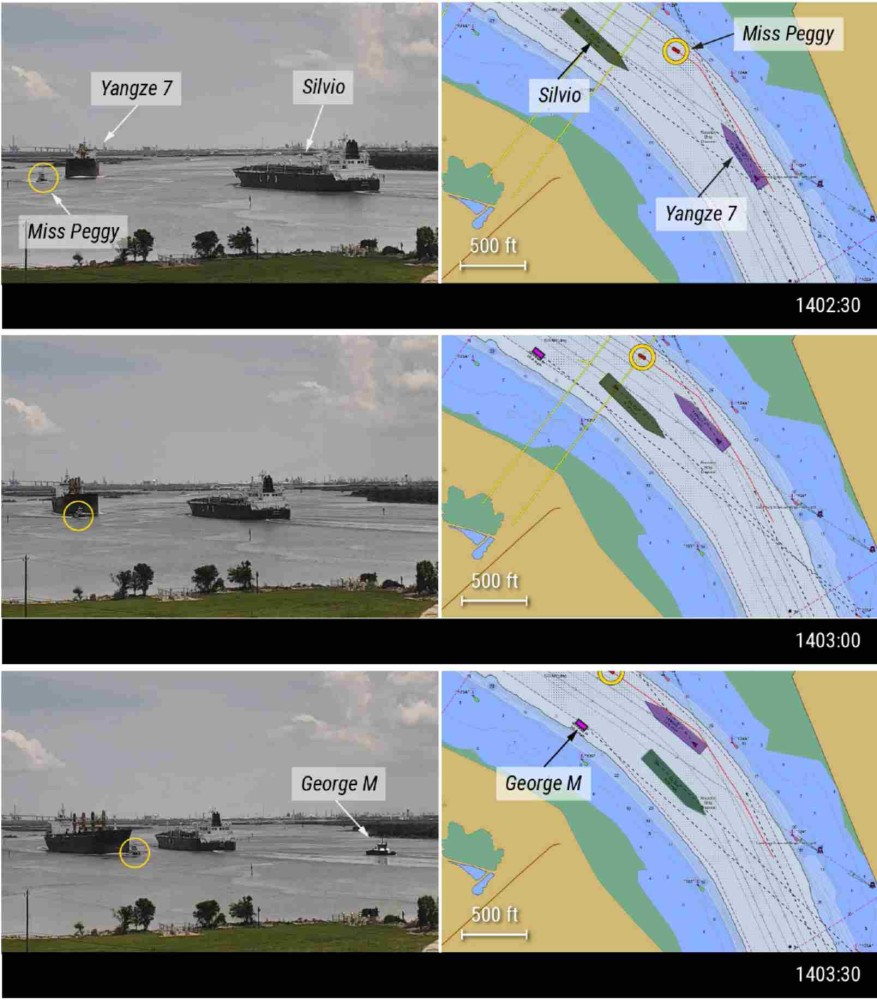
In other words, the pilot had missed the best visual opportunity to detect the tug during the preceding period.
By the time his attention returned fully to navigation, Miss Peggy had entered the ship’s forward blind sector.
The pilot then focused primarily on two outbound commercial vessels and on manoeuvring through the Lynchburg Bend area.
The much smaller tug directly ahead still did not form part of his effective situational awareness.
At about 1402, roughly 1 minute and 35 seconds before the collision, YANGZE 7 remained at Full Ahead.
Its bow was approximately 781 feet, or 238 metres, astern of Miss Peggy — only about 1.2 times the bulk carrier’s own length.
On the bridge, the second officer’s attention was largely directed towards the outbound vessel Silvio approaching from the port side.
He later told investigators that because the pilot was actively issuing helm orders and speaking, his own attention was concentrated on the meeting situation with Silvio.
Meanwhile, on Miss Peggy, one crew member walked onto the upper deck while making a video call.
Ironically, he became one of the first people to recognise the developing danger.
After seeing YANGZE 7 rapidly closing from astern, he concluded that a collision was imminent and immediately ended his video call.
At 1402:42, the boatswain stationed forward on YANGZE 7 reported to the bridge that a tug was “very close”.
He estimated the distance at only 20 to 30 metres.
AIS analysis later showed that the actual separation between YANGZE 7’s bow and Miss Peggy’s stern was about 538 feet, or 164 metres.
Less than a minute remained before impact.
Shortly afterwards, the pilot asked:
“We are Half Ahead now, right?”
The second officer initially answered yes, then immediately corrected himself:
“Full Ahead, sir.”
Only then did the pilot order the engine reduced from Full Ahead to Half Ahead.
The exchange was another important detail in the investigation.
Even as the bulk carrier was rapidly overtaking the tug, the person directly conning the ship briefly appeared uncertain about the vessel’s actual engine setting.
At 1403:28, the operator of another outbound tug, George M, recognised the danger and issued an urgent VHF warning to YANGZE 7 that a tug was directly ahead.
The pilot then ordered starboard helm, including starboard 10 and later starboard 15.
But by that stage, the vessels were effectively too close for the collision to be avoided.
At 1403:35, YANGZE 7’s bulbous bow struck the stern of Miss Peggy.
The tug surged forward, rolled heavily to starboard and capsized.
About 20 seconds later, the bridge of YANGZE 7 received another radio call informing them that they had struck a tug and that the vessel had overturned ahead of them.
Only then did the full consequences of the collision become clear on the bridge.
The second officer was concerned — but said nothing
One of the most important questions raised by the investigation was why nobody on YANGZE 7’s bridge challenged the pilot during a personal call that continued for almost 40 minutes.
The answer points directly to a failure of Bridge Resource Management, or BRM.
At the time, the bridge team included the pilot, master, second officer and helmsman.
The second officer knew that the pilot had been engaged in non-operational mobile-phone activity and had become concerned that it could affect the accuracy of the navigation.
However, he did not voice that concern.
He told investigators that because the master was also present on the bridge, he assumed the master was aware of the situation and would intervene if necessary.
The master, however, had reached a very different conclusion.
Although he knew the pilot was on the phone, English was not his first language and he found it difficult to follow the pilot’s rapid conversation.
The master therefore assumed the call was work-related.
He did not intervene either.
The result was a classic BRM breakdown.
The second officer knew the call was inappropriate but assumed the master knew as well.
The master knew the pilot was on the phone but assumed the call was operational.
Everyone was on the same bridge, yet they did not share the same understanding of the situation.
The master’s own standing orders prohibited mobile-phone use on the bridge, although the wording did not specifically state whether that restriction applied to pilots boarding the vessel.
The NTSB nevertheless noted that, regardless of the exact subject of the call, a telephone conversation lasting 39 minutes should itself have raised concerns about sustained distraction.
The master remained ultimately responsible for the safety of the vessel and was expected to question a pilot’s actions or inaction when necessary.
The NTSB concluded that if a member of the bridge team had challenged the pilot over his phone use, the pilot might have ended the conversation earlier and redirected his attention to the navigation task.
The absence of such intervention was therefore evidence of ineffective BRM.
The lesson is particularly important in pilotage waters.
A pilot boarding a vessel does not mean that the master and bridge officers surrender responsibility for safe navigation.
Effective BRM depends on the pilot, master, officers and helmsman developing and maintaining a common mental picture of the vessel’s situation.
Any member of the bridge team who identifies unsafe behaviour must be willing to raise the issue clearly and professionally, regardless of rank, seniority, language barriers, cultural differences or the authority traditionally associated with a local pilot.
NTSB did not blame the pilot alone
Despite the focus on the 39-minute call, the NTSB did not reduce the accident to a simple case of a distracted pilot hitting another vessel.
Its probable-cause findings were broader.
The agency concluded that the Houston pilot, YANGZE 7’s bridge team and the master of Miss Peggy all failed to maintain a proper lookout, resulting in a loss of situational awareness.
The pilot’s distraction from the prolonged non-work phone call contributed to his failure to detect the tug.
Houston Pilots’ lack of a policy prohibiting non-operational use of personal electronic devices while pilots were directly controlling vessels also contributed to the unsafe situation.
The master of Miss Peggy also failed to detect YANGZE 7 approaching from astern in time to avoid the collision.
Investigators found that the tug master had made a separate private phone call lasting 76 seconds about 24 minutes before impact.
The NTSB concluded that this call may have briefly diverted his attention but occurred too far in advance of the collision to be considered a contributing factor.
The accident therefore represented the simultaneous failure of several defensive layers.
The pilot did not see the tug.
The bridge team did not identify the tug early enough and did not challenge the pilot’s prolonged distraction.
The tug master did not detect the bulk carrier closing rapidly from astern.
By the time the forward lookout on YANGZE 7 and another nearby tug sounded warnings, only seconds remained.
New recommendations: no personal phone use while conning a vessel
The investigation also prompted the NTSB to examine whether existing rules were strong enough.
At the time of the accident, Houston Pilots had no written rule explicitly prohibiting pilots from using mobile phones or other personal electronic devices for private purposes while providing pilotage services.
Whether a pilot should use a phone was largely left to individual judgment and what might be regarded as “common sense”.
The NTSB warned that this approach creates inconsistent interpretations and can gradually lead to tolerance of unsafe practices.
Houston Pilots has since revised its rules.
Effective February 8, 2026, pilots providing pilotage services are required to limit personal electronic-device use to vessel safety, necessary communication with other pilots, pilot transportation, the US Coast Guard, national security, law enforcement or other professional purposes.
Use is to be minimised, and personal use avoided.
The NTSB, however, concluded that individual pilot organisations should not be left to address the issue alone.
It issued two new safety recommendations.
M-26-001, directed to the US Coast Guard, calls for a prohibition on the non-operational use of personal electronic devices by individuals directly controlling vessel movements in waters under Coast Guard jurisdiction.
M-26-002, directed to the American Pilots’ Association, calls for guidance prohibiting pilots who are directly manoeuvring or directing vessels from using personal electronic devices for non-work purposes, and for member pilot associations to incorporate such restrictions into their operating rules and policies.
The NTSB also made an important practical point.
It is unrealistic to place the entire burden on ship masters and bridge officers to determine whether a pilot’s phone call is operational and then expect foreign seafarers to challenge a local pilot and tell him or her to hang up.
Clear regulatory and industry boundaries are therefore needed.
Electronic-device distraction is not a new maritime risk
The YANGZE 7 accident is far from the first maritime casualty in which personal electronic-device use has played a role.
According to the NTSB, between 2009 and 2024, distraction involving mobile phones or other personal electronic devices was identified as a probable cause or contributing factor in at least 10 marine accidents.
Those accidents resulted in three deaths, 45 injuries and more than $85 million in direct property damage.
Adjusted to 2026 values, the NTSB estimated the losses at more than $111.5 million.
One of the best-known examples was the grounding of the container ship Ever Forward in Chesapeake Bay in 2022.
Investigators found that the pilot made five phone calls totalling more than an hour during the voyage and, before the grounding, exited the real-time navigation function of his portable pilot unit to view information from a previous transit, sent text messages and drafted an email.
The US Coast Guard ultimately concluded that loss of situational awareness and ineffective BRM contributed to that accident as well.
The Coast Guard had already issued a safety alert on “Distracted Operations” as far back as 2010, warning that non-operational use of mobile phones and other electronic devices during navigation could interfere with essential information exchange, delay reactions and interrupt attention.
Yet the NTSB noted that, at the time of its YANGZE 7 investigation, no comprehensive Coast Guard regulation prohibited non-work use of personal electronic devices by personnel performing safety-critical vessel-control duties.
The collision with Miss Peggy has once again brought that regulatory gap into focus.
The deeper lesson: everyone saw the distraction, but nobody spoke
Reducing this casualty to the sentence “a pilot was on his phone and hit a tug” would miss the most important lesson in the NTSB report.
The 39-minute call was clearly the most visible source of distraction.
But what allowed that distraction to develop into a fatal collision was the failure of the wider safety system to interrupt it.
The bridge team knew the pilot was using his phone.
The second officer was already concerned that the behaviour could affect navigation.
The master could see that the pilot was engaged in a prolonged conversation.
A lookout was stationed forward.
The vessel was equipped with radar, ECDIS and AIS.
Other vessels and traffic services were operating in the area.
Each represented another potential safety barrier.
Yet during those 39 minutes, none stopped the accident sequence.
Only after Miss Peggy had entered YANGZE 7’s forward blind sector, after the boatswain reported a tug “very close”, and after George M issued an urgent VHF warning did the bridge fully recognise the immediate danger.
By then, there was almost no time left.
The accident was therefore both a distraction casualty and a bridge-resource-management casualty.
It exposed authority gradients, communication failures and the danger of assuming that because the master is present, or because a pilot is conning the vessel, somebody else will take care of the risk.
Effective BRM does not mean every person on the bridge simply performs his or her assigned task.
It means that when any member of the team detects an unsafe condition, the concern is communicated, challenged and acted upon.
In a narrow and heavily trafficked pilotage waterway, the 39 minutes of silence from the bridge team proved almost as consequential as the 39-minute phone call itself.

READ MORE
 Safety
25 Crew Abandon MSC Container Ship in the South China Sea — All Rescued, Vessel Still Adrift
 Safety
MSC Hermes III Adrift Unmanned in South China Sea After 25 Crew Abandon Ship
 Safety
Dangerous Goods Container Fire Reported at NPCT1 Terminal in Jakarta
 Safety
1 seafarer killed, Fatal attack in the Strait of Hormuz: Capesize bulker CAPE DAO hit by unknown projectile
 Safety
Suspected Cyber Incident Diverts LNG Carrier After Cargo-Control Failure
 Safety
Xinde Marine Forum London 2026: Shipping Moves from Lean Logistics to Resilience by Design
 Safety
Almost the Entire Black Sea Is Now a War-Risk Listed Area
 Safety
Saudi pipeline attack exposes limits of Hormuz bypass strategy
 Safety
Engine Room Fire Epidemic Prompts Global Safety Alert After Qingdao Shipyard Tragedy
 Safety