


$510,000 a Day: Sinokor VLCC Fixture Sends Tanker Market Into Uncharted Territory
CNOOC books the 2021-built Angola Prosperity for a Middle East Gulf voyage at near-record earnings as TD3C surges to WS475.6 — exposing an extraordinary divide between abundant global tonnage and the handful of owners willing to transit the Strait of Hormuz
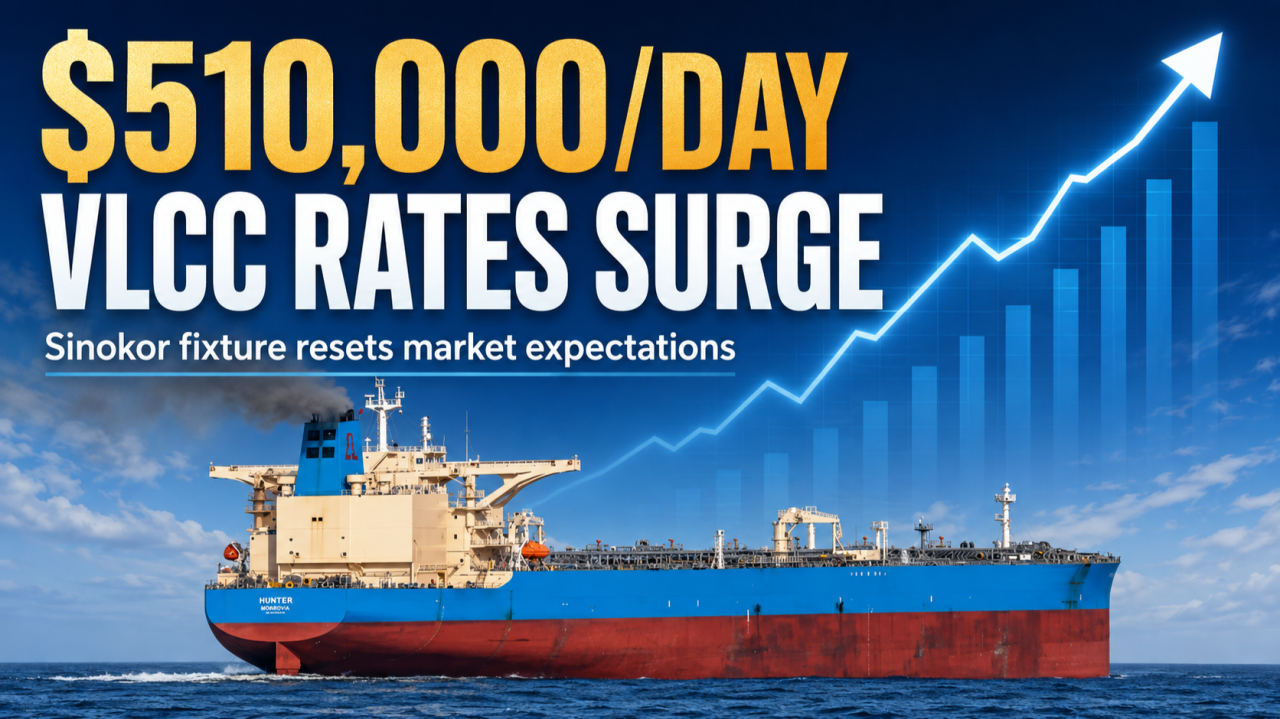

The VLCC market has delivered another extraordinary fixture, with South Korea’s Sinokor Merchant Marine securing earnings of more than half a million dollars per day for a voyage through the Strait of Hormuz.
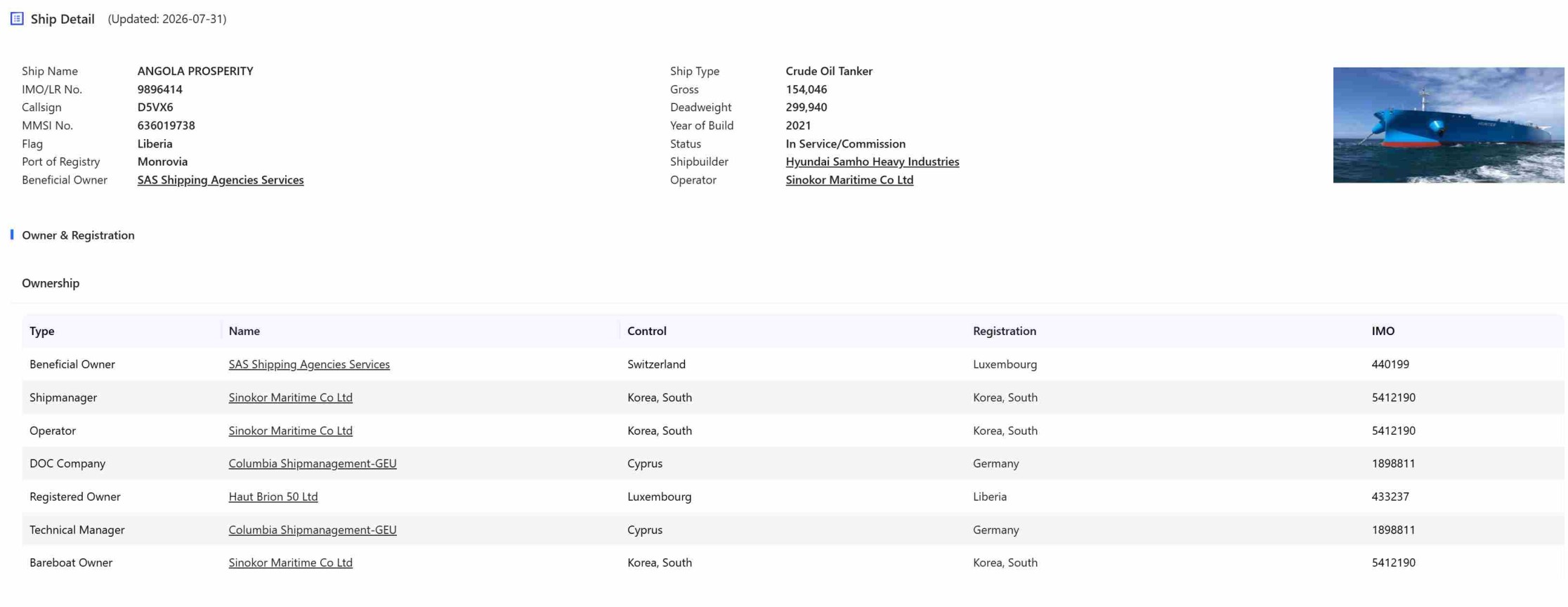
According to Tankers International and market data circulated by @Seoul Line, Sinokor has fixed the 299,940-dwt Angola Prosperity, built in 2021, to China National Offshore Oil Corporation (CNOOC) for a mid-August loading in the Middle East Gulf. The fixture is estimated to generate earnings of $510,604 per day, putting it within touching distance of the highest VLCC spot earnings ever recorded.
Tankers International puts the historical record at around $527,000 per day, achieved by Embiricos with the 2010-built Kalamos. Sinokor’s latest fixture is therefore only around $16,400 per day short of that record.
More importantly, the deal has immediately reset expectations across the Middle East VLCC market. On 6 August, benchmark Middle East Gulf-to-China route TD3C jumped by 43.3 Worldscale points in a single session to WS475.6, producing estimated TCE earnings of $481,286 per day. By comparison, West Africa-to-China TD15 was generating around $107,079 per day, US Gulf-to-China TD22 around $118,899 per day and Oman-to-China TD34 approximately $145,814 per day.
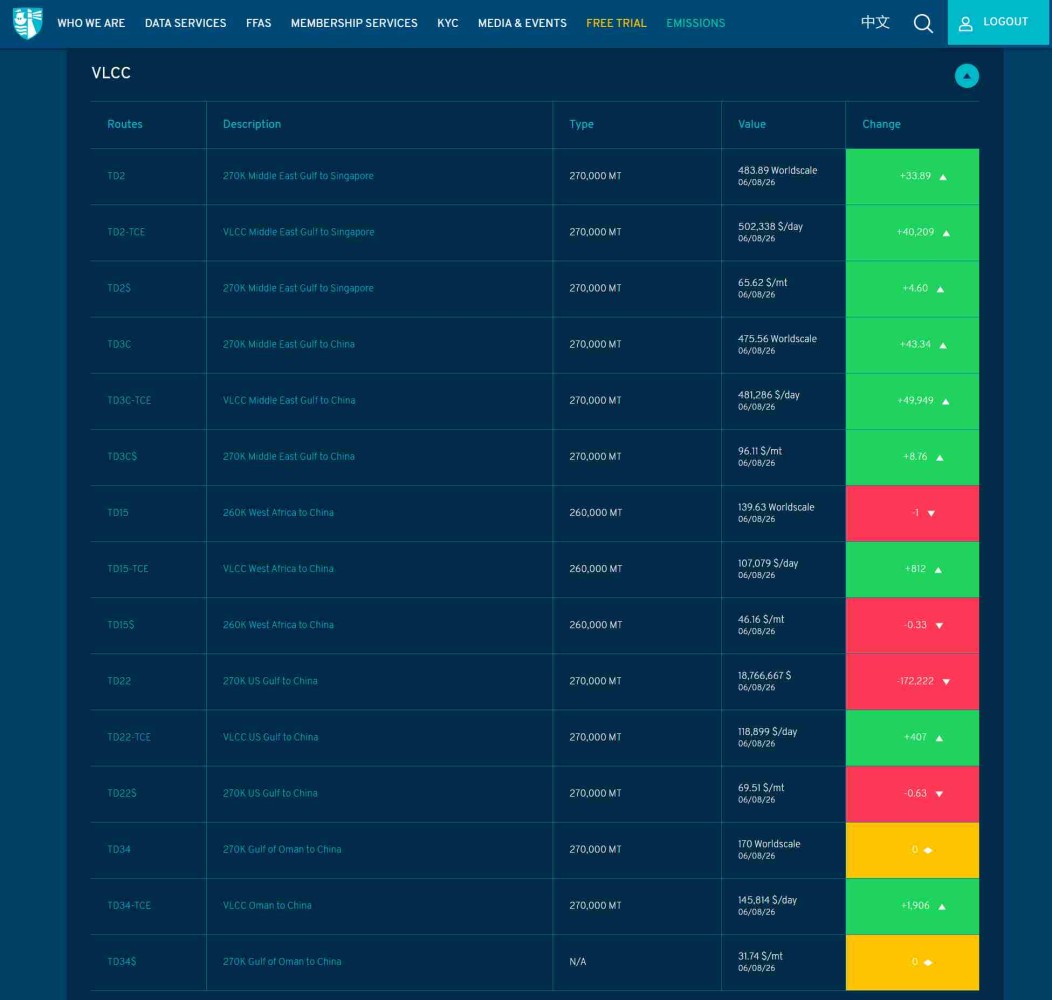
A relatively shorter Middle East Gulf-to-China voyage is therefore earning more than four times as much as some of the longest-haul Atlantic VLCC routes. That kind of inversion is extremely unusual and shows just how far geopolitical risk has overtaken conventional tonne-mile economics in the current market.
The $510,000 fixture is really a price for risk
The Angola Prosperity is a modern VLCC currently positioned in the Indian Ocean and expected to head towards the Middle East Gulf for the CNOOC cargo. Its extraordinary earnings are not primarily the result of age, fuel efficiency or a sudden increase in crude volumes. The decisive factor is that the vessel is prepared to enter the Persian Gulf and accept the risks associated with transiting the Strait of Hormuz.
As security conditions around the strait remain highly uncertain, many owners, insurers and crews have become reluctant to commit tonnage to Middle East Gulf voyages. A vessel that can meet charterer approval requirements, obtain insurance, arrive within the required laycan and — critically — whose owner is prepared to accept the voyage has become a scarce commodity.
That scarcity is visible in the enormous spread between TD3C and TD34. TD3C reached WS475.6 on 6 August, while the Oman-to-China TD34 route stood at just WS170.0. The two routes are not directly comparable in every respect: loading areas, voyage length, fuel consumption and turnaround time differ, so the entire spread cannot simply be described as a Hormuz risk premium. But a gap of more than 300 Worldscale points leaves little doubt that the market is attaching an exceptional value to vessels willing to enter the Persian Gulf.
The VLCC market has effectively split into two different pricing environments. Atlantic trades are still being influenced largely by cargo volumes, tonne-mile demand and regional vessel availability. Middle East Gulf trades, by contrast, are increasingly being priced first according to whether an owner is willing and able to take the risk, with conventional voyage economics becoming secondary.
486 ballast VLCCs — but only a fraction are truly available
The paradox is that global VLCC supply does not look tight at all on paper. Seoul Line data show a global ballast pool of around 486 VLCCs, equivalent to roughly 53.4% of the fleet. The number is up 1.7% week on week and 7.2% month on month, placing global ballast availability at historically elevated levels. Around 120 vessels are positioned in the Indian Ocean-to-Middle East Gulf region alone.
Under normal tanker-market conditions, such a large ballast pool would be expected to put considerable pressure on freight rates. Yet that is not what is happening.
The relevant number is no longer how many VLCCs are ballasting globally, but how many can realistically compete for Middle East Gulf cargoes over the coming weeks. The position list through 26 August shows only around 25 vessels available on a Fujairah basis, concentrated among just 12 operators. That level of concentration gives owners considerable pricing power and helps explain why freight discipline has survived despite apparently abundant global tonnage.
The difference between 486 global ballast vessels and only around 25 practical candidates for near-term Gulf business captures the core of the present market. Vessel age, flag, insurance arrangements, crew willingness, charterer approval, contractual restrictions, geographic position and owner risk appetite can remove large numbers of ships from the effective supply pool.
There may be plenty of VLCCs in the world, but there are far fewer VLCCs prepared to be in the right place, at the right time, for the right high-risk voyage.
One fixture is becoming a new price anchor
The importance of the Angola Prosperity fixture extends beyond the extraordinary headline number. It provides a real transaction against which the market can benchmark previous high offers.
For several weeks, Middle East Gulf VLCC indications had been climbing sharply, but relatively limited fixing activity made it difficult to determine whether levels above WS400 represented a sustainable market or aggressive owner aspirations. A confirmed fixture equivalent to more than $510,000 per day changes that discussion. Once a charterer accepts such a level, other owners immediately have stronger grounds to raise their own expectations, while charterers have to reassess the cost of securing prompt tonnage.
That helps explain TD3C’s sudden 43-point move.
Other recent fixtures also show how sharply earnings are being differentiated according to geographic risk. Minerva Marine’s 317,000-dwt Pantanassa, built in 2011, was reported fixed for a Red Sea voyage at around $304,374 per day, with the vessel expected to transit the Bab el-Mandeb, another security-sensitive chokepoint. Koch-chartered 2012-built Aragona was fixed from the Gulf of Oman to China at around $246,350 per day, while HMM’s 2019-built Universal Frontier was reported fixed to Taiwan at approximately $184,946 per day.
A previously reported fixture involving Maran Tankers Management’s 2018-built Maran Aphrodite at around $456,646 per day appears to have fallen through, according to the latest TradeWinds update, and should therefore not be treated as a completed transaction.
Taken together, these fixtures reveal a clear hierarchy. The greater the exposure to Hormuz, Bab el-Mandeb or other high-risk waters, the greater the earnings owners are demanding.
The remarkable part: Middle East cargo volumes are still weak
The current VLCC rally is not being driven by a boom in Middle East crude exports.
Seoul Line data put Middle East Gulf VLCC tonne-mile demand at around 3.973 billion, still at historically weak levels, while regional crude exports stood at approximately 7.517 million barrels per day. The Signal Group’s Week 31 tanker report similarly showed global VLCC crude liftings falling to 201.4 million tonnes in the second quarter of 2026, down 22% year on year.
Combined VLCC loadings from Saudi Arabia, the UAE, Iraq and Kuwait fell from 163.3 million tonnes a year earlier to just 97.6 million tonnes, a decline of around 40%.
In other words, TD3C is approaching half a million dollars per day even though the underlying Middle East cargo base remains depressed.
This is fundamentally a supply-efficiency and risk-driven market. Some crude flows are being rerouted around the Cape of Good Hope, while Saudi barrels are increasingly being redirected through Yanbu and the SUMED system. Asian refiners have also increased purchases from West Africa, Brazil and other Atlantic suppliers, stretching voyage distances and keeping ships employed for longer.
Brazilian crude exports have now surged to around 3.543 million barrels per day, up 31.1% week on week and reaching a new high in the current data series. Strong Atlantic volumes had been drawing ballast VLCCs westward from Asia and the Indian Ocean. But with Middle East Gulf earnings now approaching $500,000 per day, that deployment logic could begin to reverse.
Owners previously planning to ballast towards West Africa, the US Gulf or Brazil may reconsider whether the potential rewards justify returning to Middle East Gulf business. If enough ships change direction, Atlantic availability could tighten again, while increased Gulf supply could eventually compress the extreme TD3C premium.
Hormuz talks advance, but the market is pricing today’s reality
Another striking feature of the latest move is that it has occurred while reports suggest talks over commercial shipping arrangements in the Strait of Hormuz are progressing.
Normally, signs of a reopening agreement would be expected to reduce the war-risk premium. Instead, TD3C has broken sharply higher.
The reason is that owners are pricing actual operating conditions rather than a possible future agreement. Until ships are seen transiting the strait consistently, war-risk insurance premiums decline and more owners become willing to accept Persian Gulf employment, there is little incentive for those already prepared to take the risk to reduce their asking levels.
Security concerns in the Red Sea also remain unresolved, adding another layer of uncertainty around Middle Eastern crude flows. For VLCC owners, simultaneous disruption around Hormuz and Bab el-Mandeb makes voyage planning, insurance and fleet positioning significantly more complicated and increases the value of tonnage that can actually be deployed.
Can $510,000 per day become the new normal?
Probably not — at least not without an extended period of severe disruption.
The Angola Prosperity fixture reflects an unusually specific combination of circumstances: high security risk, a charterer needing prompt lifting capacity, limited acceptable tonnage, owner reluctance to enter the Persian Gulf and strong pricing discipline among a relatively small group of operators.
Any change in those conditions could trigger an equally sharp correction.
The global ballast pool of 486 VLCCs remains important. If TD3C stays around $400,000 to $500,000 per day for long enough, the financial incentive will eventually encourage more owners to reconsider Gulf employment. If the effective position list expands from around 25 vessels to 40 or 50, the current imbalance could quickly ease. A genuine reopening of the Strait of Hormuz, accompanied by lower insurance premiums and wider owner acceptance, would accelerate that process.
For now, however, the turning point has not arrived.
Sinokor’s $510,604-per-day fixture captures the defining feature of today’s VLCC market: the world is not short of ships; it is short of ships that are available, approved and willing to take the risk.
Traditional VLCC pricing revolves around cargo volumes, tonne-miles and fleet supply. The current market has added another variable with extraordinary power — owner risk appetite.
When that becomes the scarce commodity, VLCC earnings can move from $100,000 per day to $300,000 and then beyond $500,000 with remarkable speed.
The Angola Prosperity fixture does not mean every VLCC is suddenly worth half a million dollars a day. But it does send a clear message to the tanker market:
As long as uncertainty in the Strait of Hormuz persists, the owners willing to go in can still define the price.


READ MORE
 Tankers
Nanjing Tanker Seeks Four More LR2s as Product Tanker Expansion Accelerates
 Tankers
Trafigura Moves Deeper into Shipowning as Volare Shipping Heads for an Oslo Listing
 Tankers
$64,569 !!! Record ClarkSea Index Masks a Shipping Boom Built on Different Forces
 Tankers
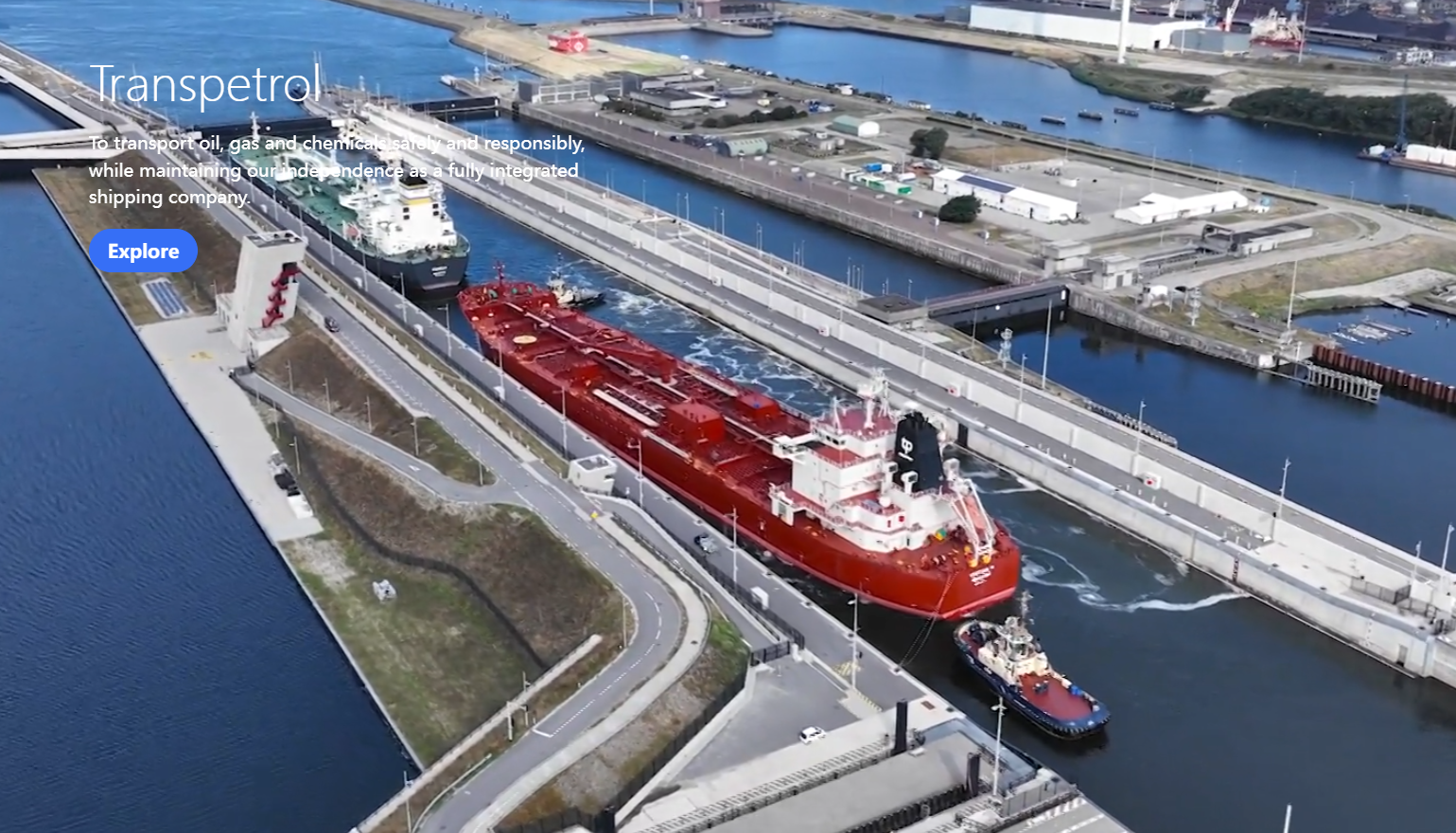
Transpetrol Makes LR1 Debut with Two 75,000-dwt Tankers at Yangzijiang
 Tankers
Trump angin. US Shadow Fleet Law Raises New Risks for China’s Russian Oil Trade
 Tankers
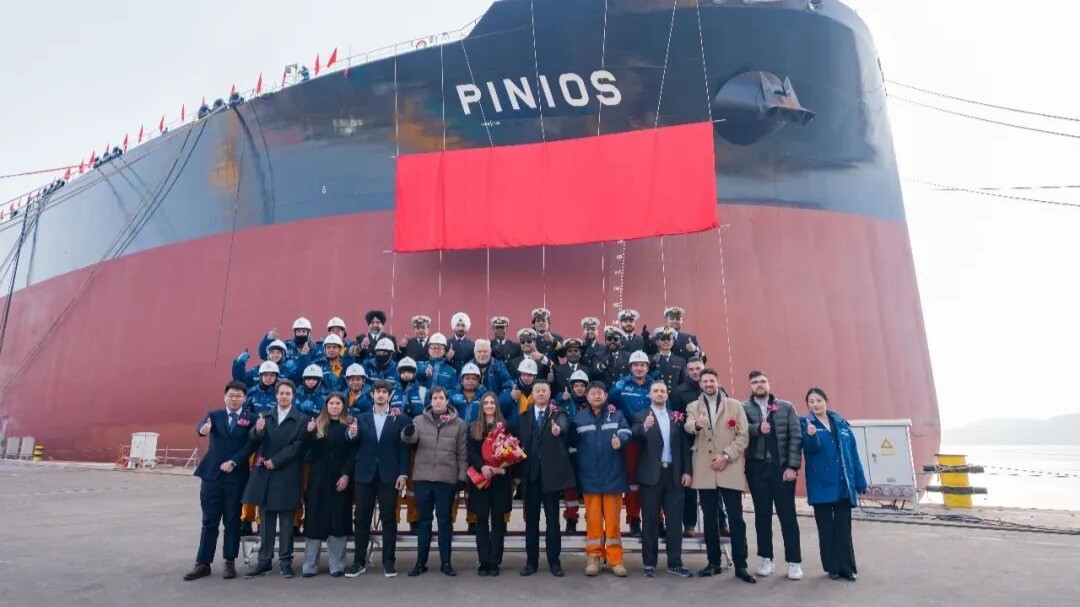
Seven Months, $78 Million: George Procopiou Reaps Windfall on Hengli-Built VLCC
 Tankers
VLCCs top $1m a day — but what price is TD3C actually discovering?
 Tankers
Nearly $1 Billion: Dynacom Orders 8More Ships as Hengli Tops Global 2026 VLAC Orders
 Tankers
$862,150 a Day: VLCC Rates Set Another Record as Global Composite Nears $500,000
 Tankers