

Breaking: IMO Launches Large-Scale Evacuation Plan in Strait of Hormuz, Over 11,000 Seafarers to Leave Region in Phases

Oman issues navigation warning: existing TSS not safe for use; vessels to transit via IMO-coordinated temporary routes under phased and controlled arrangements
Xinde Marine News — The situation in the Strait of Hormuz has entered a critical new phase.
According to Chinese media reports citing Xinhua and CCTV News, Ali Bahreini, Iran’s Permanent Representative to the United Nations Office in Geneva, said on June 23 local time that the Strait of Hormuz has been fully opened to commercial vessels and that no fees will be charged.
Bahreini said, in response to questions from the Association of Accredited Correspondents at the United Nations in Geneva, that the Strait is now open for a period of 60 days. During this period, no transit fees will be imposed. Iran and the United States have also agreed to establish a communication mechanism to monitor and resolve any issues that may arise. After the 60-day period, future arrangements for the Strait will depend on the outcome of further talks between Iran and the United States.
On the same day, U.S. President Donald Trump said on social media that, based on concessions made by Iran, he had agreed to allow the Strait of Hormuz to remain open and would no longer implement a maritime blockade.
This does not mean the Strait has simply returned to its pre-conflict status. A more accurate assessment is that the Strait of Hormuz has entered a 60-day controlled reopening window, supported by political conditions, safety coordination and temporary traffic management mechanisms.
IMO begins seafarer evacuation plan
Against this backdrop, the International Maritime Organization announced on June 23 that it would begin implementing an evacuation plan for seafarers still stranded in the Strait of Hormuz region.
IMO Secretary-General Arsenio Dominguez said in a statement that, following the signing of the Memorandum of Understanding between the Islamic Republic of Iran and the United States, he welcomed the peace agreement between the two sides as a decisive step towards restoring maritime security and bringing an end to unacceptable attacks against civilian shipping.
Dominguez also paid tribute to the 14 innocent seafarers who lost their lives during the conflict, saying their dedication in service of global trade would not be forgotten.
According to the IMO, more than 11,000 seafarers remain stranded in the region. The large-scale operation will be carried out in close cooperation with Iran, Oman, other coastal states in the region, the United States and the maritime industry. The IMO said that the necessary safety guarantees have been secured and that the conditions for safe navigation to support these operations have been thoroughly verified.
It should be noted that this “evacuation of seafarers” is not merely a crew repatriation operation in the narrow sense. Operationally, it is also about enabling vessels and their crews that have been trapped or delayed in the region to leave high-risk waters in a phased, orderly and controlled manner.
For shipowners, ship managers and masters, this is closer to a large-scale emergency traffic evacuation operation than a normal resumption of navigation.
The key point is clear: reopening does not mean risk has disappeared, and an open transit window does not mean vessels can proceed independently or rush to transit.
Iran says management of the Strait will not return to pre-war conditions
Iran has also made clear that future management of the Strait of Hormuz will not simply return to previous arrangements.
On June 22 local time, Mohammad Bagher Ghalibaf, head of Iran’s negotiating delegation and Speaker of the Iranian Parliament, said the management of the Strait of Hormuz would not return to pre-war conditions. He said that, while respecting international law, the Strait would be managed according to mechanisms formulated by Iran.
Ghalibaf also said that problems may arise in the Strait of Hormuz, and that Iran and the United States had agreed to establish a coordination centre and open a hotline to handle incidents more quickly during a 30-day period. He stressed that the hotline is not intended to approve transit permits. Existing procedures for permits remain in place, while the hotline is designed to deal with vessel-related problems and emergencies.
At the same time, Oman and Iran have issued a joint statement on the Strait of Hormuz. The two sides agreed to maintain dialogue through a joint working group between their foreign ministries, with a view to reaching consensus on future navigation management, services provided and related fee arrangements in the Strait. They also agreed to consult regional coastal states and other relevant parties.
The statement said that all arrangements concerning the Strait of Hormuz must fully respect the sovereignty and sovereign rights of the two coastal states of the Strait. Oman and Iran also reaffirmed their commitment to maintaining the Strait as a safe and open international shipping waterway, and to strengthening cooperation on maritime security, freedom of navigation and regional stability.
For the global shipping industry, these statements send an important signal: the Strait of Hormuz has entered a temporary reopening phase, but its future navigation management, service arrangements, fee mechanism and emergency response framework remain under negotiation and coordination.
Oman warning: existing TSS is not safe for use
In parallel with the IMO statement, Oman’s National Hydrographic Office submitted a request to the NAVAREA IX coordinator for the promulgation of a navigation warning covering the Arabian Gulf and the Strait of Hormuz.
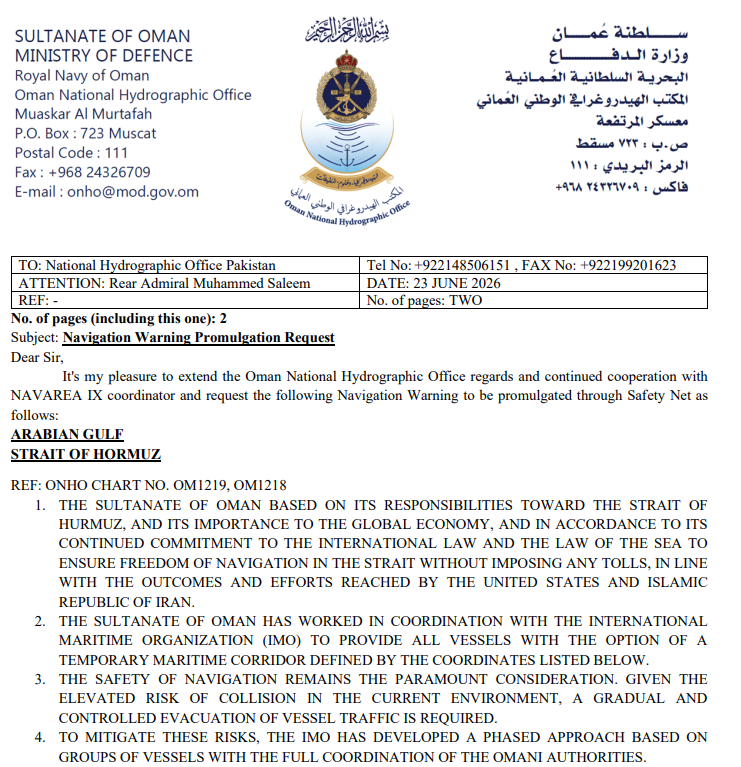
In the warning, Oman said that, based on its responsibilities towards the Strait of Hormuz, the Strait’s importance to the global economy, and its continued commitment to international law and the law of the sea, it would ensure freedom of navigation in the Strait without imposing any tolls. The warning said this was in line with the outcomes and efforts reached by the United States and Iran.
The warning states that Oman has worked in coordination with the IMO to provide all vessels with the option of using a temporary maritime corridor.
It also makes clear that the safety of navigation remains the paramount consideration. Given the elevated risk of collision in the current environment, a gradual and controlled evacuation of vessel traffic is required.
According to the warning, the IMO has developed a phased approach based on groups of vessels, in full coordination with Omani authorities.
Most importantly, the warning says that current reports indicate the existing Traffic Separation Scheme, or TSS, is not safe for use at this time. Based on information available from the IMO, two temporary routes may be used by vessels departing through the Strait of Hormuz: one south of the existing TSS and one to the north.
This is a crucial operational point for masters and shore-based management teams. Even if the Strait is politically described as “open,” actual navigation still requires vessels to avoid the unsafe regular TSS and follow temporary traffic management arrangements.
Vessels will be contacted individually
The Omani navigation warning states that vessels included in designated groups will be contacted individually and provided with further departure instructions by relevant parties coordinated by the IMO.
Vessels will be advised individually of their allocated transit day. Upon receiving this information, vessels may proceed to the designated waiting area in international waters, within a three-nautical-mile radius of position 26°16.17'N, 055°46.52'E.
Upon arrival at the designated waiting area, vessels are required to contact the relevant coastal state of their selected route to confirm that traffic conditions permit them to proceed.
For the route under the Sultanate of Oman, vessels must also re-contact radio station “A4N” on VHF Channel 16 when one nautical mile from the first waypoint.
The Omani warning lists the following route authorized for eastbound transit only:
26°02.72'N, 056°00.68'E 26°22.56'N, 056°16.93'E 26°24.35'N, 056°23.00'E 26°24.75'N, 056°31.11'E 26°22.10'N, 056°33.42'E 26°00.00'N, 056°33.30'E
The warning stresses that the route is authorized for eastbound transit only.
The IMO will report daily on the number of vessels safely departing the region. Vessel traffic may also be temporarily suspended for safety or security purposes, including deconfliction with naval vessels.
What shipowners, managers and masters must watch closely
For shipping companies, ship managers and seafarers, the most important assessment is this: the Strait of Hormuz has entered an organized transit window, but it remains a highly sensitive, highly controlled and highly uncertain operating environment.
First, shipowners and masters remain responsible for independent risk assessment. The Omani warning explicitly states that each shipowner and master remains responsible for conducting an independent risk assessment prior to the voyage. Shore-based safety teams, DPAs, CSOs, masters and ship managers should take into account vessel type, draft, cargo, crew condition, insurance arrangements, charterparty terms, destination requirements, flag state advice and real-time security intelligence before making decisions.
Second, vessels should not proceed solely on the basis of general statements that the Strait is “open.” The existing TSS is not safe for use at this time. Vessels are expected to transit under IMO-coordinated, phased and controlled arrangements. Any attempt to proceed outside the coordination mechanism could increase collision risk, miscalculation risk, military deconfliction risk and potential insurance disputes.
Third, AIS must be switched on during transit. The Omani warning requires vessels to ensure AIS is on while transiting. LRIT, where applicable, should also be used. Vessels must comply with all instructions issued by coastal states via VHF.
Fourth, crew welfare requires particular attention. Over the past several months, seafarers in the region have been under sustained pressure, with some vessels facing prolonged anchorage, schedule disruption, supply concerns, communication stress and psychological strain. The evacuation phase may also carry significant operational risks. Ship managers should maintain close communication with crews and make sure that voyage plans, emergency contacts, contingency procedures and company support measures are clearly understood.
Fifth, insurance, charterparty and compliance issues should be reviewed carefully. War risk cover, P&I arrangements, cargo insurance, demurrage, deviation clauses, force majeure, safe port obligations, sanctions compliance and port entry requirements may all continue to be affected by the temporary management mechanism, the pace of route normalization and the actual security situation.
A 60-day window is not a return to normality
The Strait of Hormuz is one of the most important maritime chokepoints for global energy transportation and international trade. Over the past several months, regional conflict has placed severe pressure on merchant vessels, tankers, containerships, vehicle carriers and other commercial ships operating in the Arabian Gulf and surrounding waters.
It has also directly affected seafarer safety, vessel schedules, charterparty performance, insurance arrangements and the stability of global supply chains.
Iran’s statement that the Strait is open to commercial shipping without fees, the U.S. decision not to implement a maritime blockade, and the IMO’s decision to launch a large-scale seafarer evacuation plan all indicate that relevant parties are attempting to move the situation from military confrontation towards controlled de-escalation.
However, the next 60 days will remain an observation and negotiation period.
The Iran-U.S. coordination centre and hotline, the Oman-Iran joint working group, consultations with regional coastal states, the use of temporary transit corridors, the timing for restoring the TSS, and the future management mechanism after the 60-day window all remain uncertain.
Before the situation truly returns to normal, shipowners, ship managers and masters should remain highly cautious. They should continue to monitor the latest notices from the IMO, Oman, Iran, flag states, classification societies, insurers and maritime security organizations, and avoid making operational decisions based only on unverified market messages or AIS movements.
The reopening of the Strait is a positive signal. But seafarer safety must remain the first priority.
For vessels still waiting to leave the area, the immediate focus should be on following coordinated instructions, maintaining communications, keeping AIS on, complying with VHF directions and completing a full voyage risk assessment with shore-side support.
For the global shipping industry, this large-scale evacuation operation in the Strait of Hormuz will also be an important test of international maritime coordination, shipping companies’ emergency management capabilities and the industry’s ability to protect seafarers in a complex security environment.


READ MORE
 Careers & Jobs
Invitation to Participate in the Survey on Global Seafarers’ Physical and Mental Health and Rights Protection
 Careers & Jobs
Crew Remuneration Rises 8–10% as Chinese Shipping Group Steps Up Investment in Seafarers
 Careers & Jobs
HKSR Logo & Tagline Design Competition Rules (“Competition Rules”)
 Careers & Jobs
Fleet Management and Dalian Maritime University Sign Training agreement to Strengthen Seafarer Training in China
 Careers & Jobs
The Captain's Table Returns Bigger Than Ever: 2026 LIVE Finals to Set Sail in Hong Kong
 Careers & Jobs