


Up to 6% Net Efficiency Gain: Everllence and Silverstream Integrate Air Lubrication with the Main Engine
As uncertainty continues to surround future marine fuels, fuel availability, carbon pricing and the global regulatory framework, energy efficiency is emerging as one of the more dependable investment themes in shipping’s decarbonisation transition.
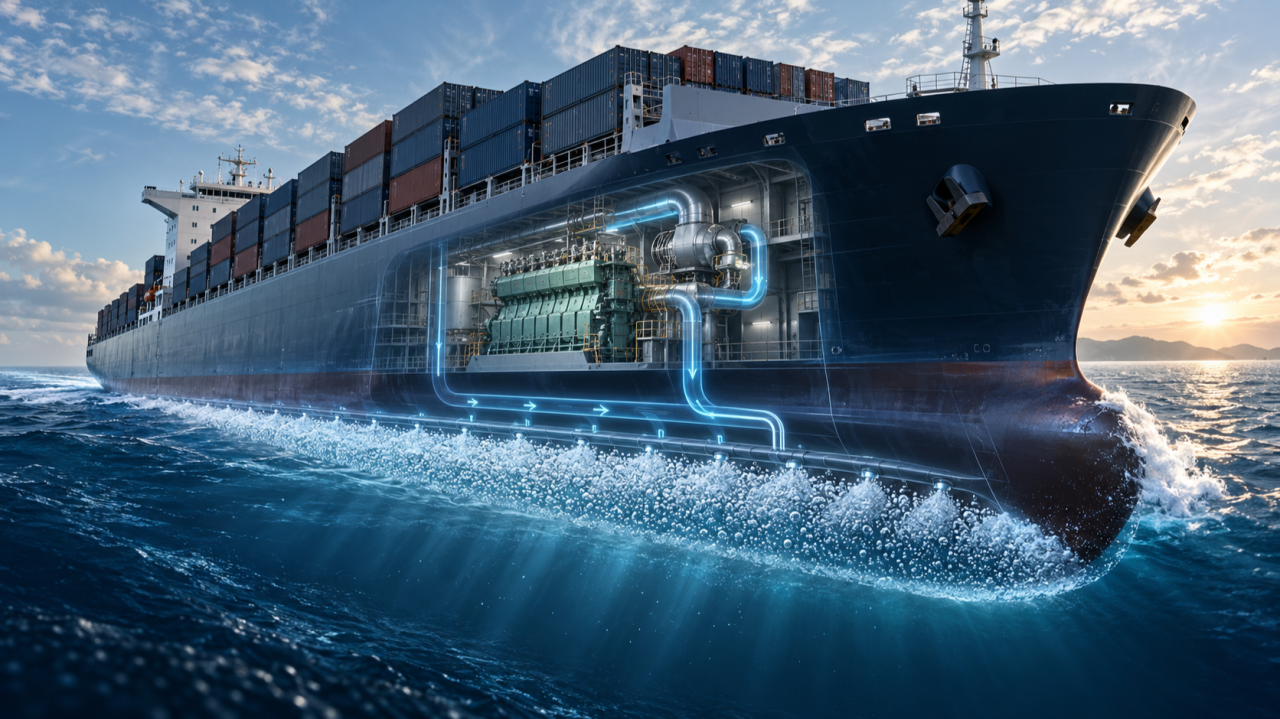
Everllence has now formally introduced a new technology known as Engine Supported Air Lubrication, or ESAL, together with a white paper titled A Leap in Vessel Energy Efficiency Advancement with Engine-Supported Air Lubrication. According to the company, ESAL integrates a vessel’s hull air lubrication system directly with the air supply of the two-stroke main engine, enabling net efficiency gains of up to 6% while reducing fuel consumption, emissions and future compliance costs.
For readers who have followed this technology through Xinde Marine News over the past several years, ESAL is not an entirely new concept. Everllence — formerly MAN Energy Solutions — and air-lubrication specialist Silverstream Technologies have been developing the concept step by step, moving from early joint research and system compatibility studies to the use of main-engine scavenge air to support hull lubrication, followed by in-service testing and now formal commercialisation.
The result is more than another standalone fuel-saving device. It represents a broader shift towards integrated vessel efficiency, linking the main engine, turbocharger, scavenge-air system, engine control system and hull hydrodynamics into a single energy-management equation.
Why connect air lubrication to the main engine?
The basic principle of air lubrication is relatively straightforward.
A significant proportion of the power required to propel a vessel is used to overcome friction between the hull surface and surrounding seawater. The Silverstream® System releases compressed air through openings in the bottom of the hull, creating a controlled layer of air between the hull and the water. By reducing frictional resistance, the vessel requires less propulsion power to maintain the same speed.
In October 2023, Silverstream and MAN Energy Solutions, as Everllence was then known, signed a formal collaboration agreement focused particularly on two-stroke engine applications for both newbuildings and retrofits.

At the time, Silverstream said its conventional air lubrication technology could deliver average net fuel and greenhouse-gas savings of around 5% to 10%. By October 2023, around 180 vessels had been contracted with the @Silverstream® System and 50 were already operating with the technology, with customers including MSC, Maersk, Grimaldi, Shell, Vale, Carnival and ADNOC L&S.
But air lubrication has an important energy penalty of its own: producing the air requires power.
Traditional air lubrication installations generally rely on dedicated electrically driven compressors to compress ambient air and deliver it beneath the hull. The system reduces hydrodynamic resistance and therefore propulsion demand, but the compressors themselves consume electricity. Since onboard electricity is still largely generated using fuel, the relevant performance metric is not simply the percentage reduction in hull resistance. What matters is the net fuel saving for the entire vessel after auxiliary power consumption is deducted.
That is the problem Everllence and Silverstream have sought to address with ESAL.
Using scavenge air instead of relying entirely on separate compressors
Xinde Marine News reported on the concept in June this year, when Everllence and Silverstream disclosed further details of their engine-integrated approach.
Instead of relying entirely on dedicated electric compressors, ESAL makes use of pressurised scavenge air already generated within Everllence’s two-stroke engine system.
The engine turbocharger produces compressed air for combustion and scavenging. Under ESAL, and within the operating and safety limits of the engine, part of that compressed-air capacity can also support the hull air lubrication system. This reduces the operating requirement placed on auxiliary compressors and therefore lowers their electrical consumption.
The engine control system continuously monitors operating conditions and manages the air flow so that the requirements of the engine and those of the air lubrication system remain coordinated.
Earlier information associated with the developing concept referred to around 3.5% net fuel-saving potential under certain configurations. With the formal launch of ESAL during the SMM Hamburg period, Everllence’s latest official performance statement is that the integrated system can deliver net efficiency gains of up to 6%.
The two figures should not, however, automatically be treated as directly comparable measurements from identical operating conditions. The earlier 3.5% figure and the newly stated “up to 6%” figure come from different stages of the technology’s development and may involve different vessel configurations, operating assumptions and calculation boundaries.
The same caution applies when comparing ESAL with Silverstream’s previously stated 5%-10% savings range for conventional air lubrication. The figures should not be added together to produce a theoretical “16% saving”. Actual performance will depend on vessel type, speed, draught, hull form, engine load, air demand and overall system design.
The engineering logic is nevertheless important.
Supplying additional air from the engine side may itself impose a certain energy cost. But if the reduction in propulsion power and auxiliary-compressor consumption exceeds the additional energy required to supply that air, the vessel achieves a positive net result.
In other words, ESAL should not be assessed purely as an engine-efficiency technology or purely as a hull-efficiency technology. The relevant question is the total energy balance of the vessel.
From a 2021 proof of concept to in-service testing
Another important feature of the latest announcement is that ESAL has moved well beyond laboratory modelling.
According to information released by Silverstream around this year’s SMM in Hamburg, cooperation between the two companies can be traced back to 2021, when an initial proof-of-concept installation was completed.

The partners subsequently spent several years developing the integration between Silverstream’s air lubrication technology and Everllence’s two-stroke scavenge-air system.
One installation has now completed a full year of in-service testing, with fuel-saving performance monitored under actual vessel operating conditions. At the same time, a third vessel fitted with the engine-supported configuration has entered commercial operation and validation.
Everllence has also confirmed that the technology has been tested onboard several vessels.
Per Cato, Senior Vice President and Head of Two-Stroke Engineering at Everllence, has linked the technology not only to environmental performance but also to commercial risk management. Lower fuel consumption means lower absolute emissions, lower compliance costs and reduced exposure to fuel-price volatility and future regulatory changes.
That is why Everllence increasingly presents ESAL not simply as another technical product, but as a tool for dealing with regulatory and fuel-market uncertainty.
The division of responsibilities between the two companies is also clear. Silverstream remains responsible for the Silverstream® air lubrication system and acts as the principal commercial and technical interface with shipowners, operators and shipyards. Everllence provides the two-stroke engine expertise, scavenge-air integration and associated engine-control capabilities.
This means ESAL is considerably more sophisticated than adding another compressed-air outlet to the main engine.
The system must manage air volume and pressure, engine loading, turbocharger capability, control logic and the requirements of the hull air-release arrangement as an integrated engineering package.
Everllence has previously indicated that initial applications are particularly relevant to vessel types where air lubrication is already gaining traction, including large containerships and LNG carriers, with early development centred on its G95 two-stroke engine platform.
Vessel draught is another fundamental technical consideration. The deeper the vessel, the greater the hydrostatic pressure that must be overcome to inject air below the hull. The air-pressure requirements of a relatively shallow-draught vessel are therefore very different from those of a deeply laden VLCC.
For that reason, ESAL remains a project-specific solution rather than a universal plug-and-play product. Air demand, scavenge-air pressure and overall vessel operating conditions all need to be evaluated individually.
Why saving fuel could become even more valuable in the alternative-fuel era
Everllence devoted considerable attention in its latest ESAL release to the commercial rationale behind energy efficiency, rather than limiting the discussion to technical performance.
That reflects a wider shift taking place across the maritime industry.
Much of the shipping decarbonisation debate over the past several years has centred on LNG, methanol, ammonia, hydrogen, biofuels and other future fuel pathways. But for an ocean-going vessel ordered today and potentially still operating around 2050, there remains substantial uncertainty over which fuels will dominate, how widely they will be available, what they will cost and how global carbon regulations will ultimately develop.
Everllence’s argument starts one step earlier:
reduce how much energy the vessel requires before deciding how that remaining energy should be supplied.
Bjarne Foldager, Head of Two-Stroke Business at Everllence, has argued that the shipping energy transition must begin by reducing energy demand. Any solution that improves efficiency today, he says, will retain value under credible future regulatory frameworks.
From this perspective, efficiency is not an alternative to the fuel transition. It is one of the conditions that can make the transition economically manageable.
Every tonne of fuel that does not need to be consumed means lower fuel expenditure, lower emissions and lower exposure to carbon-related compliance costs.
This becomes even more significant if shipping increasingly turns to higher-cost low- and zero-GHG fuels.
Saving 5% of conventional marine fuel already has a measurable economic value. Saving the same percentage of green methanol, renewable ammonia or another expensive low-carbon fuel could have a substantially greater dollar value.
Lower energy demand can also reduce the amount of alternative fuel that needs to be stored onboard, potentially easing some of the cargo-capacity and space penalties associated with fuels that have lower volumetric energy density than conventional fuel oil.
That is why a much wider range of efficiency technologies is attracting renewed attention: air lubrication, wind-assisted propulsion, shaft generators, waste-heat recovery, high-efficiency propellers, hull-form optimisation and digitally enabled voyage optimisation.
These technologies have one important characteristic in common: their business case does not depend on correctly predicting the eventual winner of the marine-fuel transition.
Whether a vessel ultimately burns conventional fuel, LNG, methanol, ammonia or something else, reducing the amount of energy required to move the ship still creates value.
And the more expensive the fuel becomes, the more valuable every percentage point of efficiency improvement may become.
From standalone equipment to integrated vessel energy systems
The five-year development path of Everllence and Silverstream also points to a broader technological change in marine engineering.
Historically, many ship efficiency technologies have entered the vessel as separate packages. Air lubrication was one system, the main engine another, the shaft generator another, with wind propulsion and digital optimisation often supplied by entirely different companies.
Each technology came with its own estimated saving percentage, and shipowners selected which technologies to install.
That model is becoming less sufficient as vessels become more efficient and the interaction between individual systems becomes more important.
ESAL provides a good example.
The air lubrication system needs compressed air. The main propulsion engine already incorporates a large compressed-air generation and management system. If the two operate entirely independently, potential energy synergies remain unused.
Everllence and Silverstream are effectively taking a technology that was previously treated mainly as a hull-efficiency measure and connecting it directly with the vessel’s core propulsion machinery.
The main engine is therefore becoming part of the hull-efficiency solution.
This has implications for future newbuilding design.
If shipowners want to extract increasingly small but commercially valuable increments of efficiency, engine manufacturers, naval architects, shipyards, propeller suppliers, air-lubrication specialists and control-system providers will need to engage earlier and more closely in the same design process.
Performance evaluation will also need to move beyond individual metrics such as the specific fuel oil consumption of the engine or the standalone saving generated by one energy-saving device.
The more relevant metric will increasingly be the overall propulsion efficiency and lifecycle energy cost of the vessel under real operating conditions.
From the first proof-of-concept work in 2021, through the formal Silverstream-MAN Energy Solutions collaboration agreement in 2023, to long-term onboard validation and Everllence’s formal ESAL launch in 2026, the two companies have spent several years pushing an established hull-efficiency technology deeper into the propulsion system.
How widely the concept can eventually be deployed will depend on retrofit economics, engine compatibility, long-term reliability and verified savings across different vessel types and operating profiles.
But the direction is already clear.
Air lubrication is no longer simply about “blowing bubbles under the hull”.
Once the main engine begins supplying and managing the air, the technology becomes part of a much larger shift towards integrated vessel energy optimisation.
For a ship expected to remain in service for another 20 or 30 years, while the future fuel landscape remains uncertain, using less energy is one form of competitiveness that can already be delivered today.

READ MORE
 Technology
Connecting maritime digitalisation to process
 Technology
Shiptec China 2026.10.28-10.30 | The Enterprises of International Pavilion
 Technology
Shipowners are finding a new business beyond ships
 Technology
Global technology CEOs join ADIPEC 2026 as AI reshapes energy demand and operations
 Technology
Maritime is using AI every day. Now comes the harder part: trusting it to act.
 Technology
Shiptec China 2026.10.28-10.30 | Russian Delegation to Make a Grand Appearance at the 17th International Shipbuilding,Marine Equipment and Offshore Engineering Exhibition For China
 Technology
AI Is Moving Into Shipping’s Core Business. What Will Set Companies Apart?
 Technology
Shiptec China 2026.10.28-10.30 | German Pavilion | High-Precision Threading Tools & Clamping Systems: NORIS Debuts at Dalian Maritime Exhibition
 Technology
Shiptec China 2026.10.28-10.30 | German Pavilion | Mayr Safety Brakes: Robust, Powerful and Seawater-Corrosion Resistant – Safe and Durable Product Solutions for Harsh Environments
 Technology