


The Complete 2026 Cargo Securing CIC Inspection Guide
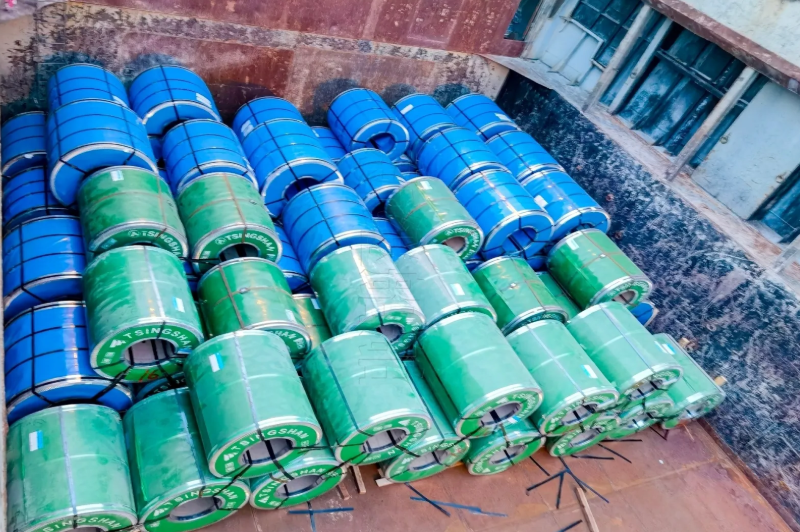

Pitfall Avoidance Guide for the 2026 Cargo Securing Concentrated Inspection Campaign
Capt. Zhou Minjing | Capt. Wu Jianbo | V.SHIPS SHANGHAI
────────────────────────────────────────────────────────────
I. Overview
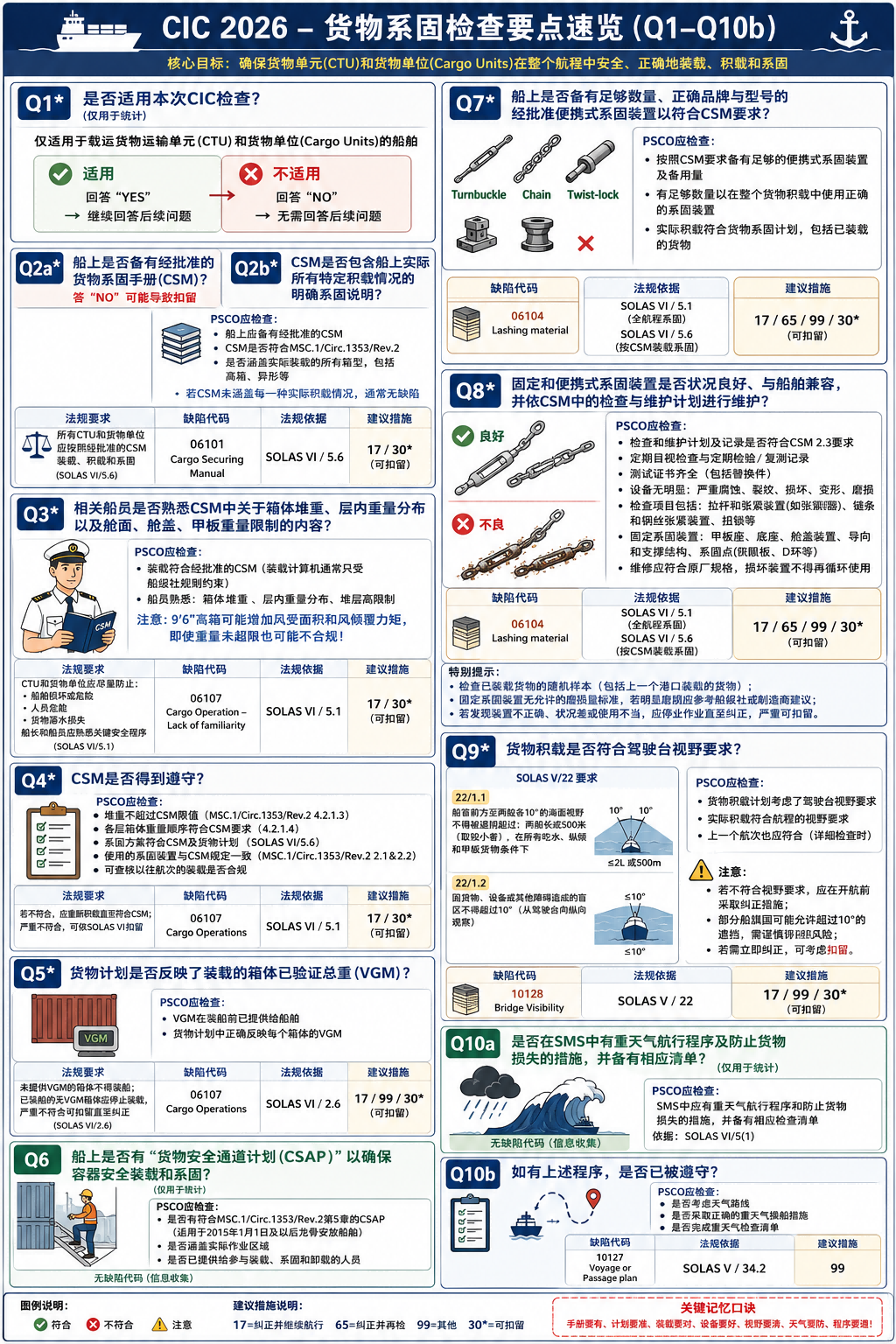
In 2026, the Paris and Tokyo Memoranda of Understanding (MOUs) are jointly conducting a Concentrated Inspection Campaign (CIC) on cargo securing. The campaign is based on SOLAS Chapters VI and VII, as well as the Code of Safe Practice for Cargo Stowage and Securing (CSS Code), to verify vessels' compliance with cargo securing requirements. Inspection results directly affect a vessel's sailing clearance: serious deficiencies must be rectified before departure, and severe cases may result in detention.
The current focus of PSC inspections has shifted from paper-based documentation to the on-board quality of lashing and the condition of securing equipment. In recent years, incidents involving containers lost overboard and heavy cargo shifting have become more frequent. Securing deficiencies can lead to commercial claims and even endanger the hull structure and crew safety.
This guide covers three areas of preparation:
· Statutory documents are complete and valid — the approved Cargo Securing Manual (CSM), Cargo Safe Access Plan (CSAP), etc., are readily available at all times;
· Fixed and portable securing equipment is in good condition, with adequate spare parts and a properly established maintenance record book;
· Crew members are familiar with the stack weight limits, tier weight distribution, VGM, bridge visibility restrictions, and heavy-weather navigation procedures specified in the CSM.
When the above preparations are in place, the probability of PSC deficiencies can be significantly reduced.
II. Introduction to the 2026 Cargo Securing CIC
CIC Inspection Overview
The 2026 CIC verifies whether vessels comply with SOLAS and the CSS Code in their cargo securing practices:
· Purpose: To verify whether vessels meet the cargo securing requirements of SOLAS and the CSS Code; to collect technical data on the condition of lashing and securing equipment; and to promote convergence of enforcement standards across MOU regions.
· Scope: The inspection covers the following seven areas:
· The vessel carries an approved, vessel-specific Cargo Securing Manual (CSM) issued by the Administration / Recognized Organization (RO);
· The manual covers the actual cargo types carried and specific stowage/securing arrangements on board;
· The familiarity of officers and ratings with the CSM content, system limitations, and their responsibilities;
· Consistency between actual lashing/securing and the stowage plan, and verification of container Verified Gross Mass (VGM);
· On-site implementation of the Cargo Safe Access Plan (CSAP) applicable to container ships;
· Physical condition, compatibility, spare parts inventory, and maintenance records (Record Book) of fixed and portable securing equipment;
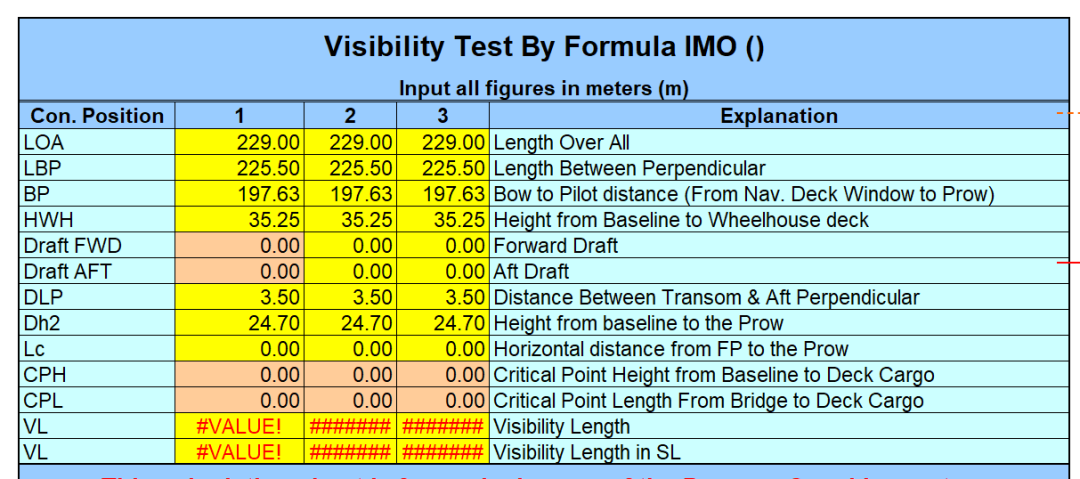
· Compliance of cargo stacking with bridge visibility requirements (SOLAS V/22), and whether heavy-weather cargo-loss-prevention procedures in the SMS are genuinely implemented.
· Duration: The campaign runs from 1 September 2026 to 30 November 2026, lasting three months. During the campaign period, each vessel will, in principle, undergo only one CIC inspection.
CIC Applicability
· The CIC applies to vessels required to carry an approved CSM that actually carry or plan to carry cargo units / cargo transport units. Vessels equipped only with container facilities but not planning to transport such cargo on the next voyage are outside the scope of this CIC.
· The CIC is an additional inspection conducted in parallel with routine PSC inspections and does not alter the type or scope of routine inspections.
· Each official question must be answered Yes, No, or N/A. N/A may only be used when the question genuinely does not apply to the vessel.
· Every "No" answer must be accompanied by a related deficiency. Questions marked with an asterisk (*) answered "No" may lead to detention, at the PSCO's professional discretion.
· The PSCO may also consider suspending or restricting cargo operations until unsafe or non-compliant conditions are rectified.
Core Preparation Principle
Consistency is the lifeline: The content of the approved CSM, what is planned in the cargo and lashing documents, the condition of equipment actually available and in use on board, and the knowledge actually held by the responsible crew — these four elements must be fully consistent. Any disconnect at any link constitutes a deficiency.
III. Detailed Analysis of CIC Questionnaire Items and Compliance Requirements
Below is an item-by-item review of the core questions in the CIC questionnaire. Each question is addressed in three parts: Core Requirement, Inspection Points, and Pitfall Avoidance Guide.
2026 Cargo Securing CIC Questionnaire
Note: Questions marked with an asterisk (*), if answered "No", may result in detention. Q10a is not marked with an asterisk, but the official questionnaire stipulates that a "No" answer must also be accompanied by a related deficiency and cannot be treated as optional.
|
No. |
Questionnaire Item |
Yes |
No |
N/A |
Detention |
|
1a* |
Is an approved, vessel-specific CSM on board? |
|
|
|
Yes |
|
1b* |
Does the CSM cover the vessel's actual stowage/lashing arrangements? |
|
|
|
|
|
2* |
Are the Master and cargo operation personnel familiar with the CSM? |
|
|
|
|
|
3* |
Does actual lashing/securing comply with the CSM? |
|
|
|
|
|
4* |
Does the stowage plan accurately reflect VGM? |
|
|
|
|
|
5* |
Is a CSAP in place and being implemented? |
|
|
|
|
|
6* |
Are sufficient portable securing devices available? |
|
|
|
|
|
7* |
Are securing equipment in good condition and properly maintained? |
|
|
|
|
|
8* |
Is cargo effectively secured throughout the voyage? |
|
|
|
|
|
9* |
Does cargo stacking comply with bridge visibility requirements? |
|
|
|
|
|
10a |
Does the SMS include heavy-weather procedures? |
|
|
|
|
|
10b |
Are heavy-weather procedures effectively implemented? |
|
|
|
|
Q1. Is an approved Cargo Securing Manual (CSM) on board?
(SOLAS 1974/Chapter VI Reg. 5.6 & MSC.1/Circ.1353/Rev.2)
【Core Requirement】
All vessels engaged in non-bulk cargo transport must carry an approved CSM, written in the working language and accompanied by statutory translations.
【Detailed Inspection Points】
· The PSCO will verify whether an approved CSM is on board and whether it is applicable to the vessel type (vessel-specific) and the actual cargo carried.
· The CSM must be readily available on board in hard copy or acceptable electronic form. A manual locked in the Master's drawer and inaccessible to the crew is equivalent to having none.
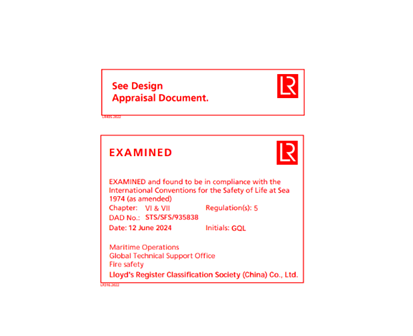
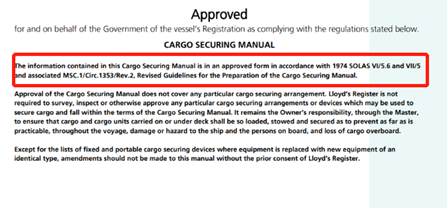
· Confirm that the original CSM approved by the Administration or RO is on board, with the approval page, approval letter, or RO endorsement traceable to this vessel.
· Confirm the CSM is vessel-specific — the vessel name, IMO number, principal dimensions, and deck design load (t/m²) in the manual match the actual vessel.
· Confirm the manual language is understandable by the crew and statutory translations are available.
· Confirm the manual covers the actual cargo carried and container sizes, including HiCube or out-of-gauge units.
· Confirm the current on-board arrangement and securing equipment are consistent with the approved CSM.
· The Master and crew should be able to demonstrate:
· Where the CSM is stored and how it is accessed during cargo planning and operations;
· Which chapters govern the cargo configuration currently being loaded or already loaded.
· For container ships with keels laid on or after 1 January 2015, the CSM must fully comply with MSC.1/Circ.1353/Rev.2, including Chapter 5 on the Cargo Safe Access Plan (CSAP).
· For existing container ships built before 1 January 2015, compliance with Chapters 1–4 of MSC.1/Circ.1353 is required; existing CSMs approved under MSC/Circ.745 remain valid if they meet Chapters 1–4. However, inclusion of CSAP procedures at the next revision of the approved CSM is encouraged. If port State authorities require compliance with Annex 14 of the revised CSS Code, the vessel may be denied berthing at relevant ports.
· Vessels carrying non-standardized cargo, using the methodology in Annex 13 of the revised CSS Code, and adopting weather-related assumptions in securing assessments must ensure their CSM meets the corresponding requirements.
【Special Reminder】
· For older or converted vessels, if the rigging type has been changed or the cargo type carried has been altered (e.g., addition of heavy-lift / ro-ro cargo securing), the CSM must be re-evaluated and re-approved.
· High-risk situation: If a vessel requires a CSM but does not have one on board, the PSCO should normally directly consider detention.
【Pitfall Avoidance Guide】
· The "approval stamp" is the foundation of legality. The PSCO will check the cover and amendment pages of the CSM for the Administration's or RO's approval stamp and signature date. Presenting a sister-ship manual scan, draft, or unapproved document is equivalent to having no CSM — direct detention (Code 30 / 06101).
· "Vessel-specific" details cannot deviate. If the eye plate arrangement or hatch cover load limits in the manual do not match the actual vessel, the PSCO will deem the manual invalid.
· Recommended PSC evidence to prepare in advance: Original approved CSM, approval letter or endorsement, revision history, RO approval records, and controlled document records showing the current revision on board. These documents should be immediately producible during inspection.
Q2. Does the CSM contain clear instructions for all specific stowage and lashing arrangements on board?
(SOLAS VI/5.6; MSC.1/Circ.1353/Rev.2, Chapters 1 to 4)
【Core Requirement】
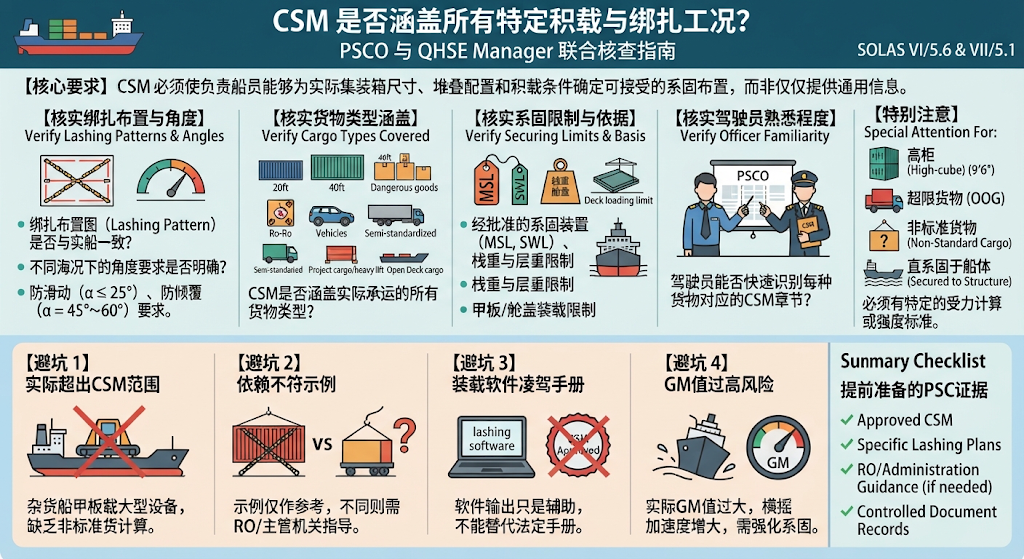
The CSM must enable responsible crew to determine acceptable securing arrangements for actual container sizes, stacking configurations, and stowage conditions, rather than merely providing general information.
【Detailed Inspection Points】
· The PSCO will verify whether the approved CSM adequately covers the cargo configurations actually carried on board.
· Check whether the CSM includes lashing patterns for the cargo actually loaded.
· Check whether the manual specifies securing angle requirements under different sea states (e.g., anti-sliding angle α ≤ 25°, anti-tipping angle α = 45°–60°).
· The content must cover the dimensions and physical sizes of cargo actually carried, including 9'6" HiCube and out-of-gauge containers.
· Permissible stack weights, vertical weight sequences, stacking heights, and applicable lashing arrangements must be clearly specified.
· Any alternative stowage pattern must be supported by an approved CSM or approved amendment.
· The CSM should clearly address (as applicable):
· Container stowage on and under deck;
· 20-foot, 40-foot, and 45-foot containers;
· Heavy and empty containers;
· Dangerous goods units;
· Ro-ro cargo;
· Vehicles and trailers;
· Semi-standardized cargo;
· Non-standardized cargo;
· Project cargo and heavy lifts;
· Weather deck cargo.
· The CSM should also specify:
· Approved securing devices;
· Maximum Securing Load (MSL) and Safe Working Load (SWL);
· Stack weight limits;
· Tier weight limitations;
· Approved lashing arrangements;
· Deck and hatch cover loading limits (if relevant).
· Special attention should be paid to:
· High-cube containers;
· Out-of-gauge cargo;
· Non-standard cargo arrangements;
· Cargo secured directly to ship structure.
· The PSCO will expect officers to quickly identify the CSM chapter corresponding to each cargo arrangement on board.
【Pitfall Avoidance Guide】
· Actual loading beyond the CSM coverage is a high-frequency deficiency. For example, a general cargo vessel temporarily loads large equipment on deck, but the CSM completely lacks securing force calculations and eye plate fillet weld strength standards for non-standardized cargo — the PSCO will determine that the lashing plan lacks statutory basis.
· Do not rely on examples that do not match reality. Examples in the CSM are for reference only; if actual loading differs from the examples and the manual provides no clear guidance, technical guidance or approval from the RO / Administration must be obtained in advance.
· It is strictly forbidden to substitute loading computer or unapproved lashing software output for the approved CSM. Software output is only an auxiliary tool and cannot supersede the statutory manual.
· Risk of actual GM exceeding CSM design assumptions: Lashing mechanical calculations in the CSM are typically based on standard GM values. If the actual vessel GM is excessively large, the rolling period shortens and accelerations increase sharply. If lashing is not reinforced or stack weights not restricted as required by the manual, the PSCO will readily identify a safety hazard.
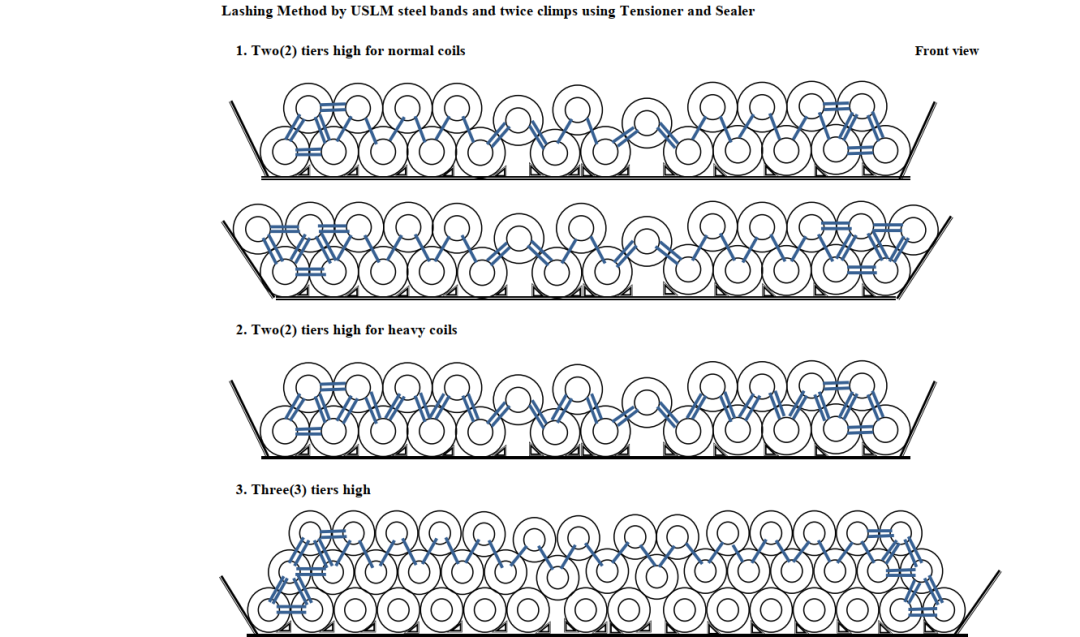
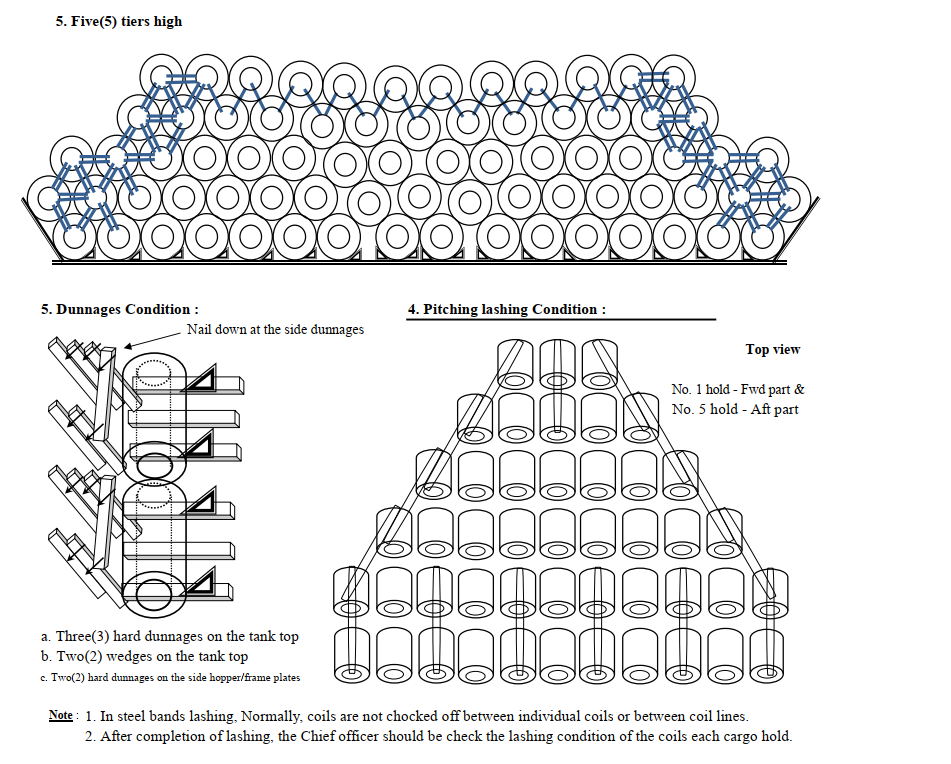
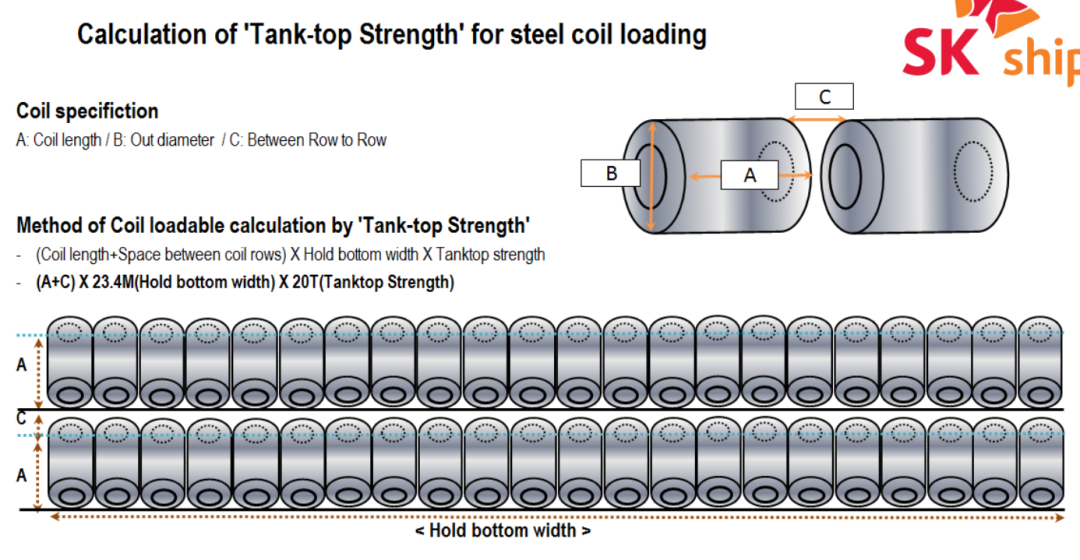
· For bulk carriers that occasionally carry boxed or unitized cargo in holds / on hatch covers or decks, the CSM must cover such cargo (e.g., vehicles / steel coils / steel products). The Master should understand that the CSM only lists classic (general) cargo cases and will not include every cargo, but the relevant lashing requirements must comply with the CSM.
Q3. Are relevant senior officers familiar with the CSM provisions on container stack weights, tier weight distribution, and hatch cover, deck, and double-bottom load limits?
(SOLAS VI/5.1 and 5.6; SOLAS XI-1/4; STCW Chapter VIII/2; ISM Code 6.3)
【Core Requirement】
The Master and responsible officers must understand the vessel-specific limitations and be able to explain how planned and actual stowage comply with these limits.
【Detailed Inspection Points】
· The PSCO will verify whether the Master and cargo officer demonstrate practical knowledge of cargo securing requirements.
· Through on-site oral questioning and practical assessment, verify the Chief Officer's grasp of CSM limit parameters.
· Check whether the lashing calculation results of the loading computer are consistent with the CSM statutory standards.
· Specific questions the PSCO may raise (crew must be able to answer):
· What is the maximum permissible mass for the selected stack or stowage position?
· What is the permissible vertical weight sequence of containers within the stack?
· What are the relevant limits for the tank top, hatch covers, and deck?
· What stacking height limits apply (including when HiCube containers are used)?
· How is compliance verified before the cargo plan is accepted?
· Expected practical demonstration:
· Ability to quickly locate relevant limits in the approved CSM;
· Select a representative stack from the current cargo plan and demonstrate compliance;
· Explain the relationship between the CSM, stability/loading computer, and any lashing software.
· Officers should be able to explain:
· Stack Weight Limits:
· Maximum permissible stack masses;
· Bay-specific restrictions;
· On-deck versus under-deck limitations.
· Tier Weight Restrictions:
· Vertical weight distribution requirements;
· Heavy-over-light restrictions;
· Loading computer verification methods.
· Structural Limits:
· Tank top loading limits;
· Hatch cover loading limitations;
· Weather deck loading limitations;
· Concentrated load restrictions.
【Pitfall Avoidance Guide】
· The loading computer's lashing module does not have overriding authority. Chief Officers often mistakenly believe that "if the lashing software shows PASS, everything is fine" — but lashing software is only an auxiliary tool. Unless the module has received special Class approval, when software results conflict with the CSM text, the approved CSM prevails. The loading computer is essentially a stability tool; its lashing module is only reliable within its documented approved scope and does not automatically form part of the statutory CSM.
· Hi-Cube container height trap: Loading 9'6" HiCube containers increases the overall stack height and significantly raises windage area. If the Chief Officer cannot explain the impact of HiCube containers on windward lashing rod forces or exceeds the permissible height in the CSM, deficiencies 06107 (Lack of familiarity) or 15105 (Resources and personnel) will be issued.
· SMS familiarity records are an acceptable means of demonstrating officer familiarity. Recommended PSC evidence: SMS familiarity records, training records, stowage planning procedures, loading computer instructions. For each voyage, the cargo stowage plan / lashing plan / strength calculation report should ensure cargo is correctly loaded, stowed, and secured throughout the voyage in accordance with the CSM. Please note that for vessels recently carrying general cargo, verify promptly whether the voyage's cargo stowage plan / lashing plan / strength calculation report has been filed for inspection. If not (especially for voyages executed by domestic charterers), request them from the charterer and file them promptly. For vessels whose loading instrument includes general cargo loading content, the strength calculation report (local strength, not uniform strength of tank top) can be exported from the loading instrument, signed by the Master and Chief Officer, and filed.
Q4. Does actual lashing/securing comply with the Cargo Securing Manual?
(SOLAS VI/5.1 and 5.6; IMO Resolution A.714(17); ISM Code 7)
【Core Requirement】
All cargo on deck and in holds must be secured throughout the entire voyage strictly in accordance with the lashing patterns, rigging specifications, and stowage positions prescribed in the CSM. Actual or proposed cargo stowage and lashing arrangements must be consistent with the approved CSM, not merely with commercial loading instructions.
【Detailed Inspection Points】
· The PSCO will compare the actual cargo securing arrangement against the approved CSM.
· Areas the PSCO may spot-check:
· Stack weights are not exceeded;
· Permissible vertical weight sequences are observed;
· Cargo plans and proposed lashing plans comply with the CSM;
· Fixed and portable devices used are of the types described in the CSM;
· Cargo already on board (including that loaded at other ports) is properly secured;
· Previous cargo plans (if non-compliant) may become the basis for more detailed inspection.
· Verify that lashing rods, turnbuckles, and twistlocks used on site match the models specified in the CSM.
· Check whether the weight distribution of containers within stacks follows the "light on top, heavy at bottom" principle.
· Officers should be able to demonstrate:
· Actual stowage matches approved arrangements;
· Approved lashing patterns are used;
· Securing devices correspond to approved types;
· Any deviations are supported by approved engineering calculations.
· Regarding lashing software:
· The software should be approved by the RO;
· The software supplements, not replaces, the approved CSM;
· Crew should understand the software output and its assumptions.
· IMO is currently developing uniform performance standards for lashing software as a supplement to the CSM. Such software should be ship-specific and approved by the Administration or RO.
【Pitfall Avoidance Guide】
· "Simplified lashing" is the most common trouble source. For example, the CSM requires double lashing, but only single lashing is used on site as a shortcut; or semi-automatic twistlocks (SATL) are not fitted at the bottom tier as required.
· Securing inspection of cargo loaded at previous ports: The PSCO will not only inspect cargo loaded at the current port but also specifically spot-check the securing condition of cargo loaded at previous ports and already completed.
· Preparatory actions:
· Conduct documented cross-checks of cargo plans, lashing plans, and the CSM before loading approval;
· Verify that software warnings and overrides have been investigated and recorded;
· Rectify or re-stow non-compliant containers before departure;
· Report recurring or systematic failures through the SMS and company corrective action process.
· Possible PSC consequences: The PSCO may require containers to be re-stowed, suspend cargo operations, or detain the vessel until loading complies with the CSM. Systematic failures may also support ISM-related deficiencies or detention.
Q5. Does the stowage plan accurately reflect the Verified Gross Mass (VGM) of containers?
(SOLAS VI/2.6; ISM Code 7)
【Core Requirement】
Shippers must provide the container's Verified Gross Mass (VGM) to the Master or their representative before loading. The cargo stowage plan and stability calculations must be based on actual VGM data. Every container entering the final stowage plan must have a VGM before loading, and that value must be the one used for stability calculations.
【Detailed Inspection Points】
· The PSCO will verify whether container weights used in the stowage plan comply with SOLAS VGM requirements.
· The PSCO may verify:
· VGM information was received before loading commenced;
· VGM is correctly reflected in the vessel's loading/stowage plan;
· Containers without VGM have not been loaded;
· Amended or late-submitted VGM submissions are controlled and reflected in the final plan.
· Spot-check whether pre-stowage plans, final stowage plans, and VGM documents provided by shippers are consistent.
· Check whether any containers without VGM verification have been loaded on board.
· The vessel should demonstrate:
· Receipt of VGM before loading;
· Use of VGM during cargo planning;
· Verification of stack and tier weight limitations.
【Pitfall Avoidance Guide】
· Loading without obtaining VGM is a serious violation of SOLAS; the PSCO has the authority to directly suspend loading/discharge operations and detain the vessel.
· If containers without VGM are already on board, cargo operations may be suspended until the issue is resolved. Serious non-compliance may lead to detention and may expose systemic weaknesses under the ISM Code.
· Recommended PSC evidence: VGM messages / EDI records, terminal documentation or other accepted shipper declarations; final cargo/stowage plans and amendment records; SMS procedures describing how the vessel receives, verifies, and controls VGM; cargo manifest.
Q6. Does the vessel have a Cargo Safe Access Plan (CSAP) to ensure safe container securing operations?
(MSC.1/Circ.1353/Rev.2, paragraphs 5.1 and 5.2, Chapter 5; CSS Code, Annex 14; SOLAS VI/5; ISM Code 7)
【Core Requirement】
Approved CSAP drawings must be on board to provide a safe lashing operation environment for dockworkers and crew.
【Detailed Inspection Points】
· For container ships with keels laid on or after 1 January 2015:
· A CSAP compliant with Chapter 5 of MSC.1/Circ.1353/Rev.2 must be maintained as part of the applicable approved documentation;
· Ensure the plan covers all actual cargo operation areas and identifies handrails, platforms, walkways, ladders, access covers, lighting, storage locations, emergency access/exit, and other relevant arrangements;
· Make the CSAP available to crew and other personnel engaged in stowage, securing, or discharge;
· Confirm the plan is compatible with the vessel design and installed equipment.
· For existing container ships with keels laid before 1 January 2015:
· Chapter 5 of MSC.1/Circ.1353/Rev.2 is not retroactively applicable; however, safe access remains necessary for cargo operations;
· Document the vessel's safe access arrangements and verify their physical condition and practical availability;
· As a precaution, consider preparing a voluntary CSAP or equivalent controlled safe access plan;
· If new documents modify or supplement the approved CSM, consult the RO/Administration regarding review and approval before placing them into controlled use.
· The PSCO will verify that safe access arrangements for container securing operations actually exist.
· Check whether lashing bridges, walkway width (not less than 600mm), guardrail height (1m with three horizontal bars), and toe boards are intact.
· Check operation lighting at securing positions (not less than 50 lux) and anti-slip surfaces.
· Physical inspection points:
· Access is clear and passable;
· Walkways, ladders, platforms, and handrails are in safe condition;
· Lighting is adequate and emergency access/exits are usable;
· Crew and dockworkers have been informed of applicable access arrangements.
【Pitfall Avoidance Guide】
· Lashing bridges cluttered with debris, guardrails rusted through and unrepaired, and large areas of non-functional lighting are all CSAP non-conformities that can easily lead to detention.
· Key compliance distinction: The absence of mandatory post-2015 CSAP requirements for older vessels cannot justify unsafe access. When access is unsafe or systematic controls are lacking, the PSCO may restrict cargo operations and record deficiencies under cargo operation or ISM clauses.
Q7. Is the vessel equipped with a sufficient quantity of correct brand, model, and approved portable cargo securing devices?
(SOLAS VI/5.1 and 5.6; MSC.1/Circ.1353/Rev.2, paragraphs 1.3.5 and 1.3.6)
【Core Requirement】
The quantity and model of portable rigging on board (twistlocks, bridge fittings, lashing rods, chains, jacks, etc.) must fully comply with the CSM inventory requirements, and a sufficient quantity of spare parts (reserve supply) must be carried to compensate for wear and condemnation during the voyage.
【Detailed Inspection Points】
· The PSCO will verify whether the vessel carries a sufficient quantity of approved portable securing devices.
· The PSCO may verify:
· On-board quantities and types match the CSM and planned cargo configuration;
· Adequate reserve supply is available;
· Correct devices are used throughout the stowage; cones must not replace twistlocks, and required corner fittings must not be omitted;
· Brand, type, locking orientation, and compatibility are controlled;
· Vessel and shore personnel can distinguish devices such as base locks.
· Check the physical inventory of portable rigging, manufacturer certificates (test certificates), and factory MSL markings.
· Check whether the quantity of spare rigging meets the minimum reserve ratio specified in the CSM.
· The vessel should maintain:
· Adequate securing devices for the loaded cargo;
· Additional reserve equipment;
· Approved replacement fittings;
· Inventory control records.
· The quantity carried should be sufficient for the intended voyage and include spare equipment to address possible damage or loss during the voyage.
【Evidence and Controls to Prepare】
· Updated inventory list by device type, model, and quantity;
· Certificates, manufacturer information, and MSL data;
· Requisition or purchase evidence for ordering replacement inventory (if correcting minor shortages);
· Procedures for issuing, recovering, isolating, and accounting for portable devices.
【Pitfall Avoidance Guide】
· It is strictly forbidden to use ordinary stacking cones to replace base twistlocks. When procuring replacement rigging, its MSL strength must not be lower than the original manual design requirements, and approval certificates must be available.
· Possible PSC consequences: If correct devices are not available or cargo cannot be properly secured, the PSCO may suspend cargo operations. Serious non-compliance may warrant detention.
Q8. Are fixed and portable securing equipment in good condition, compatible with the vessel, and maintained according to the inspection/maintenance plan in the CSM?
(SOLAS VI/5.1 and 5.6; MSC.1/Circ.1353/Rev.2, Section 2.3; ISM Code 10)
【Core Requirement】
All fixed securing points (eye plates, D-rings, footings, dovetail foundations) and portable rigging must be in good condition, with a well-established inspection, maintenance, and condemnation/isolation system (Lashing Gear Record Book). Equipment must not only exist but also be applicable, identifiable, maintained, inspected, and prevented from re-entering service when defective.
【Detailed Inspection Points】
· The PSCO will verify whether fixed and portable securing equipment are properly maintained.
· Records the PSCO may require:
· Routine visual inspection records and periodic inspection/retest records;
· Inspection and maintenance scheme required by the CSM;
· Record book kept with the CSM or referenced computerized maintenance records;
· Test certificates and documentation for replacement equipment;
· Repair records demonstrating compliance with manufacturer or classification society requirements.
· Physical sample inspection scope:
· Portable equipment: lashing rods, turnbuckles, chains, wire rope tensioners, and twistlocks;
· Fixed equipment: ISO deck sockets, dovetail foundations, hatch top container seats, base fittings, cell guides, buttresses, eye plates, and D-rings;
· Evidence of severe corrosion, fracture, deformation, excessive wear, damage, or unauthorized repair;
· Compatibility, including locking orientation and matching replacement parts;
· Effective isolation and control of non-conforming or damaged equipment.
· Check whether fixed eye plate weld roots have cracks and whether eye hole reduction exceeds 10%.
· Check whether portable rigging meets condemnation standards (e.g., wire rope broken wires exceeding 10%, webbing cuts/tears, turnbuckle thread slipping/bending).
· Review the on-board Securing Equipment Maintenance Record Book to confirm periodic inspection records and condemnation/isolation ledgers.
· Any securing device exhibiting the following should be removed from service:
· Cracks;
· Deformation;
· Excessive wear;
· Corrosion;
· Missing components;
· Damaged threads.
· Electronic PMS records are acceptable if readily available during inspection.
【Company Preventive Measures】
· Conduct focused inspections and repair defective equipment before the CIC;
· Define rejection criteria and clearly mark/isolate unusable equipment;
· Submit significant reductions or suspect repairs to the manufacturer, classification society, or RO for technical evaluation;
· Investigate recurring equipment failures as potential SMS maintenance weaknesses.
【Pitfall Avoidance Guide】
· A "quarantine bin/area" must be established! All damaged or condemned rigging must be immediately moved to a red-painted isolation box and locked. It is strictly forbidden to mix them in normal rigging boxes; otherwise the PSCO will deem it a "misuse hazard."
· Do not "backfill" maintenance records at the last minute. An experienced PSCO can spot a "perfect ledger" with uniform ink color and no replacement or condemnation records at a glance.
· Possible PSC consequences: Incorrect, incompatible, deteriorated, or improperly used equipment may lead to suspension of cargo operations and may warrant detention. Systematic maintenance failures may also support ISM deficiencies.
Q9. Is cargo effectively secured throughout the voyage?
(SOLAS VI/5.1 and 5.6; ISM Code 7)
【Core Requirement】
Cargo must remain effectively secured throughout the entire voyage, particularly with inspections and reinforcement before and after heavy weather. The vessel must not sail before required lashing is completed, nor release lashing prematurely before arrival, and securing effectiveness must be continuously monitored during the voyage.
【Detailed Inspection Points】
· The PSCO will focus on proving that cargo remains effectively secured throughout the voyage.
· The PSCO may verify:
· No evidence that the vessel sailed or arrived with cargo unlashed or inadequately secured;
· Deck logbooks and operational records support the timing and completion of lashing/unlashing;
· Containers not intended for discharge remain properly secured;
· Turnbuckles and other tensioning devices have been inspected and maintained during the voyage;
· Damaged, loose, or removed securing devices have been promptly rectified or replaced.
· Check whether the Deck Logbook contains records of pre-departure securing inspections and periodic lashing tightening during the voyage (especially before heavy weather).
· Recommended evidence:
· Deck log entries;
· Heavy weather reports;
· Cargo inspection records;
· Lashing adjustment records;
· Master's standing orders;
· Cargo shift reports.
· Officers should be able to demonstrate that lashing has been inspected as required and adjusted as necessary.
【Pitfall Avoidance Guide】
· If the deck logbook lacks signed records of pre-departure securing self-inspection, deficiency 10127 (Voyage or passage plan) will be issued.
· Key practice: Commercial schedules must not be allowed to result in sailing before securing is completed, or premature release of lashing before the vessel is safely berthed and authorized on board. This is the most easily overlooked but readily caught hard deficiency by the PSCO.
Q10. Does cargo stacking comply with bridge visibility requirements?
(SOLAS V/22; MSC.1/Circ.1353/Rev.2, Section 4.2.1; ISM Code 7)
【Core Requirement】
Planned and actual cargo heights and arrangements must preserve the statutory view from the bridge over the intended route. Deck cargo or container stacks must not obstruct bridge visibility.
【Detailed Inspection Points】
· The PSCO will verify compliance with SOLAS Chapter V Regulation 22.
· Geometric hard criteria:
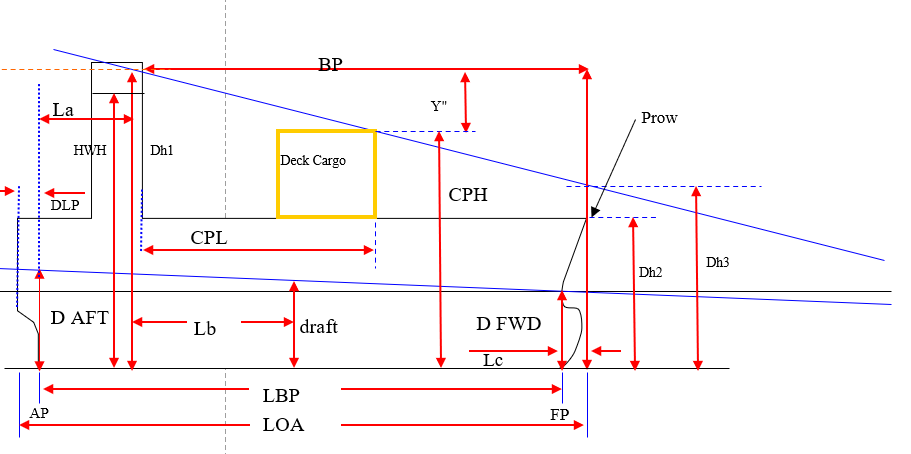
· From the conning position, the sea surface must not be obscured by cargo over an arc from directly ahead to 10° on either bow, extending forward to twice the vessel's length or 500 metres (whichever is less);
· A single blind sector caused by cargo, cargo equipment, or other obstructions forward of the beam must not exceed 10°;
· Cargo stowage plans must account for approved sight lines and maximum permissible stacking heights;
· HiCube, out-of-gauge, or other oversized cargo must not cause the vessel to exceed visibility limits.
· The stowage plan should demonstrate:
· Approved stack heights;
· Compliance with visibility limitations;
· Preservation of bridge sight lines.
· The PSCO may conduct direct bridge observation to verify compliance.
· Special attention should be paid to:
· Forward visibility;
· Bridge wing visibility;
· Blind sectors;
· High-cube container arrangements.
【Preparatory Actions】
· Verify the final cargo plan against approved sight line drawings or visibility calculations;
· Confirm actual stowage after loading and before departure;
· Retain inspection evidence and any approved technical assessments;
· Do not rely on commercial convenience or non-convention documents to accept obstructed visibility.
【Pitfall Avoidance Guide】
· When stacking Hi-Cube containers or large equipment on deck, visibility blind sectors must be calculated at the stowage planning stage. If visibility exceeds limits, a special dispensation letter from the Flag State must be obtained in advance; otherwise the vessel will be prohibited from sailing.
· Possible PSC consequences: The PSCO may require corrective measures before departure. If immediate action is necessary or systematic non-compliance exists, detention may be considered.
· For vessels carrying deck cargo, the loading instrument or visibility calculation table must be used to calculate the bridge visual range distance. If visibility is verified to be non-compliant with IMO requirements, the charterer must be immediately notified to adjust the stowage plan or offload cargo. In particular, wind turbine blade project cargo may involve applying for dispensation from the Flag State.
Q11. Does the vessel's Safety Management System (SMS) include procedures and checklists for heavy-weather navigation and prevention of cargo loss overboard? If so, are they effectively implemented?
(SOLAS VI/5.1; ISM Code 7)
【Core Requirement】
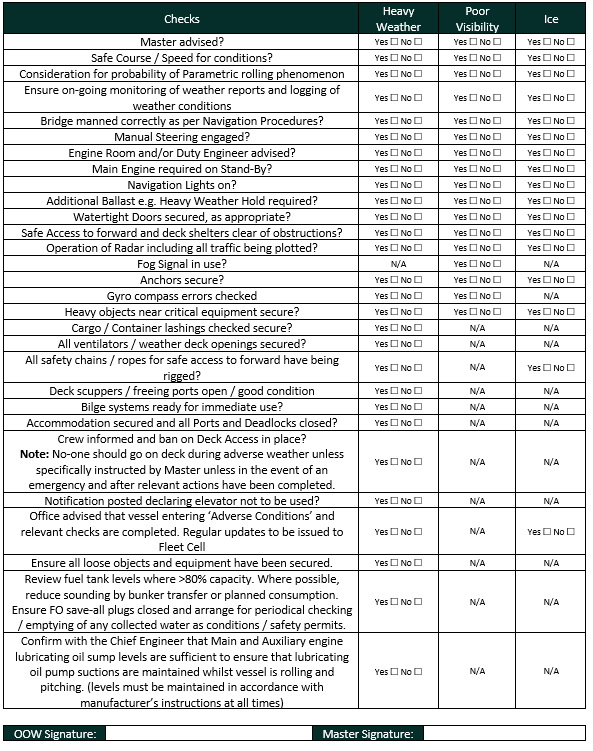
The SMS should include heavy-weather navigation contingency plans and weather routing assessments, which are effectively implemented in actual operations. The company and vessel must have available, vessel-specific procedures enabling the Master to reduce forces on the vessel and cargo and prevent cargo loss when heavy weather is forecast or encountered.
Q10a — SMS Procedure Requirements
· The PSCO will verify heavy-weather navigation procedures and their availability and adequacy.
· SMS procedures should cover, as appropriate:
· Weather routing and forecasting, warnings, and monitoring of navigation conditions;
· The Master's authority to alter route, speed, or heading for safety;
· Assessment of expected accelerations, stability/GM, and impacts on container stacks and lashing;
· Pre-heavy-weather inspections and securing tensioning;
· Deck access restrictions and safe methods for any necessary inspections;
· Post-incident inspections, deficiency reporting, and reporting to the company;
· Appropriate checklists and records.
· Company preparation:
· Review explicit cargo loss prevention measures in the SMS, rather than generic heavy-weather wording;
· Ensure procedures are consistent with the CSM and vessel-specific operational limits;
· Brief the Master and deck officers and test their ability to explain when and how procedures are implemented.
Important note: Q10a is not marked with an asterisk in the official questionnaire, but the official questionnaire stipulates that a "No" answer must be accompanied by a related deficiency. Companies should not treat this question as optional or merely procedural.
Q10b — Procedure Implementation Requirements
· Written procedures must be implemented and supported by evidence. The PSCO may look for proof of actual execution of weather routing, safe vessel operation, securing inspections, and required checklists.
· Evidence the PSCO may review:
· Navigation or voyage plans showing consideration of forecast weather and route information;
· Weather reports, route advice, and Master's decisions on heading, speed, or route;
· Completed adverse weather and cargo securing checklists;
· Deck log entries and inspection records before, during, and after heavy weather;
· Records of loose or damaged lashing, corrective measures, and company notification;
· Consistency between documented procedures and actual bridge/deck practices.
· Crew should be able to explain:
· When heavy-weather preventive measures were most recently implemented;
· How the vessel reduces forces acting on cargo through voyage planning and vessel operation;
· Who authorizes deck access and safeguards under adverse conditions;
· How cargo securing deficiencies are reported, rectified, and escalated.
· Check whether the deck logbook contains cargo inspection and lashing reinforcement records before heavy weather.
· Check weather routing service (WNI/AWT, etc.) assessment records and route adjustment decisions.
【Pitfall Avoidance Guide】
· If the deck logbook lacks signed records of pre-departure securing self-inspection, deficiency 10127 will be issued.
· After receiving a heavy-weather warning, failure to complete the cargo-loss-prevention checklist as required by the SMS or failure to conduct secondary reinforcement of deck lashing constitutes SMS implementation failure.
· Common failure mode: Checklists exist on board but are not completed, or weather routing is recorded but no action is taken on the risks — this may indicate non-compliant SMS rather than effective implementation. This is more dangerous than having no procedures, as it constitutes "knowing but not acting."
IV. Deficiency Summary
During the 2026 Cargo Securing CIC, PSCOs will adopt a progressive inspection strategy. Based on historical inspection data and the latest regulatory trends, the following summarizes the common deficiencies most likely to be issued on vessels:

Deficiency Risk Level Overview
|
Risk Level (Code) |
Common Deficiency Content |
|
High Risk (Code 30 / 17) |
CSM missing / not vessel-specific / not updated; lashing deviation / reduced lashing rods; damaged rigging mixed in use / no isolation area; visibility obstruction without dispensation letter; loading without VGM |
|
Medium Risk (Code 17/16 / 18) |
Crew unfamiliar with CSM / calculations; insufficient rigging spare parts; CSAP facilities (lighting / guardrails) damaged; stowage inconsistent with VGM; 15105 personnel resource deficiency |
|
Low Risk (Code 11) |
Non-standard heavy-weather self-inspection records in deck logbook; delayed filing of portable rigging manufacturer certificates |
A. Documentation and Manual Deficiencies
· CSM unapproved or outdated: Only a CSM draft or sister-ship manual copy on board; or container ships have not updated the manual to MSC.1/Circ.1353/Rev.2 standards.
· CSAP missing or non-compliant: Container ships built on or after 1 January 2015 do not carry approved CSAP drawings.
· Information contradiction: Deck design loads recorded in the CSM do not match data in the vessel's Stability Booklet or Structural Loading Manual.
B. Stowage, Calculation, and Visibility Deficiencies
· Exceeding stack and tier weight limits: Actual container stack weight exceeds the maximum permissible stack weight in the CSM, or "light at bottom, heavy on top" reverse stacking occurs.
· Bridge visibility exceeding limits: After stacking high containers on deck, the forward sea surface blind sector from the bridge exceeds twice the vessel length or 500 metres, without Flag State special authorization.
· Unapproved lashing software: Using lashing software not approved by Class, with calculation results in serious conflict with CSM statutory drawings.
C. Cargo Securing Equipment (Fixed/Portable) Operation and Maintenance Deficiencies
· Poor rigging condition: Severe broken wires in lashing wire ropes, cut/damaged webbing, rusted or slipping turnbuckles.
· Missing condemnation isolation mechanism: Condemned or damaged rigging not placed in a dedicated red-painted quarantine bin, still mixed in deck spare parts boxes.
· Damaged fixed points: Cracked weld roots at D-rings and footings on deck and hatch covers, severely deformed or excessively corroded dovetail foundations.
· Insufficient reserve: Actual quantity of portable rigging below the minimum reserve required by the CSM inventory.
D. Crew Familiarity and SMS Implementation Deficiencies
· Officers unfamiliar with the CSM: The Chief Officer cannot quickly locate securing requirements for specific cargo in the CSM, or cannot explain MSL conversion and force calculations.
· Untrue/missing records: No pre-departure securing self-inspection records in the deck logbook; the Securing Equipment Maintenance Record Book has not been filled in for a long time.
· Heavy-weather contingency plan not implemented: After receiving a heavy-weather warning, failure to complete the cargo-loss-prevention checklist as required by the SMS or failure to conduct secondary reinforcement of deck lashing.
V. Action Recommendations for Pitfall Avoidance
To pass the 2026 CIC smoothly, shipowners, management companies, and vessels are advised to promptly take the following actions:
1. Conduct Immediate On-Board Self-Inspection
Referring to the CIC questionnaire and verification points in this guide, organize a vessel-wide special self-inspection on cargo securing. Focus on whether statutory documents are valid, rigging condition and isolation area setup, the Chief Officer's force calculation capability, and whether deck logbook records are complete.
2. Action & Complete Checklist: Cargo Securing Inspection Preparation Checklist
|
Inspection Area |
Specific Action Requirement |
Complete |
|
Certificates and Manuals |
Confirm the vessel carries the original approved, vessel-specific CSM stamped by the Administration/RO (hard copy or acceptable electronic form), with compliant language |
☐ |
|
CSM Specific Arrangement Coverage |
Against actual and planned stowage scenarios, confirm the CSM provides clear guidance, not merely generic examples. Any alternative stowage pattern must be supported by approved documentation |
☐ |
|
Crew Familiarity |
Organize special CSM training for the Chief Officer and watch officers, focusing on stack/tier weight limits, structural load limits, and HiCube impacts |
☐ |
|
CSM Consistency Cross-Check |
Conduct documented cross-checks of cargo plans, lashing plans, and the CSM before loading approval. Verify software warnings and overrides are investigated and recorded |
☐ |
|
VGM Control |
Confirm every container to be loaded has a VGM reflected in the final cargo plan. Organize VGM messages/EDI records and terminal documentation |
☐ |
|
CSAP and Safe Access |
For post-2015 built vessels: Confirm CSAP is on board, current, compatible with actual arrangements, and covers all cargo operation areas |
☐ |
|
Portable Equipment Quantity and Compatibility |
Inventory portable rigging quantities (by type, model), ensuring minimum CSM reserve requirements are met. Confirm brand, type, and locking orientation are controlled |
☐ |
|
Equipment Condition and Maintenance |
Conduct focused inspection before CIC: fixed points (eye plates, D-rings, dovetail foundations, hatch cover seats) and portable rigging (lashing rods, turnbuckles, twistlocks) |
☐ |
|
Continuous Securing During Voyage |
Check Deck Logs of the last three voyages, confirming pre-departure securing self-inspection, underway inspection, and pre-heavy-weather reinforcement records |
☐ |
|
Bridge Visibility |
Verify final cargo plan against approved sight line drawings or calculations. Confirm actual stowage after loading and before departure |
☐ |
|
Heavy-Weather Procedures |
Confirm SMS contains complete, vessel-specific heavy-weather procedures (weather routing, cargo inspection, re-tensioning of lashing, cargo loss reporting) |
☐ |
|
Procedure Implementation Evidence |
Organize recent voyage navigation plans, weather reports, route advice, and Master decision records. Confirm adverse weather and cargo securing checklists are completed |
☐ |
3. Strengthen Technical Competence of Chief Officers and Responsible Officers
Organize special training based on the vessel's CSM, enabling the Chief Officer to proficiently calculate non-standard cargo securing mechanics using the advanced calculation method (Annex 13), and to understand the authority boundary between the loading computer's lashing module and the statutory CSM. Conduct simulated PSC oral assessments after training.
4. Establish Reporting and Maintenance Mechanisms
If damage to fixed securing points or significant wear and loss of portable rigging is found during the voyage, immediately report to the shipowner, RO, and port State in accordance with company SMS procedures, and record mitigation measures in detail in the record book. Never conceal or fail to report. Investigate recurring equipment failures as potential SMS maintenance weaknesses.
5. Pre-Arrival Self-Assessment Checklist
Before entering a Paris MOU or Tokyo MOU port, the Master is strongly advised to verify the following:
|
Self-Inspection Item |
Confirmation Standard |
OK |
|
CSM Approval and Revision |
Approved, current version, readily available on board |
☐ |
|
Cargo Coverage |
Clear guidance for actual cargo dimensions and stowage arrangements |
☐ |
|
Crew Familiarity |
Responsible crew can locate and explain stack, tier, deck, hatch cover, and tank top limits |
☐ |
|
CSM Consistency |
Cargo plan, lashing plan, equipment selection, and actual stowage consistent with CSM |
☐ |
|
VGM |
Every container to be loaded has VGM reflected in the final cargo plan |
☐ |
|
CSAP / Safe Access |
Applicable documents on board; physical access safe, clear, and passable |
☐ |
|
Portable Equipment |
Correct types, sufficient quantity (including reserve) available |
☐ |
|
Condition and Maintenance |
Fixed and portable equipment serviceable; records and certificates complete |
☐ |
|
Continuous Voyage Securing |
Logs and inspections prove continuous securing and timely deficiency rectification |
☐ |
|
Bridge Visibility |
Final plan and actual stowage comply with approved visibility requirements |
☐ |
|
Heavy-Weather Procedures |
Vessel-specific procedures and checklists available and understood |
☐ |
|
Implementation Evidence |
Recent records prove heavy-weather procedures have been followed |
☐ |
────────────────────────────────────────────────────────────
The above is a personal study summary shared for mutual learning. Original authors: Capt. Zhou Minjing (WeChat: Zenwalking), Capt. Wu Jianbo (WeChat: king-kim-11).


READ MORE
 Safety
US Says It Disabled Hong Kong-Owned Bulker off Oman
 Safety
Attacked Just 42Days After Delivery: George Prokopiou’s 115,000-Dwt Tanker Hit in Hormuz
 Safety
Five Seafarers Reported Dead as Puntland Retakes Hijacked Tanker Honour 25
 Safety
Middle East war leaves mounting toll on merchant shipping
 Safety
China-U.S. Consensus Highlights Free Navigation: No Country or Entity Should Impose Transit Fees on International Waterways
 Safety
1 seafarer killed, Fatal attack in the Strait of Hormuz: Capesize bulker CAPE DAO hit by unknown projectile
 Safety
25 Crew Abandon MSC Container Ship in the South China Sea — All Rescued, Vessel Still Adrift
 Safety
MSC Hermes III Adrift Unmanned in South China Sea After 25 Crew Abandon Ship
 Safety
Dangerous Goods Container Fire Reported at NPCT1 Terminal in Jakarta
 Safety