


Fishing Season Reopens Sept 1: 30,000 Vessels Put to Sea
Merchant-Fishing Collision Risk Surges — A Safety Guide for Watchkeepers
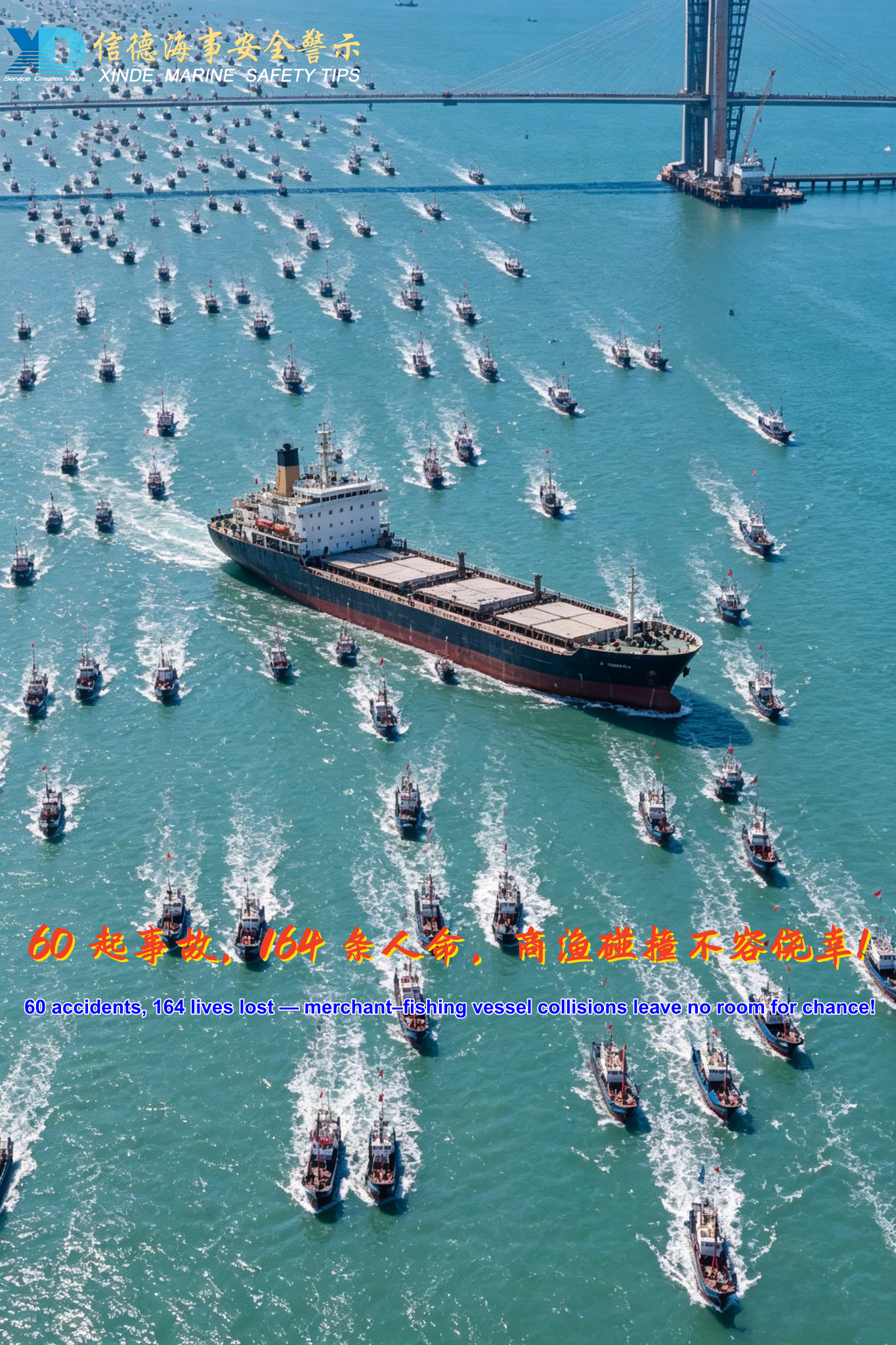

Fishing Season Special Alert
Figure 1: Thousands of fishing vessels depart simultaneously as the Bohai and Yellow Sea fishing season reopens (illustrative image)
At 1200 hrs on September 1, the four-month summer fishing moratorium ends in the Bohai Sea and the Yellow Sea north of latitude 35°N. Over 30,000 fishing vessels from Shandong, Liaoning, Hebei and Tianjin will simultaneously depart for traditional fishing grounds. China's coastal waters host more than 200,000 active fishing vessels, with traditional fishing grounds heavily overlapping international and domestic shipping lanes. In the past five years, 60 merchant-fishing vessel collisions at or above the general accident level were recorded, resulting in 164 fatalities or missing persons — each incident shattering a family.
|
⚠ KEY WARNING The 2–4 weeks after the season reopens see the highest collision rate. The most dangerous window is 2300–0400 hrs. Abandon the assumption that "fishing boats are small and maneuverable, they'll get out of the way." Apply the "Early, Large, Wide, Clear" principles and take proactive avoiding action — do not wait. |
01 Lessons from Blood: The Root Cause of Three Accidents
In April 2024, the second officer of a Panama-flagged container ship (Vessel A) left the bridge to download electronic charts in the radio room, leaving the bridge unmanned for 20 minutes. The BNWAS had been incorrectly set and failed to trigger an alarm. The vessel collided with a fishing boat, killing all 8 crew members. In the "Jinwangling" case, the give-way vessel failed to take early, substantial action and repeatedly relied on VHF calls instead of manoeuvring. The second officer was sentenced to 3 years and 6 months for traffic肇事 negligence. In 2016, the bulk carrier "CATALINA" collided head-on with the fishing vessel "Lurongyu 58398" in dense fog off the Zhejiang coast. The fishing vessel capsized and sank instantly — 14 crew died and 5 were missing, while the freighter suffered only a dented bow.
All three accidents share the same root causes: watchkeepers leaving the bridge or failing to maintain a proper lookout; give-way vessels acting too late with insufficient alteration; and over-reliance on VHF communication instead of proactive manoeuvring. Even a slight contact between a merchant ship and a fishing vessel can capsize the smaller craft, often without anyone on the bridge even noticing.
02 Merchant Vessel Avoidance: "Early, Large, Wide, Clear" in Practice

Figure 2: Night navigation in fishing grounds — the bridge team must maintain a proper lookout using vision, radar and AIS in combination (illustrative image)
● Early: Detect fishing vessel clusters at 5 NM on long-range radar; initiate avoiding decisions at 3 NM — never delay until close-quarters. Stand by engines and steering one hour before entering fishing grounds.
● Large: Alter course by no less than 30° so fishing vessels can clearly read your intention; small alterations are easily misread. In congested waters, substantial speed reduction or stopping is often more effective than turning. If three VHF calls go unanswered, treat the vessel as unwatched and take immediate avoiding action, accompanied by 5 short flashes on the daylight signalling lamp and 5 short blasts on the whistle.
● Wide: Maintain a minimum passing distance of at least 1 NM in open waters and 0.5 NM in congested areas. "Rather steam 1 NM around than risk 0.5 NM through" — detouring is safer and more economical than cutting through. Never pass between pair-trawlers, to leeward of purse seiners, or across the bow of longliners.
● Clear: Resume your original course and speed only after confirming the vessel is finally past and clear with no risk of a second collision. For fishing vessels with erratic course/speed, maintain continuous radar plotting and take one substantial alteration and/or major speed reduction at 1–2 NM to clear in a single action.
Avoidance by fishing gear type: pass at least 1 NM astern of pair-trawlers; at least 0.5 NM to windward of purse seiners; at least 0.5 NM astern of longliners. Watch for nearly stationary gillnet/set-net vessels and their gear-protecting manoeuvres.
03 For Fishing Vessels: Five Red Lines
● Stay off channels: Do not set nets in shipping lanes, anchorages or pilot boarding areas.
● Don't cut the bow: Abandon the old habit of cutting across a large vessel's bow — understand their limited manoeuvrability and blind sectors.
● Never leave the watch: Maintain a 24-hour bridge watch, display correct lights and shapes, keep AIS on, and maintain a continuous listening watch on VHF Ch.16.
● No violations: Eliminate the "five excesses": excess crew, excess load, excess horsepower, excess operating area, and excess wind force operations.
● Don't take risks: Seek shelter in gales and dense fog; call 12395 (China MSA distress line) in an emergency.
04 Special Conditions and Post-Collision Action
In night fishing grounds (highest risk 2300–0400), steer by hand, maintain a safe speed, and post an additional lookout. Use the searchlight to scan the bow sectors and radar blind areas; watch for unlit vessels and learn to identify trawler lights (two sidelights + green light + white light) and purse seiner lights (two sidelights + two white lights). In reduced visibility, stand by engines and sound signals (one prolonged blast every 2 minutes for power-driven vessels underway), use two radars on alternating range scales, use rain suppression cautiously to avoid filtering out small returns, and heave to if necessary until the fog lifts. In dense fishing vessel concentrations, the master must take the conn, steer by hand, and pass around the outer edge of the fleet. Beware of massive AIS interference from net buoys, and continuously monitor other merchant vessels also manoeuvring in the area.
After a collision, follow four steps: stop immediately and rescue survivors → report to the nearest maritime authority within 10 minutes → never leave the scene before all persons are accounted for → preserve the logbook, engine-room bell record, AIS log, VHF recording and VDR data for the investigation. Hit-and-run at sea carries severe criminal penalties.
05 Conclusion
The whistle on September 1 marks the start of the harvest — and a safety reminder for every mariner. With more proactive avoidance from merchant ships and greater discipline from fishing crews, we can make these waters safer. May every fishing vessel return with a full catch and every merchant ship reach her port safely.


READ MORE
 Safety
US Says It Disabled Hong Kong-Owned Bulker off Oman
 Safety
Attacked Just 42Days After Delivery: George Prokopiou’s 115,000-Dwt Tanker Hit in Hormuz
 Safety
Five Seafarers Reported Dead as Puntland Retakes Hijacked Tanker Honour 25
 Safety
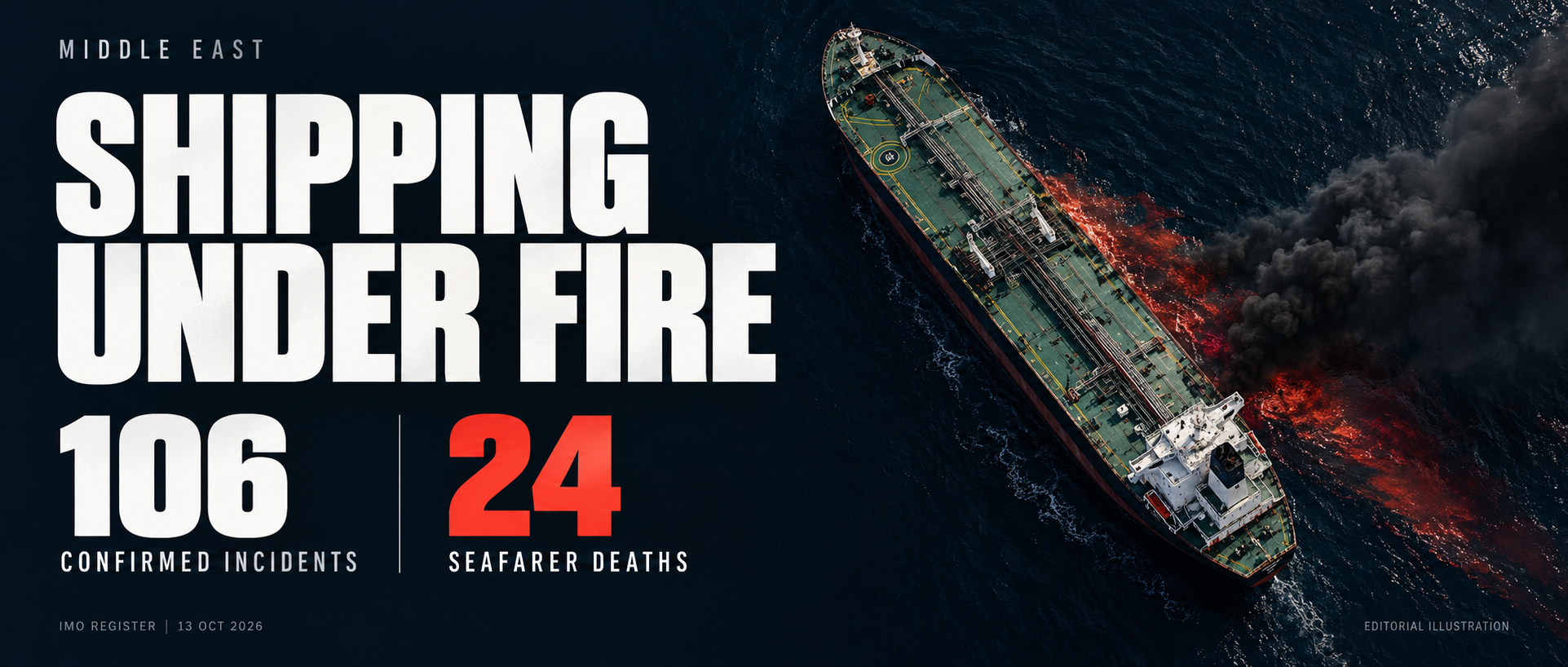
Middle East war leaves mounting toll on merchant shipping
 Safety
China-U.S. Consensus Highlights Free Navigation: No Country or Entity Should Impose Transit Fees on International Waterways
 Safety
1 seafarer killed, Fatal attack in the Strait of Hormuz: Capesize bulker CAPE DAO hit by unknown projectile
 Safety
25 Crew Abandon MSC Container Ship in the South China Sea — All Rescued, Vessel Still Adrift
 Safety
MSC Hermes III Adrift Unmanned in South China Sea After 25 Crew Abandon Ship
 Safety
Dangerous Goods Container Fire Reported at NPCT1 Terminal in Jakarta
 Safety