

Historic First: Seaspan to Pay China P&I Club Calls in Offshore RMB for Two 14,000-TEU Newbuildings
China P&I Club will accept RMB call payments from an overseas shipowner for the first time, marking a pioneering use of offshore RMB settlement in the global protection and indemnity insurance sector.
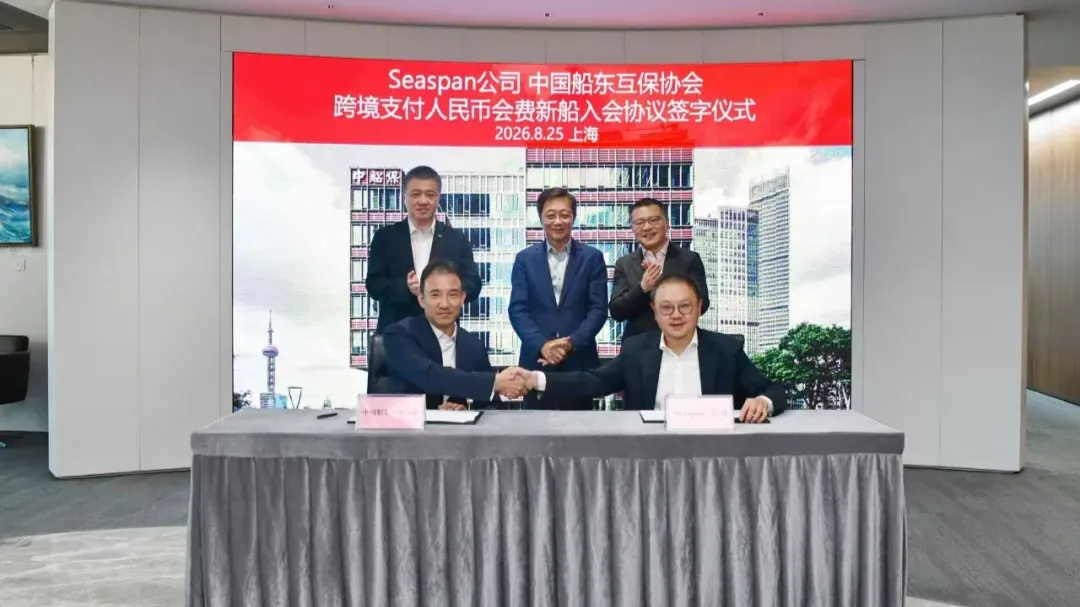
Seaspan Corporation and the China Shipowners Mutual Assurance Association, widely known as China P&I Club or CPI, signed an agreement on 25 August covering the cross-border payment of P&I calls in renminbi for two new containerships.
Under the agreement, two 14,000-TEU newbuildings owned by Seaspan will enter China P&I Club for P&I cover, with the associated calls paid through a cross-border RMB arrangement.
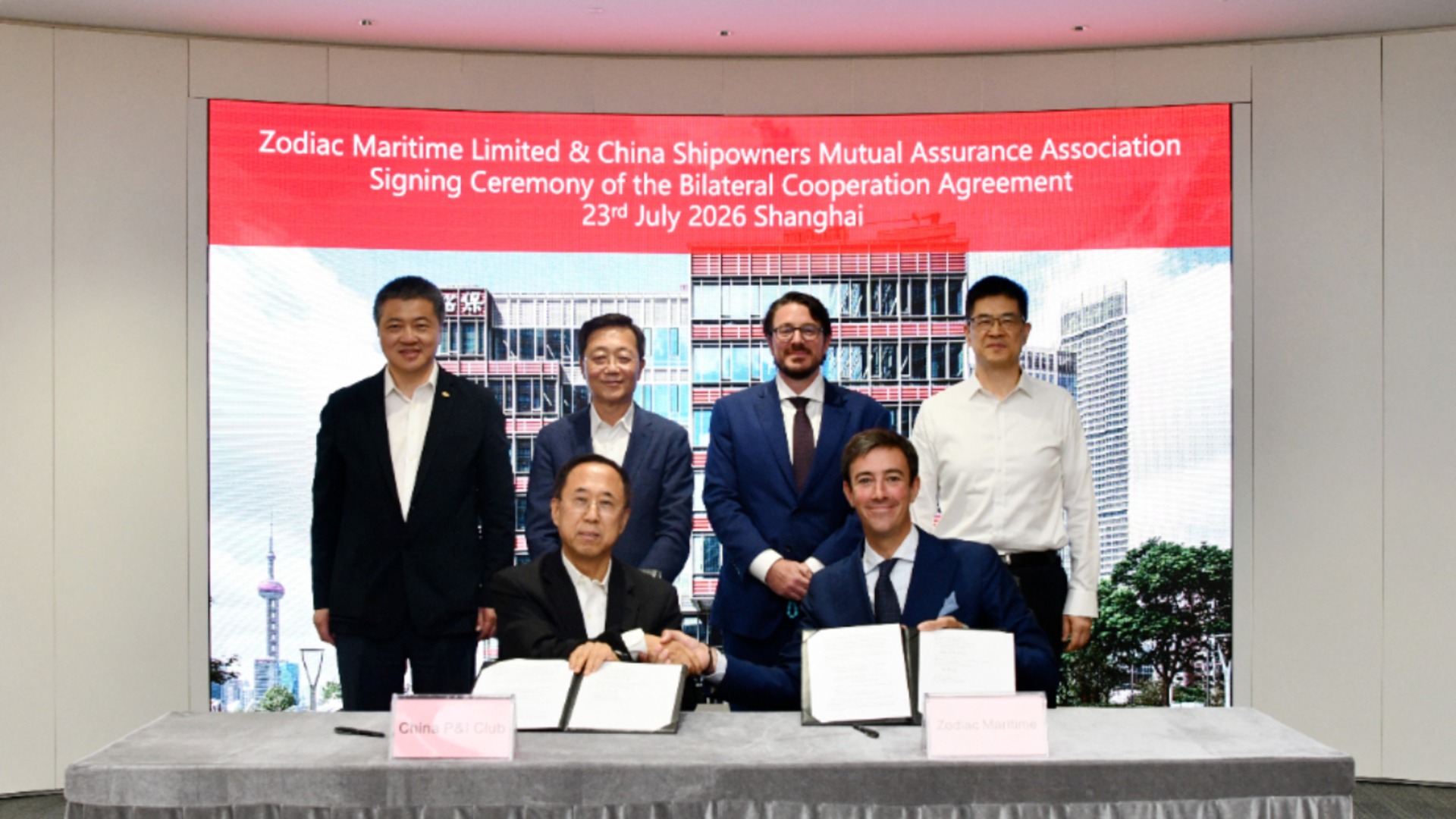
The signing ceremony was held at CPI’s Shanghai headquarters and witnessed by Xu Lirong, Chairman of China P&I Club; Bing CHEN , Chairman, President and CEO of Seaspan; and Tao Weidong, Chairman of COSCO SHIPPING Lines. The agreement was signed by @Li Kun, Executive Vice President and Chief Commercial Officer of Seaspan, and Liu Yutong, Deputy General Manager of CPI.
According to China P&I Club, this is the first time the Association has accepted RMB call payments from an overseas shipowner for the entry of new vessels. CPI also described the transaction as a pioneering exploration of offshore RMB settlement in the global P&I insurance sector.

Offshore RMB enters international P&I call payments
P&I clubs provide shipowners with mutual liability cover for risks including crew injury and illness, cargo loss or damage, collision liabilities, pollution, wreck removal and other third-party claims arising from vessel operations.
Unlike ordinary commercial insurance, a mutual P&I club is owned by its members. Shipowners entering vessels with the club contribute calls to a shared risk pool, while the club provides claims handling, legal support, guarantees, loss-prevention services and access to a worldwide network of correspondents.
Global P&I business has traditionally been closely connected to the London and Nordic marine insurance markets, with the US dollar remaining the dominant currency for calls, claims payments, reinsurance and financial guarantees. An overseas shipowner paying P&I calls to a Chinese mutual insurer in offshore RMB therefore represents a new operational use of the currency in a highly specialised and internationally regulated sector.
The arrangement involves more than selecting a different payment currency. It requires workable mechanisms for RMB call calculation, cross-border collection, account management, financial reporting and regulatory compliance. Once tested through live vessel entries, the structure could potentially be extended to other Seaspan vessels and additional international members of CPI.
The current agreement specifically covers the cross-border payment of calls for two newbuildings. It does not indicate that all related claims, guarantees, reinsurance payments or other insurance cash flows will also be settled in RMB. Its immediate significance lies in establishing a practical route for offshore RMB to enter international P&I call payments.
Strong connection with the newly delivered OOCL CHANCAY
The signing came one day after Hudong-Zhonghua Shipbuilding delivered the 13,600-TEU OOCL CHANCAY to Seaspan on 24 August.

The vessel is the first in a series of six 13,600-TEU containerships ordered by Seaspan in October 2024. It was delivered several months ahead of its contractual schedule.
OOCL CHANCAY measures approximately 336 metres in length, 51 metres in breadth and 30.2 metres in depth. Although described as a 13,600-TEU design, its maximum container capacity reaches 14,132 TEU, including around 2,000 reefer slots. The vessel incorporates energy-saving technologies designed to reduce fuel consumption and emissions while maintaining high loading efficiency and operational reliability.
CPI has not disclosed the names of the two newbuildings covered by the RMB call-payment agreement. However, its reference to two “14,000-TEU new containerships” closely corresponds with the 14,132-TEU maximum capacity of the Hudong-Zhonghua series. The timing, vessel size, ownership and project schedule indicate a strong connection between the two developments.
The sequence is particularly significant. Seaspan ordered the vessels from a Chinese shipyard using RMB in October 2024. The lead vessel was delivered in August 2026, and the following day Seaspan and CPI agreed to use RMB for P&I calls on two newbuildings of the same size.
RMB has therefore followed this newbuilding programme from the shipbuilding contract into the post-delivery risk-protection stage.
From RMB ship prices to RMB 3.5 billion financing and a RMB 1.5 billion Panda Bond
Seaspan’s expanding use of RMB began on 18 October 2024, when Hudong-Zhonghua and China Shipbuilding Trading signed contracts with the shipowner for six 13,600-TEU containerships.
The contract was settled in RMB, making it one of the most prominent large-scale Chinese shipbuilding deals signed directly by an international shipowner in the Chinese currency. The vessels are scheduled for delivery between 2026 and 2028.
On the same day, ICBC Financial Leasing signed a financing agreement with Seaspan covering three of the six vessels. The financing package was valued at approximately RMB 3.5 billion and used RMB for both ship-price payment and vessel financing. It was described at the time as the largest single international RMB-denominated ship leasing transaction.
The six ships were subsequently linked to 15-year charter agreements between Seaspan and Orient Overseas Container Line. OOCL disclosed a maximum aggregate charter value of RMB 11.2 billion, with deliveries expected between the fourth quarter of 2026 and the first quarter of 2028.
Seaspan continued to expand its RMB-based newbuilding activity in 2025. The company ordered six containerships of more than 10,000 TEU at Shanghai Waigaoqiao Shipbuilding under a cross-border RMB settlement arrangement. It later contracted twelve approximately 9,000-TEU containerships from China State Shipbuilding Corporation, again using cross-border RMB settlement and financing support from ICBC Financial Leasing.
A further milestone followed in July 2026, when Seaspan issued a RMB 1.5 billion Panda Bond in China’s domestic bond market. The three-year private placement carried a coupon of 2.50% and achieved a book-coverage ratio of 2.3 times.
The transaction made Seaspan the first international shipowner and operator to access China’s Panda Bond market. Unlike financing tied to individual vessels, the Panda Bond created a corporate-level unsecured RMB funding channel that can support fleet investment and future growth, although Seaspan has not linked the proceeds to any specific newbuilding project. Seaspan announced the transaction on 7 August.
RMB now appears at four levels of Seaspan’s activities in China: newbuilding payments, vessel leasing finance, corporate bond funding and marine insurance calls. The latest CPI agreement extends the currency’s role beyond asset acquisition and financing into the continuing operational and risk-management requirements of an international shipowner.
The 24-vessel CPI framework moves into implementation
The two-vessel agreement also represents the implementation of the broader cooperation framework signed by Seaspan and China P&I Club in October 2025.
Under that framework, CPI is expected to provide cover for 24 Seaspan containership newbuildings scheduled for delivery between 2026 and 2028, representing approximately 2.6 million gross tonnes. The agreement was among CPI’s largest international shipowner projects in terms of both entered tonnage and the number of new vessels involved. CPI announced the framework in October 2025.
As of 20 February 2026, China P&I Club had 218 members and provided P&I cover for 2,199 vessels totalling approximately 104.8 million GT. Its network includes 490 correspondents across 145 countries and regions, while the club ranks eighth globally by entered P&I tonnage.
Measured against the February 2026 total, the 2.6 million GT covered by the Seaspan framework is equivalent to approximately 2.5% of CPI’s existing entered tonnage. The actual impact will be spread over several years and will also be affected by other vessel entries and withdrawals, but the comparison demonstrates the scale of the relationship.
The latest agreement adds a settlement dimension to that partnership. The 2025 framework established that CPI would cover the 24 newbuildings. The 2026 agreement begins to establish how an international member can pay calls in RMB as those ships are delivered and enter service.
For CPI, the transaction supports its strategy of professionalism, market orientation, internationalisation and digitalisation. The club has expanded beyond 100 million GT, established a service company in Greece, attracted major international members including Seaspan and Zodiac Maritime, and maintained an A.M. Best financial strength rating of A- for five consecutive years.
Accepting offshore RMB calls from an international shipowner shows that CPI’s internationalisation is extending from overseas membership and service locations into products, accounts and settlement mechanisms.
RMB moves into the global maritime risk-protection system
China has become the world’s leading shipbuilding nation, while Chinese leasing companies have developed into major providers of capital to international shipowners. These industrial and financial strengths have created practical foundations for the wider use of RMB in global shipping.
The Seaspan–CPI agreement brings marine insurance into that framework. A currency already being used to purchase ships, finance assets and raise corporate capital will now also be used to pay for P&I protection.
Further development will require RMB applications to expand into claims payments, overseas guarantees, reinsurance settlements, correspondent expenses and marine insurance investment portfolios. CPI will also need to manage the potential currency mismatch between RMB-denominated call income and claims or reinsurance costs that may remain denominated in US dollars.
The 25 August agreement nevertheless represents a concrete transaction involving an international shipowner, identifiable newbuildings, real cross-border payments and specific insurance cover. It creates a replicable precedent for the wider use of RMB in international marine insurance.
Less than 22 months have passed since Seaspan signed the original RMB-denominated shipbuilding contract. During that period, RMB has moved through the shipyard, financial leasing market and domestic bond market, and has now reached P&I insurance.
For China P&I Club, the agreement creates two milestones: its first newbuilding entries for which an overseas shipowner will pay calls in RMB, and its first application of offshore RMB to international-member P&I call settlement.
For the wider P&I market, it is a pioneering experiment. RMB is evolving from a currency used to price and finance ships into one that can also support their operation and liability protection.