


China and Thailand Sign MoU to Strengthen Industrial and Supply Chain Cooperation
The agreement establishes a regular coordination platform for government agencies, local authorities and businesses, as the two countries seek safer, more resilient and better-integrated supply chains.
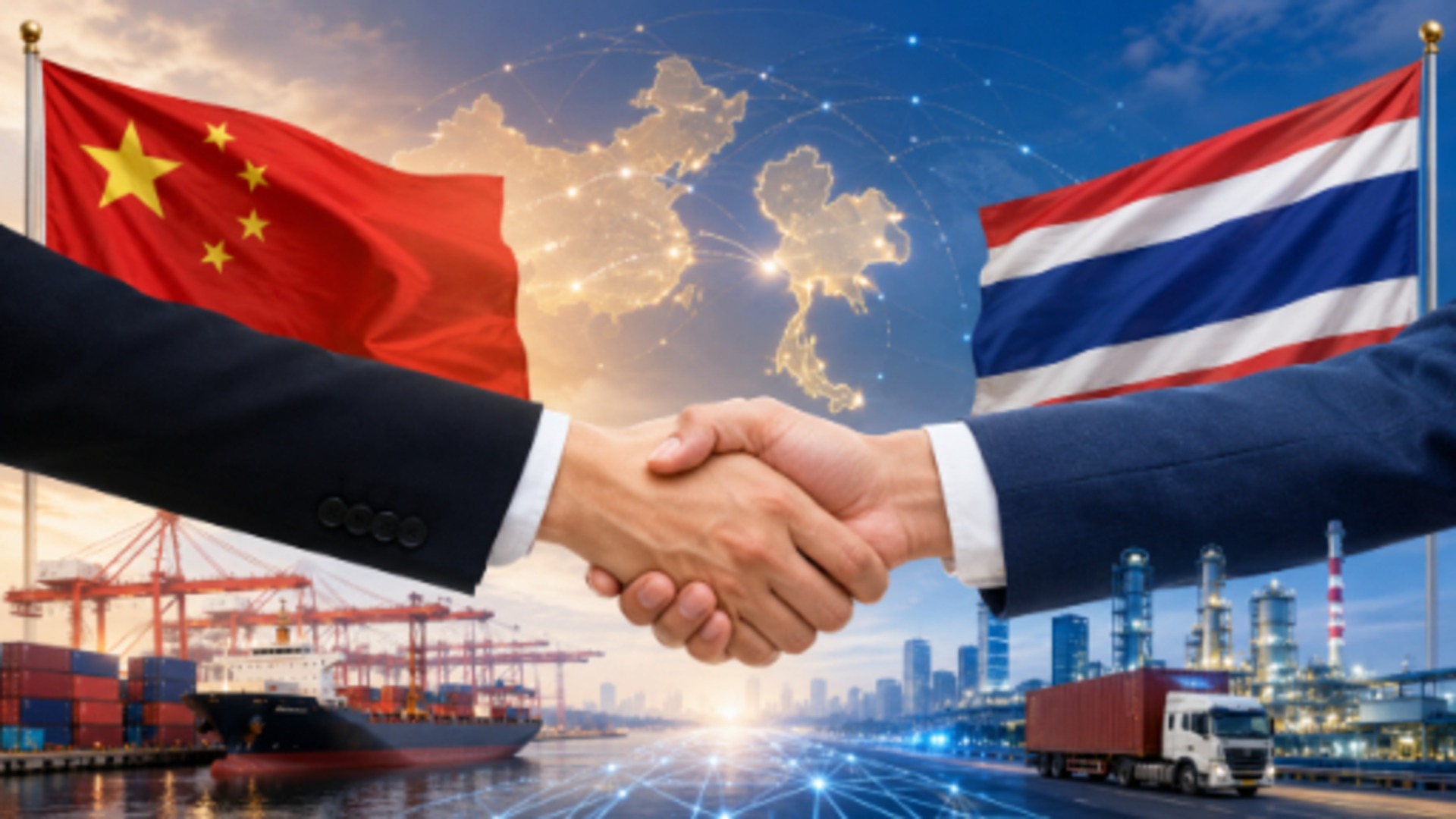
BEIJING, July 20, 2026 — China and Thailand have signed a memorandum of understanding aimed at strengthening economic cooperation across industrial and supply chains, adding a new institutional mechanism to their expanding bilateral trade, investment and technology partnership.
The document, formally titled the Memorandum of Understanding between the Ministry of Commerce of the People’s Republic of China and the Ministry of Commerce of the Kingdom of Thailand on Strengthening Economic Cooperation in Industrial and Supply Chains, was signed in Beijing on July 20.
Chinese Minister of Commerce Wang Wentao and Thai Deputy Prime Minister and Minister of Commerce Suphajee Suthumpun signed the agreement in the presence of Chinese Premier Li Qiang and Thai Prime Minister Anutin Charnvirakul, according to China’s Ministry of Commerce.
Under the MoU, the two countries agreed to advance industrial and supply chain cooperation through regular meetings and closer exchanges. The framework will encourage relevant government departments, local authorities and enterprises from both countries to deepen practical cooperation and jointly address emerging challenges.
The agreement also calls for the creation of a more favourable business environment for Chinese and Thai companies. China’s Ministry of Commerce said the new mechanism would help establish a practical and efficient bilateral cooperation platform while supporting the security, resilience and smooth functioning of industrial and supply chains between the two economies.
The publicly disclosed provisions focus primarily on establishing coordination mechanisms, facilitating exchanges and supporting cooperation among public and private-sector participants. No quantitative investment targets, specific commercial projects or implementation timetable were announced.
Part of a broader economic cooperation agenda
The MoU was signed during Anutin’s official visit to China from July 16 to 20, his first official visit to the country since taking office. The visit also included meetings with Chinese leaders and participation in the 2026 World Artificial Intelligence Conference and High-Level Meeting on Global AI Governance in Shanghai.
A joint statement issued by the two governments placed the supply chain agreement within a wider programme of bilateral economic cooperation.
China and Thailand agreed to strengthen cooperation in trade, technology and talent development, with the objective of maintaining safe and resilient industrial and supply chains. They also committed to expanding market access and promoting high-quality and responsible investment that supports local business participation, follows environmental best practices and complies with domestic laws and regulations.
The two sides said they would enhance collaboration among industry, universities and research institutions and support joint research platforms, technology start-ups, talent development and technology transfer. These measures are intended to help establish a more integrated and fully functioning supply chain ecosystem.
Thailand also expressed its readiness to attract more long-term and sustainable Chinese investment and research and development partnerships, particularly in innovative, advanced and future-oriented industries. Such cooperation is expected to support the development of more closely integrated production and supply networks between the two countries.
Digital trade, customs and advanced industries
The broader bilateral agenda extends beyond traditional manufacturing and merchandise trade.
According to the joint statement, China and Thailand will strengthen digital customs cooperation, including smart customs practices, single-window services, regulatory coordination, capacity building and anti-smuggling enforcement. They will also deepen cooperation in digital trade facilitation and e-commerce, including exchanges on digital governance and standards designed to support small and medium-sized enterprises.
The governments identified a range of additional areas for closer science, technology and industrial cooperation, including artificial intelligence, advanced electronics, modern automobiles, future foods, aerospace and space technology, quantum technology, clean energy and bio-industries.
These sectors were set out in the wider China-Thailand joint statement and should be distinguished from the publicly disclosed provisions of the supply chain MoU itself.
Both countries also agreed to make fuller use of existing regional trade arrangements. They welcomed the signing of the China-ASEAN Free Trade Area 3.0 Upgrade Protocol in October 2025 and pledged to work towards its early entry into force.
China and Thailand will continue implementing the existing China-ASEAN Free Trade Agreement and the Regional Comprehensive Economic Partnership, or RCEP, to facilitate trade, investment and regional economic integration.
The two governments additionally agreed to conclude the next joint action plan under their five-year development plan for trade and economic cooperation as early as possible.
Building greater supply chain resilience
The new MoU comes as governments and businesses across Asia reassess the resilience of production networks amid geopolitical uncertainty, trade policy changes and growing demand for more diversified sourcing and manufacturing arrangements.
For China and Thailand, the agreement provides a formal channel through which ministries, local governments and companies can coordinate more closely on investment, production, logistics, technology and trade facilitation.
Thailand is an important manufacturing and logistics base in Southeast Asia, while China remains deeply connected to the region’s industrial networks as a major market, investor and supplier of machinery, intermediate goods and technology.
The effectiveness of the MoU will ultimately depend on the implementation of its regular dialogue mechanism and the ability of both sides to translate central-government commitments into commercially viable cooperation among local authorities and enterprises.
The signing nevertheless gives China and Thailand a clearer institutional framework for addressing supply chain risks, improving the operating environment for businesses and developing more integrated economic links under the China-ASEAN and RCEP frameworks.

READ MORE
 Technology
Shiptec China 2026.10.28-10.30 | The Enterprises of International Pavilion
 Technology
Shipowners are finding a new business beyond ships
 Technology
Maritime is using AI every day. Now comes the harder part: trusting it to act.
 Technology
Connecting maritime digitalisation to process
 Technology
Shiptec China 2026.10.28-10.30 | Russian Delegation to Make a Grand Appearance at the 17th International Shipbuilding,Marine Equipment and Offshore Engineering Exhibition For China
 Technology
AI Is Moving Into Shipping’s Core Business. What Will Set Companies Apart?
 Technology
Shiptec China 2026.10.28-10.30 | German Pavilion | High-Precision Threading Tools & Clamping Systems: NORIS Debuts at Dalian Maritime Exhibition
 Technology
Shiptec China 2026.10.28-10.30 | German Pavilion | Mayr Safety Brakes: Robust, Powerful and Seawater-Corrosion Resistant – Safe and Durable Product Solutions for Harsh Environments
 Technology
Shiptec China 2026.10.28-10.30 | TECHNOBIO with POWER-Z: Improving Power and Thermal Efficiency through Fuel Additives
 Technology