


Houthis Declare Maritime Blockade on Saudi Arabia: What If Hormuz and Bab el-Mandeb Both Become Unusable?
.


The announcement does not yet amount to a confirmed closure of the Bab el-Mandeb Strait. But with commercial traffic through Hormuz already severely constrained, even a Saudi-specific blockade could expose the global energy and shipping system to a two-chokepoint crisis.
Yemen’s Houthis have opened a new front in the Middle East’s widening maritime confrontation.
On 20 July, Houthi military spokesman Yahya Saree announced an immediate “maritime embargo” against Saudi Arabia, describing the decision as a response to what the group called the kingdom’s long-running blockade of Yemen. The declaration followed renewed exchanges of fire between the Houthis and Saudi Arabia, including a dispute over an attack on Sanaa International Airport. Saudi-led forces said they would respond firmly.
The announcement is significant, but its operational scope remains unclear.
The Houthis have not yet published detailed targeting criteria explaining whether the blockade applies only to Saudi-flagged vessels, all ships calling at Saudi ports, Saudi-owned cargoes, charterers trading with the kingdom, or companies with broader commercial links to Saudi Arabia. Nor has there been an official declaration closing Bab el-Mandeb to all merchant traffic.
For shipping companies, however, the distinction may offer limited comfort.
The Houthis have repeatedly demonstrated that a waterway does not need to be physically sealed to become commercially unusable. Missile and drone attacks, ambiguous targeting rules and the risk of misidentification can be sufficient to persuade owners, insurers and crews to withdraw well before governments formally declare a route closed.
Saudi Arabia’s Hormuz escape route is now exposed
The timing of the Houthi declaration makes the threat especially serious.
Traffic through the Strait of Hormuz has already been heavily disrupted by attacks on commercial ships, competing Iranian and US navigation controls, naval interception and escalating war-risk costs. Hormuz carried about 20 million barrels per day of petroleum liquids in 2024, equivalent to roughly 20% of global consumption.
Saudi Arabia has responded by redirecting a large share of its exports through the East-West Pipeline to the Red Sea port of Yanbu. The pipeline was designed to move crude from the kingdom’s Eastern Province to its western coast, allowing some volumes to bypass Hormuz. Saudi Arabia and the UAE together possess approximately 4.7 million barrels per day of effective bypass capacity under normal operating conditions, although the theoretical capacity of Saudi infrastructure may be higher.
That strategy provides an escape from Hormuz, but it does not remove maritime risk.
Crude loaded at Yanbu for Asian customers must sail south through the Red Sea and pass Bab el-Mandeb. Cargoes heading north towards Europe can use the Suez Canal without transiting Bab el-Mandeb, but they would still remain exposed if the Houthi blockade targets Saudi-linked shipping throughout the Red Sea rather than only at the southern chokepoint.
The new declaration therefore threatens the principal alternative route Saudi Arabia has relied upon as Gulf shipping conditions deteriorated.
A Saudi blockade is not yet a full Bab el-Mandeb closure
The immediate market risk depends heavily on how the Houthis enforce their announcement.
A narrowly defined blockade could focus on Saudi-flagged vessels, ships owned by Saudi interests, or vessels sailing to and from Saudi ports. Such an operation would directly affect Yanbu, Jeddah and other Saudi Red Sea facilities while allowing unrelated regional traffic to continue.
A broader interpretation could place any company trading with Saudi Arabia at risk. Previous Houthi maritime campaigns expanded through several stages, moving from vessels directly connected with a designated country to ships associated through ownership, management, port calls or corporate relationships.
The most disruptive scenario would be an attempt to shut Bab el-Mandeb to most international shipping. That has not yet happened, and the current announcement should not be reported as proof that the strait is closed.
Still, uncertainty over the rules may itself reduce traffic. An owner does not need certainty that its vessel will be attacked; a material possibility of mistaken identification may be enough to cancel a voyage.
War-risk insurance prices in the Red Sea have already risen following the announcement. Reuters reported that premiums increased from around 0.3% to approximately 0.75% of a vessel’s value, adding hundreds of thousands of dollars to a single voyage for a large tanker or container ship.
Two chokepoints would create a multiplier effect
Hormuz and Bab el-Mandeb are often discussed as separate waterways, but they form connected parts of the same energy and trade system.
Hormuz controls access to the Persian Gulf. Bab el-Mandeb connects the Gulf of Aden with the Red Sea, Suez Canal and Mediterranean.
Crude and condensate flows through Bab el-Mandeb recovered to approximately 5.4 million barrels per day in the first quarter of 2026, up from 3.7 million barrels per day a year earlier. LNG traffic through the strait had also begun recovering following the earlier Red Sea disruption.
If both waterways became commercially unusable, the impact would extend beyond simply adding together the volumes normally passing through each strait.
Hormuz disruption restricts access to production and export terminals in the Gulf. Bab el-Mandeb disruption weakens the main alternative route for Saudi crude and blocks the southern entrance to the Red Sea–Suez corridor.
The result would be a multiplier effect across production, shipping, refining, insurance, ports and vessel availability.
Energy markets could lose both supply and delivery capacity
The first impact would be a reduction in reliably deliverable energy supplies.
Oil might still be produced, and tankers might still exist, yet cargoes could remain stranded because ships cannot enter loading areas, obtain insurance or safely reach their destination.
Saudi Arabia would retain some ability to move crude through Yanbu towards Europe via Suez. However, Asian-bound Yanbu exports would face Bab el-Mandeb, while any Houthi campaign against Saudi port calls could make even northbound Red Sea voyages difficult to insure.
Other Gulf producers would have fewer alternatives.
The UAE’s Habshan–Fujairah pipeline can place some crude outside Hormuz, but cargoes travelling from Fujairah to Europe would still have to choose between Bab el-Mandeb and Suez or a longer voyage around the Cape of Good Hope.
Iraq, Kuwait, Qatar and Bahrain remain more dependent on Hormuz. Qatar’s LNG exports are particularly exposed because there is no pipeline alternative capable of replacing seaborne LNG transportation at scale.
A complete shutdown of Bab el-Mandeb could threaten oil flows equivalent to as much as 7% of global supply, according to market assessments cited by Reuters. That figure represents a severe scenario rather than a confirmed loss.
Tanker rates could surge while actual fixtures decline
A dual-chokepoint crisis would initially appear bullish for tanker freight.
Longer voyages around southern Africa would absorb vessel days and increase tonne-mile demand. Tankers already positioned outside the affected regions would become more valuable, while ships willing and able to accept high-risk voyages could command exceptional premiums.
Yet the market could simultaneously experience fewer completed fixtures.
Owners may refuse Gulf or Red Sea exposure. Charterers may struggle to secure insurance and bank approval. Crews may reject assignments. Cargo interests may delay loadings while waiting for safer conditions.
This creates a market characterised by high quoted rates, limited liquidity and unreliable execution.
The global tanker fleet could also fragment into separate pools. Flag, beneficial ownership, management, cargo origin, previous port calls and AIS behaviour would influence where a vessel could trade. Western-linked ships could face threats from Iran-aligned forces, while Iran-linked or opaque vessels could face US interception, sanctions or denial of services.
Freight prices would therefore measure risk and scarcity rather than genuine growth in transportation capacity.
Container shipping would face a second network shock
Container shipping has already adapted to years of Red Sea disruption by routing many Asia–Europe services around the Cape of Good Hope.
But Bab el-Mandeb has never been entirely closed. Smaller regional carriers, feeder ships and some global liner services have continued to transit. CMA CGM maintained a comparatively greater Red Sea presence, while Maersk and Hapag-Lloyd recently began cautiously returning selected services to the Suez route.
A blockade enforced at the level now seen around Hormuz would hit Asia–Red Sea cargoes particularly hard.
Services to Jeddah, Aqaba, Port Sudan and other Red Sea ports cannot be maintained simply by sailing around Africa. Carriers would need to redesign networks using Mediterranean gateways, land transport, transshipment hubs or separate northern and southern Red Sea services.
Asia–Eastern Mediterranean trades could still route around the Cape and enter the Mediterranean through Gibraltar, but voyages would lengthen substantially. More ships would be required to maintain weekly schedules, while blank sailings, port omissions and schedule changes would increase.
The operational effects would then spread through the wider network: delayed ships would arrive in clusters, empty containers would accumulate in the wrong locations, and feeder connections would miss their planned windows.
Insurance and crews may close the route before navies do
The decisive constraint may emerge outside the waterway itself.
A shipowner requires hull insurance, P&I cover, war-risk insurance, cargo insurance, charterer approval, financing consent and a crew willing to sail. The withdrawal of any one of these elements can stop a voyage.
War-risk underwriters can reprice exposure rapidly or cancel cover under short notice provisions. Naval escorts may reduce the probability of attack, but they cannot guarantee that a port remains safe or that insurers will continue accepting the risk.
Crew availability is equally important. India has already restricted the deployment of Indian seafarers on voyages requiring passage through Hormuz. Similar measures by other major labour-supplying countries could create crewing and relief problems for tankers, LNG carriers, container ships and bulkers.
Commercial closure frequently arrives before legal or physical closure. Once insurers, crews and financiers withdraw, the fact that a strait technically remains open becomes largely irrelevant.
Ports from Oman to southern Africa would face new pressure
A two-strait disruption would redistribute maritime activity across a wide region.
Fujairah, Sohar, Duqm and anchorage areas in the Gulf of Oman could receive more vessels waiting for instructions, conducting ship-to-ship transfers or seeking bunkers and repairs.
Along the Cape route, ports including Djibouti, Mombasa, Durban, Richards Bay and Port Louis could face higher demand for fuel, crew changes, provisions and emergency services.
The challenge would extend beyond available fuel stocks. Ports would need sufficient barges, pilots, tugs, berths and technical capacity to handle more large tankers, bulk carriers and container ships with irregular arrival patterns.
Mediterranean and northern European terminals could also experience waves of delayed arrivals, creating alternating periods of low utilisation and congestion.
Suez would remain open but lose traffic
A closure of Bab el-Mandeb would undermine the Suez Canal without any need to attack the canal itself.
Ships arriving from Asia could no longer reach Suez through the southern Red Sea. Egypt would lose canal tolls and associated revenue from agency, towage, bunkering and ship services.
Discounts offered by the Suez Canal Authority would have limited effect because lower transit fees cannot compensate for missile, drone or mine exposure.
The SUMED pipeline would offer only partial support. It can move oil that has already reached the Red Sea, but it cannot help tankers cross Bab el-Mandeb or deliver cargoes that remain stranded elsewhere.
The first market signals may appear in diesel, bunkers and insurance
Crude benchmarks would attract the headlines, but refined products and maritime costs could react faster.
Diesel cracks, jet fuel margins, bunker prices, tanker freight and war-risk insurance could rise as voyages lengthen and refinery feedstocks become harder to replace.
European and Asian refiners would need to manage delayed arrivals, different crude grades and lower inventories. Strategic petroleum reserves could soften the impact, but reserves are useful only when the right product is stored in the right location and can reach consumers through functioning ports and transport networks.
Extreme forecasts of oil reaching $150 or $200 per barrel remain scenario-based estimates rather than reliable predictions. Brent briefly traded above $90 following the Houthi declaration before settling at $89.22 as hopes for renewed diplomacy limited the increase.
A blockade declaration is only the beginning
The Houthi announcement is verified. The operational meaning of the blockade remains unresolved.
No detailed targeting rules have been issued publicly, and Bab el-Mandeb has not yet been confirmed closed to general merchant shipping.
The next signals will be more important than the declaration itself: whether vessels connected with Saudi ports receive warnings, whether attacks resume, whether insurers withdraw cover, and whether global carriers suspend their remaining Red Sea services.
If the campaign remains narrowly focused on Saudi-linked shipping, the impact will still be substantial because Saudi Arabia has shifted much of its crude export strategy towards the Red Sea.
If it develops into a broader closure of Bab el-Mandeb while Hormuz remains severely constrained, the global maritime system would face something far larger than another diversion around the Cape.
It would confront a simultaneous breakdown in energy access, vessel productivity, insurance capacity, crewing, port reliability and liner connectivity.
The ships would still exist. The cargoes might still be available. The central question would be whether the two could be brought together and delivered safely.


READ MORE
 Safety
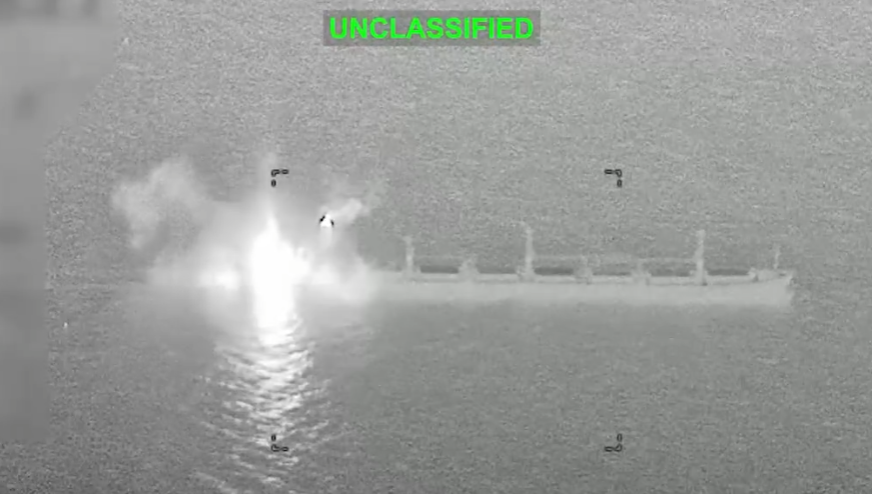
US Says It Disabled Hong Kong-Owned Bulker off Oman
 Safety
Attacked Just 42Days After Delivery: George Prokopiou’s 115,000-Dwt Tanker Hit in Hormuz
 Safety
Five Seafarers Reported Dead as Puntland Retakes Hijacked Tanker Honour 25
 Safety
Middle East war leaves mounting toll on merchant shipping
 Safety
China-U.S. Consensus Highlights Free Navigation: No Country or Entity Should Impose Transit Fees on International Waterways
 Safety
1 seafarer killed, Fatal attack in the Strait of Hormuz: Capesize bulker CAPE DAO hit by unknown projectile
 Safety
25 Crew Abandon MSC Container Ship in the South China Sea — All Rescued, Vessel Still Adrift
 Safety
MSC Hermes III Adrift Unmanned in South China Sea After 25 Crew Abandon Ship
 Safety
Dangerous Goods Container Fire Reported at NPCT1 Terminal in Jakarta
 Safety