


Deadly Mooring Ropes: The "Super Cycle" of South Korea's Shipbuilding Industry
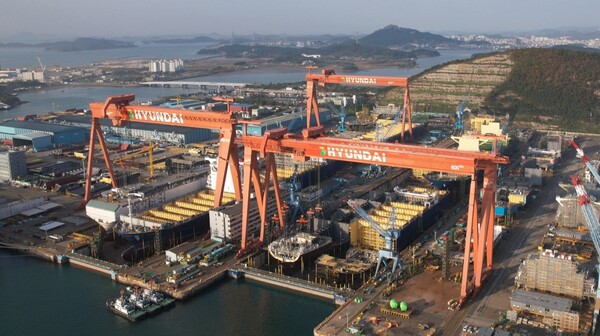
In recent years, top-tier shipyards such as HD Hyundai Samho, HD Hyundai Heavy Industries, and Hanwha Ocean have seen a succession of fatal accidents. Repeated incidents—including mooring rope snap-backs, submarine fires, falls from heights, diver drownings, confined space suffocations, and mechanical crushing—reveal problems that go far beyond a single site or a specific process. Instead, they expose a systemic safety crisis in the South Korean shipbuilding industry, driven by high-intensity rushed schedules, labor shortages, and an expanding outsourcing system.
The Latest Accident: A Mooring Rope Takes a Worker's Life
The accident occurred at HD Hyundai Samho's shipyard in Yeongam, South Korea.
According to the company's regulatory filings and South Korean media reports, on the morning of June 22, a foreman in his 40s was struck in the face by a suddenly rebounding mooring rope during a vessel berthing operation. He subsequently died despite emergency rescue efforts. Following the accident, HD Hyundai suspended all operations involving mooring ropes and stated it would cooperate with the Ministry of Employment and Labor's investigation while conducting special occupational health and safety training.
From a technical standpoint, mooring operations are inherently among the most dangerous tasks at shipyards and docks. When a vessel berths, the ropes bear immense tension. If an auxiliary line or the main rope breaks, the accumulated elastic potential energy is released instantly, creating a highly lethal "snap-back zone." Anyone caught in this area faces impacts that are often fatal.
But the crux of this accident is not simply that "a rope broke."
The Korean Metal Workers' Union subsequently pointed out that there were obvious understaffing and operational organization issues on-site that day. According to requirements for high-risk berthing operations, multiple personnel should work collaboratively: operators and signalmen should be positioned at the bow and stern, and ground rope operations should be handled by at least teams of two looking out for each other. However, at the time of the accident, it is alleged that the related mooring work was being handled solely by the deceased, and no dedicated signalman was assigned to the crane operation.
The union believes that personnel had been temporarily reassigned to a launching event for another ship, creating a manpower shortage at the berthing site. In other words, this accident was not a mere "mishap," but the result of pushing forward with high-risk work under conditions of understaffing, inadequate supervision, and the pressure to rush production.
Warnings of such risks were not absent prior to this. The union stated that several near-misses involving broken mooring ropes had previously occurred at HD Hyundai Samho, yet on-site operational methods and risk monitoring had not been fundamentally improved.
Not an Isolated Case: HD Hyundai Has Seen Multiple Fatalities This Year
If one looks only at this single mooring rope accident, it is easy to dismiss it as an isolated operational error. But placed within the chain of accidents at the HD Hyundai Group in recent years, it looks more like yet another manifestation of long-term safety failures.
In April of this year, a submarine fire occurred at the Naval Ship Division of HD Hyundai Heavy Industries' Ulsan shipyard. A fire broke out inside a South Korean Navy submarine undergoing an overhaul, trapping and killing a female subcontractor cleaner in her 60s. The April accident prompted the Korean Metal Workers' Union to hold a press conference protesting what they called the "477th fatal accident since the founding of Hyundai Heavy Industries."
The interior of a submarine is cramped and difficult to ventilate. Following a fire, the intermingling risks of heavy smoke, electrical damage, electric shocks, and secondary fires make rescue extremely difficult. What is even more concerning is that the deceased was a subcontracted cleaner, yet she was assigned to work in a high-risk confined space like the inside of a submarine. Such work typically involves complex risks such as oxygen deficiency, toxic and combustible gases, and electrical fires, and should strictly follow gas detection, ventilation, monitoring, and emergency rescue protocols.
Similar issues are not unprecedented within the HD Hyundai system. Previously, a worker at HD Hyundai Heavy Industries suffocated to death while performing argon gas welding inside a pipe. Argon is colorless and odorless, and it displaces oxygen in the air. Without oxygen concentration monitoring and forced ventilation in a confined space, a worker can lose consciousness without any warning. Accident investigations showed that relevant basic protective measures had not been effectively implemented.
Although these accidents occurred during different processes, the underlying logic is highly consistent: high-risk operations are executed with substandard resources, standard protocols are compressed on-site, and essential human supervision is treated as an expendable cost.
The Same Risks Repeated at Another Giant
The safety issues in South Korea's shipbuilding industry are not limited to HD Hyundai.
Hanwha Ocean's Geoje shipyard has also been plagued by accidents in recent years. In January 2026, the yard experienced multiple fatalities in a short period: a night shift worker died after losing consciousness in a rest area; a 28-year-old subcontractor worker was killed in an explosion during rudder manufacturing operations; and shortly after, a 31-year-old diver drowned.
The drowning of the diver sparked particular controversy. The union's investigation claimed that the personnel registered on the safety approval documents submitted to regulators did not match the worker who actually went underwater and died. This implies a potential disconnect between safety approvals, on-site personnel, and actual operations, exposing a risk that safety management processes are formalized on paper but distorted in reality.
The risks of working at heights at Hanwha Ocean have also drawn attention. In September 2024, a subcontracted foreman fell nearly 30 meters to his death while installing container ship lashing bridges on a floating dock at the Geoje shipyard. After the accident, regulators issued a stop-work order, but its scope was limited to that single process. The union criticized this, arguing that the real problem was not just one process, but a lack of systemic fall protection across the entire upper structure work area.
Additionally, a severe near-miss occurred within the Hanwha Ocean plant when the forks of a heavy forklift pierced the cabin of a utility vehicle. Although no one died, this incident exposed glaring loopholes in the traffic organization of large shipyard laydown yards, the isolation of heavy machinery, signal commands, and the separation of personnel and vehicles.
These cases demonstrate that safety risks in large South Korean shipyards are not unique to any single company, but are industry-wide.
Casualties Are Not Evenly Distributed
Looking at accidents in 2024 as an example.

Public statistics show that of the 24 confirmed fatal accidents in the South Korean shipbuilding industry in 2024, subcontractor workers accounted for nearly 80% of the deaths. Accident types included fires and explosions, falls from heights, mechanical crushing, drownings, suffocation, severe heatstroke, and cerebrovascular diseases.
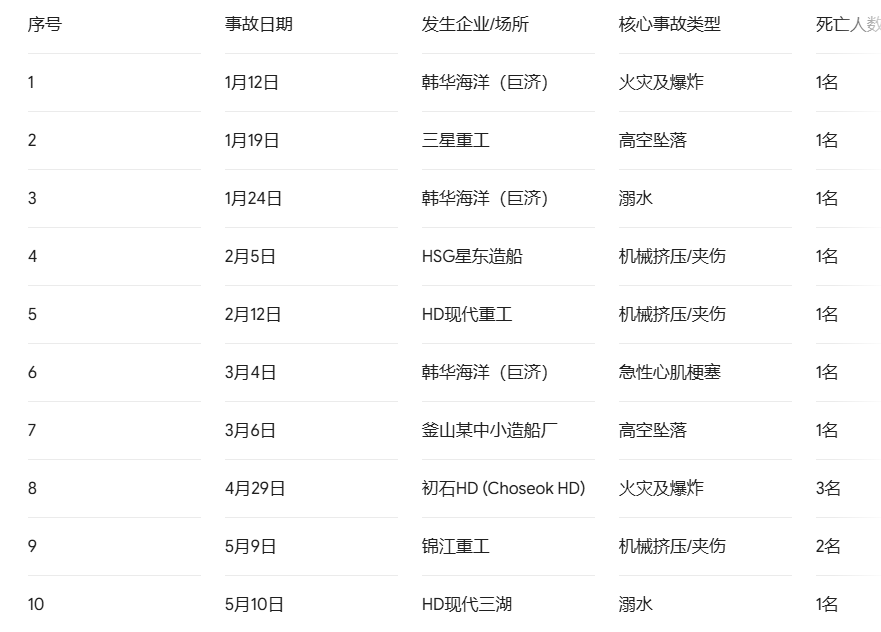
(Graphic omitted: Partial list of the 24 confirmed fatal accidents in the South Korean shipbuilding industry in 2024)
This data reveals the sharpest structural contradiction in the South Korean shipbuilding industry: large shipyards control the orders, profits, and production organization, but a massive amount of the most dangerous, dirtiest, most exhausting, and most difficult work is outsourced to subcontractors, temporary workers, elderly workers, and foreign laborers.
Submarine cleaning, confined space work, underwater inspections, high-altitude installations, scaffolding, painting, grinding, and hot work—these positions, which should be afforded the strictest protections, are often undertaken by the exact populations with the lowest bargaining power and the weakest safety safety nets.
In other words, shipyards are not simply "having accidents"; over long periods of operation, they have formed a risk-transfer mechanism. Companies shift physical risks, environmental risks, and delivery deadline pressures down through layers of outsourcing to the very bottom of the supply chain.
How Does the "Super Cycle" Amplify Safety Risks?
The concentrated outbreak of these accidents is closely tied to the current boom cycle in the South Korean shipbuilding industry.
Over the past few years, global fleet renewals, stricter environmental regulations, and changes in the energy trade structure have driven up demand for high-value-added vessels such as LNG carriers, dual-fuel ships, and ultra-large container ships. South Korea's top shipyards have consequently secured massive orders, keeping capacity utilization at consistently high levels.
The problem, however, is that the South Korean shipbuilding industry experienced a massive exodus of personnel during the previous downturn. Many skilled workers who left the industry did not quickly return when the market recovered. When orders suddenly surged, the front lines of shipyards faced a shortage of skilled labor.
To meet delivery deadlines, control costs, and avoid default penalties, shipyards have had to rely more heavily on subcontractors, foreign laborers, and temporary workers. As a result, ship designs are becoming more complex and production tempos are accelerating, but the structure of the on-site workforce has become increasingly unstable. Many front-line workers actually bearing the risks may not possess adequate training, experience, or a voice in the workplace.
In this environment, safety protocols are easily swallowed up by the pressure to rush work. Oxygen testing and ventilation before entering confined spaces, assigning signalmen during berthing, checking fall protection nets before working at heights, and dual-monitoring during diving operations—these should be non-negotiable baselines. But on high-load production sites, they are often viewed as "extra processes" that hinder efficiency.
When "on-time delivery" and "profit margins" become the core metrics for front-line management, safety can morph from a baseline requirement into an expendable variable.
The Real Problem: Layer-by-Layer Dilution of Safety Responsibilities
The core problem currently facing the South Korean shipbuilding industry is not merely a technical lack of safety equipment, nor is it simply rule-breaking by certain on-site personnel; it is the layer-by-layer dilution of safety responsibility boundaries.
On one hand, the prime contractor shipyards control overall production schedules, construction timelines, and site management. On the other hand, a vast amount of specific, high-risk work is carried out by subcontractors. Once an accident occurs, responsibility is often fractured between the prime contractor, the subcontractor, site managers, and individual operators.
Under this model, safety management tends to suffer two consequences: First, the prime contractor lacks actual control over outsourced operations, with safety requirements remaining purely on paper and in approval forms. Second, subcontractors, in an effort to cut costs and keep contracts, may skimp on training, protective gear, and staffing levels.
Ultimately, the most vulnerable front-line workers bear the highest risks, while the entities with the greatest capacity to change on-site conditions do not necessarily face sufficiently direct consequences.
Conclusion: The South Korean Shipbuilding Industry Needs Governance, Not Promises
For the South Korean shipbuilding industry, the most urgent task right now is not to issue another safety declaration, but to restructure the safety accountability system.
-
Shipyards must staff adequately based on actual operational risks. In high-risk scenarios such as berthing, confined spaces, diving, heights, lifting, painting, and hot work, minimum staffing requirements cannot be compromised due to rushed work or temporary shift changes. The solo execution of high-risk tasks requiring multiple people must be completely banned.
-
Subcontractor workers must be integrated into the same safety management system as formal employees. As long as personnel enter the shipyard to work, the prime contractor should bear substantive responsibility for their training, protective equipment, emergency rescue, and the right to stop work, and cannot use the nature of their labor contracts as an excuse to weaken this responsibility.
-
Front-line workers must have a truly effective right to stop work. When a site lacks signalmen, fall protection nets, confined space testing, ventilation, or monitoring, workers should have the right to refuse work without facing termination, fines, pay cuts, or marginalization.
-
Regulators need to shift from "localized post-accident work stoppages" to penetrative oversight of corporate systemic risks. For companies that repeatedly experience major accidents, penalties should not stop at symbolic fines and superficial rectifications; they must truly impact corporate decision-making levels and production organization models.
The South Korean shipbuilding industry remains a vital force in global high-end vessel manufacturing. Products like LNG carriers, dual-fuel ships, and ultra-large container ships underpin the competitiveness of Korean shipyards in the global market.
However, true industrial competitiveness should not be reflected solely in order volumes, delivery speeds, and profit margins—it must also be reflected in the production system's respect for human life.
If high orders and high profits are built upon high casualties, high outsourcing risks, and intense rushed labor, the so-called "super cycle" will turn into another form of crisis. For the South Korean shipbuilding industry, the deadly mooring ropes, submarine fires, falls, and drownings are proof enough: to maintain long-term competitiveness, shipyards need to restore not just their production capacity, but the baseline of their safety governance.

READ MORE
 Safety
25 Crew Abandon MSC Container Ship in the South China Sea — All Rescued, Vessel Still Adrift
 Safety
MSC Hermes III Adrift Unmanned in South China Sea After 25 Crew Abandon Ship
 Safety
Dangerous Goods Container Fire Reported at NPCT1 Terminal in Jakarta
 Safety
1 seafarer killed, Fatal attack in the Strait of Hormuz: Capesize bulker CAPE DAO hit by unknown projectile
 Safety
Suspected Cyber Incident Diverts LNG Carrier After Cargo-Control Failure
 Safety
Xinde Marine Forum London 2026: Shipping Moves from Lean Logistics to Resilience by Design
 Safety
Almost the Entire Black Sea Is Now a War-Risk Listed Area
 Safety
Saudi pipeline attack exposes limits of Hormuz bypass strategy
 Safety
Engine Room Fire Epidemic Prompts Global Safety Alert After Qingdao Shipyard Tragedy
 Safety