


CMA CGM’s Saadé Warns Net Zero by 2050 Is Out of Reach Under Current Conditions
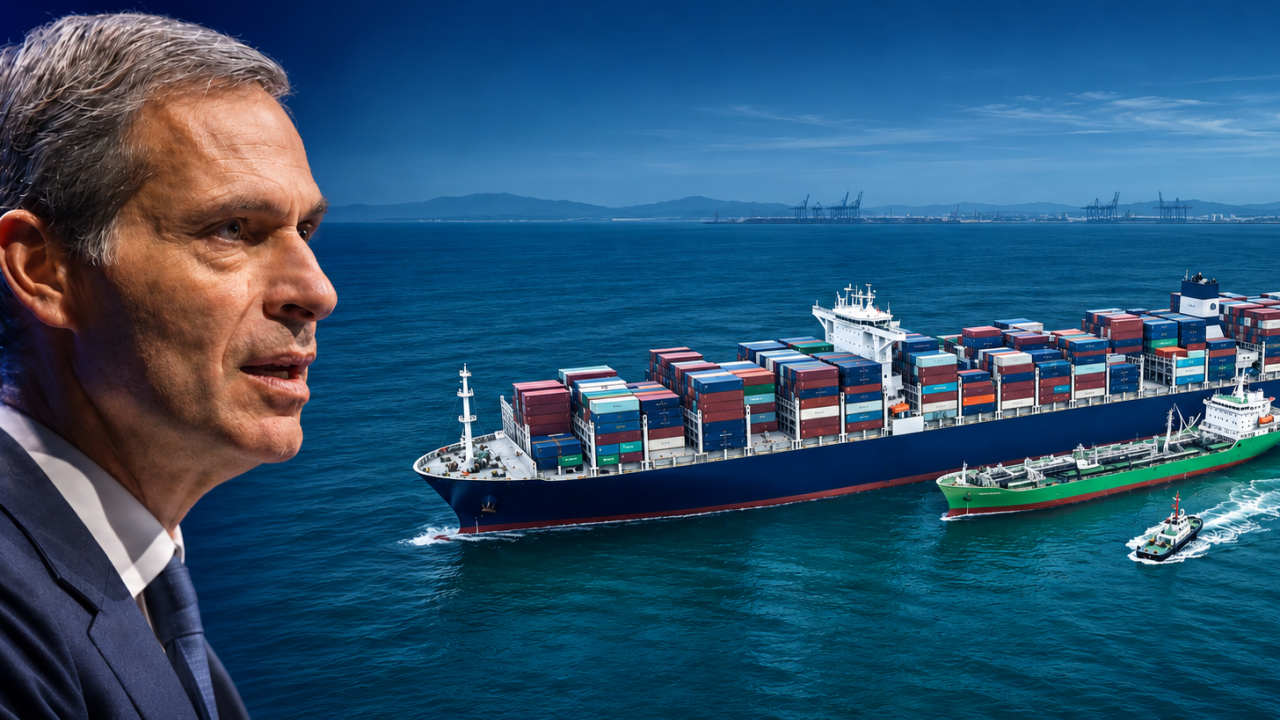
“Under current circumstances, we will not be able to meet our targets by 2050,” CMA CGM chairman and chief executive Rodolphe Saadé told delegates at the Assises de l’économie de la mer, France’s maritime economy conference, in Montpellier on 24 November 2026. The group still lists net-zero carbon across all its businesses as its ambition for 2050. Its next maritime emissions milestone falls in 2030, when annual emissions from marine fuel would need to be nearly 10 million tonnes of CO₂ equivalent below their 2025 level.
At a hearing of the French National Assembly’s Economic Affairs Committee in September 2025, Saadé had already acknowledged that he was asking himself how the group could honour its pledge. In Montpellier, he pointed to conflicts that lengthen voyages or leave ships stranded, the time needed to develop low-carbon fuels, and the lack of common rules among major economies. He estimated that decarbonising shipping worldwide would require more than $1 trillion in investment by 2050.
Carbon intensity fell 58%. Annual emissions barely moved.
CMA CGM’s 2025 Sustainability Report shows a 58% drop since 2008 in the carbon emissions associated with moving one twenty-foot equivalent unit (TEU) one kilometre. Over the same period, the line’s annual container volume rose from about 8.9 million to 24.2 million TEU, a 2.7-fold increase. On any service forced to divert, every box on board also travels the extra miles.
The group measures progress towards its maritime targets on a well-to-wake basis, counting greenhouse gases from fuel production through to use on board. Those emissions stood at 33.3 million tonnes of CO₂ equivalent (CO₂e) in 2025, less than 1% below the 2008 baseline of 33.6 million tonnes. CMA CGM aims to cut emissions by 30% from that baseline by 2030 and by 80% by 2040. The 2030 target implies annual emissions of about 23.52 million tonnes, or 9.78 million tonnes less than in 2025.
Keeping a weekly service around the Cape
In its 2024 sustainability report, CMA CGM expected the extra emissions from sailing around the Cape of Good Hope to fall away once its crews could safely return to the Red Sea. A year later, the group reported that Cape diversions were still lengthening voyages and slowing its progress on emissions. Middle East tensions again forced changes to routes and networks in the third quarter of 2026, when CMA CGM carried 5.5% more containers by TEU than a year earlier.
A customer booking a weekly Asia–Europe service still expects a departure each week. A longer round trip can require more ships in the rotation, higher speeds on some legs, or both. In early 2024, UN Trade and Development (UNCTAD) estimated that raising a large container ship’s speed from 14 to 16 knots could increase fuel consumption per nautical mile by 31%. At the speeds then observed, a Singapore–Northern Europe round trip around the Cape could produce over 70% more greenhouse gas emissions than the voyage via Suez.
The fuel bill behind nearly $30 billion in ship orders
CMA CGM disclosed in its 2025 financial results that it had committed nearly $30 billion to orders for ships powered by liquefied natural gas (LNG) or methanol. It took delivery of 27 such vessels that year. By year-end, 90 dual-fuel ships in its fleet could use biomethane or biomethanol. Including vessels ordered or secured on charter by 1 March 2026, the group expects that figure to reach 208 ships by 2030, representing about 40% of fleet capacity.
Across its owned and chartered ships, CMA CGM consumed 9.1 million tonnes of marine fuel in 2025, including about 1.22 million tonnes of LNG. Biofuel use more than doubled, from 50,900 to 104,500 tonnes, yet accounted for only 1.15% of total consumption by weight. The company’s broader figure of 14.4% for alternative fuels in its maritime energy mix includes LNG. An LNG dual-fuel vessel can run on fossil LNG or liquefied biomethane. Which one goes into the tank depends on what the operator can buy at its ports of call and at what price.
Inside an 8,016-tonne biomethanol delivery
In March 2025, Xinde Marine reported on a long-term green methanol supply agreement between CMA CGM, Shanghai Electric and SIPG Energy, part of Shanghai International Port Group. A year later, the 13,000-TEU CMA CGM Osmium bunkered 3,643 tonnes of Chinese-produced biomethanol in Shanghai before entering the Asia–Mexico service. In August it returned for 8,016 tonnes, then the world’s largest single delivery of biomethanol to a ship.
Most of that fuel came from Shanghai Electric’s plant in Taonan, in the northeastern Chinese province of Jilin. It travelled first to Dalian for consolidation and storage, then by sea to Shanghai. On 15 and 16 August, the bunker vessel Hai Gang Zhi Yuan delivered it to Osmium at the Lyuhuashan anchorage. That one call on a transpacific service required an inland producer, storage facilities in Dalian and a bunker operator off Shanghai to work to the same timetable.
In France, CMA CGM plans to take a stake in fuel production. Under an October 2026 framework agreement with ENGIE, its PULSE energy fund would become a minority shareholder in a biomethane plant at Le Havre. ENGIE will handle design and permitting, and the project still needs a final investment decision. If it proceeds on schedule, it would supply about 7,000 tonnes a year to the fleet through the European gas grid under a certified mass-balance system. The ships can use that fuel without engine modifications. The plant is expected to start supplying it in 2029 or 2030.
Who will pay the fuel premium?
Even where a port can supply the fuel, a carrier has to quote a freight rate its customer will accept. In late 2025, Boston Consulting Group surveyed 125 executives involved in choosing ocean carriers for cargo owners. The average freight premium they were willing to pay for lower-carbon shipping fell to 3%, from 4.5% in 2024. Among customers shipping mainly in containers, it fell from 4.5% to 3.5%. A carrier signing a multi-year fuel contract has to judge how much of the extra cost it can recover when freight contracts come up for renewal.
Some shippers have committed in advance. The Zero Emission Maritime Buyers Alliance (ZEMBA) pooled cargo owners’ demand in its second tender, selecting Hapag-Lloyd and regional feeder operator North Sea Container Line. Hapag-Lloyd plans to use e-methanol on a transoceanic service from 2027. Across the two awards, buyers have committed to purchasing emissions reductions of at least 120,000 tonnes of CO₂e over a minimum of three years. That gives the carriers customers willing to share part of the fuel cost before they negotiate with suppliers.
What the IMO negotiations could change
The EU has included shipping in its Emissions Trading System since 2024. The International Maritime Organization (IMO) aims to reach net-zero greenhouse gas emissions from international shipping by or around 2050. Its proposed Net-Zero Framework would tighten limits on the greenhouse gas intensity of marine fuels and put a price on emissions above specified thresholds. That compliance cost would change the price comparison a shipowner makes when choosing between fuels.
The IMO approved the draft amendments in April 2025. The extraordinary session called to consider formal adoption that October was adjourned. Saadé spoke as the IMO’s greenhouse gas working group was meeting, ahead of the Marine Environment Protection Committee’s 30 November–3 December session in London. Whether the extraordinary session resumes on 4 December is for the committee to confirm.
A container ship is a 25-year financial commitment, Saadé told the Montpellier audience. Delivered in 2026, CMA CGM Osmium could still be trading in 2050. Its two Shanghai bunker calls show what it takes to supply one ship on one route. In 2030, CMA CGM will be able to count the vessels in service against its 208-ship plan. Whether it brings annual maritime emissions down to around 23.5 million tonnes will depend on the fuel its whole fleet burns and the distances those ships actually sail.


READ MORE
 Sustainability
Shanghai Targets One Million Tonnes of Green Fuel Bunkering Capacity by 2028
 Sustainability
Qingdao Port Completes China’s First Bio-LNG Bunkering for International Shipping
 Sustainability
The Missing Global Carbon Price Holding Back Green Shipping Investment
 Sustainability
Five Key Issues Continue to Divide IMO Member States over the Net-Zero Framework
 Sustainability
Green Ammonia Moves Closer to Commercial Shipping Applications
 Sustainability
IBIA Launches Marine Energy Outlook Survey
 Sustainability
UK's Own “FuelEU Maritime” Is on the Way!
 Sustainability
Nine Shipping Associations Call for Global GHG Rules Ahead of MEPC 85
 Sustainability
Three More African Countries Set to Join Regional Shipping Carbon Levy Scheme
 Sustainability