


4 More,totally 16 Since 2024: Why RCL Keeps Ordering at Huangpu Wenchong
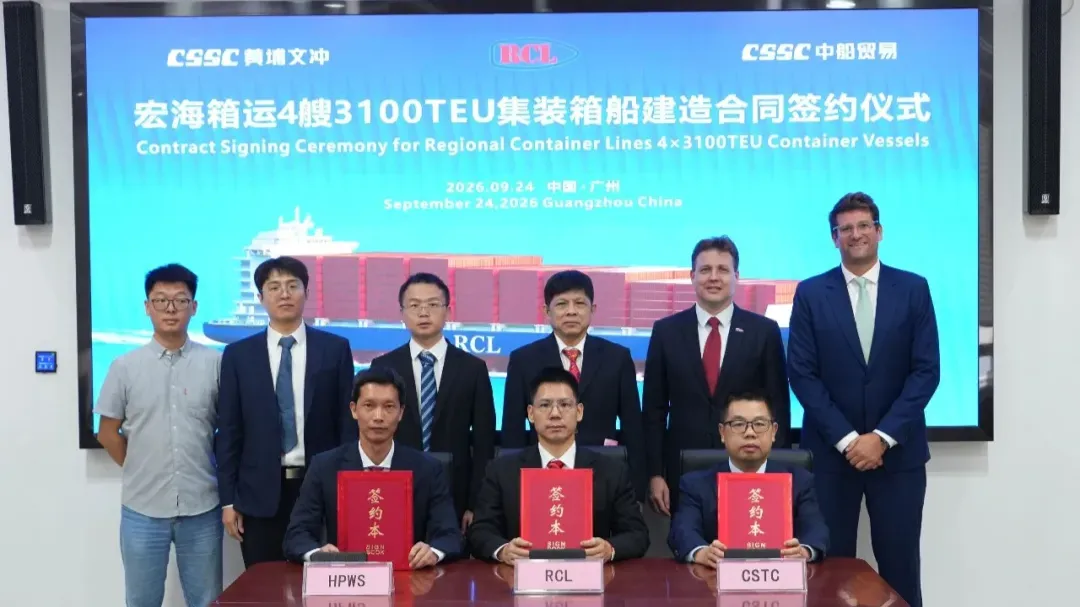
Thailand’s Regional Container Lines (RCL) has ordered four more 3,100 TEU containerships at CSSC Huangpu Wenchong Shipbuilding, taking its cumulative orders at the Chinese yard since 2024 to 16 vessels with a combined capacity of 55,904 TEU.
The contract was signed on September 24, 2026, when the yard also held a naming ceremony for three 4,488 TEU ships previously ordered by RCL. One of them, ANITTA BHUM, was delivered that afternoon, bringing the partnership into its first delivery phase even as the owner committed to another batch of newbuildings.
The latest agreement brings RCL’s commitments at Huangpu Wenchong to eight 4,488 TEU ships, four 1,900 TEU vessels and four 3,100 TEU vessels. With the first ship delivered, 15 remained outstanding at the end of the day.
Taken together, the orders point to a fleet strategy built around a wider choice of vessel sizes. RCL is strengthening its Asian network, extending its reach into longer trades and renewing its fleet, while seeking ships suited to different port constraints and cargo volumes.
From Eight Ships to Sixteen
The relationship began with a series of contracts in 2024. RCL’s financial disclosures recorded four approximately 4,300 TEU ships contracted on January 23 for $226 million, another two confirmed on May 7 for $113 million, and two more contracted on August 22 for $115 million. The eight ships carried a combined disclosed contract value of $454 million.
Although the earlier filings described them as approximately 4,300 TEU vessels, the yard and RCL have cited a capacity of 4,488 TEU at the naming and delivery stage. These figures reflect different disclosure descriptions of the same series.
RCL subsequently ordered four 1,900 TEU ships from the yard’s Honghu series on August 21, 2026, followed about a month later by the four 3,100 TEU vessels. Contract prices and delivery schedules for these two batches have not been publicly disclosed.
The 16 vessels contracted at Huangpu Wenchong should also be distinguished from the 16 ships in RCL’s company-wide orderbook presented at its April 2026 annual general meeting. That earlier total comprised ten approximately 4,400 TEU ships and two each of 7,000 TEU, 11,000 TEU and 14,000 TEU. It predated the eight ships ordered from Huangpu Wenchong in August and September.
Matching Ship Size to Trade Demand
RCL’s management has explained why a regional carrier needs this range of vessel sizes. At the annual general meeting, the company highlighted congestion across Asian and Far Eastern ports, where infrastructure development has not always kept pace with the growing size of containerships.
Moderately sized vessels can offer access to a wider selection of ports, including smaller gateways that may help reduce waiting time at major hubs. However, management also stressed the commercial limits at either end of the size range: deploying a large ship on a thin trade can undermine its economics, while using only small ships on a high-volume route can weaken competitiveness.
The three sizes ordered at Huangpu Wenchong give RCL more options to address those differences.
The 1,900 TEU Bangkokmax vessels have a clearly stated role. RCL intends them to strengthen service frequency and deployment flexibility within its core regional network, complementing larger newbuildings serving expanding medium-haul trades.
The 4,488 TEU ships, designed by the Shanghai Merchant Ship Design and Research Institute (SDARI), are approximately 220 metres long and 37.5 metres wide, with a design service speed of around 19 knots. They represent an important step in Huangpu Wenchong’s expansion into the midsize containership market.
The newly ordered 3,100 TEU vessels add a capacity option between those two classes. At 199.99 metres in length and 35.2 metres in beam, they have a design speed of 18.5 knots. The yard highlights their reefer carrying capability, provision for carrying 2,500 mm-wide containers on deck, and a range of approximately 15,000 nautical miles. The design also meets IMO Tier III nitrogen oxide emissions requirements.
RCL has yet to announce intended routes or any alternative-fuel propulsion configuration for the four ships. Their place in the fleet therefore remains clearer in terms of capacity than in terms of specific deployment.
Expanding Routes While Renewing the Fleet
The first 4,488 TEU deliveries already show how far the carrier’s ambitions extend beyond its traditional Southeast Asian feeder business.
ANITTA BHUM, yard number H2548, is scheduled to enter the Far East–Latin America trade. BENYAPAR BHUM, H2549, is planned for delivery on October 19 and deployment between the Far East and India. CHANTISA BHUM, H2550, is scheduled for delivery on November 20 and service between South China and Indonesia.
All three were named on September 24, but only ANITTA BHUM was delivered that day.
Their planned assignments demonstrate how a common vessel design can serve several parts of RCL’s network. Management has said the Latin American business would initially be tested with smaller ships, with larger vessels to follow once market performance supports the move. The carrier has also been developing cargo opportunities through smaller Vietnamese ports and inland areas of China.
Fleet renewal provides another reason for the investment. RCL expects the introduction of new tonnage and the gradual withdrawal of older ships with higher fuel consumption to reduce its average fleet age to below 11.8 years by 2028, under normal market conditions.
Ownership does not necessarily mean deployment on RCL-operated services. Management has indicated that roughly 20% of total vessel capacity is associated with ships chartered out, with decisions on operating or chartering out individual vessels guided by market returns. The newbuilding programme therefore combines replacement, network expansion and opportunities to earn charter income.
Huangpu Wenchong Broadens Its Containership Portfolio
For Huangpu Wenchong, the repeat business spans two design approaches. The 4,488 TEU series was designed by SDARI, while the 1,900 TEU and 3,100 TEU ships belong to the yard’s own Honghu range. The relationship gives the builder an opportunity to demonstrate both its established feeder expertise and its ability to deliver larger containerships in series.
Other owners have also committed to vessels around the 3,000 TEU mark. Turkey’s Arkas added four 3,100 TEU ships at Huangpu Wenchong in 2025. COSCO SHIPPING Holdings disclosed an order in August 2026 for six 3,200 TEU wide-beam vessels at the yard, priced at RMB339.8 million each.
Arkas had previously disclosed an investment of $360 million in six 4,300 TEU ships, followed by a total investment of $560 million for those vessels and the four 3,100 TEU additions. The difference implies approximately $200 million for the later four ships.
These figures offer market context, but differences in design, equipment, delivery slots and commercial terms limit direct comparisons. RCL has not disclosed the price of its latest 3,100 TEU order.
The Next Test Is Operational Performance
The scale of the carrier’s wider expansion makes execution increasingly important. Alphaliner’s September 25 figures listed RCL’s operated fleet at 32 ships with 91,433 TEU of capacity, against an orderbook of 28 ships totalling 143,852 TEU. On that basis, capacity on order was equivalent to 157.3% of the operated fleet.
Those figures use a different scope from RCL’s own reference to a fleet of 46 ships, which includes owned vessels chartered out as well as chartered-in tonnage. Another figure cited by the company, 191,816 TEU, refers to its container equipment fleet and should not be read as shipboard carrying capacity.
The repeated orders at Huangpu Wenchong suggest that RCL sees value in maintaining several capacity options as its network develops. Smaller ships can support frequency and port access, while larger vessels can accommodate stronger cargo flows and longer routes. The 3,100 TEU series broadens the choices between them.
As deliveries accelerate, the commercial test will be whether RCL can match those ships with reliable cargo volumes, suitable ports and sustainable service frequencies. Congestion may absorb capacity, but it can also disrupt schedules and erode returns. The next developments to watch are where the 3,100 TEU vessels will trade and how effectively the three vessel sizes work together across RCL’s expanding network.


READ MORE
 Shipbuilding
RCL Adds Four Feeders to Its Huangpu Wenchong Programme
 Shipbuilding
X-Press Feeders CEO Shmuel Yoskovitz : “When You Own Your Own Vessels, You Control Your Destiny”
 Shipbuilding
DAB Group Enters Shipowning With First Ultramax Pair Ordered in China
 Shipbuilding
Zodiac Linked to First LNG Carrier Order at Hanwha Ocean
 Shipbuilding
Union Maritime Adds Nine Ships Across Five Segments as Newbuild Programme Reaches 79
 Shipbuilding
Fujian Guohang Plans RMB2.49bn Fleet Expansion into LR2 Tankers and Heavylift
 Shipbuilding
Swire Buys Four Heavy-Lift Ships in Latest Strategic Shift
 Shipbuilding
French Space Logistics Owner Selects China’s GSI for Next-Generation Ro-Ro Vessel Project
 Shipbuilding
Will Newbuilding Prices Still Be This High a Year From Now?
 Shipbuilding