

From Offshore Wind to LNG: Why RWE Matters to Shipping
The German energy group is linking offshore projects, commodity trading, maritime logistics and Chinese supply-chain capacity
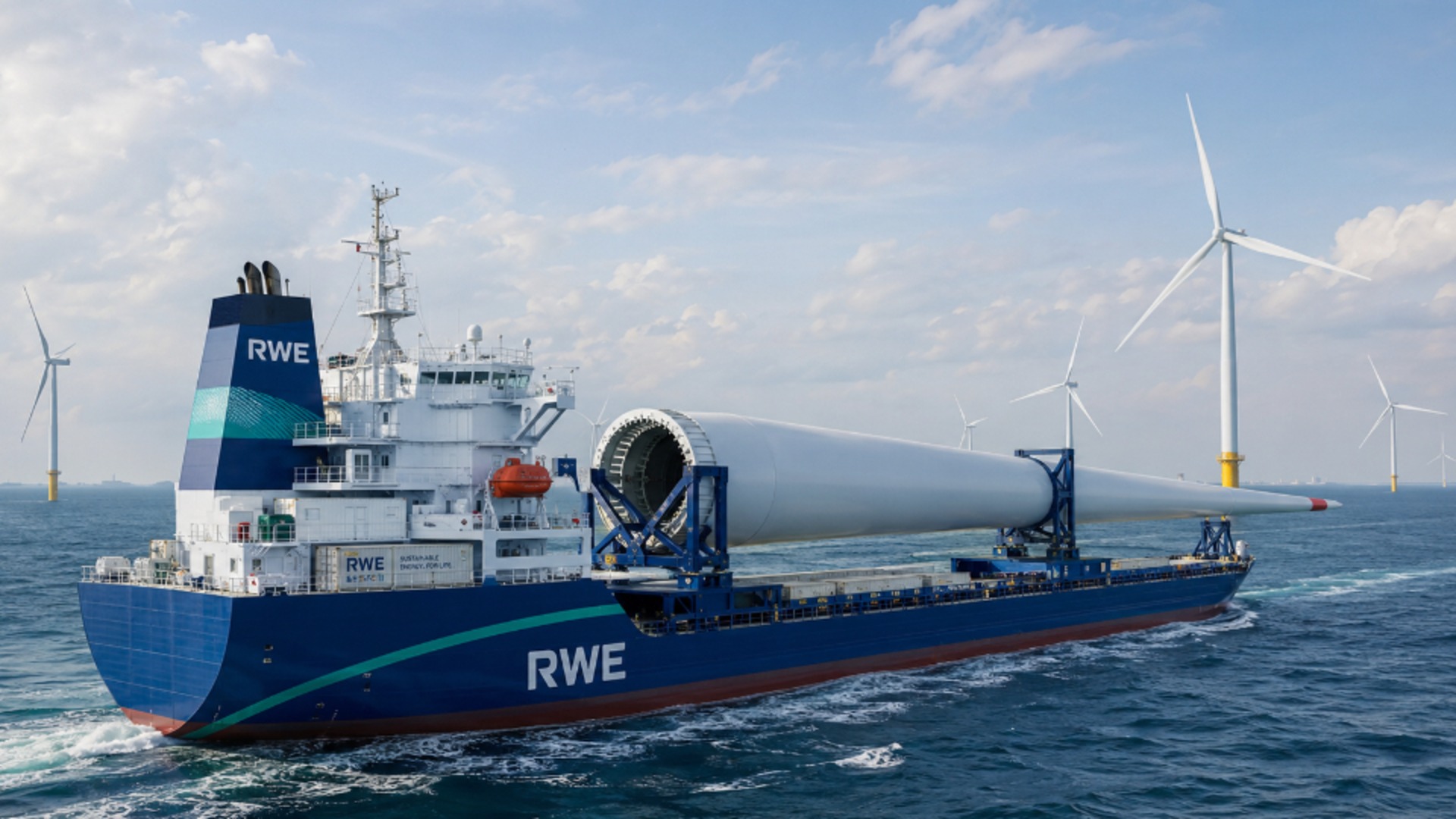

RWE is often described as one of Europe’s leading energy-transition companies. For the maritime industry, however, its transformation has a wider significance.
The German group is expanding offshore wind, securing long-term LNG supply, managing global commodity flows and building closer links with international suppliers. Each of these activities depends on ships, ports, offshore contractors and reliable maritime logistics.
Recent developments in the North Sea show how closely RWE’s future is now connected with shipping.
Sofia completes installation of 100 turbines
In June 2026, RWE completed the installation of all 100 turbines at its 1.4-GW Sofia offshore wind farm in the UK North Sea.
The project uses 14-MW Siemens Gamesa turbines and is located more than 200 kilometres from the British coast. Once fully operational, Sofia is expected to generate enough electricity to supply around 1.2 million UK homes.
Cadeler’s wind turbine installation vessel Wind Peak carried out the offshore transportation and installation work. The vessel was able to transport six complete turbine sets on each voyage between the project’s marshalling port and the offshore site.
The project illustrates the growing importance of specialised vessels in offshore wind development.
As turbine capacity increases, blades, towers and nacelles are becoming larger and heavier. Developers therefore require vessels with greater deck space, higher lifting capacity, longer legs and more advanced offshore handling systems.
Installation vessels are no longer simply supporting assets. Their availability can directly affect project schedules, construction costs and execution risk.
Chinese foundations support RWE’s German project
At almost the same time, RWE installed the first 15-MW turbine at Nordseecluster A in the German North Sea.
Nordseecluster is being developed in two phases, with a combined capacity of about 1.6 GW. The first phase will include 44 Vestas 15-MW turbines and is expected to enter operation in 2027. The second phase is scheduled to follow in 2029.
DEME’s installation vessel Norse Wind is handling the turbine installation campaign.
The project also has a strong connection with China.
Dajin Heavy Industry manufactured the monopile foundations for Nordseecluster A at its production base in Penglai, Shandong. The foundations were then transported to Europe and installed in the German North Sea.
This supply chain connects Chinese steel fabrication, heavy transport, European ports, offshore installation vessels and wind turbine manufacturers.
It also shows that RWE’s offshore wind expansion is already creating opportunities for Chinese maritime and offshore suppliers.
Future projects will require not only foundations, but also heavy-lift shipping, offshore construction, subsea cables, maintenance vessels, digital monitoring, insurance, finance and long-term technical support.
Offshore wind creates long-term maritime demand
Completing turbine installation does not end the maritime requirement.
In June, RWE also opened a new offshore wind control centre in Jemgum, Germany. The facility will provide round-the-clock monitoring of the group’s offshore wind assets in Germany and continental Europe.
RWE currently operates 18 offshore wind farms and has several large projects under construction.
Once offshore wind farms enter operation, they continue to depend on crew transfer vessels, service operation vessels, supply vessels, helicopters and specialised maintenance support.
As wind farms move farther offshore, daily transfers from shore become less practical. More projects are therefore using service operation vessels that provide accommodation, workshops, spare-parts storage and offshore access for technicians.
Offshore wind is consequently becoming a long-term maritime market rather than a temporary construction activity.
RWE is also locking in long-term LNG supply
RWE is expanding offshore wind, but it is not abandoning natural gas.
In January 2026, RWE Supply & Trading signed a 20-year agreement with Glenfarne’s Texas LNG project for the purchase of 1 million tonnes of LNG per year.
The supply is expected to begin in 2030 and could represent around 13 LNG cargoes annually.
RWE had previously signed a 15-year agreement with Sempra Infrastructure for approximately 2.25 million tonnes of LNG per year from the Port Arthur LNG project in the United States.
Together, the two contracts represent around 3.25 million tonnes of annual LNG supply, or more than 40 standard LNG cargoes based on RWE’s conversion assumptions.
These contracts are important for shipping because they create long-term demand for LNG transportation.
They also demonstrate RWE’s broader energy strategy. The company is expanding renewable power while retaining access to flexible gas supply to support energy security and electricity-system stability.
For shipping, the transition will therefore not mean the immediate disappearance of conventional energy cargoes. LNG may remain part of the energy mix for longer than some earlier forecasts suggested.
More than a power company
RWE Supply & Trading plays a central role in connecting the group’s energy assets with global markets.
Its activities include power, gas, LNG, coal, oil, carbon allowances, commodity derivatives and freight-related risk management.
This makes RWE more than a power producer. It is also a cargo interest, energy trader and organiser of international supply chains.
Shipping capacity, freight rates, port congestion, route security, sanctions, carbon costs and geopolitical disruption can all affect the profitability of its energy business.
The Red Sea crisis, Black Sea risks and uncertainty around major maritime chokepoints have reinforced the need for energy companies to manage cargo flows, vessel availability and route exposure within a single commercial strategy.
Large energy companies are increasingly moving beyond the simple purchase of transportation services. They are taking a more active role in managing maritime risk and supply-chain resilience.
RWE’s links with China are expanding
RWE has maintained a presence in China since 2016.
Through RWE Supply & Trading Shanghai, the group participates in international and domestic energy and commodity markets and maintains operations in Shanghai, Beijing and Taiyuan.
Its cooperation with Chinese companies already extends beyond commodity trading.
The use of Dajin-built foundations at Nordseecluster shows that Chinese offshore manufacturing has entered the supply chain of one of RWE’s largest European renewable projects.
For Chinese shipowners, shipyards, ports, equipment suppliers and leasing companies, RWE’s expansion may create further opportunities across offshore wind, LNG transportation, maritime finance and global logistics.
China’s maritime industry has strong capabilities in vessel construction, heavy engineering, offshore equipment, ship leasing and port services. These capabilities could become increasingly relevant as RWE expands its global energy infrastructure.
Energy transition will increase shipping complexity
RWE’s strategy reflects a broader change in the relationship between energy and shipping.
In the past, the division was relatively simple: energy companies provided cargo and shipowners provided transportation.
That model is becoming more complex.
Offshore wind requires installation vessels, heavy transport ships, cable-laying vessels and long-term service fleets. LNG requires liquefaction terminals, specialised carriers, regasification infrastructure and flexible global trading networks.
At the same time, geopolitical risk is increasing the importance of route planning, vessel control, freight trading and supply-chain resilience.
RWE is building a portfolio that combines offshore wind, LNG, flexible generation, storage and global energy trading.
All of these businesses depend on maritime infrastructure.
For the shipping industry, the message is clear: the energy transition will not reduce the importance of ships. It will increase demand for specialised vessels, reliable logistics and closer cooperation between cargo interests and maritime companies.
RWE is not only building wind farms and purchasing LNG.
It is developing an energy system in which vessels, ports, offshore assets, commodity flows and international suppliers are becoming increasingly interconnected.