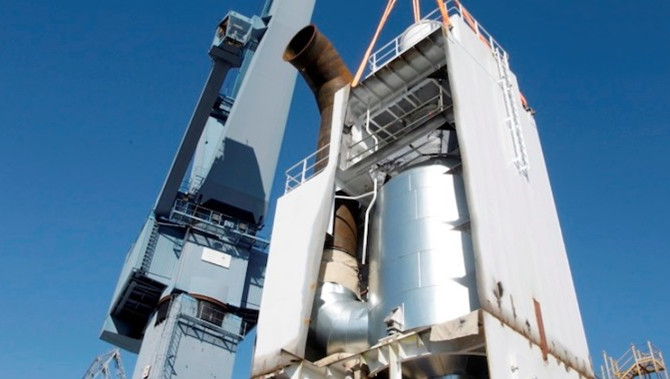
Very large crude tankers lead the way when it comes to adopting marine scrubber technology. For the moment this move appears to be paying dividends, but this should be weighed against a growing antipathy toward the technology from governments.
It is estimated that by the end of 2021 close to 40% of the global fleet of VLCCs will be operating marine scrubbers. This is made up by 31% of the existing fleet having been retrofitted with the exhaust gas cleaning system, a further 7% waiting to be retrofitted along with 32% of the current orderbook scheduled to have the technology fitted during construction.
But, according to analyst Gibson in its latest report, “Although the scrubber uptake is significant for larger crude carriers, we are unlikely to see further exponential growth. Major scrubber manufacturers reported a sizable slowdown in new scrubber orders last year.” The reason being, an increasing number of ports across the globe are shutting the door to vessels that employ scrubbers, particularly open-loop scrubbers, a trend that Gibson insists will continue.
In November 2020, the Washington DC-based International Council on Clean Transportation issued a study calling for individual governments and the International Maritime Organization, to set in place plans to phase out, both open and closed-loop marine scrubbers, claiming that marine scrubbers are an unacceptable threat to the environment.
“For now, however, while tanker supply/demand conditions remain severely unbalanced, even a modest scrubber premium could mean staying afloat and earnings above opex,” Gibson insisted.
Scrubber economics may look positive at present: the spread between high sulphur fuel oil (HSFO) and very low sulphur fuel oil (VLSFO) having widened to around $80 to $100 per metric tonne (pmt) and scrubber savings climbing above $5,000 a day for VLCCs. But it’s a roller coaster. Ahead of the global pandemic, owners of scrubber-fitted vessels had benefited from a discount for HSFO versus VLSFO, which averaged $250-300 pmt in key bunkering hubs during December 2019 to January 2020.
But once the pandemic took hold oil prices plummeted and the spread shrunk to $40-60 pmt between April and November 2020. For scrubber tonnage, this meant that the savings for burning HSFO fell from $16,000 a day in January 2020 to $3,000-4,000 a day for most of last year.
Source:hongkongmaritimehub
The opinions expressed herein are the author's and not necessarily those of The Xinde Marine News.
Please Contact Us at:
media@xindemarine.com