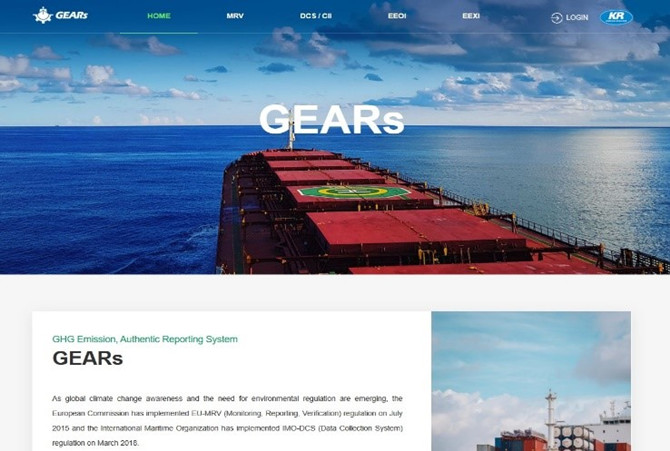
The newly upgraded GHG Emission Authentic Reporting system (KR GEARs) enables maritime stakeholders to more easily ensure compliance with greenhouse gas (GHG) regulations in a shorter period.
Launched by Korean Register (KR) in 2019, KR GEARs has been supporting shipping companies and operators to efficiently manage their fleet's GHG emissions data and remain compliant with tightening GHG regulations. Updated key features include a new real-time CII monitor, CII simulator, ETS calculator and advanced SEEMP Part III & CII, EU/UK MRV services.
At a seminar jointly organized by KR and Korea Shipowners’ Association and supported by the Ministry of Oceans and Fisheries on 9 February, the newly upgraded features of KR GEARs were presented to maritime stakeholders in Korea.
Previous KR GEARs could calculate the CII rating based on approved DCS data. However, the new CII Monitor uses real-time operational data, allowing the CII rating to be derived and managed in real-time.
A new CII Simulator feature automatically calculates and predicts the ships’ CO2 emissions and CII reduction effects, allowing shipping companies to manage their fleets more flexibly. Scenarios and reports are generated as each condition is selected, such as sailing speed, fuel type, operational measures and installation of energy-saving devices.
Another highlighted new feature of KR GEARs is the Emissions Trading System (ETS) Calculator. Users can predict the ETS costs by simply entering vessel information and ETS unit price. KR plans to expand the service in the near future by integrating carbon spot and futures market information into the system to easily calculate estimated ETS costs in real-time.
KIM Daeheon, Executive Vice President of KR R&D Division said:
"The new upgrade of KR GEARs will enable our customers to respond quickly and flexibly to ensure compliance of their existing vessels. We will continue our efforts to advance our technologies to support the decarbonization of the maritime industry."
Beginning on 1 January this year, the CII framework regulates the operational carbon intensity of a vessel and how efficiently a ship operates at sea. Vessels are given a rating based on the grams of CO2 emitted per cargo-carrying capacity and nautical mile.
The opinions expressed herein are the author's and not necessarily those of The Xinde Marine News.
Please Contact Us at:
media@xindemarine.com