According to the World Meteorological Organisation (WMO), La Niña has developed and is expected to last into next year, affecting temperatures, precipitation and storm patterns in many parts of the world.
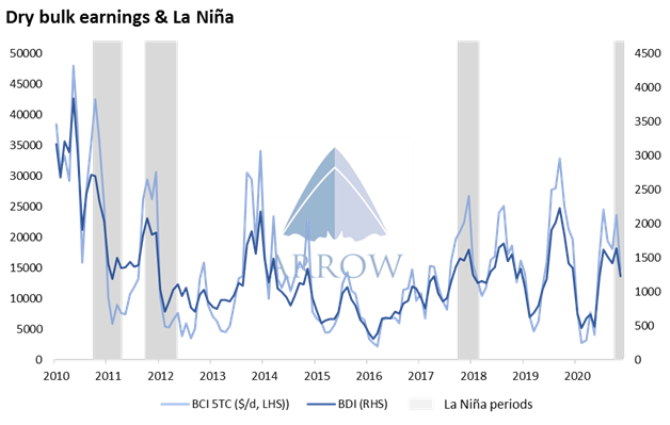
La Niña is a weather phenomenon that takes place every 2-7 years and begins with sea surface water cooling in central/eastern Pacific. In the past decade, there have been three La Niña events; a strong one in the winter of 2010-11, a moderate one in 2011-12 and a short one in 2017-18. According to the WMO, this year’s La Niña is expected to be moderate-to-strong, peaking in December and subsiding by April-May 2021.
It is typically responsible for above-average rainfall across South-Southeast Asia and parts of Australia, and below-average rainfall in Southern Africa, across the western & southern Pacific and central North America. Typhoons and cyclones also occur more frequently in the Asia-Pacific, particularly in Australia.
Adverse weather conditions caused by La Niña tend to disrupt vessel operations and put downward pressure on freight rates, particularly if the port and land logistics infrastructure is damaged. As this year’s event is predicted to be moderate-to-strong, lengthy disruptions and periods of weak freight rates are quite likely.
But in China, La Niña presents itself in the form of colder than usual winters, hot summers and more frequent typhoons. There is already evidence of that happening, with major cities in China averaging lower than usual temperatures since late September.
During the previous La Niña weather events in the winters of 2010-11, 2011-12, and 2017-18 electricity consumption in China increased significantly (+25% in Feb-11, +23% in Mar-12, +21% in Mar-18). According to the China National Climate Centre, this winter’s La Niña will be more powerful than the last one in 2017-18. As a result, electricity consumption during the upcoming winter may see a large year-on-year increase and boost demand for thermal coal. With tight domestic supply and fresh import quotas, China may end up lifting its coal imports in Q1.
With La Nina now well underway and geopolitics at play, the next few months are set to be quite volatile for the dry bulk market.
The opinions expressed herein are the author's and not necessarily those of The Xinde Marine News.
Please Contact Us at:
media@xindemarine.com