Offering immediate emissions reductions, compliance advantages and drop in feasibility to replace LNG, Biomethane has growing potential as an alternative fuel. Mark Smith, Loss Prevention Director – NNE and Decarbonisation, NorthStandard provides points to consider.
The adjournment of The International Maritime Organization’s (IMO) Net Zero Framework (NZF) increases the relative importance of the European Union (EU) regulations, including FuelEU maritime and EU Emissions Trading Scheme (ETS).
In lieu of a global framework, the FuelEU Maritime strongly favours Biomethane (specifically Bio-LNG) as a compliance option because of its low to negative life cycle greenhouse gas (GHG) emissions. In addition to their own decarbonisation targets shipowners with liquefied natural gas (LNG) engines are financially encouraged to switch to Bio-LNG under EU regulations.
Biomethane is also a drop in fuel meaning it can be used on LNG fuelled ships without conversion. Ship operators can accrue FuelEU surplus which they are able to bank for future years or sell to operators using fossil fuel under a pooling arrangement.
Compatible fuel source
Bio-LNG is compatible with existing LNG engines, transfer systems and infrastructure, once it has been upgraded to Biomethane and liquefied. Significant GHG reductions are easy to achieve with minimal retrofitting of LNG vessels. Dual fuel engines can commonly burn LNG or Bio-LNG as well as diesel or biofuels if required. This provides more options should suitable infrastructure not be available in ports. This is known as de-risking.
Bio-LNG is stored in cryogenic tanks at the same temperature as fossil LNG (–162°C) and the same insulated pipes are used for both. It can make use of the growing LNG bunkering network already in place, through delivery methods to the ship including ship-to-ship transfer, truck-to-ship and terminal-based refuelling
Production and Liquefaction
Bio-LNG can be produced onshore or through a liquefaction process. Either:
- Liquefied Biomethane is purified to remove components that would freeze, corrode equipment or degrade LNG quality at cryogenic temperatures prior to liquefaction. It is also filtered after liquefaction to remove debris.
- Biomethane is cooled to -162 °C at near atmospheric pressure to turn the gas into a liquid (liquefaction).
The quantity sold as renewable fuel should never exceed the net Biomethane liquefied and available for delivery, after accounting for all process and logistics losses, regardless of physical mixing.
Using the same tanks, trucks, terminals and engines for fossil fuels brings lower costs, assists with scalability and makes use of existing LNG hubs.
Environmental Benefits
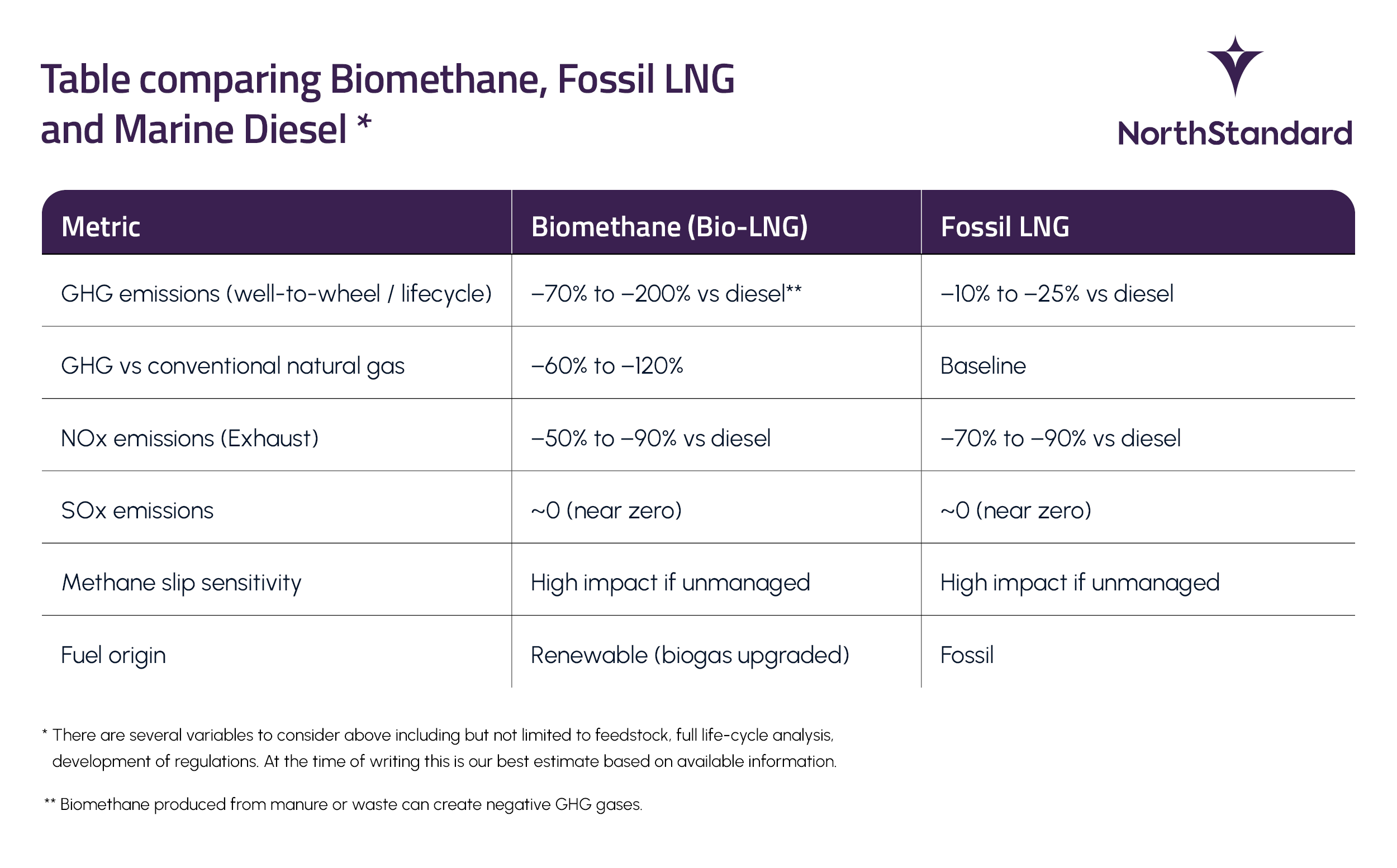
Biomethane ships offer several significant environmental advantages. Feedstock dependent Bio-LNG can provide large emission savings when accounted through certain certification schemes including but not limited to:
Waste-derived Biomethane provides the greatest benefits. Crop-based Biomethane still provides emissions reductions, but there are sustainability restrictions because RED II addresses anything that competes with food production and land use.
Regulatory Compliance
Under EU regulatory frameworks EU ETS and FuelEU Maritime, Bio-LNG counts as a renewable/ low carbon fuel. This helps operators to reduce their exposure to penalties.
Under FuelEU some may make a financial gain by selling the surplus created by burning Bio-LNG to operators in deficit, who consume higher carbon fossil fuels.
In conclusion, Biomethane offers immediate emissions reductions, compliance advantages, and operational feasibility unmatched by many alternative fuels in the short term.
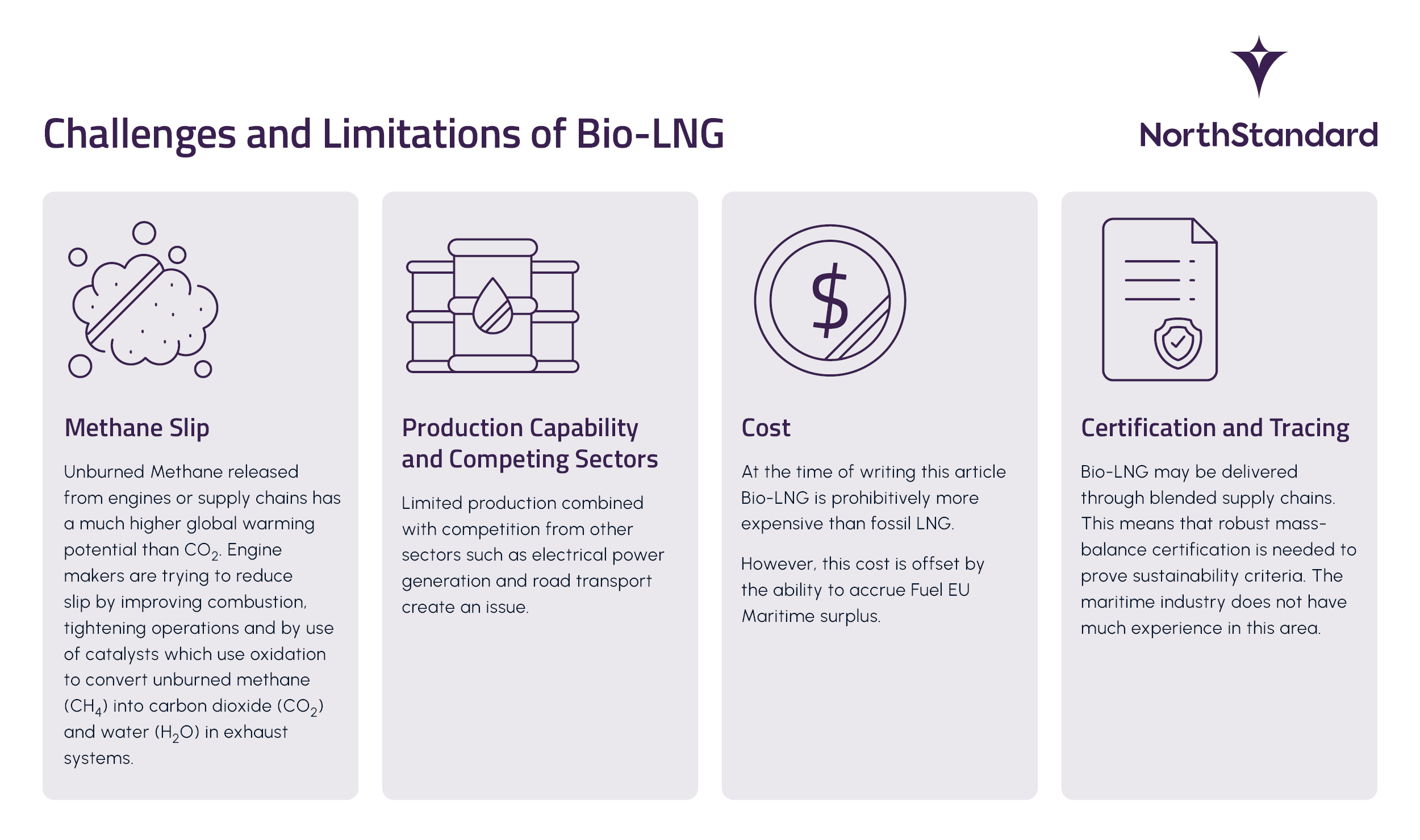
The main challenges include sustainable Biomethane supply, controlling methane slip, and ensuring sustainability certification integrity.
Some may consider these issues as significant, but we believe that engine makers are constantly reducing slip, infrastructure will expand and the industry will adapt to sustainable certification for financial rewards.
Please Contact Us at:
media@xindemarine.com