Following our previous snapshot of vessels crossing the Strait of Hormuz up to 19 March, a further 15 Bulk Carrier and MPP vessels have now completed transit based on AIS-derived tracking.
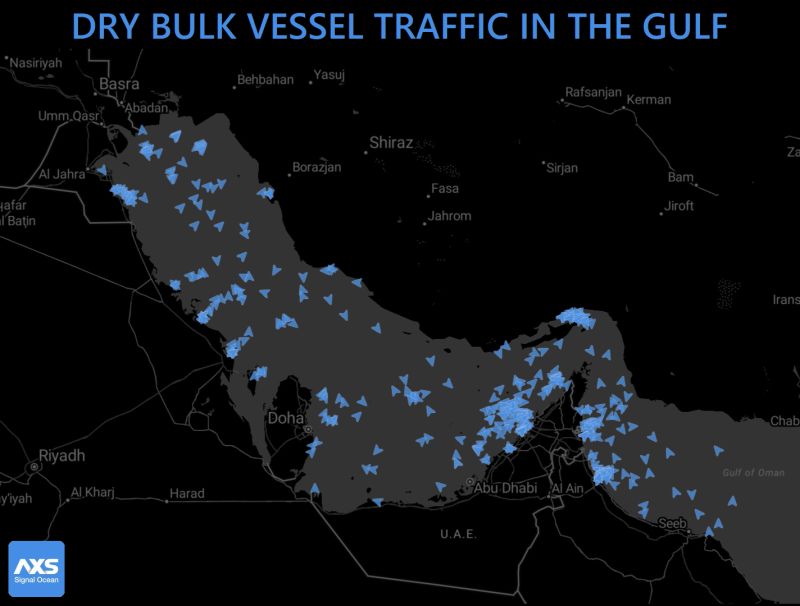
At the same time, a much larger fleet remains positioned within the Arabian Gulf. Currently, 319 bulk carriers and MPP vessels are located west of Hormuz, of which 162 are assessed as laden and 157 as ballasting. The fleet is split between 201 bulk carriers and 118 MPP units, with 82 vessels currently operating under AIS blackout conditions, further complicating real-time visibility.
Of the latest crossings, 11 vessels exited the Arabian Gulf (west to east), while just 4 vessels moved in the opposite direction, reinforcing the same pattern we’ve been observing over the past weeks.
Outbound movements remain dominant, with a mix of laden cargoes and ballast repositioning. These include LUCKY LONG (75.5k dwt) and PERLITA (75.6k dwt), both of which completed their transit with AIS switched off, alongside GLYKOFILOUSSA (75.7k dwt), ZEA (81.4k dwt) and STAR KAMILA (82.8k dwt), all recorded as ballasting.
At the same time, cargo is still moving out of the region, with ARVIN (72.6k dwt) carrying approximately 60,000 MT of iron ore and ARTMAN (53.5k dwt) transporting around 44,000 MT of gypsum.
Vessels such as LEVANTES (82.1k dwt), KIAZAND (53.1k dwt), NERAKI (28.4k dwt) and NADA-B (23.7k dwt) have also exited the Gulf, although in several of these cases vessels were observed transmitting irregular or potentially spoofed AIS signals, making their real-time operational status more difficult to verify.
Inbound traffic, meanwhile, remains limited and selective. Only 4 vessels were recorded crossing into the Gulf over the past 7 days, including NJ JUPITER (56.0k dwt) carrying approximately 51,000 MT of corn and GIACOMETTI (81.7k dwt), which has since discharged around 74,000 MT of grains at Bandar Imam Khomeini. The remaining inbound movements, ARDAVAN (53.1k dwt) and the GOLSAN (22.9k dwt MPP), were both ballasting.
Taken together, the trend remains consistent with what we’ve been previously observing. Vessels are still able to transit the Strait, but activity is uneven, opaque, and shaped by risk tolerance.
With hundreds of dry bulkers still positioned inside the Gulf and a steady share operating under AIS disruption, the imbalance between outbound and inbound flows continues to widen, as operators still prioritize exits over new entries into the region.
The opinions expressed herein are the author's and not necessarily those of The Xinde Marine News.
Please Contact Us at:
media@xindemarine.com



 Dong Fang Offshore Selects ScanReach ConnectPOB for
  More vessels are leaving the Gulf than entering and
  Chemical tanker activity in the Persian (Arabian) G
  Reframing Make or Buy: Additive Manufacturing Chang
  Why Maritime Cybersecurity Still Depends on Where Y
  INTERCARGO Urges Vigilance and Reaffirms Priority o